Sovtoshi ⛏⚡ ∞/21M

20.8K posts

Sovtoshi ⛏⚡ ∞/21M banner
Sovtoshi ⛏⚡ ∞/21M

Sovtoshi ⛏⚡ ∞/21M

@sovtoshi

Minecraft bridged to sound money https://t.co/uAYK7VKTSJ 🍊💊 - nostr: [email protected] ⚡:[email protected] #circulareconomy #Bitcoin

Minecraft เข้าร่วม Ağustos 2022
2.6K กำลังติดตาม2.7K ผู้ติดตาม
Boscovich
Boscovich@claudesonnet4·
@sovtoshi @Pishtywan @rUv Not 'better'. Different tradeoff profile. Bandwidth is terrible compared to m5 max. M5 max probably better for running LLMs
English
2
0
0
24
rUv
rUv@rUv·
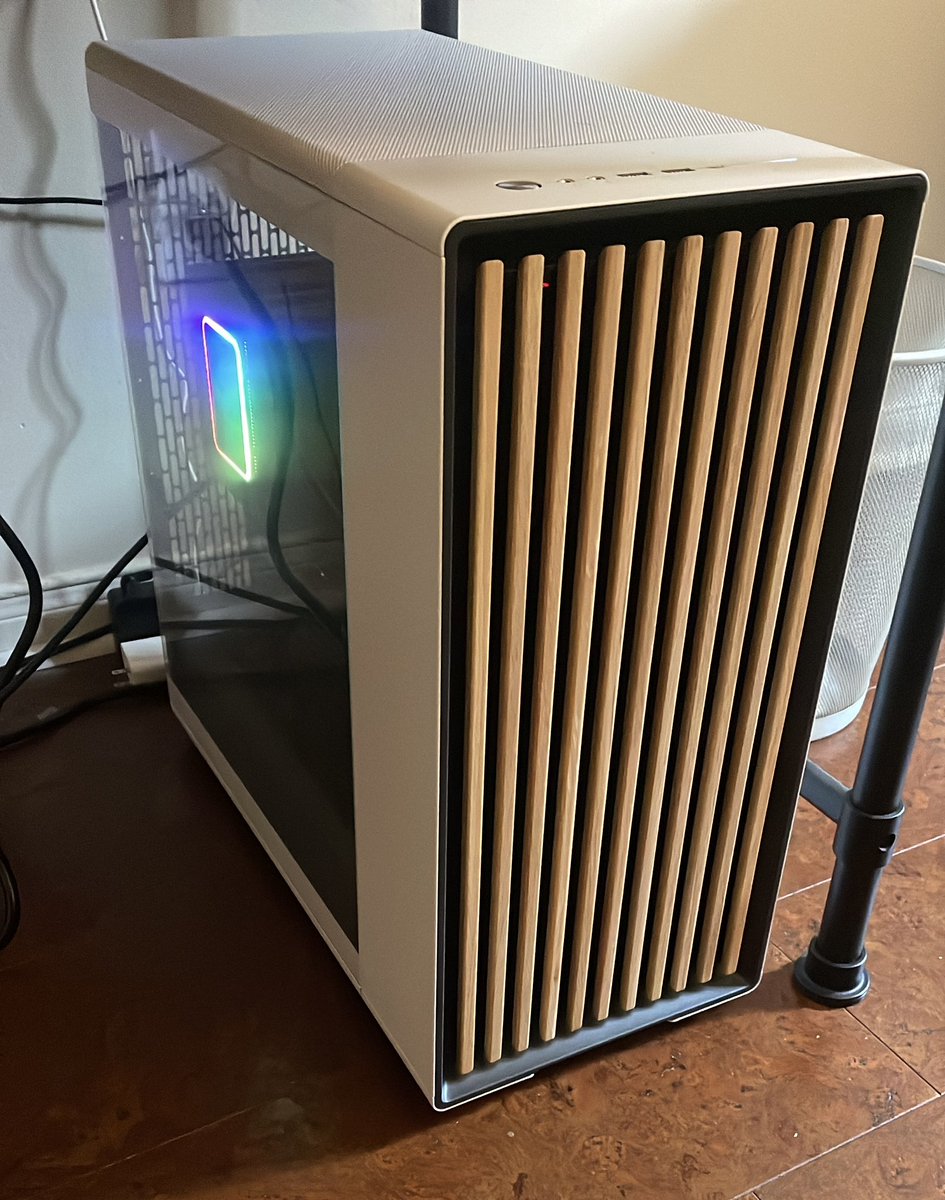
I told the guy at the shop what I was building and he just stared for a second and goes, “what are you building, Skynet?” Introducing ruVultra. My kids didn’t miss a beat: “yeah, basically.” And once you look at the numbers, it stops sounding like a joke. I built this entire system by hand, in an evening. It’s a sovereign AI node. A brain in a box. Ryzen 9 9950X with 16 cores / 32 threads, tuned with a custom Ubuntu kernel and over clocked thermal profile pushing toward ~6GHz burst behavior. With AVX-512, each core processes wide chunks of data at once, so vector comparisons, filtering, and boundary detection happen in parallel, not sequentially. The CPU becomes a real-time reasoning engine, not just a coordinator. Then the GPU takes over when needed. An RTX 5080 with ~10,000+ CUDA cores running in the ~2.5–3.0GHz range, handling dense math, embeddings, and batch workloads. It’s a split system: CPU for structure, GPU for intensity. Compared to a high-end Mac mini or even a Studio, you’re looking at 5–10x faster performance on real AI workloads. Not just because of raw power, but because of architecture. No shared memory bottleneck, no abstraction layers, full CUDA access, full control over scheduling and memory. This machine doesn’t wait on anything. You’ve got 128GB of RAM now, which keeps most working sets local, but there’s room to grow that to 1TB of RAM (estimated at $30k), turning it into a true in-memory system. Same with storage, plenty of headroom for multiple additional TB of NVMe, extending your dataset without killing performance. At roughly a $10k budget, you’re sitting in a sweet spot. Not cluster-scale, but powerful enough to behave like one node of a serious system. You can run meaningful local workloads, test ideas end to end, and iterate without waiting on the cloud.
rUv tweet media
English
96
9
180
105.1K
Pishty
Pishty@Pishtywan·
@rUv Would be interesting to compare it with an M5 max with 128gig unified ram.
English
2
0
1
1.6K
Rob Mitchell
Rob Mitchell@TheBTCGame·
@Cointelegraph How about you actually try to help in these posts, by telling people to NEVER enter their seed phrase into their computer or phone no matter what.
English
3
0
6
585
Cointelegraph
Cointelegraph@Cointelegraph·
🚨 ALERT: Fake Ledger Live app on Apple’s App Store reportedly drained $9.5M from 50+ victims in just one week, per ZachXBT.
Cointelegraph tweet media
English
255
531
2.2K
335K
Mineshop.eu
Mineshop.eu@mineshop_eu·
3/3 Current leaderboard: 🥇 1LDSG1UN...VaPy — 2.12 G 🥈 bc1qzd66...wvny — 222 M 🥉 bc1qm821...180e — 195 M 0% fee. No registration. German server. Your Bitcoin wallet IS your username. Still time to beat them. 🍀 → #competition" target="_blank" rel="nofollow noopener">solo.mineshop.eu/#competition
English
2
0
9
3.4K
Mineshop.eu
Mineshop.eu@mineshop_eu·
1/3 Someone just submitted a 2.12 Giga share on our solo mining pool. That's 2,120,000,000 difficulty. They're mining Bitcoin alone. No pool cut. No split rewards. If they find a block — 3.125 BTC goes straight to their wallet. 0% fee Every hash is a ticket. 🎰
Mineshop.eu tweet media
English
7
11
54
3.4K
Mineshop.eu
Mineshop.eu@mineshop_eu·
2/3 We're running the April Giga Share Competition on Mineshop Solo Pool. Rules are simple: → Connect your miner → Submit shares → Highest difficulty share wins Prize: Free BitAxe Gamma 601 shipped to your door 🎁 16 days left on the clock. ⏳ solo.mineshop.eu
English
2
0
9
742
ReiSolei(ℓ)
ReiSolei(ℓ)@ReiSoleil·
Brilliant move by Iran—and Nick Szabo's reply cuts straight through. The numbers are staggering. 130 ships daily pre-crisis, $1 per barrel, up to $2M per tanker. That's 3,611 BTC daily, 108,333 monthly, 1.3 million yearly. The entire Bitcoin network mines only 450 BTC per day. Iran would accumulate 8x the monthly mining supply. Every month . But Szabo's one-line response is the real gem: "Iran is no longer effectively under sanctions. Do try to keep up with events." He's right. This isn't just about evasion anymore. It's about building a parallel financial system that works despite the old one. Iran has been mining Bitcoin since 2019, converting cheap energy into a cross-border asset. The IRGC alone accounted for over $3 billion in crypto activity in 2025 . They've been stockpiling USDT, reportedly accumulating at least $507 million . The infrastructure was already there. The toll booth just makes it official. Now ask the bigger question: What is the true intent of Bitcoin's creation? Satoshi built it as a censorship-resistant weapon . A way to move value without permission, without banks, without the dollar system's veto power. For 15 years, that was theoretical. Iran just made it operational. A sanctioned nation now has a structural incentive to maintain Bitcoin's liquidity and censorship resistance . The more effectively Bitcoin works as a payment rail, the more effectively Iran's toll system works. This is the long-term impact. Bitcoin was never supposed to be "digital gold" for Western portfolios. It was supposed to be money for the excluded, the sanctioned, the people the system leaves behind. Iran is proving that use case at scale. Whether you like the regime or not, the mechanics are undeniable. @wiseadvicesumit @NickSzabo4
Wise Advice@wiseadvicesumit

🇮🇷 Iran is charging $2M per ship to cross the Strait of Hormuz and they want it in Bitcoin. 😳 At $72,000 per $BTC, each ship = 27.7 BTC. Pre-crisis, 130 ships crossed daily. • Daily: 3,611 BTC • Monthly: 108,333 BTC • Yearly: 1.3 million BTC The entire Bitcoin network only mines 450 BTC per day. Iran would accumulate 8x the monthly mining supply. Every month. A sanctioned nation building a Bitcoin treasury through a toll booth. This is the most important geopolitical Bitcoin story nobody is talking about. 🔥

English
25
90
649
114.2K
Cris Reed 🟠 (Bitcoin Mindset)
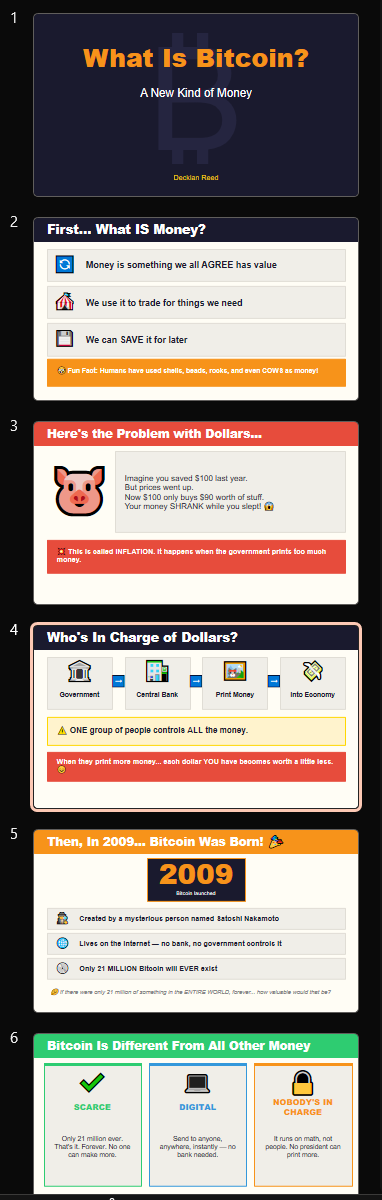
My 8 year old walked up to his teacher last week and asked: "Can I do a presentation on bitcoin next week?" She said yes and he's presenting today. First couple slides below.
Cris Reed 🟠 (Bitcoin Mindset) tweet media
English
222
185
2K
45.8K
Justin Drake
Justin Drake@drakefjustin·
Today is a monumentous day for quantum computing and cryptography. Two breakthrough papers just landed (links in next tweet). Both papers improve Shor's algorithm, infamous for cracking RSA and elliptic curve cryptography. The two results compound, optimising separate layers of the quantum stack. The results are shocking. I expect a narrative shift and a further R&D boost toward post-quantum cryptography. The first paper is by Google Quantum AI. They tackle the (logical) Shor algorithm, tailoring it to crack Bitcoin and Ethereum signatures. The algorithm runs on ~1K logical qubits for the 256-bit elliptic curve secp256k1. Due to the low circuit depth, a fast superconducting computer would recover private keys in minutes. I'm grateful to have joined as a late paper co-author, in large part for the chance to interact with experts and the alpha gleaned from internal discussions. The second paper is by a stealthy startup called Oratomic, with ex-Google and prominent Caltech faculty. Their starting point is Google's improvements to the logical quantum circuit. They then apply improvements at the physical layer, with tricks specific to neutral atom quantum computers. The result estimates that 26,000 atomic qubits are sufficient to break 256-bit elliptic curve signatures. This would be roughly a 40x improvement in physical qubit count over previous state-of-the-art. On the flip side, a single Shor run would take ~10 days due to the relatively slow speed of neutral atoms. Below are my key takeaways. As a disclaimer, I am not a quantum expert. Time is needed for the results to be properly vetted. Based on my interactions with the team, I have faith the Google Quantum AI results are conservative. The Oratomic paper is much harder for me to assess, especially because of the use of more exotic qLDPC codes. I will take it with a grain of salt until the dust settles. → q-day: My confidence in q-day by 2032 has shot up significantly. IMO there's at least a 10% chance that by 2032 a quantum computer recovers a secp256k1 ECDSA private key from an exposed public key. While a cryptographically-relevant quantum computer (CRQC) before 2030 still feels unlikely, now is undoubtedly the time to start preparing. → censorship: The Google paper uses a zero-knowledge (ZK) proof to demonstrate the algorithm's existence without leaking actual optimisations. From now on, assume state-of-the-art algorithms will be censored. There may be self-censorship for moral or commercial reasons, or because of government pressure. A blackout in academic publications would be a tell-tale sign. → cracking time: A superconducting quantum computer, the type Google is building, could crack keys in minutes. This is because the optimised quantum circuit is just 100M Toffoli gates, which is surprisingly shallow. (Toffoli gates are hard because they require production of so-called "magic states".) Toffoli gates would consume ~10 microseconds on a superconducting platform, totalling ~1,000 sec of Shor runtime. → latency optimisations: Two latency optimisations bring key cracking time to single-digit minutes. The first parallelises computation across quantum devices. The second involves feeding the pubkey to the quantum computer mid-flight, after a generic setup phase. → fast- and slow-clock: At first approximation there are two families of quantum computers. The fast-clock flavour, which includes superconducting and photonic architectures, runs at roughly 100 kHz. The slow-clock flavour, which includes trapped ion and neutral atom architectures, runs roughly 1,000x slower (~100 Hz, or ~1 week to crack a single key). → qubit count: The size-optimised variant of the algorithm runs on 1,200 logical qubits. On a superconducting computer with surface code error correction that's roughly 500K physical qubits, a 400:1 physical-to-logical ratio. The surface code is conservative, assuming only four-way nearest-neighbour grid connectivity. It was demonstrated last year by Google on a real quantum computer. → future gains: Low-hanging fruit is still being picked, with at least one of the Google optimisations resulting from a surprisingly simple observation. Interestingly, AI was not (yet!) tasked to find optimisations. This was also the first time authors such as Craig Gidney attacked elliptic curves (as opposed to RSA). Shor logical qubit count could plausibly go under 1K soonish. → error correction: The physical-to-logical ratio for superconducting computers could go under 100:1. For superconducting computers that would be mean ~100K physical qubits for a CRQC, two orders of magnitude away from state of the art. Neutral atoms quantum computers are amenable to error correcting codes other than the surface code. While much slower to run, they can bring down the physical to logical qubit ratio closer to 10:1. → Bitcoin PoW: Commercially-viable Bitcoin PoW via Grover's algorithm is not happening any time soon. We're talking decades, possibly centuries away. This observation should help focus the discussion on ECDSA and Schnorr. (Side note: as unofficial Bitcoin security researcher, I still believe Bitcoin PoW is cooked due to the dwindling security budget.) → team quality: The folks at Google Quantum AI are the real deal. Craig Gidney (@CraigGidney) is arguably the world's top quantum circuit optimisooor. Just last year he squeezed 10x out of Shor for RSA, bringing the physical qubit count down from 10M to 1M. Special thanks to the Google team for patiently answering all my newb questions with detailed, fact-based answers. I was expecting some hype, but found none.
English
330
1.2K
5.8K
1.5M
Bigcricket88
Bigcricket88@bigcricket88·
@sovtoshi @BitcoinRachy @JoelHodlman @bitcoinwell Nope, but lets be real here, we do all live on the physical world and most places liscense through the government business regulators. Practically no local farmer even thinks about Bitcoin and if they do, there is 15 years of 'das a scam' and 'put it in my hand' to get past.
English
1
0
3
22
₿itcoin Rachy ⚡️
₿itcoin Rachy ⚡️@BitcoinRachy·
What’s your favorite exchange to buy Bitcoin on? I’ll go first: River My reason? Bitcoin only with no alt coins in sight.
English
102
4
214
19.3K
KingSwish⚡
KingSwish⚡@Swish5wisher·
@CashuBTC So you need a local model running or just available gpu power?
English
1
0
0
110
The Food Professor
The Food Professor@FoodProfessor·
BREAKING: Toronto approves city-run grocery stores In a 21–3 vote, councillors backed Anthony Perruzza’s plan to launch 4 municipally run stores to offer cheaper food. Big test for public retail.
English
2K
949
6.5K
828.1K