𝐀𝐠𝐫𝐢𝐩𝐩𝐚 𝐈𝐧𝐯𝐞𝐬𝐭𝐦𝐞𝐧𝐭𝐬@Agrippa_Inv
Why I’m Not Invested in $NBIS
First of all, let me make one thing clear: contrary to what you might think, I’m not an $NBIS bear. But then again, I’m not invested either… and for good reason.
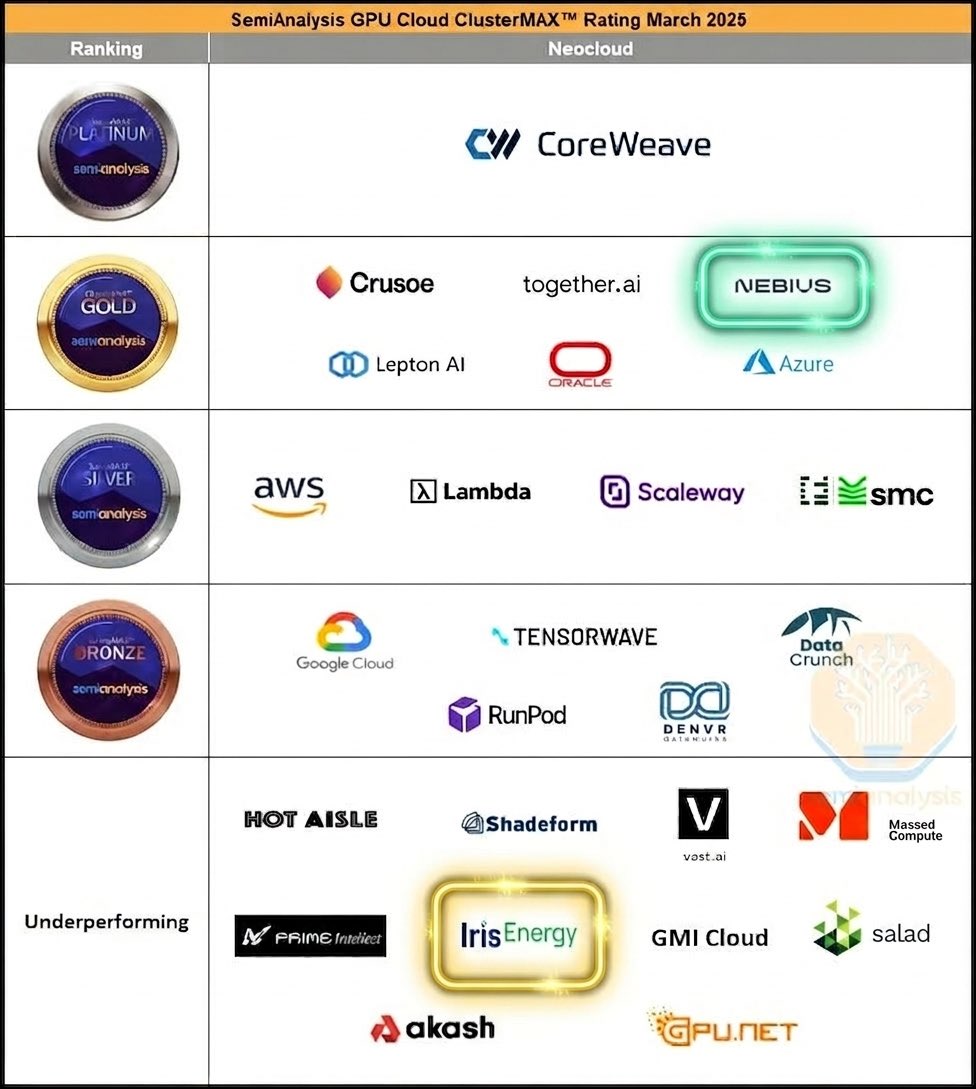
Nebius positions itself as a holistic cloud platform with superior software technology that caters to AI-native start-ups and enterprise clients.
That in and of itself isn’t a problem, but it means they're directly competing against the largest hyperscalers in the world, who are also targeting that exact cohort with their own set of software solutions (Google Cloud, Microsoft, etc.).
Nonetheless, if $NBIS can successfully differentiate itself with its core offerings, it could gain some pricing power, which is the company’s best shot at one day becoming profitable.
The problem is, $NBIS is VERY far away from that…
Looking at the last quarterly filing, the company’s gross expenses + depreciation equaled ~110% of its revenues. In other words, these two cost categories exceeded the value of the underlying revenues ($249.2m vs. revenue of $227.7m).
To be fair, last quarter Nebius still used a 4 year depreciation schedule on GPUs, which is rather short and overstates depreciation.
Adjusting for a 5 year depreciation schedule (industry standard) leads us to $144.6m of depreciation. Then, adding gross expenses of $68.5m on top gets you to $213.1m, which equals 93.5% of revenues.
And keep in mind, this figure does NOT include the hundreds of millions in costs spent on SG&A, R&D, and financing (interest).
So what’s my point with this?
The problem is, these are STRUCTURAL costs, the kind that scale with revenue, meaning you can’t easily grow out of them through sheer scale.
My point is that $NBIS' pricing power is nowhere to be seen, at least not relative to its costs.
Now, most $NBIS investors would probably argue that we are still "early" and that pricing power will show up eventually.
My problem with that argument is that the company seems to be allocating a very large chunk of its pipeline towards servicing hyperscalers through bare metal offerings, the kind of “bulk” service that does NOT command significant pricing power.
That means, fundamentally speaking, $NBIS is likely very far away from actually becoming profitable.
And while right now everyone is focused on headline figures like ARR, the market’s patience will run out eventually... it ALWAYS does for every company.
One day, the market will demand to see real profits flow down to the bottom line, and I’m not sure if $NBIS is structurally positioned to deliver on that any time soon.
To make matters worse, investors can’t even model out the economics of these large hyperscaler deals, because management provides absolutely 0 information on anything except headline figures.
We don’t even know the CapEx associated with these deals, or at the very least, the number of GPUs they have to purchase to fulfill their end of the bargain.
Contrast that with a company like $IREN, which gives you all the necessary information to build an entire P&L and cash flow model over the full course of the contract length, which is exactly what I’ve done extensively for our subscribers on Substack.
I have a VERY good idea of how much actual post-tax net income $IREN is making in every year of their hyperscaler contract.
There are other reasons that further point in the same direction, but I won’t get into them right now.
If they fix their cost structure one day, I’m happy to reconsider my stance.
But as of today, their “black box” approach to publishing details on their largest deals makes them uninvestable for me.