
Ale𝕩ander Moore, CPA 🇺🇸

18.7K posts

Ale𝕩ander Moore, CPA 🇺🇸 banner
Ale𝕩ander Moore, CPA 🇺🇸

Ale𝕩ander Moore, CPA 🇺🇸

@Moore_Irish

🎿 @ZephyrAdvGrp 🇺🇸 ‘Global macro is like a drug, views are mine. ♥ #lover of all asset classes, #alpha is always there if you can find it.’ 💎 $BTC 2013 🪙

Greenwood Village, CO Sumali Eylül 2009
7.5K Sinusundan3.6K Mga Tagasunod
Naka-pin na Tweet
Ale𝕩ander Moore, CPA 🇺🇸
📌 Follow the @Scobleizer aka Robert Scoble and be sure to check out his 𝕏 Lists. 🍄 x.com/scobleizer/lis… 🏁 💡From topics and domains that generate economic productivity, spark hobbyist interests, emerging technology breakthroughs and the spectrum of hardware, software, and AR/VR or XR at the intersection of robotics. 💡Scoble's 𝕏 Lists are the closest thing to an intelligent + lived experienced knowledge base alpha database for science, technology, and creative discipline ontologies. These lists were recursive before most of the world knew what that word meant. 🔔His donation of countless years contributing to the timeline but also in spaces should earn him a Bell Award. He has certainly earned my nomination for quality content on X (and any social media platform for that matter). #bellaward @adiboaron94 🔔This award is unique in that it objectively looks at the creator, the individual content produced and the perceived value to the platform without consideration for follower or subscriber counts. **I know he has a lot of followers which is a social proof in itself, but this is a different path into very high value small accounts.** 💡It's a great starting point for the average user, but a frontier of truly infinite possibilities if you have access to the 𝕏 API. 💡Real-time tracking, tagging, account IDs, organization, a data repository one could see as social value agnostic of bias from follower count. These can be a foundation for additional hierarchies of attributions and qualitative keywords; think of it like a game of ontological cross-domain 'connect the dots' if you will. 💡My main utility in being drawn to the library of lists (aside from an excellent source for inherently high quality 𝕏 Pro inputs) is the wide userbase that can find their own niche content in curating a project or customizing their 𝕏 user experience. 💎If 𝕏 were to have a graph database with @neo4j overlay to further dive into these lists, that would be a cool project and a feature I'd probably use often. XR capabilities would be neat, obviously further the road along with 3D displays (with no glasses) to view the GraphQL-type relationships. @engineering @XCreators @premium
English
3
1
18
879
Ale𝕩ander Moore, CPA 🇺🇸 nag-retweet
TheNewPhysics
TheNewPhysics@CharlesMullins2·
🚨 SCIENTISTS JUST FOUND A WAY TO CONTROL ELECTRON SPIN IN GRAPHENE USING ONLY ELECTRICITY A MAJOR STEP TOWARD LOW-POWER SPINTRONICS. Researchers at the University of Manchester’s National Graphene Institute, working with the National University of Singapore, have shown that the spin of electrons in graphene can be precisely tuned with electrical signals when the material is placed near a magnetic layer. By combining magnetic proximity effects with engineered graphene superlattices and operating at very low charge densities, they achieved spin polarizations approaching 50% and nonlocal spin resistances over 300 ohms nearly 100 times larger than in conventional setups. Why this matters: • Conventional electronics move information using charge, which wastes energy as heat • Spintronics uses the electron’s magnetic “spin” instead, promising far lower power consumption • This work shows electrical control of spin signals in graphene without permanently magnetizing the material itself • The effect works across multiple electronic regimes, including specially engineered superlattices The deeper implication: Graphene has long been promising for spintronics because of its exceptional spin transport properties, but controlling spin electrically (rather than with permanent magnets) has been difficult. This breakthrough demonstrates that by carefully aligning graphene with magnetic materials and tuning the carrier density, we can achieve strong, reversible electrical control of spin currents. It brings us significantly closer to practical, low-power spin-based devices for memory, logic, and quantum technologies. We’re moving from “spin is interesting in theory” to “we can now engineer and control it with electricity in real devices.” How soon do you think spintronic chips could start replacing or complementing conventional electronics in everyday devices? Follow for more frontier graphene and spintronics research.
English
5
23
78
4K
Ale𝕩ander Moore, CPA 🇺🇸 nag-retweet
All day Astronomy
All day Astronomy@forallcurious·
🚨: Quantum Physics shows that objective reality doesn't exist Properties of a particle do not have a definitive state until they are measured. This challenges the classical idea of "objective reality"—the belief that the universe exists independently of observation.
All day Astronomy tweet media
English
81
117
537
22.2K
Ale𝕩ander Moore, CPA 🇺🇸 nag-retweet
TheNewPhysics
TheNewPhysics@CharlesMullins2·
🚨 SCIENTISTS JUST FOUND A WAY TO CONTROL TWISTED LIGHT USING ONLY OTHER LIGHT NO MAGNETS NEEDED. Researchers at Vilnius University have developed a theoretical method to “pre-program” atoms with light so they can reshape complex structured laser beams (optical vector vortices) on the fly. When these specially prepared atoms interact with the twisted, polarized light, they create a feedback loop: the light imprints its pattern onto the atoms, and the atoms then actively reshape the light turning simple ring-shaped beams into beautiful petal-like structures while also controlling the beam’s polarization. Why this matters: • Previous methods to control these advanced light beams required strong external magnetic fields and bulky equipment • This new all-optical approach is potentially far more compact, scalable, and elegant • Optical vortices can carry huge amounts of information (qudits instead of qubits), making them powerful for quantum communication • The same technique could improve quantum computing and ultra-precise optical sensors The deeper implication: We’re learning to treat light and matter as a single programmable system. Instead of forcing atoms to behave using magnets, we can now use light itself to prepare atoms that then sculpt light in highly structured ways. This feedback loop between structured light and atomic response opens a new route to controlling quantum states of light without the hardware overhead of magnetic fields. It’s a beautiful example of how clever preparation of quantum systems can replace brute-force engineering. How do you think all-optical control of structured light could change quantum communication or computing in the next decade? Follow for more frontier quantum optics and light-matter interaction breakthroughs.
English
11
43
143
7.7K
Ale𝕩ander Moore, CPA 🇺🇸 nag-retweet
OpenAI
OpenAI@OpenAI·
As AI takes on longer, higher-stakes tasks, we want models to carry beneficial and safe behavior into new domains beyond their training—and maintain it under pressure. That’s the idea behind our new research on training models to be broadly and persistently beneficial. alignment.openai.com/beneficial-rl/
English
186
234
2.6K
289.7K
Ale𝕩ander Moore, CPA 🇺🇸
TON 618 aka Tonantzintla 618 was initially documented in 1957 during a survey of faint blue stars by Mexican astronomers Braulio Iriarte and Enrique Chavira. 🔭 66 billion solar masses. it is a hyperluminous quasar forcing astrophysicists to reexamine black hole growth and consider new classifications such as “ultramassive” extending beyond current growth models. we observe it 10.4 billion years in the past when the universe was only 3.4 billion years old. something is missing… #blackholes #astrophysics @NASAWebb @NASAHubble @elonmusk
English
0
0
0
29
Rohan Paul
Rohan Paul@rohanpaul_ai·
Vertical wind turbine in a rural hilly region of China. These blades allow operation independent of wind direction changes. China's wind turbines generated nearly 990 TWh of electricity in 2024, almost double the roughly 450 TWh produced in the US.
English
14
29
176
16.4K
Ale𝕩ander Moore, CPA 🇺🇸 nag-retweet
Rohan Paul
Rohan Paul@rohanpaul_ai·
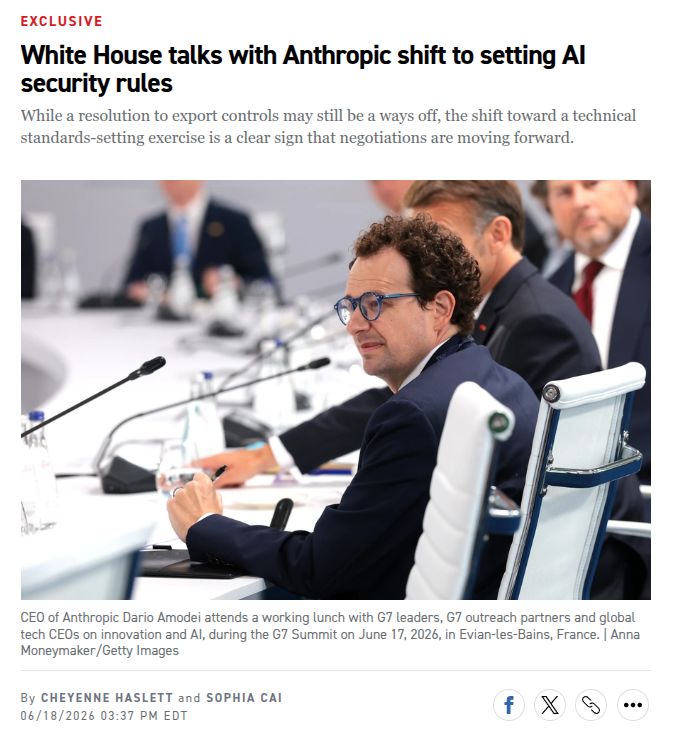
The White House and Anthropic may have found the first serious path to restore Mythos and Fable access without pretending jailbreaks can be eliminated. AI regulation may be shifting from vague fear to a benchmark based tests of model failure, because completely removing absolutely all jailbreak is probably not a possible target. The proposed framework would score how far the bypass went, what capabilities became reachable, how repeatable the attack was, and whether the exposed behavior had real operational consequences. Both sides are now moving toward a shared way to score what a jailbreak actually means. The hard truth is that perfect immunity is probably the wrong target; a recent red-team study found even hardened frontier models still produced confirmed harmful completions under sustained automated attack, with Fable 5 remaining more robust than Opus 4.8 but not invulnerable. So once, for a newly released model, the governments can ask the same questions every time, how much was bypassed, what capability was exposed, how reproducible was the attack, and what damage could follow, thats a much more practical path.
Rohan Paul tweet media
Sophia Cai@SophiaCai99

NEW: White House and Anthropic are working to create a formal technical assessment framework that can quantify the severity of the jailbreak in question and create a standardized methodology for evaluating similar incidents in the future.  It’s the clearest sign yet that talks are moving forward and it reflects an understanding that no AI model can be completely immune to hacking. Aim is to developing a common set of benchmarks that could be used to assess future jailbreaks, including the extent to which safeguards were bypassed, the capabilities exposed, and the practical consequences of the breach. w/ @cheyennehaslett politico.com/news/2026/06/1…

English
24
25
194
54.4K
Ale𝕩ander Moore, CPA 🇺🇸 nag-retweet
Equationsinmotion
Equationsinmotion@EqsInMotion·
Satisfying Math Behind the Spherical Pendulum! Witness the mesmerizing beauty of classical mechanics with this spherical pendulum simulation. As the mass swings, it traces a complex path, illustrating the delicate balance between gravity and centripetal forces. This video showcases the governing differential equations that define this motion, highlighting the conservation of angular momentum around the vertical axis. Explore the fascinating intersection of science and art through the lens of computational physics and geometry. #physics #mamim #math #chaos #pendulum
English
3
23
109
4.5K
Ale𝕩ander Moore, CPA 🇺🇸 nag-retweet
Science Simplified
I quantum mechanics, particles are described by a wave function, which provides probabilities for different possible outcomes rather than predicting a single definite result.
English
0
10
42
3.5K
Ale𝕩ander Moore, CPA 🇺🇸 nag-retweet
Sebastian Raschka
Just caught up with the recent GLM-5.2 release. The best open-weight model today. Architecture-wise, it's build on the GLM-5 and GLM-5.1 architecture that I covered previously, which means it's reusing the Multi-head Latent Attention (MLA) and DeepSeek Sparse Attention (DSA) mechanisms from DeepSeek V3.2. (I wrote about it here: magazine.sebastianraschka.com/p/technical-de…) What's new is that they added an IndexShare mechanism. (That's a cross-layer reuse trick for DSA where instead of recomputing the sparse-attention top-k indexer in every layer, GLM-5.2 runs the full indexer only once every four layers and lets the following layers reuse those selected token indices. This keeps the same DSA idea but makes 1M-token inference much cheaper.)
Sebastian Raschka tweet media
English
53
216
1.7K
81.5K
Ale𝕩ander Moore, CPA 🇺🇸 nag-retweet
MATLAB
MATLAB@MATLAB·
Run system commands and AI coding agents directly inside MATLAB desktop and Simulink Canvas ➡️ spr.ly/6014BDONQo - Run CLI tools without leaving MATLAB and Simulink - Launch your AI coding agents from a terminal docked in MATLAB or Simulink. - Free and open source
English
1
23
144
11.6K
Ale𝕩ander Moore, CPA 🇺🇸 nag-retweet
alphaXiv
alphaXiv@askalphaxiv·
"Variable-Width Transformers" This paper shows that width should be allocated unevenly, with models wide at the start and end but narrow in the middle. So the bottleneck forces better use of representations instead of wasting capacity in collapsed middle layers. The ">
alphaXiv tweet media
English
8
74
435
32.1K
Jaylene🐰
Jaylene🐰@playmatejaylene·
hi from my new online dating pfp 🎣
Jaylene🐰 tweet media
English
222
11
699
12.7K
Ale𝕩ander Moore, CPA 🇺🇸 nag-retweet
Claude
Claude@claudeai·
New in Claude Code: Artifacts. Interactive pages built from your session, like a PR walkthrough or a living project dashboard, shared with your team at a private link. Available in beta on Team and Enterprise plans.
English
643
1.2K
17.2K
3.6M
Ale𝕩ander Moore, CPA 🇺🇸 nag-retweet
Mathelirium
Mathelirium@mathelirium·
QUANTUM MECHANICS · Probability Current Several quantum packets move through the same 2D field. Each packet is a wavefunction ψₐ(x,y,t), evolving by i∂ψₐ/∂t = [-½∇² + V(x,y,t) + gρ(x,y,t)]ψₐ. The total probability density is ρ = Σₐ |ψₐ|². The flowing threads show the total probability current: J = Σₐ Im(ψₐ*∇ψₐ). The dotted particles ride the velocity field v = J / ρ. So the dots are following the actual quantum flow. As the packets overlap, scatter, and reshape one another, the current stretches into luminous ribbons, curls into vortices, and braids through interference regions. It is incredible that all of this comes from a complex wavefunction evolving through Schrödinger’s equation. #QuantumMechanics #SchrodingerEquation #ProbabilityCurrent #Wavefunction #MathematicalPhysics #Mathematics
English
14
64
311
12.8K
Storm🌪
Storm🌪@CryptoStorm__·
hii gmmm goodmorningggg ☀️
Storm🌪 tweet media
English
171
7
333
6K