Amy Nice

138 posts

Amy Nice banner
Amy Nice

Amy Nice

@AmyMNice

Distinguished Immigration Counsel @IFP, trying to make the immigration system we're stuck with work better

Washington, DC شامل ہوئے Mart 2024
112 فالونگ750 فالوورز
پن کیا گیا ٹویٹ
Amy Nice
Amy Nice@AmyMNice·
What are the right questions about H-1B wage gaps? (Here are three, and the answers.) Is there a systematic approach (without Congress taking action) that can ensure each individual H-1B professional a US employer seeks to hire is indeed paid at least the wages a similar American would receive for that work? Well, yeah, experience-benchmarked prevailing wages. How can we best position the H-1B visa category as a tool to attract and retain high-skilled immigrants to the US workforce so they contribute to US innovation, productivity, and progress in critical fields—while also avoiding underpayment compared to similar American professionals? *Experience benchmarking* by agency action for prevailing wages. Can we avoid 1 in 6 H-1B visas going to workers making less than similarly qualified Americans? Yes, we can. DOL should adopt … experience benchmarking instead of sticking with their uniform percentiles approach. In a Hoover essay I explain why these are the right questions: t.co/QHR6Inm0wF In a new analysis with @cojobrien and @JeremyLNeufeld we dig into experience benchmarking: t.co/pldeQiuPXV
Patrick Wilson 🇺🇸@DUhockeyFan

Terrific Work from @IFP's rockstar Amy Nice: The H-1B Wage Gaps: Are We Asking The Right Questions? hoover.org/research/h-1b-… via @HooverInst #immigration #H1B #highskilled

English
0
0
3
455
Amy Nice
Amy Nice@AmyMNice·
But they didn’t follow your policy recommendations. They did _not_ increase the number of immigration judges (instead they fired ~140-150 and made new replacement hires ~140) and are closing more cases by pressuring IJs, reducing due process for those in removal proceedings, and defining new things as “closing” a case.
English
0
0
0
11
Daniel Di Martino 🇺🇸🇻🇪
Daniel Di Martino 🇺🇸🇻🇪@DanielDiMartino·
It feels great to see your policy recommendations in action make a good impact ⬇️
Daniel Di Martino 🇺🇸🇻🇪 tweet media
U.S. Department of Justice@TheJusticeDept

🧵Immigration courts completed THE MOST CASES IN @DOJ_EOIR’s HISTORY in FY 2025, and EOIR is on pace to surpass that total in FY 2026. Since January 20, 2025, EOIR has reduced the immigration court backlog by over 380,000 cases and remains committed to adjudicating all cases fairly and expeditiously consistent with due process.

English
3
1
30
3.7K
Amy Nice
Amy Nice@AmyMNice·
Well, sure, it's strange but that doesn't mean there is a legal concern and litigation risk under the current law to do a pure wage ranking. The law says H1B petitions "shall" be adjudicated in "the order filed." There's really _no_ argument that passes the laugh test that the amount of compensation one receives has anything to do with the order of filing. Certainly there _is_ an argument that passes the laugh test that the agency can run a random lottery among all petitions to be considered simultaneously filed. This might be the best interpretation of the law currently on the books. But it's worth creative thinking to figure a better way under current law. If you look at Trump 1.0 interim final rule on wage prioritization and Trump 2.0 final rule on weighted lottery you'll see the concerns the Trump administration realized and tried to address with its second bite at this apple. Both Trump 1.0 and 2.0 base H1B lottery revision on the wage leveling system. (Which for sure is unfortunate.) Trump 1.0 grouped petitions based on the associated LCA wage level, then allowed all petitions to be selected for filing by the associated LCA wage level for first the the unreserved lottery for the 65k and then reserved lottery for the 20k US Masters and above, until too many in the grouping in which case a random lottery would be held within that wage level. This was not a lottery except for the last grouping - all petitions were ranked by wage level and selected on that basis first. This would have virtually eliminated Level 1, greatly reduced Level 2, and allowed most of Level 3 and 4. Again, this is not the wage level of the proffered wage as in the current iteration, but the corresponding LCA wage level that would have been assigned. But the Trump 1.0 approach wasn't allowing _all_ petitions registered to be considered for selection "in the order filed." This became evident in the litigation that followed the 2020 interim final rule (the case was resolved on other issues and the substantive legal issues never addressed, but DHS understood the defects). There _is_ an argument that passes the laugh test that the agency can run a lottery among all petitions to be considered simultaneously filed that gives some weight to the actual wage ranking of said registrants. For example, top quarter of actual wage ranking gets 4 chances in lottery, bottom quarter of actual wage ranking gets 1 chance in the lottery, etc. This is what some of us wanted Trump 2.0 to do, given the constraints of the current law, but what they did _not_ do. The issue with this argument is that it considers a factor (wages paid) where Congress nowhere says should be prioritized. So this time around, DHS proposed a lottery giving weight based on the wage level of the proffered wage. DHS said multiple times in its proposed and final rule preamble explanation that their approach allowed all registered petitions to be considered. Of course, there is an issue about considering wages this way, given that Congress nowhere says this a thing, but it's still a lottery and a lottery this random (it's random but with weights). It's clear to me that the Trump admin saw the legal risks with what they did last go around and for that very reason made their current proposal look, smell, and feel as much as it could like a lottery. Unfortunately, as you point out, relying on wage leveling is relying on arbitrary wages and occupations. The 2020 interim final rule was overturned because you can't use IFR without good cause to proceed without notice and comment and because the rule was signed by a DHS Acting Secretary not properly filling a vacancy. So its substantive legality was never tested.
English
1
0
1
18
Daniel Di Martino 🇺🇸🇻🇪
Daniel Di Martino 🇺🇸🇻🇪@DanielDiMartino·
@AmyMNice I find it strange that they would argue INA allows them to do a weighted lottery based on arbitrary wages and occupations but not a pure wage ranking.
English
1
0
0
52
Jacob Trefethen
Jacob Trefethen@JacobTref·
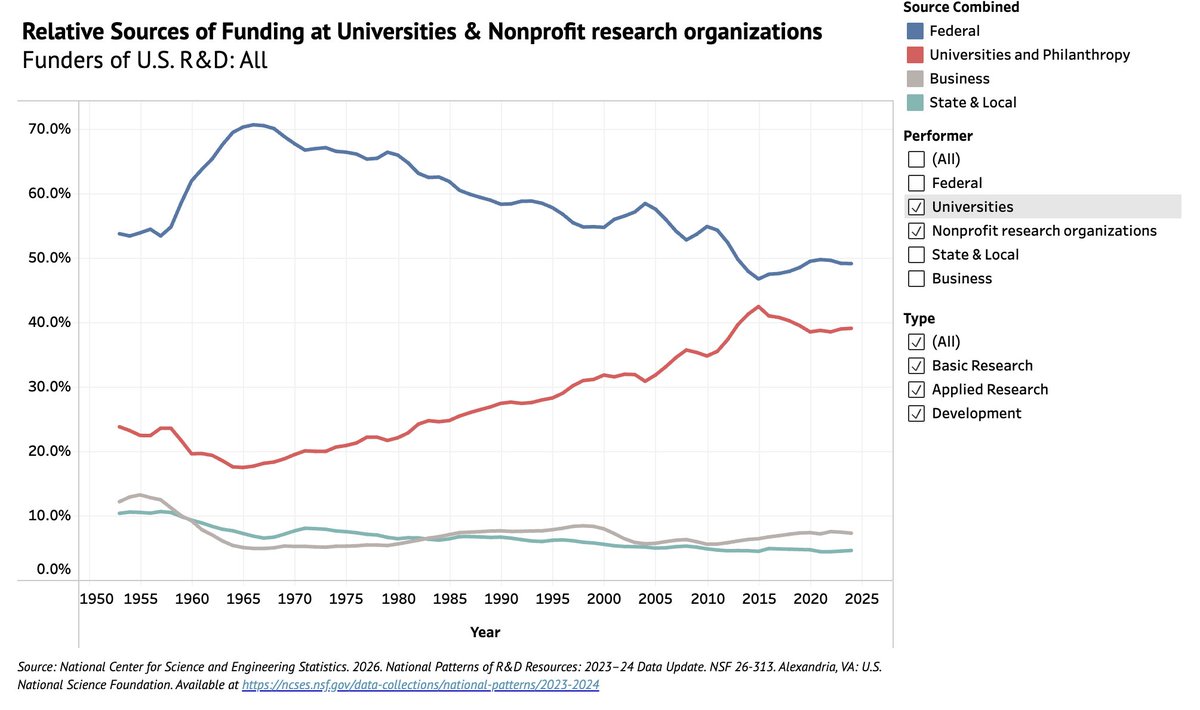
@AmyMNice @rSanti97 I believe not *mostly* - discrepancy comes from SPA analysis making assumptions on top of underlying NCSES data, attributing more uni spending to an original philanthropic source ($27B) vs other higher ed ($21B patents, tuition, etc). But yes my 2nd sentence worded badly vs 1st
English
2
0
0
80
Santi Ruiz
Santi Ruiz@rSanti97·
I think tech folks are overrating the degree to which tech philanthropy will replace federal dollars. The science funding piece isn’t crazy — there’s huge money flowing that way, and more coming — but it’s still an OOM off federal funding.
roon@tszzl

the private sector has been remaking its own versions of NIH, ARPA etc as these public science institutions have seen structural decline and defunding and it will be supercharged by the funding NPV of machine intelligence and its firepower at allocation decisions

English
17
43
471
85.7K
Amy Nice
Amy Nice@AmyMNice·
Isn’t the red line (university + philanthropy) mostly higher ed per NSF (not philanthropy)? I see this graph is looking at funding of R&D performed by universities and nonprofits, but if looking at total R&D dollars for research performed by all sectors am I recalling correctly that NSF shows philanthropic funding is the source for ~7.5% of all R&D? Or maybe I’m remembering that wrong or that’s not the right way to think about it.
English
1
0
0
100
Jacob Trefethen
Jacob Trefethen@JacobTref·
@rSanti97 Philanthropy as a whole is closer already, $27B if you include endowment spending vs $64B federal in 2024 indicators.sciphil.org/key-findings For extramural spending, it's near 50/50 now. Wish blue line went up But agree _tech_ philanthropy is currently small vs federal, and vs tech wealth
Jacob Trefethen tweet media
English
5
0
22
1.2K
Amy Nice
Amy Nice@AmyMNice·
@JuniperViews @IFP @cojobrien @JeremyLNeufeld Oh I know. It's crazy but it's a _requirement_ of the United States Department of _Labor_ (labor is in their name!) that for H-1B an employer is only permitted to identify base, guaranteed salary. No alternative comp can be listed or counted unless it is "guaranteed."
English
0
0
2
73
Amy Nice
Amy Nice@AmyMNice·
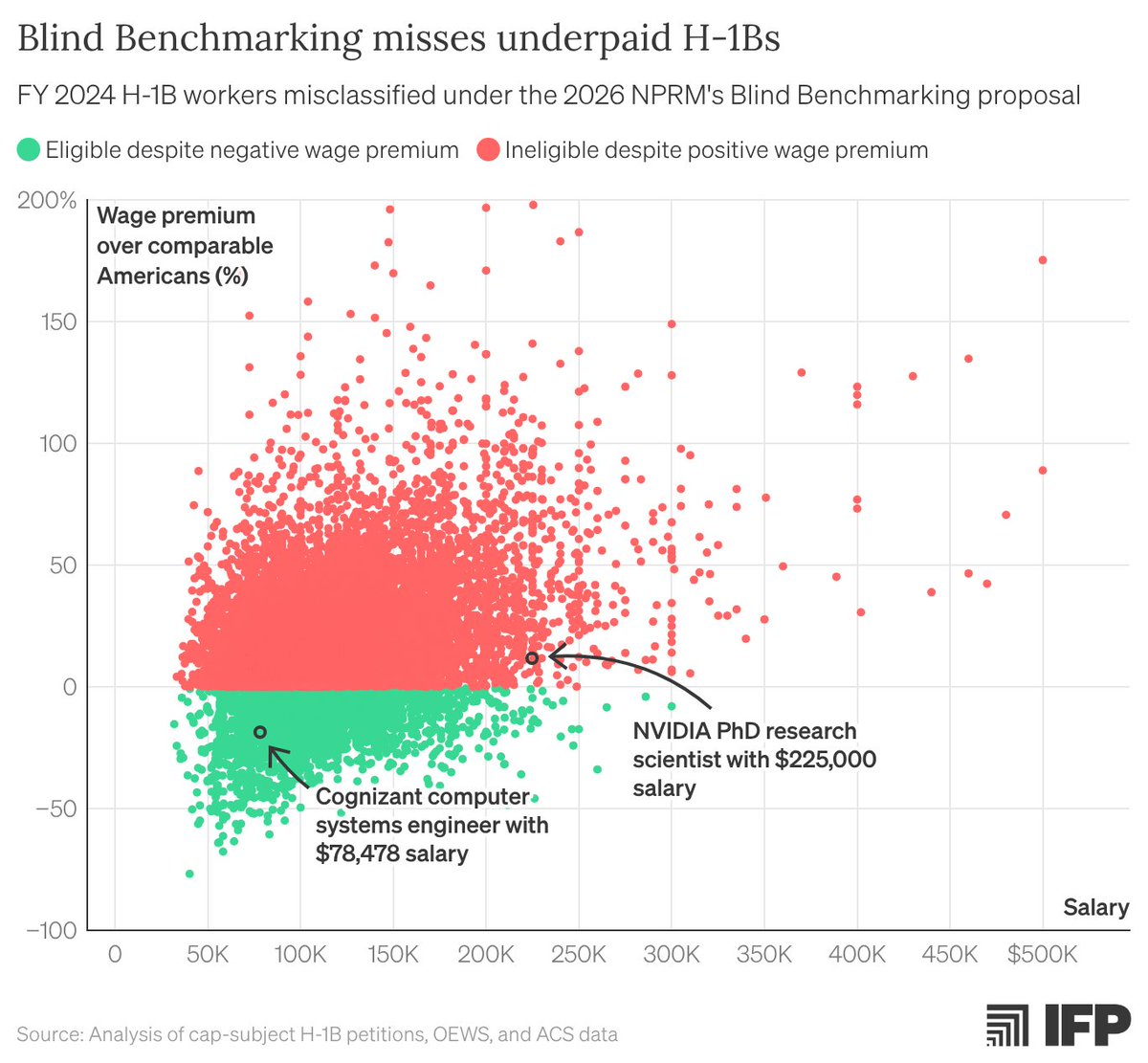
A new rule was just proposed to update the prevailing wage requirements for H-1B. It relies on what @cojobrien, @JeremyLNeufeld, and I call “Blind Benchmarking.” It’s blind to the actual credentials of the H-1B professional *and* relies on a dataset with *zero* information on experience or education of US workers. Shouldn’t the minimum prevailing wage for hiring noncitizen professionals just be the median wage Americans receive with the same education and experience in the same occupation and geography? That’s certainly what the *law* requires (“prevailing wages shall be commensurate with education, experience, and level of supervision”). Instead, with Blind Benchmarking DOL still uses the uniform percentiles it has relied on for 25+ years and just raises those fixed percentiles. With this Blind Benchmarking, DOL’s primary proposal in the Notice of Proposed Rulemaking allows some workers to be barred from H-1B status even though they get paid *more* than similar Americans and allows other workers to have access to H-1B status despite being paid *less* than an American with the same education and experience. In a new analysis @cojobrien, @JeremyLNeufeld, and I dig into the proposed regulation: t.co/pldeQiuPXV
Amy Nice tweet media
English
5
8
32
5K
Amy Nice
Amy Nice@AmyMNice·
@JuniperViews @IFP @cojobrien @JeremyLNeufeld Well, there was a newly minted PhD hired by Nvidia in the data, paid $225k - which is slightly above what the data show what the median wage is for an American PhD researcher with no further experience, in the same locality.
English
1
0
2
132
Amy Nice
Amy Nice@AmyMNice·
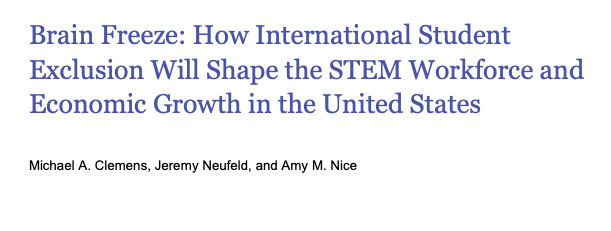
Good to discuss with @HooverInst the critical role of the US STEM workforce, including international students earning degrees here, in tech competition with China to make progress in critical fields. Don't we want as many advanced STEM degree holders as we can get, both domestic and international, contributing to American innovation and productivity? As we wrote in our paper for the National Academies in October, @m_clem @JeremyLNeufeld and I think it's vital we *retain* the international STEM talent pipeline through US universities.
Amy Nice tweet media
Hoover Institution@HooverInst

How essential are international STEM graduates to the US innovation and economic ecosystem? Hoover Senior Fellow Paola Sapienza and @IFP Distinguished Immigration Counsel @AmyMNice look to the data for answers: x.com/HooverInst/sta…

English
0
1
7
597
Amy Nice
Amy Nice@AmyMNice·
@deanwball This has also happened with corporate headquarters, not just defense headquarters - like Marriott Corp hq has Washington, D.C. 20058 zip but physically located in Bethesda, MD.
English
0
0
5
287
Dean W. Ball
Dean W. Ball@deanwball·
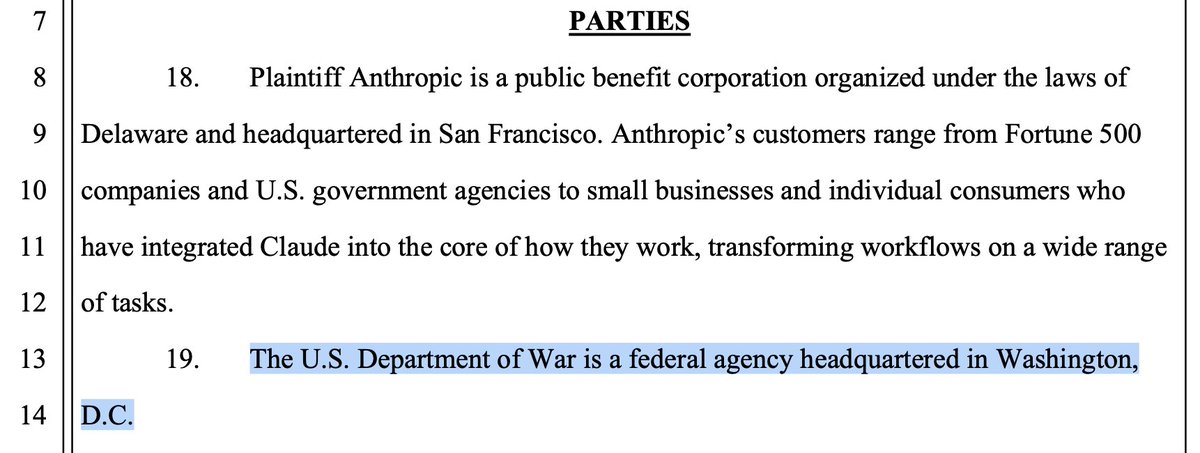
I read this and wondered: how is it that the DoW/DoD achieves having an official headquarters in D.C. when the Pentagon is in Virginia? like, how mechanically does that work? what is the address DoW uses in DC for its administrative HQ? and learned that USPS simply reshapes geography with administrative designation; their zip codes for the Pentagon simply assert it is located in Washington despite it lying within the political borders of Virginia. More broadly: "Mailing addresses are not required to match up with political boundaries — ZIP code boundaries are designed to streamline mail delivery, not serve as geographic locators," as Claude put it.
Dean W. Ball tweet media
English
8
4
148
19.2K
Amy Nice
Amy Nice@AmyMNice·
Did you know that over the last decade US industry hires of STEM PhDs have increased by about 100% in many sectors? If roughly 50% of PhDs across science, tech, and engineering disciplines granted at US research universities aren't to US-born US citizens, there's a 50-50 chance the ideal candidate might be an international student. Just sayin.
Hoover Institution@HooverInst

Are recruiters on US campuses actively looking to recruit international students over American students? The data speaks for itself, according to Hoover Senior Fellow Paola Sapienza and @IFP Distinguished Immigration Counsel @AmyMNice: x.com/HooverInst/sta…

English
2
3
16
3.9K
Amy Nice
Amy Nice@AmyMNice·
Fact: International students, scholars, and researchers who come to the nation's research universities make important contributions that benefit Americans and America. Myth: International STEM graduate students take slots for US-born students. Great to talk to @HooverInst about this important topic.
Hoover Institution@HooverInst

International students make up over half of all STEM graduate programs, driving the belief that they are taking spots away from US-born students. But is that really the case? Hoover Institution fellow Paola Sapienza and @IFP Distinguished Immigration Counsel @AmyMNice say the data tell a very different story. To learn more about the economic effects of immigration, visit: hoover.org/research-teams…

English
0
3
21
2K
Amy Nice
Amy Nice@AmyMNice·
@rSanti97 I want to remind you that, apparently like your brother, I also said must have printable pdf!
English
0
0
1
17
Steven Rattner
Steven Rattner@SteveRattner·
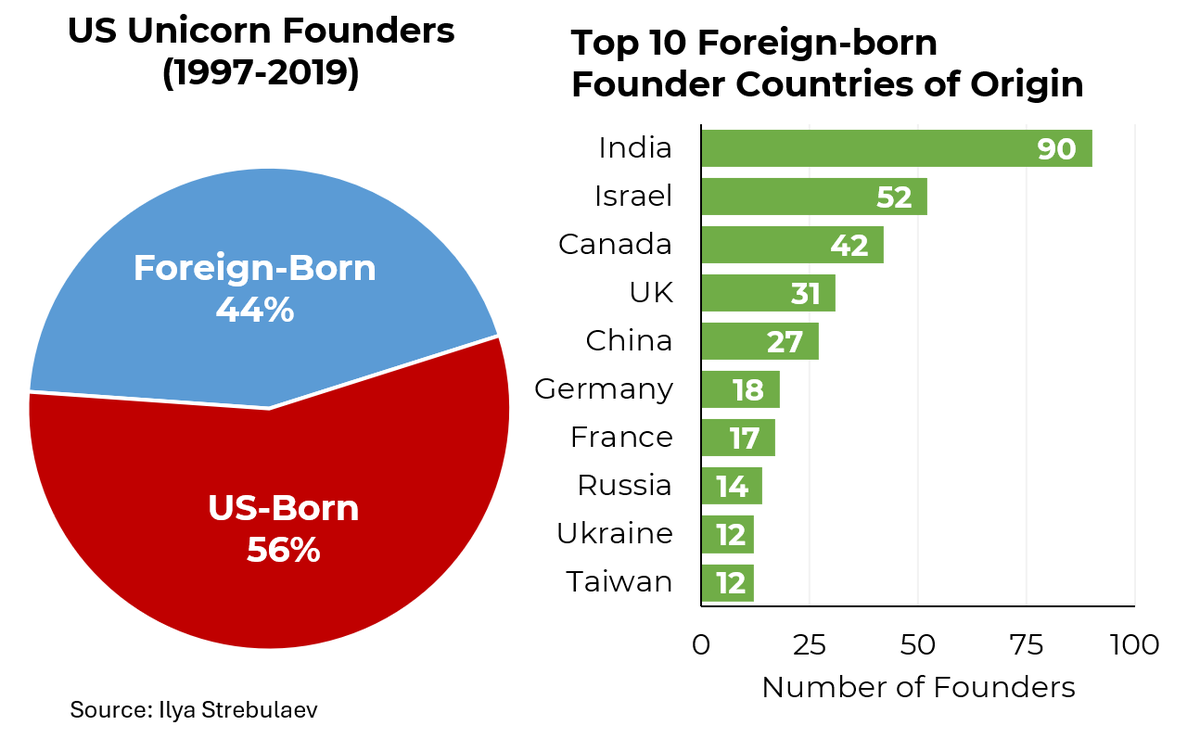
America is great because people come from all over the world to start businesses here. Nearly half of unicorn company founders are immigrants. My @Morning_Joe Chart
Steven Rattner tweet media
English
559
723
3K
636.5K
Joe Kochan
Joe Kochan@jskochan·
@mattyglesias In the mixed doubles, the men were the only ones sweeping, which was a surprise -- I am guessing the answer is yes?
English
1
0
16
1.3K
Amy Nice
Amy Nice@AmyMNice·
INA 245. The number of "immigrant visas" issued during a fiscal year includes the total of both (1) immigrant visa stamps placed by the State Department in the passports of new arrivals; and (2) adjustment of status approvals issued by the Department of Homeland Security in the United States. The latter under Section 245. That there are two ways that "immigrant visa" numbers are utilized under the original INA (1952) and current law (post IMMACT90) is confirmed by the government's administrative practice: "Glossary . . . Adjustment to Immigrant Status - . . . Aliens admitted to the United States in a nonimmigrant or other category may have their status changed to that of a lawful permanent resident if they are eligible to receive an immigrant visa and one is immediately available. In such cases, the alien is counted as an immigrant as of the date of adjustment." U.S. Department of Justice, Statistical Yearbook of the Immigration and Naturalization Service, Appendix 3 - Glossary at p. A.3-2 (Oct. 1993) (for fiscal year 1992, current law); see also U.S. Department of Justice, Statistical Yearbook of the Immigration and Naturalization Service, Glossary at p.140 (Sept. 1990) (for fiscal year 1989, the law on the books before IMMACT90).
English
0
0
0
436
Curtis Morrison
Curtis Morrison@curtismorrison·
In today’s hearing, judge asked what general statute authorizes adjustment of status? Stumped both me and the AUSA. If you know, please share because supplemental filing due on that tomorrow at 5 pm.
English
7
1
27
6.9K
Mark Regets
Mark Regets@markregets·
@AmyMNice This has long been a comparatively small (compared to how other nations fund research) part of the US portfolio of research funding. It is good that most nonprofit research organizations are still outside the H1B cap.
English
1
0
0
35
Amy Nice
Amy Nice@AmyMNice·
It’s all coming together. NSF is now going to make awards focused on talent and the autonomy to hire the best STEM experts to respond to an evolving tech landscape. *Looks at notes.* A way to retain top advanced STEM degree international talent working in the national interest who complete Masters, PhDs, and postdocs on US campuses?
Caleb Watney@calebwatney

NSF is launching one of the most ambitious experiments in federal science funding in 75 years. The program is called Tech Labs, and the goal is to invest ~$1 billion to seed new institutions of science and technology for the 21st century. Instead of funding projects, the NSF will fund teams. I’m in the @WSJ today with a piece on why this matters (gift link): wsj.com/opinion/scienc… Here’s the basic case: 1) Most federal science funding takes the form of small, incremental, project-based grants to individual scientists at universities. 2) The typical NSF grant is ~$250k/year to a professor with a couple of grad students and modest equipment over a few years. This is a perfectly reasonable way to fund some science, but it's not the only way. 3) A healthy portfolio needs more than one instrument. Project-based grants are like bonds: low-risk, steady, safe. But no one trying to maximize long-run returns would put 70% of their portfolio in bonds. 4) Yet that's basically what our civilian science funding portfolio looks like. Around 3/4ths of NSF and NIH grant funding is project-based. 5) Tech Labs is NSF's attempt to diversify that portfolio. The Tech Labs program is aiming for: - $10-50 million/year awards per team - 5+ year commitments - Measuring impact through advancement up the Tech Readiness Level scale rather than papers published - Up to ~$1 billion for the program - Supporting research orgs outside traditional university structures 6) Scientific production looks very different than it did when the NSF launched 75 years ago. The lone genius at the chalkboard can only do so much. Frontier science + tech today is increasingly team-based, interdisciplinary, and infrastructure-intensive. 7) The team behind AlphaFold just won the Nobel Prize in Chemistry. It came from DeepMind, an AI lab with sustained institutional funding and full-time research teams. It would be near-impossible to fund this kind of work on a 3-year academic grant. 8) Same pattern at the @arcinstitute (8-year appointments, cross-cutting technical support teams) and @HHMIJanelia (massive infrastructure investments to map the complete fly brain). Ambitious science increasingly needs core institutional support, not a series of project grants stapled together. 9) Similarly, Focused Research Organizations (@Convergent_FROs) have showcased a new model supporting teams with concrete missions and predefined milestones to unlock new funding. 10) There’s a whole ecosystem of philanthropically-supported centers doing amazing research, like the Institute for Protein Design, the Allen Institute, the Flatiron Institute, the Whitehead Institute, the Wyss Institute, the Broad — the list goes on. 11) But philanthropy can’t reshape American science alone. The federal government spends close to $200 billion each year on research and development, an order of magnitude more than even the largest foundations. 12) If we want to change how science gets done at scale, federal funding has to evolve. And the NSF and NIH don’t have dedicated funding mechanisms to support or seed these sorts of organizations. 13) Earlier this year, I started working on a related framework called “X-Labs” that built on all this exciting institutional experimentation that’s been happening within the private and philanthropic sectors. It’s time for the federal government to step into the arena: rebuilding.tech/posts/launchin… 14) Traditional university grants are still important for training the next generation of scientists and for certain kinds of curiosity-driven work. But after 75 years of putting nearly everything into one model, we should try something different. 15) And key program details are still being developed! You can reply to the Request for Information with suggestions or feedback on how to design this program here: nsf.gov/news/nsf-annou… 16) Science is supposed to be about experimentation. Science funding should be too.

English
1
2
14
1.9K