

random
4.1K posts

Google is one of the few institutions in the world where working on foundational new computer science problems is still encouraged.
English

For anyone curious about how the SpaceX / Cursor situation plays out, there is 0% chance Elon is writing anyone a $10b check.
English

@Cryptomnomiconz @YankeeGunner But you don't, the two clubs have won something more recently
English

If I told you a few years ago that pretty soon, spurs would be getting relegated, Chelsea would be midtable, and Arsenal would repeatedly compete to win the CL and PL, would you ever dream you’d be this miserable? 😂
English
@SpaceX @cursor_ai 60B valuation?! 10B for a coding agent on an IDE. Crazy.
English

SpaceXAI and @cursor_ai are now working closely together to create the world’s best coding and knowledge work AI.
The combination of Cursor’s leading product and distribution to expert software engineers with SpaceX’s million H100 equivalent Colossus training supercomputer will allow us to build the world’s most useful models.
Cursor has also given SpaceX the right to acquire Cursor later this year for $60 billion or pay $10 billion for our work together.
English

34 years ago today:
Ian Rush loses the ball in the centre circle at Highbury, and Martin Tyler can’t believe what happens next...
"Limpar... What's he trying? OH, THAT’S ONE YOU’LL NEVER FORGET!"
English
@0xSMW @Steve_Yegge The adoption isn't the problem. The tool sucks
English

@Steve_Yegge the ceo said in an interview, two weeks ago, that change mgmt was slow and eluded to not all teams adopting tooling quickly
youtu.be/bTA8sjgvA4c?si…
YouTube
English

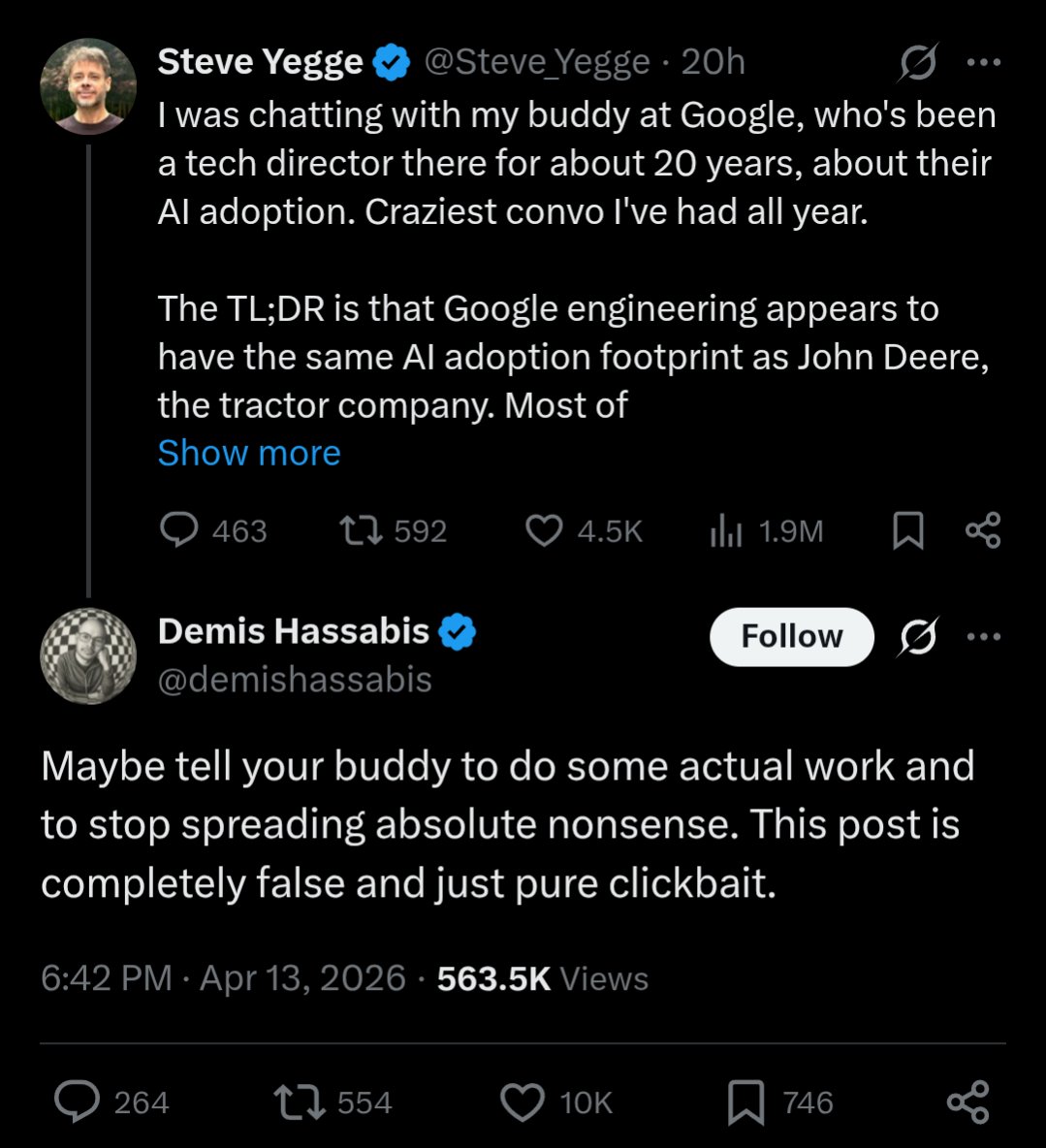
My tweet last week about Google's AI adoption drew a lot of pushback, to say the least.
Since then, Googlers from multiple orgs have reached out to me independently and anonymously. They've expressed fear of being doxxed, concern about what they saw as bullying of me, and general corroboration of my original tweet. I haven't verified each person's story, but the picture these Googlers paint is consistent across sources. It is more specific than what I originally wrote, and somewhat bleaker.
What they describe is a two-tier system. DeepMind engineers use Claude as a daily tool. Most of the rest of Google does not. When the question of equalizing access came up internally, the proposed response was to remove Claude for everyone — which DeepMind objected to so strongly that several engineers reportedly threatened to leave.
Non-DeepMind engineers get pushed onto internal Gemini variants behind router-style names that obscure which underlying model is actually serving a request. Multiple engineers describe regressions and reliability problems severe enough that some senior people have stopped using the tools. A senior manager on a major product line reportedly flagged attrition concerns over exactly this issue.
Googlers say leadership knows the gap is real. The response has been to mandate AI usage in OKRs and individual expectations, and to stand up an internal token-usage leaderboard. Unfortunately, managers have been told both that the leaderboard won't be used for performance reviews and, separately, that it absolutely will. And I hear other stories that Google's culture is not adapted properly yet for high-volume coding.
Addy Osmani's reply on behalf of Google said over 40,000 SWEs use agentic coding weekly. I don't doubt the number. But weekly use of a thin tool is precisely the box-checking I described in the original post. Volume of opens isn't adoption — and "weekly" is a low bar that includes a lot of people who tried it once and went back to writing code by hand.
The clearest thing I'm hearing is that Googlers do want to use high-quality agentic tools. They are asking repeatedly for better ones. But overall, this is not a picture of an engineering org that is fine.
My goal in the first tweet, and now, is always the same — get more people using AI and agentic coding. Nobody is as far ahead as they might look from the outside, and none of you are as far behind as you might be worried you are.
To all the Googlers who've reached out: thank you. You took a real risk and I appreciate you. Be safe. And good luck getting good models!
English
@akinfermo @Steve_Yegge Have you tried Claude code? I'm a googler too and you must be lying if you say we're not stuck in mid 2025
English

@Steve_Yegge I’m a Googler who’s not part of Deepmind and I have successfully been doing Gemini-driven agentic coding for months.
English

🚨 𝗕𝗥𝗘𝗔𝗞𝗜𝗡𝗚: Chelsea are now 25 points behind Arsenal in the title race! 😳
The Touchline | 𝐓@TouchlineX
🚨 𝗕𝗥𝗘𝗔𝗞𝗜𝗡𝗚: Chelsea are now 9 points behind Arsenal in the title race! 😳
English
@SemperFiArsenal I still believe. We want it more. We will find a way
English

@williamn95 @wolfejosh Openai spent 7B on Jonny ive's startup that doesn't have a product. Slack's acquisition was reasonable compared to this
English


what odds would you put of Bret Taylor selling Sierra to OpenAI + taking CEO with Sam moving to BoD?
a) 0%
b) 1-20%
c) 20-60%
d) 60-99%
Bret Taylor@btaylor
I had a great time speaking with Brian Roberts at Comcast headquarters in Philadelphia about the future of AI and Comcast's partnership with Sierra. I particularly loved learning more about Comcast's early bets on the Internet and the parallels to the adoption of AI.
English

Me:
1997-2026: Lived in San Francisco
1997-2026: Deeply involved in the San Francisco community
1997-2026: Voted in San Francisco (no decade-long break)
No need for a book-length tweet to explain.
Saikat Chakrabarti for Congress@saikatc
2009: Moved to San Francisco. 2012-2014: I was living/working in SF part time (was still at Stripe much of this time) as my wife (then girlfriend) was finishing school and then working in NY and on assignment abroad. I was trying to keep our long distance relationship alive, and I’m glad I did. I bought a home here in 2013 because this is where we always wanted to build our lives. 2015-2019: Working for Bernie/AOC & founding Justice Dems, bouncing around campaign HQs and in Congress. Still came back home to SF often as this is where my community was. 2019-present: Living back in the city full-time. I’ve raised a school-aged daughter here. I feel really lucky to have had the opportunity to do the work I did, and to be able to keep my family together. But this is consistent with what I told you over the phone. If you add the years up, yes, it is over a decade of living in San Francisco.
English
@aphysicist Surplus leads to deflation and gives room to print but that just means the government decides winners and losers, which means corruption
English

can someone walk me through the step-by-step of how this actually happens
Andrew Yang🧢⬆️🇺🇸@AndrewYang
It’s clear that AI will wind up funding universal income. Let’s make that happen ASAP.
English
@AndrewYang No? If prices of food, goods etc go down in a massive deflation caused by robots, the profits of companies in this new economy will look very similar to current cos. There'd be no money for universal income as usual, just higher quality of life and new occupations.
English

It’s clear that AI will wind up funding universal income. Let’s make that happen ASAP.
English
@matvelloso @OfficialLoganK @DynamicWebPaige 90% eng IC AI usage is from the model and coding agent, where Gemini lags severely behind Codex and Claude, with ~0% usage outside Google. Everything else is gravy.
English

Google literally just launched a Gemini App for Mac built with Antigravity...
My former team used AI so much that if you left @OfficialLoganK, @DynamicWebPaige or others alone for 5 minutes they would come back with new features for AI Studio. If anything, it was hard to keep track of how much was being done.
Steve Yegge@Steve_Yegge
I was chatting with my buddy at Google, who's been a tech director there for about 20 years, about their AI adoption. Craziest convo I've had all year. The TL;DR is that Google engineering appears to have the same AI adoption footprint as John Deere, the tractor company. Most of the industry has the same internal adoption curve: 20% agentic power users, 20% outright refusers, 60% still using Cursor or equivalent chat tool. It turns out Google has this curve too. But why is Google so... average? How is it that a handful of companies are taking off like a spaceship, and the rest, including Google, are mired in inaction? My buddy's observation was key here: There has been an industry-wide hiring freeze for 18+ months, during which time nobody has been moving jobs. So there are no clued-in people coming in from the outside to tell Google how far behind they are, how utterly mediocre they have become as an eng org. He says the problem is that they can't use Claude Code because it's the enemy, and Gemini has never been good enough to capture people's workflows like Claude has, so basically agentic coding just never really took off inside Google. They're all just plodding along, completely oblivious to what's happening out there right now. Not only is Google not able to do anything about it, they don't seem to be aware of the problem at all. I'm having major flashbacks to fifty years ago as a kid at the La Brea Tar Pits, asking, "why can't they just climb out?" My Google friend and I had this conversation over a month ago. I didn't share it because I wanted to look around a bit, and see if it's really as bad as all that. I've been talking to people from dozens of companies since then. And yeah. It's as bad as all that. Google is about average. Some companies at the bottom have near-zero AI adoption and can't even get budget for AI. They may have moats and high walls, but the horde is coming for them all the same. And then there are a few companies I've met recently who are *amazingly* leaned in to AI adoption. One category-leader company just cancelled IntelliJ for a thousand engineers. That's an incredibly bold move, one of many they're making towards agentic adoption. In my opinion, that company is setting themselves up for a _huge_ W. As for the rest, well, it's the Great Siloing. Everyone's flying blind. With nobody moving companies, no company knows where they stand on the AI adoption curve. Nobody knows how they're doing compared to everyone else. Half of them just check a box: "We enabled {Copilot/Cursor} for everyone!" Cue smug celebrations. They think this is like getting SOC2 compliance, just a thing they turn on and now it's "solved." And they don't realize that they've done effectively nothing at all. All because of a hiring freeze.
English
@kitten_beloved Googler here. It's true. Demis leads deepmind where the % breakdown favors forward AI usage, but the rest of Google is behind. He's livid because his org owns up leveling engineering and they're lagging claude code etc
English

@aristotelis_eco Do we have an open claw like system internally? How is Gemini coder vs Claude/codex? Can non deepmind eng use Claude?
English

@SJSharks_fish @ItsAndyRyan It's bittersweet but that's life. The upside is that his lifespan would be similar to his grandma so he wouldn't be alone. I found it unconventional, unpredictable and poignant. It's also very memorable, maybe traumatic, but a regular ending is so cliche one wouldn't remember it
English

@Cryptomnomiconz @ItsAndyRyan I didn't like that he was transformed into a mouse forever. I just couldn't stand the idea.
English

@SJSharks_fish @ItsAndyRyan Was it so bad? I liked it. It wasn't a cop out deus ex machina, and they made the best of a bad situation which felt incredibly mature for a kids book
English
@ItsAndyRyan I used to reread 'Witches' all the time hoping the ending would change. I was addicted to the dread that followed when I realized it wouldn't.
English