stumpyuk

3.3K posts

stumpyuk banner
stumpyuk

stumpyuk

@stumpyuk

Advocating Networked Commons Governance (NCG) - a practical British upgrade to fix elite disconnect, endless negation & gridlock. Democracy matters. Citizen

Tham gia Ekim 2008
1.5K Đang theo dõi387 Người theo dõi
stumpyuk
stumpyuk@stumpyuk·
@policylaila We know this is a photo of the green belt because there is virtually nobody there. By sacrificing just 20% of the unvisited green belt, you could solve the housing crisis over-night. Support young people, not the gerontocracy.
English
0
0
2
105
Laila Cunningham
Laila Cunningham@policylaila·
In Havering admiring our beautiful Green Belt. Reform will always protect this 🩵
Laila Cunningham tweet media
English
249
318
2.3K
50.8K
stumpyuk đã retweet
Danny Kruger
Danny Kruger@danny__kruger·
Here it is: an explainer that the Government doesn't run the government. The absurd convention of the Blair-Cameron years to take politics out of politics by giving civil servants political power, is fulfilled in this story: the decision by an official not to tell the PM or Foreign Sec that their pick for US ambassador had failed his vetting. It's almost incredible they weren't told. Either way the system is totally out of control. Politicians who won't lead; unaccountable officials in charge, and laws to stop them telling ministers the facts. Whitehall needs reform. spectator.com/article/in-def…
English
69
326
1.1K
98.1K
stumpyuk đã retweet
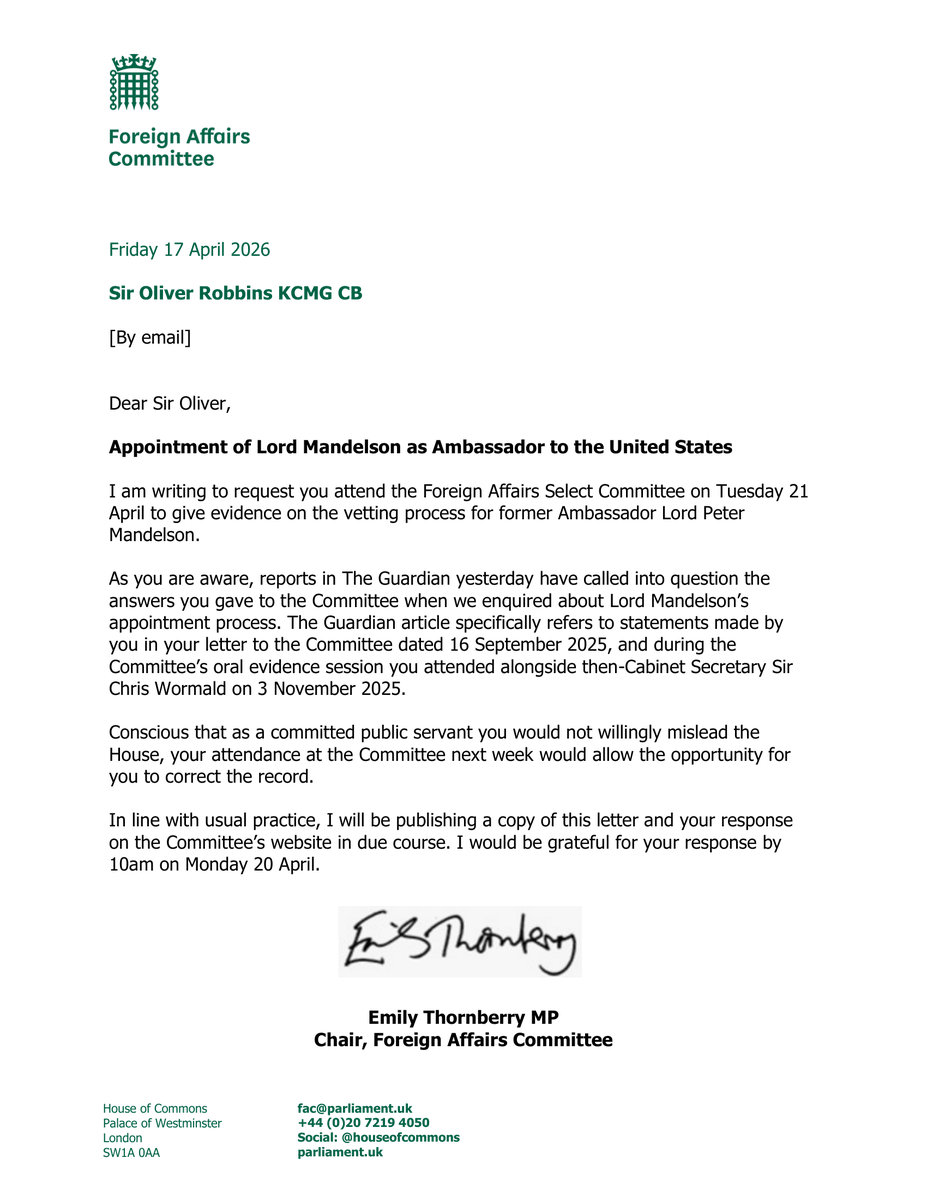
Foreign Affairs Committee
Foreign Affairs Committee@CommonsForeign·
Chair @EmilyThornberry has written to Sir Oliver Robbins @FCDOGovUK, requesting he appear before the Foreign Affairs Committee on Tuesday 21 April to give evidence on the vetting process for former Ambassador Lord Peter Mandelson.
Foreign Affairs Committee tweet media
English
125
238
513
65.1K
stumpyuk đã retweet
Creative Deduction
Creative Deduction@CreativeDeduct·
Britain could have deregulated, cut taxes, rolled back the planning regime and let entrepreneurial capitalism drag us out of the mess we're in. Instead, we're banning pastry adds and discussing capping CEO salaries and if £35k/ year is a high income. We're doomed, aren't we?
English
83
102
904
46K
stumpyuk
stumpyuk@stumpyuk·
Our current system is configured for the elite insiders to protect their positions, NOT to promote the well-being of citizens. Flip the script, choose Networked Commons Governance
English
0
0
1
63
Anglo Historian
Anglo Historian@AngloHistorian·
I just wanted to be a history account, not political. But I am so fucking Restore. I do not think Restore Britain will win. I do think that a labour/green alliance will win the next election. When they do, they will irreparably destroy Britain as we know it. But that happens eventually if Reform win too - when they lose the 2032 election to a far more radical left. I don’t even think it’s possible to undo what’s been done to this country. But Rupert Lowe has shown bravery, integrity and courage. He exemplifies every quality that made Britain the most outstanding, overachieving nation on earth. I will show him the same level of integrity that he has shown us still exists. Even if voting is bullshit, even if it helps the greens. It is the total absence of these qualities that has led to the situation we find ourselves in. Sell outs, grifters, career politicians with a copy/paste moral compass. I am voting for courage and integrity so that it may live on.
Anglo Historian tweet media
English
57
92
354
2.8K
stumpyuk đã retweet
Ken Cao-The China Crash Chronicle
Taiwan has just overtaken the UK in total stock market value, becoming the world’s 7th largest market. It’s a powerful reminder of what a small, democratic island can achieve without relying on authoritarian control.
Ken Cao-The China Crash Chronicle tweet media
English
72
494
2.3K
92.5K
stumpyuk đã retweet
Ameer Kotecha
Ameer Kotecha@Ameer_Kotecha·
Why, unlike almost every serious thinker about geopolitics today, has Starmer, Hermer and Foreign Office leadership not woken up to the fact that the “Rules Based International System” has ceased to exist, if indeed it ever did so? The foreign policy brain of the past four PM’s, John Bew, gets it. Writing recently, he pointed out “the idea of a rules-based order is treated as an almost theological abstraction, as a God-given gift from which dissent cannot be contemplated.” But “to make fidelity to international law the organising goal of our foreign policy and the premise of every decision we take” we risk being left as the only one with our pants down. Rather than getting serious about investing in our military capabilities and holding onto prized assets like Diego Garcia that will help us to navigate the the dangerous world we face, Starmer has prioritised the setting of an empty moral example. It is less the ethical foreign policy expounded by Robin Cook; more an exercise in supercilious virtue signalling on the world stage.
English
15
55
267
8.7K
Steven Barrett
Steven Barrett@SBarrettBar·
Please stop tweeting fucking essays.
English
68
20
280
9.5K
Charlotte Gill
Charlotte Gill@CharlotteCGill·
Often I’m in “fighting mood” about the UK Today I’m in a bit of a despair one though Everything is just so ghastly And the Right are way too fragmented It’s also house prices and practical things The UK feels so hostile to Brits How do we defeat the baddies? (Don’t jail me)
English
217
124
1.5K
18.9K
stumpyuk
stumpyuk@stumpyuk·
Truly transformative change has historically come from outside the governance system, but that same system fiercely guards against outsiders. Real change can only come after we have changed our system of governance.
English
0
0
0
48
stumpyuk
stumpyuk@stumpyuk·
Politics has expanded so far in the UK, that it now seeks dominion over the most intimate aspects of citizens private lives. This is the inevitable result of an increasingly top-down and centralized system of governance. This must end NOW!
English
0
0
0
45
stumpyuk đã retweet
Josh Hunt
Josh Hunt@iAmJoshHunt·
There's a crisis hiding inside British local government right now that almost nobody is talking about. And it connects to almost everything else that's going wrong. Since 2018, seven councils have effectively gone bankrupt. Northamptonshire. Croydon. Slough. Thurrock. Woking. Birmingham. Nottingham. They issued what's called a Section 114 notice. Local government's way of saying the money has run out. The number of councils needing emergency help from central government is growing every year. In 2025-26, 30 councils needed exceptional financial support. This year it's 35, sharing around £1.5 billion. The government had been warned it could reach 100. The Local Government Association estimates almost 1 in 5 councils are at risk. The LGIU found more than half of senior council figures believe their authority will effectively go bankrupt within five years. Some of this is mismanagement. Woking racked up £2.4 billion in debt, 100 times its annual budget, gambling on hotels and skyscrapers. Thurrock lost hundreds of millions on solar farm investments. Croydon's housing company collapsed. But the deeper story is structural. Between 2009 and 2020, central government funding to councils was cut by 40% in real terms. From £46.5 billion to £28 billion. At the same time, demand for the services councils are legally required to provide has been rising every single year. And while the funding was being slashed, your council tax was going in the opposite direction. In 2011, the average Band D council tax bill was £1,439. Today it's £2,392. Up over 66% in fifteen years. This year, 274 out of 384 councils raised it by the maximum allowed without triggering a referendum. Seven were given special permission to go even higher. You'd think all that extra money would mean better services. It doesn't. Libraries are closing. Bins are collected less often. Roads are falling apart. Social care is being rationed. You're paying more every year and getting less every year. So where is the money going? Social care is the single biggest answer. It's eating local government alive. The adult social care funding gap is now over £1 billion a year just to stand still. The Health Foundation estimates an additional £8.3 billion will be needed by 2032 just to keep up with growing demand. Care England estimates that increases to the National Living Wage and employer National Insurance have added £3.7 billion in extra costs to the sector. The government's response has fallen well short of that. But there's another cost most people don't know about. And I want to be precise here because the numbers are contested and the picture is complicated. Councils fund themselves from multiple sources. Government grants. Business rates. Fees. And council tax. Council tax is the part you pay directly. So when I talk about what follows, I'm talking specifically about how much of your council tax revenue goes to one particular cost. Freedom of Information requests submitted to over 300 councils found that local authorities across England contributed roughly £6.7 billion to staff pension schemes last year. When measured against the council tax those councils collected, that works out at an average of around 23p in every pound of council tax revenue going to staff pensions. Councils will rightly point out that council tax is only one part of their total funding. That's true and it's an important caveat. But council tax is the part that comes directly from you. Council employees are enrolled in the Local Government Pension Scheme. A defined benefit scheme where councils pay an average of roughly 20% of each staff member's salary in employer contributions. In the private sector, the minimum employer contribution under auto-enrolment is 3%. The two aren't directly comparable because defined benefit and defined contribution schemes work very differently. But the gap gives you a sense of the cost pressure. And this isn't an argument against council workers having decent retirements. Many of them are low paid and do vital work. The average LGPS pension in payment is around £4,000 a year. This isn't gold-plated for most people. But when your council tax has gone up over 66% in fifteen years while your services have visibly deteriorated, you deserve to understand what's driving those costs. Pension obligations are one significant part of the picture. Social care is another. And between them, they leave very little room for everything else. Now here's where it connects to the NHS. Care providers are closing. Councils are rationing who qualifies for help. And the knock-on effect is landing directly on hospitals. Every single day in England, somewhere between 13,000 and 14,000 hospital beds are occupied by patients who are medically fit to go home but can't. Because the social care they need to leave hospital doesn't exist. One in eight general and acute beds in the country. Blocked. Not because the patients are sick. Because there's nowhere for them to go. Care England estimates that over 45% of hospital discharge delays are linked to social care. The Royal College of Physicians has called this "a failing system" and said the NHS front door will remain in a state of emergency until it's fixed. This is a doom loop. And nobody in government is treating it as one. Councils can't fund social care. So elderly patients can't leave hospital. So hospital beds are blocked. So waiting lists grow. So people who need treatment can't get it. So they can't work. So economic inactivity rises. So tax receipts fall. So the government has less money. So councils get squeezed further. So social care gets worse. So more beds are blocked. And round it goes. Every part of that chain is supported by data from official sources. The waiting lists. The inactivity figures. The funding gaps. The discharge numbers. The Section 114 notices. They're all published separately by different departments. But nobody is connecting them. The DWP treats inactivity as a welfare problem. The NHS treats waiting lists as a health problem. The Treasury treats both as spending problems. Local government treats social care as a funding problem. They're all looking at their own piece. Nobody is looking at the system. Meanwhile your council tax keeps going up. Your services keep getting worse. The population is ageing. The fertility rate just hit its lowest level on record. And the cost of everything, pensions, healthcare, social care, debt interest, keeps growing faster than the economy that's supposed to pay for it. The councils going bust aren't the crisis. They're the symptom. The crisis is a system that was built for a younger, richer, growing country and is now buckling under the weight of an older, poorer, stagnating one. And nobody in power is willing to say that out loud. Because the honest answer is that this requires a fundamental redesign of how the state works. And nobody wants to be the one to start that conversation.
English
106
371
1K
71.8K