

tomichcaaa
15K posts

tomichcaaa
@tomichcaaa
Gigabrain Student. 2/kek/acc
Tham gia Temmuz 2019
1K Đang theo dõi1.1K Người theo dõi

if i was brian armstrong, i'd feel scammed lol
there's certainly 10 good guests but nobody talks with them
instead we always have the same group of scammers in the rotation and they push some bs narrative accompanied with some bs coins
Cobie@cobie
@kirbyongeo @UpOnlyTV Doubt we will ever do it again, maybe one day, but today it’s not even possible to curate a list of 10 good guests imo
English

Less wars, more @pepecoins
More building, less destruction.
Chill out in kek.space
Have fun, enjoy life.
GIF
English

Ello Frens of Kek.space!!
The FIRST EVER Costume Contest has concluded!!
And I have decided that instead of, ME, being the sole judge; that ALL OF YOU FRENS, should also have a say so on who wins!
Remember:
1st prize = 4k GT's
2nd prize = 2k GT's
3rd prize = 1k GT's
Comment below to cast your vote on who YOU THINK should be the winners!!
(Can mention who you like the most or mention the top three you like the most. I can veto public vote) @pepecoins @krakenfx
English

I still refuse to believe that Gary Gensler did a full 23-lesson course on blockchain for MIT
Was he really the bad guy?

English





tomichcaaa đã retweet

Now that ZKEVMs are at alpha stage (production-quality performance, remaining work is safety) and PeerDAS is live on mainnet, it's time to talk more about what this combination means for Ethereum.
These are not minor improvements; they are shifting Ethereum into being a fundamentally new and more powerful kind of decentralized network.
To see why, let's look at the two major types of p2p network so far:
BitTorrent (2000): huge total bandwidth, highly decentralized, no consensus
Bitcoin (2009): highly decentralized, consensus, but low bandwidth - because it’s not “distributed” in the sense of work being split up, it’s *replicated*
Now, Ethereum with PeerDAS (2025) and ZK-EVMs (expect small portions of the network using it in 2026), we get: decentralized, consensus and high bandwidth
The trilemma has been solved - not on paper, but with live running code, of which one half (data availability sampling) is *on mainnet today*, and the other half (ZK-EVMs) is *production-quality on performance today* - safety is what remains.
This was a 10-year journey (see the first commit of my original post on DAS here: github.com/ethereum/resea… , and ZK-EVM attempts started in ~2020), but it's finally here.
Over the next ~4 years, expect to see the full extent of this vision roll out:
* In 2026, large non-ZKEVM-dependent gas limit increases due to BALs and ePBS, and we'll see the first opportunities to run a ZKEVM node
* In 2026-28, gas repricings, changes to state structure, exec payload going into blobs, and other adjustments to make higher gas limits safe
* In 2027-30, large further gas limit increases, as ZKEVM becomes the primary way to validate blocks on the network
A third piece of this is distributed block building.
A long-term ideal holy grail is to get to a future where the full block is *never* constituted in one single place. This will not be necessary for a long time, but IMO it is worth striving for us at least have the capability to do that.
Even before that point, we want the meaningful authority in block building to be as distributed as possible. This can be done either in-protocol (eg. maybe we figure out how to expand FOCIL to make it a primary channel for txs), or out-of-protocol with distributed builder marketplaces. This reduces risk of centralized interference with real-time transaction inclusion, AND it creates a better environment for geographical fairness.
Onward.
English
@JoestarCrypto @YuvalRooz Oui, je travail pour une chaire de recherche sur la chaîne de blocs et j’ai eu affaire à eux, c’est une chain d’institutionnels qui back plusieurs projets plus petits comme @trize_io, je confirme qu’ils sont actifs, même si je suis d’accord avec toi, leurs stats on aucune geule.
Français

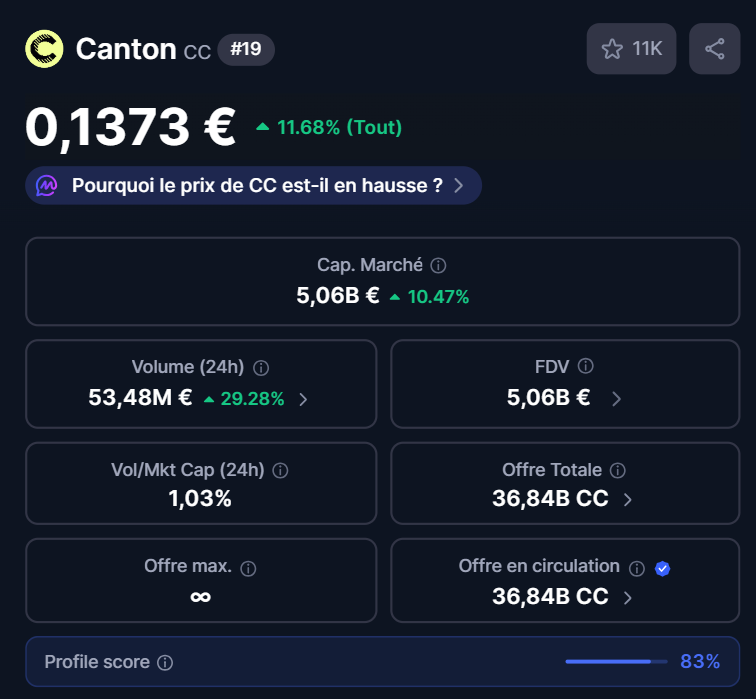
Yo wtf is $CC ??
> #19 crypto MC (x10 in 1 month)
> No tokens onchain, everything lives on tier-2 CEXs
> Raised $442M, partly from Nasdaq & S&P500 (no VC alloc, equity i guess)
> $6T “onchain” (not origination… right?)
> DAML smart contracts (??)
> @YuvalRooz as CEO @CantonNetwork (who even is that?)
> 7 TPS peak
> Horrible explorer and no TVL
Wait the funniest part :
> Supply x30 in a year thanks to infinite mint/burn tech… but no one burns lol
At this pace that’s like $1.6B inflation every 3 weeks, the more i dig the less it makes sense
Is this the new $XRP ? @hantengri might love this
Fun fact :
Nothing backed by Nasdaq or S&P as investors actually worked
@fnality raised $334M and nobody even knows them
Tbh i don’t think this is pure extraction, feels more like web2 trying to compete with crypto native, but ngl, the tech looks terrible
It’s like radio companies trying to invest in internet startups back in 1990. Cringe



English
tomichcaaa đã retweet

@Cryptchamo @chainlink Maybe @getbasedai can still be a thing, if they reach their goals it can be really incredible. Decentralized zk-llms with some great implémentations like fhe, zk-proofs, or cerberus squeezing
English

AI is clearly something everyone loves, it seems. Let's share what project we find interesting for 2026 👇
Here are the 3 projects i dug into and like in crypto:
1. @chainlink (The Data) The necessary foundation. AI agents need reliable inputs, and Chainlink remains the critical bridge connecting off-chain truth to on-chain environments.
2. @bittensor (The Models) The marketplace for intelligence. By decentralizing machine learning, TAO creates the open economy for algorithmic output.
3. @GenLayer (The Mind) The evolution of consensus. While Chainlink provides the data and TAO provides the models, GenLayer solves the missing piece: execution.
GenLayer is an Intelligent Blockchain
Current crypto projects are forced to run AI logic off-chain because standard blockchains can only handle simple math (1+1=2). They crash if they try to handle nuance.
GenLayer brings Neural Consensus. It allows validators to run AI models locally and agree on subjective results, like interpreting a news article or judging sentiment, directly on-chain.
Others plug into AI externally. @GenLayer is the only chain that can actually "think."
What is the one AI project you are betting everything on for 2026?

Cryptchamo@Cryptchamo
I've been thinking about this a lot lately, human trust is just falling apart in this new AI world. We trust vibes, faces, slow relationships. AI agents have none of that, they're emotionless, lightning-fast, global, and will spark millions of disputes no human can handle. @driudor put it best: “Trust is one of the oldest and most important social technologies. It evolved as a human mechanism to reduce complexity: we trust so we don’t have to verify everything.” That works for us, but not for agents. We need programmable trust, fast and enforceable. @GenLayer delivers: a blockchain where AIs consensus on subjective decisions and settle disputes instantly. It's the court the AI economy needs. Without it, chaos. With it, we scale. The future of trust is coded.
English
Let’s see where this journey will bring us.
Have you trade on @Dreamcash yet?
jz5cn3

Dreamcash@Dreamcash
Dreamcash is now available to everyone! Native Hyperliquid trading on your phone while claiming Dreamdrop ranks. No invite required. Fast. Simple. Addictive. Fun. dreamcash.xyz/inbound
English

@CountKekula69 @pepecoins @ShaneMac @anndylian @baseapp @xmtp_ can't wait to trade rudongs directly through chat via @xmtp_
rudongs are the future of finance.
the thong stays on.

English

Support builders, not just coins. Progress needs passionate people.
English
tomichcaaa đã retweet

Hilarious to watch everyone gang up on bubble maps while yelling about how their bundled launches "gave people chances to make money"
They also massively enriched the dev teams while sucking liquidity out of the space and wrecked tons of people
People aren't understanding that bubble maps doesn't want you to not make money, they want BAD ACTORS to stop consistently getting away with PLAYING YOU while you sit there and go "but I could've hit a 100x ☝️🤓"
We should be trying to make this space better for everyone, and that starts with fighting back against these dummies trying to make you think that bundled supply control and infinitely rich dev teams are normal
Crash@CrashiusClay69
Don’t even get me started on Bubble maps token Did your chain analysis protect investors?? No they still got fucked. Same result. Actually 100x worse. Big difference between Brett and Bubble Shit token Is Brett started at sub 2M market cap and rode up to 2.3B giving the regular person SO MANY chances to make life changing money so far. Bubble shit STARTED HIGH and only went lower meaning people ONLY could lose money on it Before you call other people out, do better and look in the mirror. Bubbleshit.
English
English

@ShaneMac @anndylian @CountKekula69 @baseapp Love to hear that!
@kekitykek has been hard at work working on enhanced functionality, and we're looking forward to deeper collaboration with yourself and the @xmtp_ team ❤️🐸
Open chat protocols and portable inboxes are the future of messaging.
English
tomichcaaa đã retweet

More room for rollups.
BPO-1 activated yesterday, raising blob capacity to 15 per block. This increased space on Ethereum for L2s without needing a hard fork.
BPO-2, which will further increase capacity, comes online in January.
English
tomichcaaa đã retweet

the irony of people celebrating this cluster is wild
these wallets dumped the next day for $2M
$PEPE didn't hit $12b thanks to a bundle
it happened DESPITE it
Bubblemaps@bubblemaps
this is $PEPE at launch with time nodes on 30% bundled you were lied to
English
tomichcaaa đã retweet

Very thoughtful post, agree with almost everything, few amendments:
Surprise #1: The U.S. just unlocked a Eurodollar 2.0 system. ✅ → although bad for Europe where I live in
Surprise #2: AI will become the biggest user of stablecoins. ✅ → ETH will be the venue, EigenCloud will provide unruggable & performant AI agents for this
Surprise #3: The bigger stablecoins become, the more the world needs neutral collateral. 👀 → partly agree, Eric argues this will be BTC. I disagree because will be hard for BTC community to agree on way to solve quantum threat (will also introduce execution risks, big differentiator until now) & longterm security issues with fees not compensating declining block subsidies, hitting in 5-10 yrs. ETH has way better fundamentals for this (most permissionless collateral for ecosystem majority of stablecoins are deployed, realyield & lower inflation than BTC).
Surprise #4: Ethereum becomes the default settlement layer. ✅ → YES
Surprise #5: Corporate treasuries will change more in the next decade than in the last century. ✅ → "for the first time ever, they’ll operate in: 24/7 on-chain dollars / real-time collateral buffers / tokenized assets / AI-driven execution flows"
Surprise #6: Lawmakers think they “regulated crypto.” What they actually did was remove the friction that kept trillions from entering the system. ✅
Visionary thinking here.
Eric Jackson@ericjackson
Everyone thinks the Clarity Act + Genius Act are just “crypto regulation.” They’re not. They’re the early blueprint for the next global monetary system — and almost nobody sees the second-order effects coming. Here are the real surprises.
English
tomichcaaa đã retweet

tomichcaaa đã retweet

In Defense of Exponentials
I used to tell founders, the reaction you are going to get to your launch is not hate, it’s indifference. By default, nobody cares about your new chain.
I have to stop telling them that now. Monad just launched this week, and I’ve never seen so much hate about a blockchain that just launched. I’ve been investing into crypto professionally for 7+ years now. Before 2023, almost every chain I’ve ever seen that launched was mostly met with enthusiasm or indifference.
But now, new chains are born into a chorus of hate. The amount of haters I’ve seen for projects like Monad, Tempo, MegaETH—before they even hit mainnet—is a genuinely new phenomenon.
I’ve been trying to diagnose: why is this happening now, and what does it mean about the psychology of this market?
The Cure is Worse than the Disease
Forewarning: this is going to be the vaguest blockchain valuation post you ever read. I don’t have any fancy metrics or charts to sell you on. Instead, I’ll be arguing against the zeitgeist of Crypto Twitter, which for the last couple of years, I’ve been constantly on the opposite side of.
In 2024, I felt like what I was arguing against was financial nihilism. Financial nihilism is the belief that none of these assets matter, it’s all memes at the end of the day, and everything we’ve built is inherently worthless.
Thankfully, that’s no longer the vibe. We have broken out of that spell.
But the zeitgeist now is what I’d call financial cynicism: OK, maybe some of this stuff has value, maybe it’s not all memes, but it’s grossly overvalued and it’s only a matter of time before Wall Street finds that out. Not that all chains are worthless. But these things are all maybe worth 1/5th-1/10th of what they’re currently trading at (have you seen these PE ratios?), and so you’d better pray like hell Wall Street doesn’t call us on our bluff, because once they do it’s all getting wiped out.
You’ve got many bullish analysts now trying to conjure up optimistic L1 valuation models, inflating PE ratios, gross margins, DCFs, trying to fight against this mood.
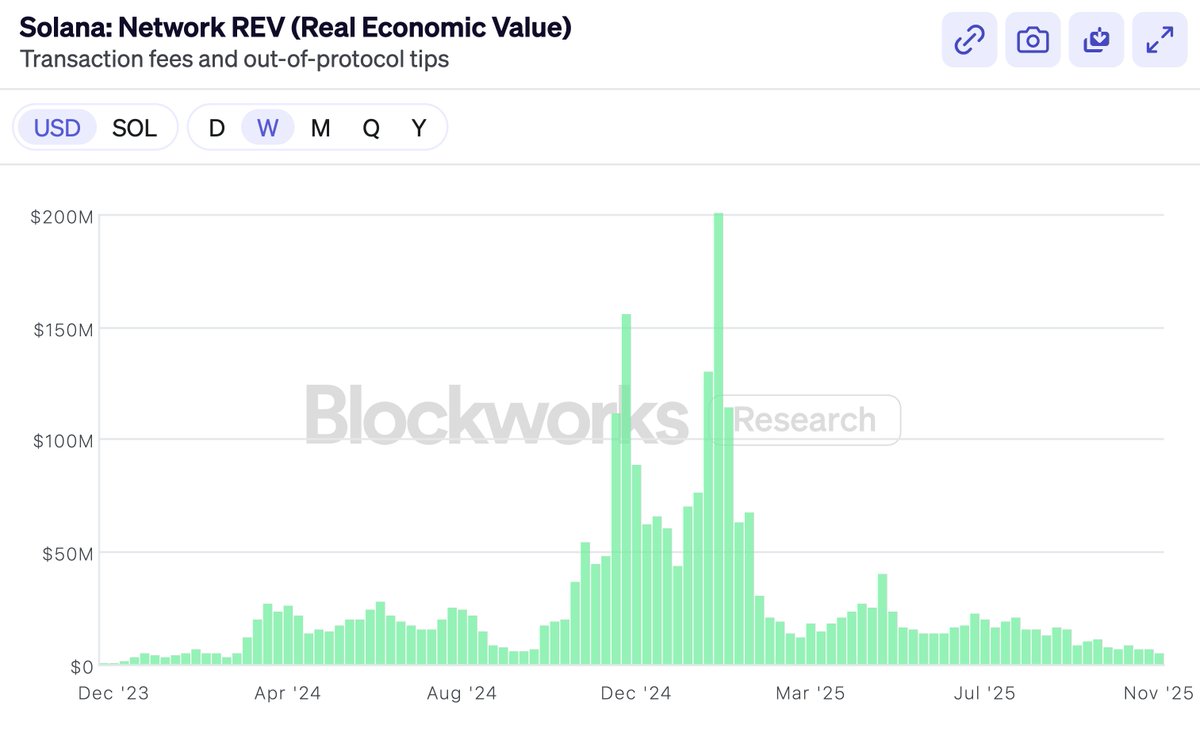
Late last year, Solana very proudly embraced REV as a metric that could finally justify their valuation. They proudly announced: we—and only we—are no longer bluffing to Wall Street!
And, of course, almost immediately after REV was embraced, it fell off a cliff (though $SOL, tellingly, did better than REV did).
Not that there’s anything wrong with REV. REV is a very clever metric. But the point of this post is not metric selection.
Then came the launch of Hyperliquid. A DEX that had real revenue and buybacks and PE multiples. And the chorus said—look, look I told you! Finally, for the first time ever, a token that has some real profits and a proper PE multiple. (Nevermind BNB, we don’t talk about that.) Hyperliquid will eat everything because obviously Ethereum and Solana don’t make any real money, we can stop pretending to value them now.
Hyperliquid, Pump, Sky, these buyback-heavy tokens are all great. But the market always had the ability to invest into exchanges. You could always buy Coinbase, or BNB, or whatever. We own $HYPE, and I agree that it’s a fantastic product.
But that’s not why people were investing in ETH and SOL. The fact that L1s don't have exchange-like profit margins is not why people were buying them—if they wanted that, they could’ve bought Coinbase stock.
So if I’m not critiquing blockchain financial metrics, maybe you think this post is going to be chiding the sinfulness of the token-industrial complex.
Obviously, everyone has lost money on tokens in the last year, VCs included. Alts are down bad this year. And so the other half of the zeitgeist on CT is arguing about who's to blame. Who’s become greedy? Are the VCs greedy? Is Wintermute greedy? Is Binance greedy? Are the farmers greedy? Are the founders greedy?
The answer, of course, is the same as it’s ever been.
Everyone is greedy. Everyone. The VCs, Wintermute, the farmers, Binance, the KOLs, they're all greedy, and you are greedy too. But it doesn't matter. Because no functioning market has ever required anyone to act against their self-interest. If we're right about crypto, we can all be greedy and the investments will still work out. Trying to analyze a market that has gone down by figuring out “who’s greedy” is going to be about as fruitful as commissioning witch trials. I guarantee you, nobody just started being greedy in 2025.
So this, too, is not what I’m going to be writing about.
Many people want me to write a post about why $MON should be valued at X or $MEGA at Y. I’m not interested in writing this post, or advocating that you buy anything in particular. In fact, you probably shouldn’t buy any of them if you don’t already believe in them.
Will any new challenger chain win? Who knows. But if it has a material chance of winning, it's going to be priced on that basis. If Ethereum is worth $300B or Solana is worth $80B, a project that has a 1-5% chance of becoming the next Ethereum or Solana will be priced according to those probabilities.
Somehow CT is scandalized by this, but it’s no different than Biotech. A drug that has less than a 10% chance of curing Alzheimer's is priced by the market as worth billions of dollars, even if 90% chance it won’t pass stage 3 trials and will go to 0. That's how the math works—and turns out, markets are pretty good at doing math. Binary outcomes are priced on probabilities, not on run rates or moral turpitude. It’s the “shut up and calculate” school of valuation.
I really don’t think that’s an interesting question to write about. “5% chance to win? No way, that’s clearly a 10% chance!” Markets, not articles, are the best way to assess that for any individual token.
So here’s what I am going to write about: CT doesn't seem to believe anymore that chains are valuable.
I don’t think this is because they don’t believe new chains can win market share. We just saw Solana dominate market share after emerging from the ashes less than 2 years ago. It’s not easy, but of course it’s possible.
It’s more that people have come to believe that even if a new chain wins, there’s no prize worth winning. If $ETH is just a meme, if it’ll never generate real revenue, then even if you win, you won’t be worth $300B. The contest is not worth winning, because these valuations are all bunk and it’ll all come crashing down before you go to claim your prize.
Being optimistic about chain valuations has become passé. Not that nobody is optimistic—obviously there must be optimists out there. For every seller there’s a buyer, and as much as CT cool kids love to drag L1s, people are comfortable buying SOL at $140, ETH at $3000.
But there’s a perception now that all the smartest people are over buying smart contract chains. Smart people know the jig is up. If not now, then soon. The only people buying here are suckers—Uber drivers, Tom Lee, and KOLs who say stuff like “trillions.” And maybe the US Treasury. But not the smart money.
This is bullshit. I don’t believe it, and you shouldn’t either.
So I felt like I had to write a smart person’s manifesto on why general purpose chains are valuable. This post is not about Monad or MegaETH. It’s really in defense of ETH and SOL. Because if you believe ETH and SOL are valuable, the rest is straight downstream.
Defending ETH and SOL valuations is generally not my job as a VC, but fuck it, if nobody else is willing to do it, then I’ll write it.
Feeling the Exponential
My partner Bo experienced the Chinese Internet boom first-hand as a VC. I’ve heard how “crypto is like the Internet” so many times now that it doesn’t even register for me anymore. But when I hear his stories, it always reminds me how costly it is to be wrong about these things.
A story he often tells is about when all the early e-commerce VCs (it was a small group back then) got together for coffee in the early 2000s. They debated: how big is the market for e-commerce going to be?
Is it going to be mostly electronics (maybe only techies will use PCs)? Could it ever work for women (perhaps they’re too tactile)? What about food (maybe impossible to manage perishables)? These were deeply important questions for early VCs to decide what to invest in and what prices to pay.
The answer, of course, was that literally every single one of them was devastatingly wrong. E-commerce would sell everything, and the target audience was the whole fucking world. But nobody at the time actually believed it. And even if they did, it would be too absurd to say out loud.
You just had to wait long enough for the exponential to show you. Even among the believers, very few thought e-commerce would become as big as it became. And those few who did, almost all of them became billionaires from just not selling. Every other VC—as Bo tells me, since he was one of them—sold too early.
It has become passé in crypto to believe in the exponential.
I believe in the crypto exponential. Because I’ve lived it.
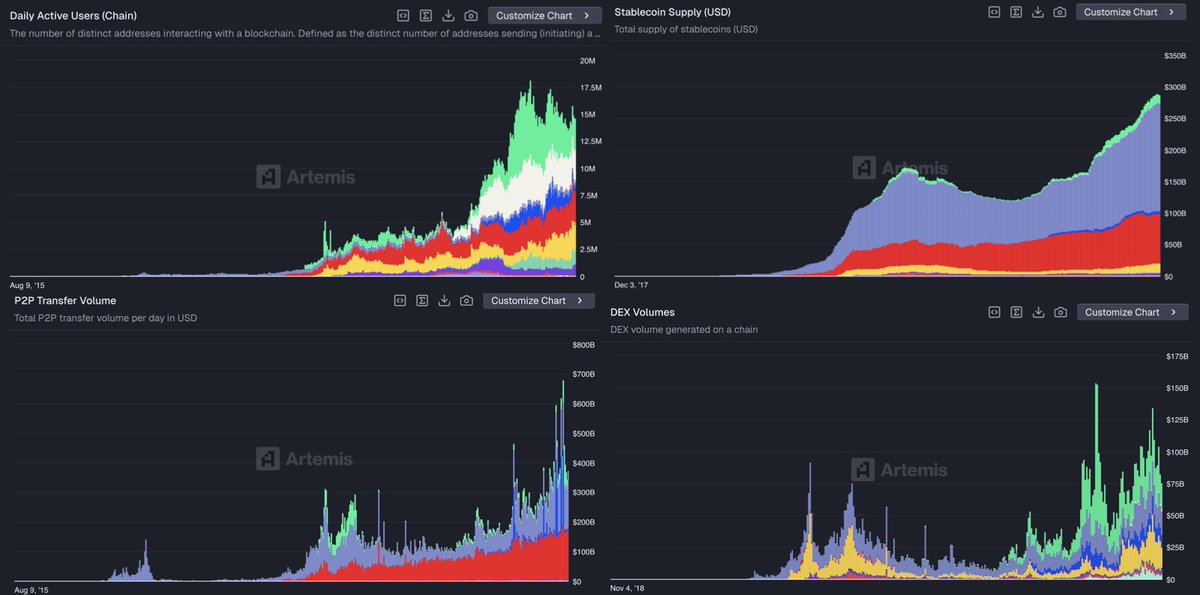
When I started in crypto, nobody used this stuff. It was tiny and broken and awful. TVL on-chain was in the millions. We invested into the first generation of DeFi, MakerDAO, Compound, 1inch, back when they were science projects. I remember playing around on EtherDelta back when DEXes traded single digit millions a day, and that was considered to be a huge success. It was complete dogshit. Now we routinely trade in the tens of billions on-chain every day. I remember believing it was crazy that Tether hit a billion dollars in issuance and was being written up in the NYT as a ponzi scheme on the brink of shutdown. Now stablecoins are over $300B and regulated by the Federal Reserve.
I believe in the exponential because I’ve lived it. I’ve seen it over and over again.
But you might respond—well, stablecoin growth might be exponential, maybe DeFi volumes are exponential, but they don’t accrue to ETH or SOL. The value doesn’t get captured by the chains.
To which I answer: you still don’t believe in the exponential.
Because the exponential’s answer is always the same: it doesn’t matter. This stuff is going to be so much bigger than it is today. And when it’s absolutely enormous, you’ll make it up on scale.
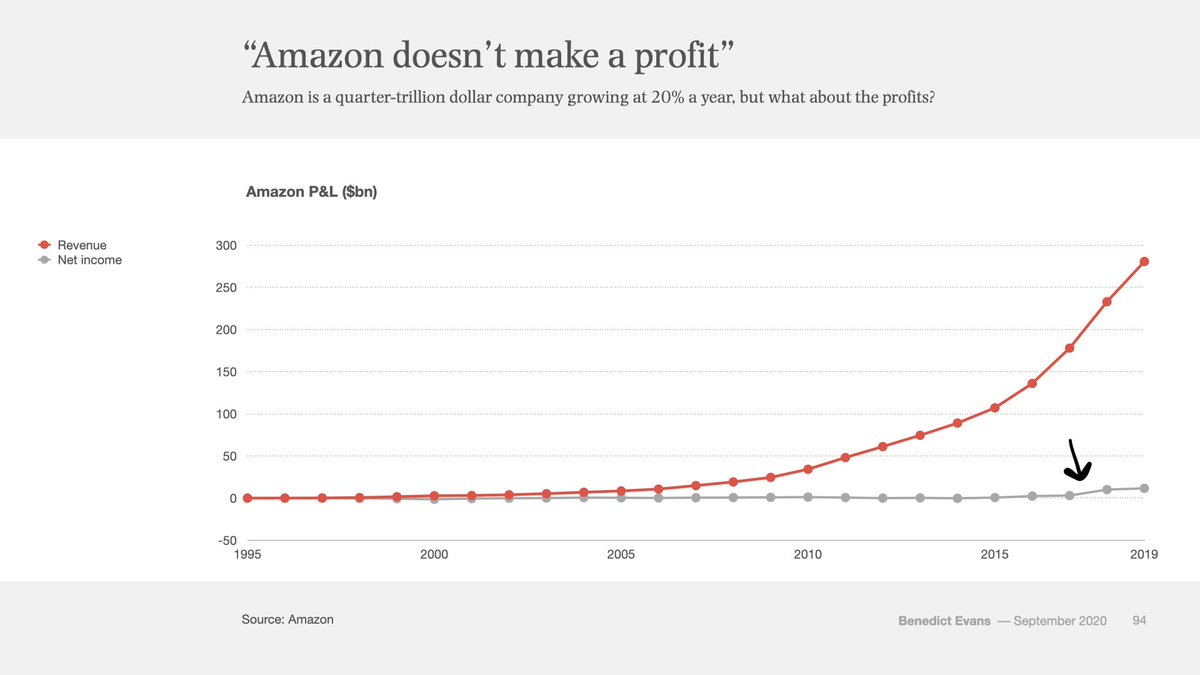
Study this chart.
This is Amazon’s P&L from 1995 to 2019. That’s 24 years. Red is revenue, gray is profit. You see that little blip on the end where the gray line goes up? That’s when, 22 years in, Amazon started actually making a profit.
Amazon was 22 years old when this little gray line of net income first peeled off of 0. Every single year before then, there were op eds and critics and short sellers claiming that Amazon was a ponzi scheme that would never make any money.
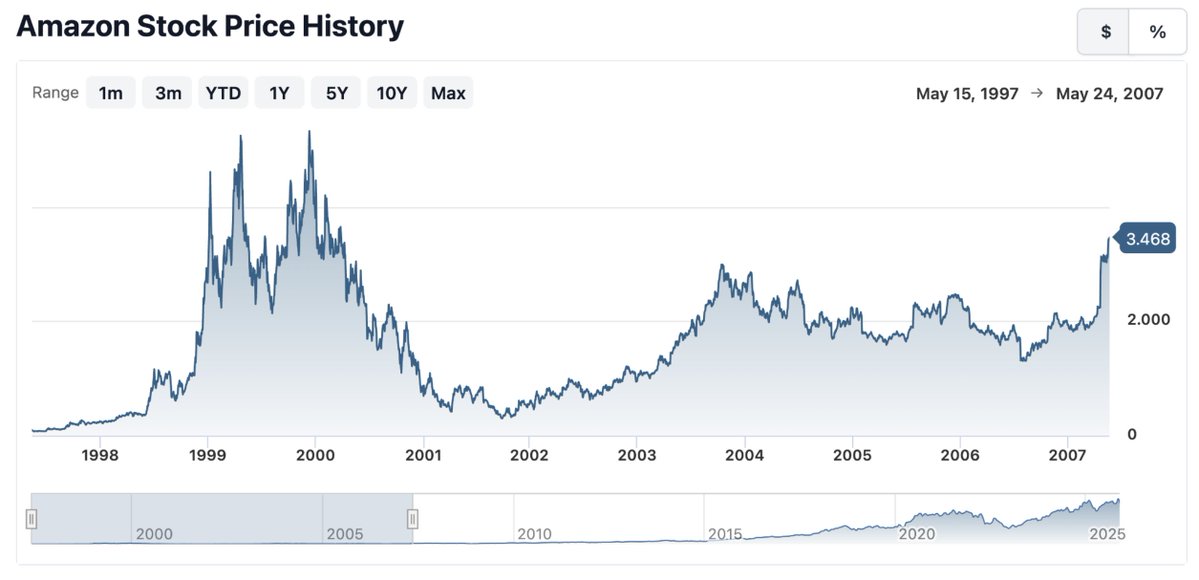
Ethereum just turned 10 years old. This is what the first 10 years of Amazon stock looked like:
10 years of chop. All along the way, Amazon was beset with doubters and non-believers. Is e-commerce a VC-subsidized charity? They’re selling underpriced cheap low-quality knick-knacks to bargain hunters, who cares? How are they ever going to make actual money, like Walmart or GE?
If you were arguing about Amazon’s P/E ratio, you were in the wrong regime. That’s the regime of linear growth. But e-commerce was not a linear trend, and so every single person for 22 years arguing about P/E ratios was devastatingly wrong. No matter what you paid, no matter when you bought, you were not bullish enough.
Because that’s what exponentials do. When it comes to truly exponential technologies, no matter how big you think it’s going to get, it just keeps getting even bigger.
This is the thing that Silicon Valley has always understood better than Wall Street. Silicon Valley was raised on exponentials, while Wall Street was raised on linearity. And over the last few years, crypto’s center of gravity has migrated from Silicon Valley to Wall Street. You can feel it.
Granted, crypto growth doesn’t look as smooth as e-commerce’s growth. It’s burstier, it goes in fits and starts. This is because crypto, being about money, is deeply tied to macro forces, and it also has more violent regulatory push and pull than e-commerce. Crypto strikes at the heart of the state—money—and so it’s more unnerving to governments than e-commerce ever was.
But the exponential is no less inevitable. It's a crude argument. But if crypto is exponential, then the crude argument is correct.
Zoom out.
Financial assets want to be free. They want to be open. They want to be interconnected. Crypto turns financial assets into file formats, makes it as easy to send a dollar or a stock as to send a PDF. Crypto makes it possible for everything to talk to everything. It makes it all 24/7, global, interconnected, and open.
That will win. Open always wins.
If there’s no other lesson I've learned from the Internet, it’s that. Incumbents will fight against it, governments will huff and puff, but eventually they will give up against the adoption, the generativeness, the sheer efficiency that this technology enables. It’s what the Internet did to every other industry. Blockchains are how that same trend will gobble up all of finance and money.
Yes—with enough time—all of it.
An old saying goes: people overestimate what can happen in two years, but they underestimate what can happen in ten.
If you believe in the exponential, if you zoom out enough, then it’s all still cheap. And it should humble you that every day, the holders outlast the sellers and naysayers. Big capital has a longer time horizon than CT swing traders might lead you to believe. Big capital has been trained through history not to fade big technologies. You know, the big gushy story that originally got you to buy $ETH or $SOL? Big capital believes that story and hasn't stopped.
So what exactly am I arguing?
I am arguing that applying P/E ratios to smart contract chains (the “revenue meta,” as it’s now called), is giving up on the exponential. It means you have consigned this industry to the regime of linear growth. It means you believe 30 million DAUs on-chain and <1% of M2 is it. Crypto is just one of the things in the world. A sideshow. It did not win. It was not inevitable.
More than anything, I’m arguing to be a believer. Not just a believer, but a long-term believer.
I’m arguing that this exponential will be bigger than anything else you’ve been a part of in your life. That this is your e-commerce. That you will look back when you’re old and tell your kids—I was there when it all happened. Not everyone believed it was possible, that whole societies could change, that all of money and finance would be transformed by programs running on decentralized computers that we collectively owned.
But it actually happened. It changed the world.
And you were a part of it.
Disclosure: These are my own views. Dragonfly is an investor in $MON, $MEGA, $ETH, $SOL, $HYPE, $SKY among many other tokens. Dragonfly believes in the exponential. This is not investment advice, but is advice of another kind.
English