PageWizard Games, Learning & Entertainment

5.7K posts

PageWizard Games, Learning & Entertainment banner
PageWizard Games, Learning & Entertainment

PageWizard Games, Learning & Entertainment

@PageWizardGLE

Affordable Computer Science Education, Games & More! Academic freedom and excellence. Dr. Daniel R. Page, Theoretical Computer Scientist, Science Educator

Sunnyside, Manitoba, Canada 加入时间 Ekim 2020
309 关注357 粉丝
Robin Hanson
Robin Hanson@robinhanson·
"Dijkstra said … Programming is not a craft. It is closer to mathematics than to carpentry, and the moment you treat it as a craft, you guarantee that the software you produce will be full of the kind of bugs that craftsmanship cannot catch. The fix, in his view, was to teach programming the way mathematics is taught. You should be able to prove your program correct before you run it." Don't we have a half century of experience showing he was just wrong?
Millie Marconi@MillieMarconnni

A Dutch computer scientist gave one lecture in 1988 arguing that programming is unlike anything humans have ever tried to do before, and the reason most software on earth is broken is that we are still teaching it as if it were a hobby. His name was Edsger Dijkstra. He won the Turing Award in 1972. He invented the shortest path algorithm that every GPS on earth still runs on. He wrote the paper that killed the goto statement in modern programming languages. He spent 50 years quietly being one of the most consequential thinkers in the entire history of computer science, and he was in a very bad mood by the time he stood up at the ACM Computer Science Conference in 1988 to deliver the lecture that almost nobody at the conference wanted to hear. The lecture was called On the Cruelty of Really Teaching Computer Science. It is now one of the most cited papers in the entire history of computing education. It was filed in his archive as EWD1036, handwritten in his careful fountain-pen calligraphy because he refused to use a typewriter and famously refused to use email for the rest of his life. The argument was simple and uncomfortable. Programming, Dijkstra said, is a radical novelty. Not a new tool. Not a new skill. Not a faster version of something humans already knew how to do. A genuinely new category of intellectual activity that has no real precedent in the entire history of the human species, and our brains have not been built to handle it. Here is what he meant by that. When a programmer writes a line of high-level code and presses run, that single line might trigger a billion operations at the level of the silicon. The ratio between the abstraction you are working in and the physical events you are actually causing is roughly one billion to one. No engineer in history before computing ever had to reason about a system spanning that kind of ratio inside their own head. A bridge builder reasons about steel beams and the physics of weight. A surgeon reasons about organs and the physics of tissue. A chemist reasons about molecules and the physics of bonds. All of them are working inside ratios of physical scale where the largest and smallest things they need to think about are within a few orders of magnitude of each other. A programmer routinely writes one line that orchestrates a billion physical events on a chip, and is expected to predict the behavior of all of them in advance. Dijkstra argued that the human brain was simply not built for this. Every intuition we have evolved over hundreds of thousands of years comes from a world of medium-sized objects behaving in continuous ways. Computing is the opposite. It is discrete, not continuous. A program that runs perfectly a billion times can crash on the billion-and-first iteration because of a single bit. A single character missing from a line of code can take down a power grid. There is no margin. There is no graceful degradation. The system either works or does not, and the only way to know is to actually run it. This was the part of the lecture where Dijkstra made everyone in the room uncomfortable. He said the way computer science was being taught in universities was a quiet disaster. Professors were teaching programming the way carpenters teach woodworking. With examples. With metaphors. With analogies to things students already understood. Files are like folders. Memory is like a desk. A function is like a recipe. Dijkstra said this was actively making it harder for students to think clearly. The whole point of a radical novelty is that there is nothing in your past experience to compare it to. The moment you start reaching for metaphors, you are smuggling in old intuitions that do not apply, and those intuitions will betray you the first time you try to reason about a system the metaphor was not built to describe. His exact line was this: the usual way in which we plan today for tomorrow is in yesterday's vocabulary. And yesterday's vocabulary, he argued, was killing the field. The reason most software is broken is downstream of this single misunderstanding. Programmers are taught to think of code as a craft. Something you get a feel for. Something you pick up through practice. Something where intuition gets sharper with experience. Dijkstra said this is exactly backwards. Programming is not a craft. It is closer to mathematics than to carpentry, and the moment you treat it as a craft, you guarantee that the software you produce will be full of the kind of bugs that craftsmanship cannot catch. The fix, in his view, was to teach programming the way mathematics is taught. You should be able to prove your program correct before you run it. You should reason about your code formally, the way a mathematician reasons about a theorem, not the way a carpenter feels their way through a joint. The students who learned this way, he said, would walk out of their classes with a kind of confidence that no amount of typing practice could produce. The lecture was published in Communications of the ACM in 1989. The field did not listen. Universities kept teaching programming the same way. Software kept getting bigger. Bugs kept compounding. By 2026, almost every piece of software on earth has known security vulnerabilities, undefined behaviors, and edge cases that nobody has ever proven safe. The doom that Dijkstra warned about in 1988 is now the default condition of the digital world we have built. The deeper lesson is the one most readers miss the first time through. Dijkstra was not just talking about software. He was making a much bigger point about how humans learn anything that is genuinely new. The instinct to translate the unfamiliar into the familiar is the most natural thing in the world. It is also the single biggest obstacle to actually understanding something that has no precedent. If you keep reaching for analogies, you will never see the new thing clearly. You will only see your old framework projected onto it. This is happening right now with AI. The same instinct that made people learn programming through metaphors of files and folders is making people understand large language models through metaphors of brains and people. Almost every framework being used to describe AI in 2026 is borrowed from a previous domain. None of them quite fit. The few people who are actually building useful intuitions about how these systems work are the ones who have done what Dijkstra recommended forty years ago. They have set down the old vocabulary. They have looked at the new thing on its own terms. They have accepted that the radical novelty is radical for a reason. You are not slow. You were taught a discipline as if it were a hobby. The cruelty is real. The fix is still available.

English
92
71
1.5K
169.3K
PageWizard Games, Learning & Entertainment 已转推
William McNally
William McNally@WilliamMcNall18·
@QueensU CS job ad demands a "demonstrated commitment to I-EDIAA" for a Computational Intelligence position. As @ConceptualJames puts it: "Diversity means hiring people who believe in critical social justice ideology who might or might not happen to look different." The woke grip on Canadian universities tightens. @chrisbrunet @PageWizardGLE @jonkay employment.cs.queensu.ca/2026/05/19/fac…
English
0
1
4
102
PageWizard Games, Learning & Entertainment 已转推
Aaron Pete
Aaron Pete@Aaronpete_·
I'm prepared to go to jail over this. My grandmother Rita Pete went to St. Mary's Indian Residential School. She experienced terrible abuse. As a consequence, she struggled with alcohol use most of her life. My mother was born with FASD as a consequence of her using alcohol to cope with her trauma. I am Chief of my community Chawathil First Nation. I am working to address the longstanding impacts of these past policies through renovating homes, building new homes, creating childcare, and growing businesses through economic development. I have interviewed people who went to Indian Residential Schools. I have interviewed people who believe Indian Residential Schools were awful, horrible schools, meant to remove the Indian from the child. I've also interviewed people who believe they were well intended, generous investments by Canadian taxpayers meant to assimilate a society and had shortcomings. Like with many things, the history is dark, complicated, and with any policy that existed for a long time, across a whole country - there were different experiences. No one story tells us everything. No report shares the full experience of the individuals who went. No commentator today can disprove someone's lived experience with statistics. The path forward is not to criminalize speech, questions, or debate. The path forward is empathy for past attendees. The path forward is truth based on facts. The path forward is real conversations. The path forward is to lean into complexity. If the government criminalizes this, then I will be a criminal for having these conversations. If I am a criminal by the laws definition, then I am committed to going to jail over this.
Holly Doan@hollyanndoan

.@SenateCA human rights committee votes 7 to 1 to criminalize Indian Residential School “denialism.” Public statements intended to promote hatred by downplaying impacts of Residential Schools would be outlawed under threat of 2 years in jail. blacklocks.ca/vote-to-outlaw… #cdnpoli @TerryGlavin @jonkay

English
722
1.8K
7.2K
429.8K
Polymarket
Polymarket@Polymarket·
JUST IN: Google DeepMind says its AI solved 9 open Erdős problems — considered among the hardest unsolved questions in mathematics.
English
262
444
6.1K
644.7K
PageWizard Games, Learning & Entertainment 已转推
Carson Jerema
Carson Jerema@CarsonJerema·
As radical as Canadian judges have become, they've got nothing on human rights commissioners, who are operating on an entirely different plane of existence where reality is optional ... nationalpost.com/opinion/jamie-… via @nationalpost
English
1
14
50
2.1K
PageWizard Games, Learning & Entertainment
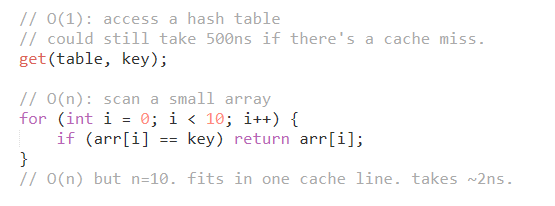
@sudox7 The first example is not necessarily O(1) [it depends on how your hash table is implemented and the size of "table"], the second example is O(1). If it's standard separate chaining being employed, it's not O(1) time complexity. Not a good example.
English
0
0
1
433
SudoX7
SudoX7@sudox7·
O(1) means the time doesn't grow with input size. it doesn't mean the time is small. this is the most misunderstood thing in algorithms.
SudoX7 tweet media
English
49
51
1.6K
91.2K
PageWizard Games, Learning & Entertainment
1/2 In today's lecture, we ease into the concept of computational equivalence in models of computation, by exploring different variants or extensions of Turing Machines. This will begin several lectures where these mathematically powerful ideas will be discussed.
PageWizard Games, Learning & Entertainment tweet media
English
1
0
0
23
PageWizard Games, Learning & Entertainment 已转推
Frances Widdowson
Frances Widdowson@FrancesWiddows1·
COUNTDOWN (19 days until #Kamloops215Deception): How @UofRegina President Jeff keshen failed in upholding academic freedom at his institution.
PageWizard Games, Learning & Entertainment@PageWizardGLE

1/4 Frances Widdowson travelled to @UofRegina campus to do Spectrum Street Epistemology, after her events were cancelled. She had a message for President Jeff Keshen. @SocietyforAcad1 @JimMcMurtry01 @ChanLPfa @WatSAFS @GadSaad @WokeAcademy @CanadaPoli2 @peterboghossian @jonkay

English
1
14
79
1.3K
PageWizard Games, Learning & Entertainment
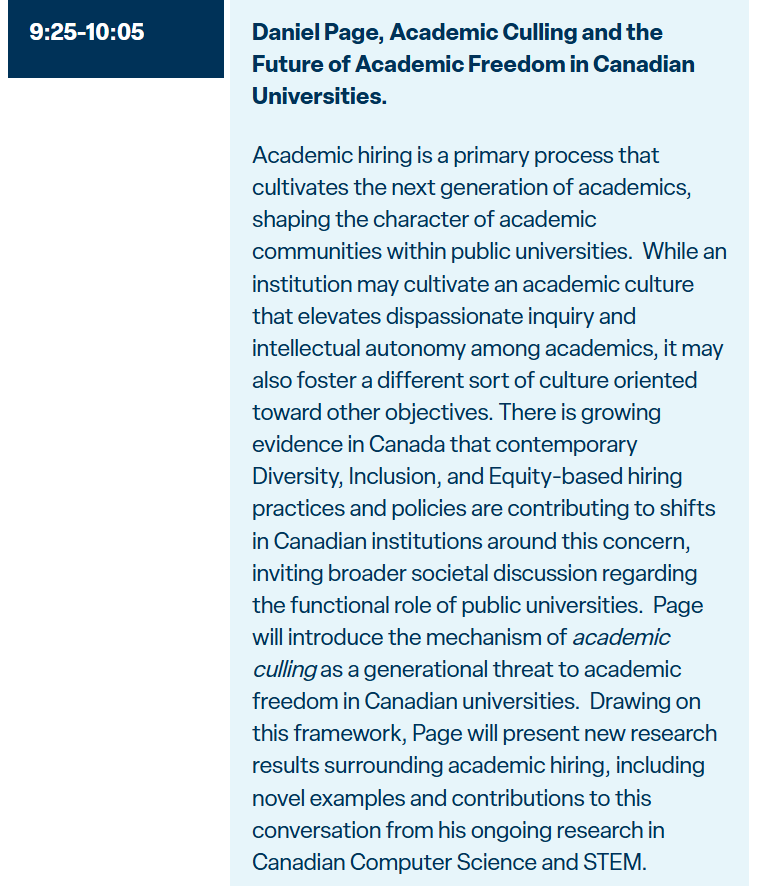
1/2 I will be giving an invited talk at the 2026 Academic General Meeting of @SocietyforAcad1 May 29 - May 30, 2026 in London, Ontario. While there is a number of interesting talks, the keynote talk will be given by Dr. Andrew Irvine.
PageWizard Games, Learning & Entertainment tweet media
English
1
1
1
98
PageWizard Games, Learning & Entertainment 已转推
Geoff Horsman
Geoff Horsman@HorsmanGeoff·
From Fraser Institute report "Canadian Students Are Getting a One-Sided University Education." Presenting the "other side" of topics like DEI is risky. Administrators say it's "beyond debate." True story.
Geoff Horsman tweet media
English
6
11
60
1.8K
PageWizard Games, Learning & Entertainment
It's almost like if places called universities don't actually foster deeply the academic culture of an academic university, these problems are bound to continue to happen. You got declining standards, and too many academics and admins who take the path of least resistance.
Luiza Jarovsky, PhD@LuizaJarovsky

🚨 University professors have been saying AI is completely destroying learning and that we'll soon have an AI-powered, semi-illiterate workforce. Here's a glimpse into the educational apocalypse: "Sarah, a freshman at Wilfrid Laurier University in Ontario, said she first used ChatGPT to cheat during the spring semester of her final year of high school. (...) After getting acquainted with the chatbot, Sarah used it for all her classes: Indigenous studies, law, English, and a “hippie farming class” called Green Industries. “My grades were amazing,” she said. “It changed my life.” Sarah continued to use AI when she started college this past fall. Why wouldn’t she? Rarely did she sit in class and not see other students’ laptops open to ChatGPT. Toward the end of the semester, she began to think she might be dependent on the website. She already considered herself addicted to TikTok, Instagram, Snapchat, and Reddit, where she writes under the username maybeimnotsmart. “I spend so much time on TikTok,” she said. “Hours and hours, until my eyes start hurting, which makes it hard to plan and do my schoolwork. With ChatGPT, I can write an essay in two hours that normally takes 12.” - "By November, Williams estimated that at least half of his students were using AI to write their papers. Attempts at accountability were pointless. Williams had no faith in AI detectors, and the professor teaching the class instructed him not to fail individual papers, even the clearly AI-smoothed ones. “Every time I brought it up with the professor, I got the sense he was underestimating the power of ChatGPT, and the departmental stance was, ‘Well, it’s a slippery slope, and we can’t really prove they’re using AI,’” Williams said. “I was told to grade based on what the essay would’ve gotten if it were a ‘true attempt at a paper.’ So I was grading people on their ability to use ChatGPT.” - AI in education is a serious topic, and many schools and universities are blindly jumping into the "AI-first" wave without considering short and long-term consequences. It would be great to hear more from teachers and educators to understand potential solutions. This might be a great opportunity for rethinking the education system and how students are assessed. - 👉 Link to the full article below. 👉 To learn more about AI's legal and ethical challenges, join my newsletter's 94,700+ subscribers (link below).

English
0
0
1
65
PageWizard Games, Learning & Entertainment 已转推
Wokal Distance
Wokal Distance@wokal_distance·
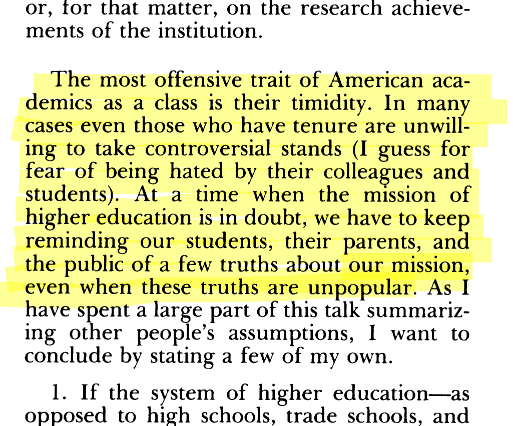
In 1993 the John Searle warned people that this was happening. He told everyone that academics were to timid and cowardly to defend the universities from being hijacked by leftists with a political agenda, and now 30 years later we are living with the consequences.
Wokal Distance tweet media
Peter Boghossian@peterboghossian

Academia *knew* entire fields could not be replicated. They watched junk science proliferate and said nothing. This was not oversight. It was cowardly complicity.

English
20
329
1.5K
33.1K