

Khaled Bin Himel
827 posts


let me paint you a picture of the trader who ignores AI tools in 2026
they wake up, check their watchlist manually, read the same news everyone else is reading, form an opinion based on gut and maybe some TA, and then place a trade
on the other side of that trade is someone running quantitative models, real time news sentiment analysis, on-chain flow data, and options positioning all at the same time
that's not a fair fight
it has never been a fair fight. hedge funds have had machine assisted edge for two decades. what's changed is that edge is now available outside of a $10M minimum investment
the traders who ignored the shift from floor trading to algorithmic execution got left behind. the traders who ignored screeners and scanners when those came out got left behind. every time the tools improved and someone decided they didn't need them, the market quietly redistributed their money to someone who did
AI tools are not the future of trading. they are the present. the question is not whether to use them. the question is which ones are actually built well enough to matter
most of them are not. a chatbot summarizing headlines is not an edge. a dashboard with a sentiment score is not an edge
five agents running in parallel, learning your specific behavior, cross referencing quant data with news with on-chain flow with options positioning in real time, that's closer to an edge
RAFA is not a guarantee. nothing is. but ignoring what it's doing while your competition isn't is a choice with consequences
think about that next time you're forming an opinion on a trade manually
@RAFA_AI

0x_Mîtå@0xMita_
ten days in and the more i learn the more i realize we are still early most people found RAFA through the retail app. the signals, the agents, the Ferrari trade. that's the entry point. but where this is going is a much bigger story than a co-pilot for retail traders the protocol is still in its early stages on Base and Solana. the RWA market it is tapping into is projected to be worth trillions. right now it handles swaps into tokenized stocks and treasuries. the logical next step is deeper liquidity, more asset classes, more chains, and institutional grade execution sitting underneath retail level access RAFA PRO is barely off the ground. the FinLink partnership is live but wealth management as a category is enormous. there are hundreds of thousands of RIAs globally managing collective trillions. if RAFA captures even a fraction of that workflow the PRO layer alone becomes a serious business the AI agent system is the part i am most interested in long term. five agents today. the architecture is built to scale. as the models improve and the training data compounds from millions of user interactions the gap between what RAFA's agents can do and what a generic AI tool can do gets wider not narrower and none of this accounts for what happens when the regulatory environment fully clears and tokenized real world assets go mainstream the roadmap is not written yet. but the foundation is already under everything ten days. still not done talking about this @RAFA_AI
English

Everyone talks about scaling execution.
Very few talk about scaling communication.
One thing I have realized about blockchain scaling is this.
Execution is only one part of the equation.
Communication matters just as much.
Every transaction, block, and state update depends on information reaching the right nodes at the right time.
That is where @get_optimum comes in.
Its decentralized networking infrastructure improves how data is distributed across blockchain networks.
• faster propagation
• lower latency
• more efficient bandwidth use
• stronger network performance
The future of scaling is not just about faster execution.
It is about building communication layers that allow the entire ecosystem to coordinate more efficiently.
Gmum
@shariaronchain

English

𝗕𝗿𝗲𝗮𝗶𝗸𝗶𝗻𝗴 𝘁𝗵𝗲 𝗕𝗼𝘁𝘁𝗹𝗲𝗻𝗲𝗰𝗸 : 𝗪𝗵𝘆 𝗕𝗹𝗼𝗰𝗸𝗰𝗵𝗮𝗶𝗻 𝘀𝗽𝗲𝗲𝗱 𝗶𝘀 𝘁𝗵𝗲 𝗨𝗹𝘁𝗶𝗺𝗮𝘁𝗲 𝗦𝗲𝗰𝘂𝗿𝗶𝘁𝘆 𝗙𝗲𝗮𝘁𝘂𝗿𝗲
We’ve all been there waiting for a Web3 transaction to clear while staring at a spinning wheel. In the decentralized world, we demand two things above all else instant execution and ironclad security. Yet, as networks expand, they traditional hit a wall. That wall is block propagation latency.
When nodes struggle to stay in sync, the entire ecosystem stalls, opening the door to security risks.
Enter Optimum Network (@get_optimum). They aren't just tweaking the existing system; they are fundamentally redesigning Web3 communication from the ground up using Random Linear Network Coding (RLNC).
The Tech Shift: Enter Random Linear Network Coding (RLNC)
Standard blockchains rely on rigid, step-by-step data transfers that easily clog during high traffic. RLNC changes the game by mathematically optimizing how data packets are coded and distributed. Instead of waiting for a sequential line of data, nodes can reconstruct information dynamically.
This architectural evolution delivers four massive upgrades to decentralized infrastructure:
Zero-Grip Throughput: By dismantling traditional packet bottlenecks, data moves across the network at maximum velocity with virtually zero lag.
Flawless Node Harmony: Real-time synchronization ensures every single node across the globe stays updated on the state of the ledger simultaneously
Hardened Network Defense: A faster network leaves no idle windows or structural gaps for malicious actors to exploit. Security is baked into the speed.
Chaos-Proof Scalability: Whether experiencing a massive traffic spike or an unexpected network surge, the infrastructure remains stable without sacrificing performance.
The New Paradigm: Velocity is the Best Weapon
In Web3, coordination speed isn't just about convenience it is the ultimate defense mechanism. The quicker nodes can talk to one alone, the harder the network is to compromise.
Optimum Network isn't just launching another layer they are laying down a bulletproof, ultra fast foundation designed to power the next generation of DeFi and scalable Web3 infrastructure.
@shariaronchain

English

Running AI onchain has traditionally been limited by scalability.
Large models require substantial computation, making traditional replicated execution impractical.
Ritual's Symphony consensus tackles this problem differently.
Large workloads are divided into smaller proof fragments.
Verification responsibilities are distributed across validator subsets.
Instead of every validator verifying every computation, verification load is shared throughout the network.
This approach improves efficiency while preserving decentralization.
What's particularly interesting is that it enables blockchain systems to support workloads that would normally be too resource intensive for conventional architectures.
As AI models continue growing in complexity, efficient proof generation and distributed verification could become critical infrastructure.
The next generation of blockchain applications may depend less on transaction throughput and more on computational throughput.
That's where Symphony becomes important.
@ritualnet || @ritualfnd || @Jez_Cryptoz

English

Speed is money, but in blockchain it's infrastructure.
Every millisecond saved in data delivery improves network coordination.
That's why Optimum accelerates information flow, helping decentralized systems become more responsive, efficient, and scalable.
🧵 Thread below

English

The biggest challenge in robotics isn't building robots.
It's making them economically useful.
Now i found @PrismaXai's approach to robots and AI models interesting.
Instead of treating robots as expensive hardware that only consume resources, prismaX views them as productive network participants that generate value through real world work and data creation.
As robots operate within the network, they produce the high quality data needed to improve physical AI models.
Those better models then make robots more capable, creating a powerful flywheel.
So this means:
More robots → more data → smarter AI → more useful robots.
What I like most is that prismaX is trying to align the incentives of robot owners, operators and AI developers into a single ecosystem.
So in total it's about continuously improving the intelligence behind it.
CC: @MaxC16134 @vivianrobotics

English

The memecoin meta moves at lightning speed, but complex onboarding kills the hype. Not anymore.
We are thrilled to officially partner with @MemeLabzdotfun to eliminate all user friction. Powered by @QwertiAI DeFAI infrastructure, users can now bypass the fragmented UX and gain instant access to the $LABZ ecosystem—whether swapping with crypto or buying directly via card.
No multi-app confusion, no network juggling. Just pure, instant on-chain action right where the community is.
The lab is fully open, and it's time to cook.
@Web4Sunny
@__Soniiiaa

English

This is a beautiful and colorful picture centered around a hot air balloon. It features a lovely colorful balloon with a small human like figure underneath it. There are also some beautiful plants and a bright sun on the sides which make the entire picture vibrant and cheerful. At the bottom the word OPtimum is written in bold, hand-drawn letters adding a sense of positivity and excellence to the artwork.
@get_optimum
@shariaronchain
@CryptoSundayz
@cryptooflashh


English

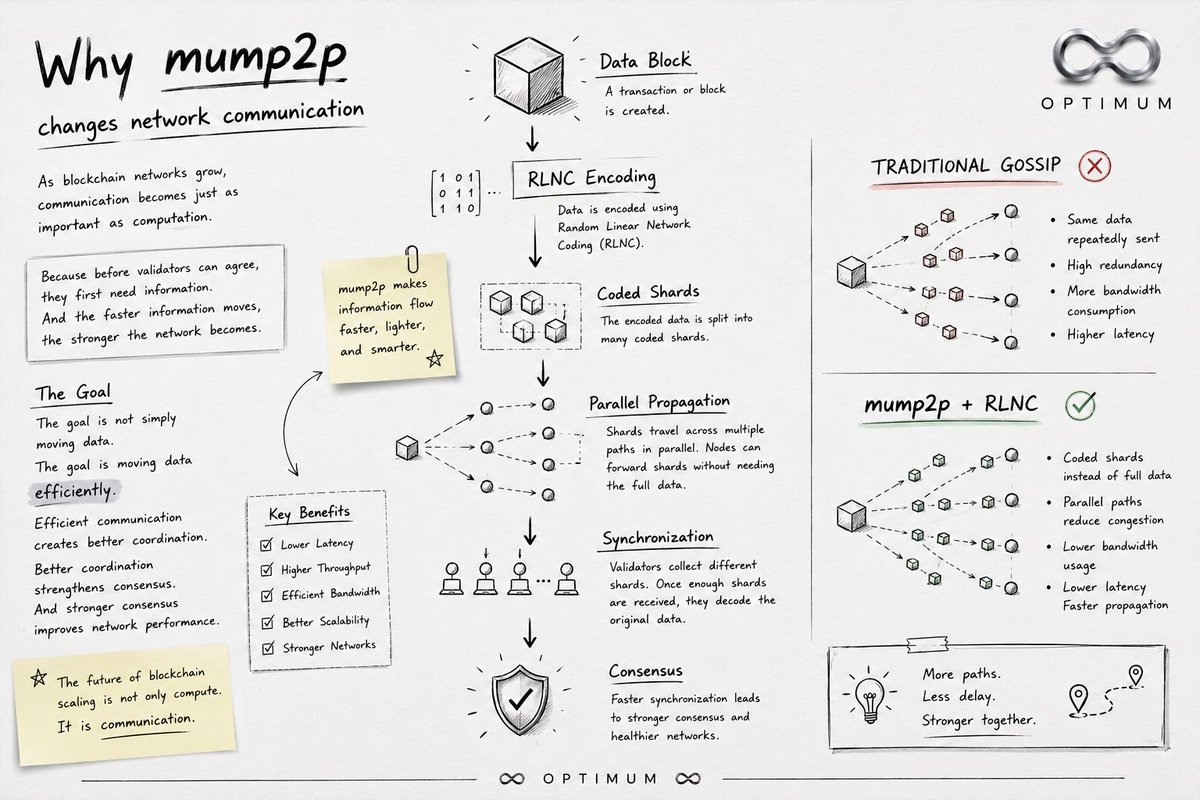
Why mump2p changes how networks communicate
Blockchains do not struggle because of computation alone.
They struggle because information takes time to move.
Before consensus happens,
data must reach validators.
And when data moves slowly,
the entire network slows down.
This is where mump2p comes in.
Traditional gossip protocols repeatedly send the same data across the network.
mump2p takes a different approach.
Instead of forwarding identical messages,
it encodes data into smaller coded pieces using Random Linear Network Coding (RLNC)
Validators can begin forwarding data even before reconstructing the full message.
The result:
faster propagation
↓
lower latency
↓
better synchronization
↓
stronger consensus
↓
healthier networks
By reducing redundant transmissions,
mump2p uses bandwidth more efficiently while keeping performance high as networks scale.
Because blockchain performance is not only about execution.
It is also about how quickly information reaches participants.
Faster information creates earlier awareness
Earlier awareness creates better coordination
And better coordination strengthens the network
The future of scaling is not only compute
It is communication
@get_optimum
English
Why does blockchain scalability depend on data movement?
@get_optimum focuses on a challenge that is often overlooked when discussing blockchain scalability: the movement of data across the network.
While scalability is frequently associated with transaction throughput and execution speed, blockchain performance also depends on how quickly information can reach participating nodes.
1. Every Node Needs Access to the Same Information:
Blockchain networks operate through distributed coordination.
Block Distribution: When a validator produces a block, that information must be propagated throughout the network before other participants can verify it.
Transaction Sharing: Transactions are continuously exchanged between nodes to maintain a consistent view of the network state.
Network Synchronization: Consensus becomes more efficient when nodes receive data within a similar timeframe.
As networks grow, distributing information quickly becomes increasingly challenging.
2. Data Movement Becomes More Difficult at Scale :
Higher adoption introduces greater communication demands.
Growing Network Size: More nodes mean more destinations that must receive blocks and transactions.
Increased Traffic Volume: Larger ecosystems generate more data that must be propagated across the network.
Propagation Delays: Information can take longer to reach distant nodes, creating temporary differences in network visibility.
Even if a blockchain can process transactions efficiently, delays in data delivery can limit overall performance.
3. Scalability Requires Efficient Communication Infrastructure :
Improving execution alone does not solve every bottleneck.
Faster Distribution: Networks benefit when blocks and transactions reach participants more efficiently.
Reduced Communication Overhead: Optimized transmission methods can improve propagation without requiring additional resources.
Better Network Coordination: Faster data movement helps nodes stay synchronized as activity increases.
This is where infrastructure focused on data transport becomes increasingly important.
Blockchain scalability is not only about processing more transactions.
@get_optimum it is also about ensuring that the information required to process those transactions can move efficiently across the entire network.

English
In blockchain, being faster by a few milliseconds can be worth millions.
That's why speed isn't a luxury, it's an advantage.
This is one thing @get_optimum never compromises with speed.
From faster data propagation to lower latency networking, the mission has always been clear.
Move data as fast and efficiently as possible.
Because speed doesn't just improve performance.
It can improve validator rewards, MEV opportunities, network efficiencand the overall user experience.
That's what I like about Optimum's approach.
They understand that data movement is the foundation.
And when the foundation gets faster, everything built on top benefits too.
Data movement sets the ceiling. Optimum raises it.
cc : @blockchainjeff | @shariaronchain

Optimum@get_optimum
English

Content No. 71 with @get_optimum
The long term bet on @get_optimum comes down to one thing Web3 cannot scale without first solving how data moves across decentralized networks
Everything else built on top of that foundation is only as good as the layer underneath it
Optimum's vision is to become the memory layer for Web3
-Not a chain
-Not an application
-Not a token narrative
Infrastructure that makes blockchain data faster more accessible and more synchronized at scale as demand actually grows rather than just in controlled conditions
The timing matters here Decentralized applications are expanding and the data propagation requirements expanding with them are outpacing what current networking infrastructure was designed to handle That gap is exactly where Optimum is building
Faster more responsive blockchain ecosystems do not happen by optimizing the application layer first
They happen when the foundational data layer stops being the bottleneck That is the problem Optimum is solving and the window to build it correctly is right now
English

People Underestimate How Noisy Crypto Data Actually Is
you're not tracking one market.l
you're tracking three layers simultaneously:
→ Price action
visible to everyone, understood by few
→ Market signals
fast moving, easy to misread
→ Portfolio risk
ignored until it's too late
combining them manually isn't a strategy. It's exhaustion
and even if you track all three perfectly
your brain still fails you
crypto demands hundreds of micro-decisions daily
that's decision fatigue at scale
most people don't lose because of bad data
they lose because of mental overload
this is where most AI crypto tools get it wrong
more dashboards
more indicators
more alerts
they mistake complexity for intelligence
what actually matters is the opposite
take overwhelming data → make the answer obvious
that's what RAFA AI is building
√ multi-timeframe scores
√ hedge alerts
√ zero noise
the real test for any AI investing tool:
does it reduce your cognitive load or increase it?
in a market this noisy, that's harder than it sounds
worth watching :)
@Metamorfozzz_ @Zlatanair @srsh_os @RAFA_AI
English

Most conversation around blockchain performance focus on speed.
Higher TPS. Faster blocks. More bandwidth. But there is another question that matters just as much.
How efficiently does information spread across the network?
In traditional networks, data is usually forwarded as identical copy. If some packet are lost along the way, the network often need additional transmission to recover what was missing. As network grow larger, this can create unnecessary overhead and slow down propagation.
What make @get_optimum interesting is that it approaches the problem differently.
Using random linear network coding (RLNC), node don't simply forward data. They continuously create new encoded version of that information. Instead of relying on specific packet arriving successfully, the network only need enough unique information to reconstruct the original data.
This change the way propagation work
The question is no longer:
Did a particular packet arrive? Do we have enough information to rebuild the message?
Flexnodes help push this idea even further.
Rather than acting as passive relays, they actively encode, recode and distribute information throughout the network. This improve resilience, reduces the impact of packet loss and help data reach validator more efficiently.
From a system perspective, that is an important distinction. Moving packets faster improves transport. Moving information smarter improves the network itself.
As blockchain infrastructure continues to evolve, information flow may become just as important as computation and consensus.
CM @shariaronchain

English

𝐁𝐥𝐨𝐜𝐤𝐜𝐡𝐚𝐢𝐧 𝐌𝐞𝐭𝐫𝐢𝐜𝐬 𝐎𝐧𝐥𝐲 𝐓𝐞𝐥𝐥 𝐏𝐚𝐫𝐭 𝐎𝐟 𝐓𝐡𝐞 𝐒𝐭𝐨𝐫𝐲
For a long time, blockchain discussions have been dominated by visible metrics.
How many transactions can be processed.
How quickly blocks are finalized.
How low fees can become.
✦ throughput
✦ finality
✦ transaction costs
Those measurements matter, but they often describe the outcome rather than the cause.
𝐄𝐯𝐞𝐫𝐲 𝐍𝐞𝐭𝐰𝐨𝐫𝐤 𝐃𝐞𝐩𝐞𝐧𝐝𝐬 𝐎𝐧 𝐈𝐧𝐟𝐨𝐫𝐦𝐚𝐭𝐢𝐨𝐧
Behind every transaction, every block, and every state update is a much simpler requirement:
information has to reach the right participants.
A validator cannot agree with information it has not received.
A network cannot coordinate around data that has not propagated.
𝐂𝐨𝐦𝐦𝐮𝐧𝐢𝐜𝐚𝐭𝐢𝐨𝐧 𝐃𝐞𝐭𝐞𝐫𝐦𝐢𝐧𝐞𝐬 𝐂𝐨𝐨𝐫𝐝𝐢𝐧𝐚𝐭𝐢𝐨𝐧
A decentralized system cannot maintain a shared view of reality if communication becomes inefficient as it grows.
➜ participants need awareness
➜ information needs propagation
➜ coordination needs communication
That is what makes network design such an interesting area of study.
𝐓𝐡𝐞 𝐍𝐞𝐱𝐭 𝐁𝐫𝐞𝐚𝐤𝐭𝐡𝐫𝐨𝐮𝐠𝐡𝐬 𝐌𝐚𝐲 𝐁𝐞 𝐈𝐧𝐯𝐢𝐬𝐢𝐛𝐥𝐞
The challenge is not only moving more data.
The challenge is preserving coordination as participation expands across different regions, different operators, and different network conditions.
@get_optimum is focused on that layer.
Many of the next breakthroughs in Web3 may not come from changing what blockchains do.
They may come from improving how blockchains communicate.
@aqccapital |@CryptoSundayz |@shariaronchain |@cryptooflashh | @tgogayi

English

Today’s AI landscape is dominated by a few tech giants with massive capital and computing power. While this drives rapid innovation, it traps control, data, and access behind corporate walls.
Decentralized intelligence offers a democratic alternative—shifting AI development from closed boardrooms to open, collaborative ecosystems.
RAFA (@RAFA_AI): A Hybrid Approach
Projects like RAFA are exploring the intersection of AI and Web3. Instead of replacing centralized systems, RAFA aims to complement them by focusing on:
Transparency: Knowing exactly how models are trained.
Inclusivity: Allowing global users to co-create, not just consume.
Trust: Removing single points of corporate failure.
Speed vs. Trust
Centralized AI: Wins on raw speed and massive scale.
Decentralized AI: Wins on accountability and user ownership.
The future isn't an all-or-nothing choice. The ultimate AI model will likely be a hybrid—combining corporate efficiency with decentralized trust.
@Rafa

English
How does RAFA transform raw financial data into structured insights?
@RAFA_AI transforms vast amounts of fragmented financial information into clear, actionable intelligence through a multi-layered process designed to improve accuracy, consistency, and decision making.
1. Data Collection & Integration:
The process begins by gathering data from multiple financial sources.
Portfolio accounting systems provide holdings and transaction records.
Market data feeds deliver pricing, performance, and valuation updates.
Client and custodial data sources are integrated into a unified framework.
2. Data Standardization & Validation:
Raw financial data often arrives in different formats and structures.
Asset information is normalized into a consistent classification system.
Transactions and positions are reconciled to eliminate discrepancies.
Validation checks help ensure data accuracy before analysis begins.
3. Analytical Processing (The Intelligence Layer):
Once the data is clean and structured, RAFA applies its analytical models.
Portfolio exposures are evaluated across sectors, asset classes, and strategies.
Performance metrics are calculated using updated market information.
Trends, risks, and portfolio inefficiencies are identified through advanced analysis.
4. Insight Generation:
The processed information is converted into meaningful investment intelligence.
Opportunities and risks are highlighted based on portfolio objectives.
Allocation imbalances and concentration issues are identified.
Potential actions are prioritized according to their expected impact.
5. Decision Ready Output:
The final step focuses on delivering information in a practical format.
Complex data is transformed into clear visual dashboards.
Research findings are summarized into concise recommendations.
Portfolio managers receive actionable insights rather than raw numbers.
@RAFA_AI objective is not simply to collect financial data, but to transform disconnected information into a structured decision making framework that helps investors understand risks, identify opportunities, and act with greater confidence.
@Metamorfozzz_ @srsh_os

English

Who can use Optimum?
If you're running a validator or operating a node, Optimum is built for you.
For validators, every reward matters. Optimum helps ensure you can efficiently capture all available reward streams from consensus issuance and transaction fees to MEV opportunities.
For node operators, the benefits go beyond rewards. By reducing bandwidth requirements and improving node synchronization, Optimum helps lower operational costs while keeping infrastructure running smoothly.
The best part? Integration is seamless, allowing operators to improve network efficiency without disrupting their existing setup.
Whether you're securing a public blockchain network or managing node infrastructure at scale, Optimum helps you do more with less.

English

High-Frequency DeFi → Why Network Speed Matters
Most traders focus only on TPS fee & execution.
But in reality market advantage often depends on how fast data reaches the network.
→ The Hidden Problem
Traditional P2P gossip systems create delays between nodes. Even milliseconds matter because price information arrives late & opportunitie disappear instantly.
→ How Modern Infrastructure Changes Trading
Platforms like @get_optimum are designed to reduce propagation delays with sub-millisecond data movement.
This helps DEX participants receive market updates faster & react before the broader market catches up.
→ Why Synchronization Is Important
When liquidity & pricing data stay synchronized across the network:
• Arbitrage gaps shrink
• Trading accuracy improves
• Bots react more efficiently
Latency + Delay = Lost Opportunity
Speed + Accurate Data = Better Execution
→ Infrastructure For Automated Trading
So basically
Low latency & synchronized data are becoming the real edge in DeFi.
The future is not just faster blockchain it’s instant information flow powering smarter & faster execution.

SHUVO@shuvo6519848199
The Hidden Side of Blockchain Most people only focus on TPS fees & execution speed when discussing blockchain performance. But before a validator confirm anything, the data must first reach the network. If data moves slowly → the entire system feels slower. → Why Data Movement Matters Most blockchain networks still spread data by repeatedly broadcasting it between nodes. It works but as networks grow bigger, it can lead to: → Higher bandwidth usage→ Slower propagation→ Network congestion Real efficiency is not just about speed.It is about how smartly data travels. → What @get_optimum Is Solving Instead of changing consensus itself, Optimum focuses on improving how blockchain data moves across participants. Using advanced network coding research, the goal is to make data transmission more efficient & reliable across the network. → Simple Logic Massive Impact A validator cannot verify data it never received. Faster propagation → smoother block distributionSmoother distribution → stronger blockchain performance → Final Learning Some of the biggest blockchain innovations happen quietly in the background. The real game changer is often the infrastructure layer that helps the entire network run faster smoother & more efficiently. @cryptooflashh @aqccapital @ada_pegasus
English
𝐅𝐫𝐨𝐦 𝐋𝐚𝐭𝐞𝐧𝐜𝐲 𝐭𝐨 𝐋𝐢𝐠𝐡𝐭𝐧𝐢𝐧𝐠 𝐒𝐩𝐞𝐞𝐝. 𝐓𝐡𝐞 𝐍𝐞𝐱𝐭 𝐆𝐞𝐧 𝐨𝐟 𝐁𝐥𝐨𝐜𝐤𝐜𝐡𝐚𝐢𝐧 𝐈𝐧𝐟𝐫𝐚𝐬𝐭𝐫𝐮𝐜𝐭𝐮𝐫𝐞.
Whenever we interact with Web3 networks, our priorities are simple: speed and security. However, as decentralized networks scale, they inevitably hit a major bottleneck—block propagation delays, commonly known as network lag or latency. When nodes take too long to sync, transactions slow down, and critical security vulnerabilities emerge.
This is exactly the core issue that @
@get_optimum is tackling head-on. By introducing RLNC (Random Linear Network Coding), they are entirely rewriting the rules of blockchain resilience.
How RLNC is Upgrading Web3 Infrastructure
Instead of relying on traditional, linear data transfers that choke under heavy loads, RLNC optimizes how data is coded and transmitted across nodes. Looking closely at the architecture breakdown, Optimum delivers on four massive pillars:
1/Faster Propagation: No more waiting around. It eliminates packet bottlenecks to achieve maximum throughput with minimal lag.
2/Better Synchronization: Real-time block delivery ensures that all nodes across the ecosystem stay updated simultaneously.
3/Stronger Security: Resilient by design and secure by default. There are no loose ends left for malicious actors to exploit.
4/Greater Network Resilience: Even under extreme network traffic or sudden volume spikes, the infrastructure maintains top-tier performance without breaking a sweat.
The Golden Rule: Faster Coordination = Stronger Security
In a truly decentralized ecosystem, communication speed equals safety. The faster the nodes can coordinate, the harder it is for the network to be compromised. Optimum Network isn’t just building another chain; they are establishing a bulletproof, lightning-fast foundation for the future of DeFi and decentralized scaling.
@get_optimum
@shariaronchain

English