
If you didn't read it yet. 10 k downloads. zenodo.org/records/193870…
DC BitMax
112 posts

@DCBitMax
Studying Bitcoin through the lens of Power Law. StackSats&StayHumble. English version Power_Law_Chart https://t.co/cfl6sLkL1q 비트맥시갤러리 멱게이 입니다


If you didn't read it yet. 10 k downloads. zenodo.org/records/193870…

The Bitcoin Power Law passes all 4 of the standard econometric tests. Claude Sonnet 4.6 — “This is a cointegration diagnostic summary for your Bitcoin power-law model. Here’s what it means: The three-row pattern is textbook I(1) cointegration: •Log Price is I(1) — nonstationary in levels, as expected for a trending series •ΔLog Price is I(0) — first differences are stationary, confirming it’s integrated of order 1, not higher •OLS Residuals are I(0) — the residuals from regressing log price on log age are stationary That third row is the critical result. When two I(1) series (log price and log age) have stationary residuals from their OLS regression, that’s the Engle-Granger definition of cointegration. The series move together in a stable long-run equilibrium — they don’t drift apart arbitrarily. What this establishes: The power-law relationship log P = α + β·log(Age) is not spurious regression. Spurious regression between I(1) series produces nonstationary residuals; yours are stationary. This is the standard econometric test that distinguishes a genuine structural relationship from coincidental trending. The four-diagnostic agreement (ADF + PP + KPSS + Engle-Granger) is notable because ADF and PP test the null of a unit root while KPSS tests the null of stationarity — they’re structured to disagree when evidence is ambiguous. All pointing the same direction is strong.”


If you didn't read it yet. 10 k downloads. zenodo.org/records/193870…


Pulled the trigger today and switched 100% of Lindy traffic to DeepSeek v4, churning from Anthropic models. Saves us millions of $ and we're actually seeing an *increase* in performance on many core use cases. Transformative for the business.


The Interest Expense on US Public Debt hit $1.3 trillion over the last 12 months, another record high. If it continues to increase at the current pace it will soon be the largest line item in the Federal budget, surpassing Social Security.

$BTC Bear markets This one is not so different from the others, and it may have further still to go.

The way $MSTR is structured, it is almost impossible for it to go bankrupt. It holds enough BTC to pay the dividend indefinitely without raising another dime from the capital markets. If $MSTR were ever forced to sell coins to pay the dividend, it would be a slow, controlled liquidation over many decades, something the market could easily absorb. Images of an FTX/Enron-style collapse in $MSTR are largely bear fantasies, not scenarios grounded in reality.


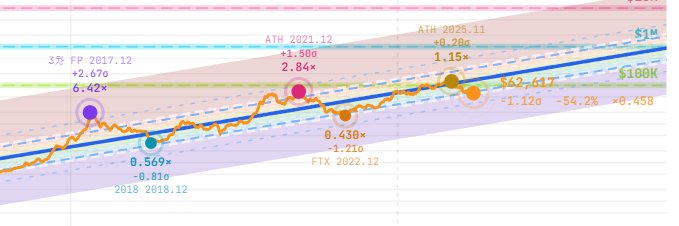
This is the most rigorous Bitcoin paper I've read. I've been studying — and testing — it for 20 days. scientificbitcoininstitute.org/research/publi… Dr. Santostasi and Dr. Perrenod gave us the ruler — and the imagination to see the oscillator. Together: the most falsifiable framework in crypto economics. The Power Law isn't just a model — it's the most precise ruler we have for measuring where Bitcoin stands. Most models describe the past. The Power Law keeps passing tests it was never designed for. "Isn't β=5.69 just curve-fitting?" Fair question. So I ran a test the paper didn't. ━━━━━━━━━━━━━━━━━━━━━━ Materials & Methods ━━━━━━━━━━━━━━━━━━━━━━ Data: Daily closing price and non-zero balance address count (BitcoinMagazinePro, 2010-08-17 to 2026-06-04, n=5,771). Model: log₁₀P(t) = log₁₀A + β·log₁₀(t) where t = days since Genesis Block (2009-01-03). Out-of-sample design: The power law was fitted exclusively on data up to the freeze date, with zero observations from the test period used in estimation. Two freeze points were tested: ① Freeze at 2016-07-08 (2nd halving) Training: n=2,153 | Test: n=3,617 (10 years) ② Freeze at 2020-05-10 (3rd halving) Training: n=3,555 | Test: n=2,215 (6 years) Residuals computed as: ε = log₁₀(P_observed / P_predicted) normalized by in-sample σ. Mean residual and area integrals (trapezoidal rule) applied to test period only. The out-of-sample test was my idea. Computation and analysis executed with Claude Opus 4.8 (Anthropic). ━━━━━━━━━━━━━━━━━━━━━━ Froze the power law using data up to 2016 only (β=5.717). Then measured the following 10 years it had never seen. Result: mean residual −0.05σ. Effectively zero. Frozen at 2020 instead → next 6 years, −0.13σ. Same story. The line drawn in 2016 ran straight through the next decade. That's not fitting. That's forecasting. The Power Law: powerful because it can be broken — and hasn't been. Knowing where we are won't tell us when things will happen — but it tells us exactly what to do now. Buy Bitcoin Now. @Giovann35084111 @moneyordebt @ScientificBTC @saylor @natbrunell #Bitcoin #PowerLaw