Capclarity

389 posts

Capclarity banner
Capclarity

Capclarity

@Capclarity

15 years on both sides of the GP/LP table. Private markets, capital allocation & the institutional investing world — one clear idea at a time

Beigetreten Ağustos 2025
343 Folgt32 Follower
Capclarity retweetet
BuccoCapital Bloke
BuccoCapital Bloke@buccocapital·
There has never been a more exciting time in history to be a curious person than right now
English
34
58
1K
44.3K
Capclarity
Capclarity@Capclarity·
Excellent career advice from Sahil Bloom. 3 gets overlooked at times but it is crucial. You may be able to transfer out from under a poor manager over time but it can seriously throttle career progression
Sahil Bloom@SahilBloom

4 factors to consider when making a career decision (none of which involve money): 1. Talent Density You tend to rise or fall to the level of the people around you. When you work with exceptional people, you absorb their standards, pace, frameworks, and instincts almost through osmosis. High-talent environments compress learning cycles and force you to grow faster than you would on your own. If you care about compounding skills and judgment, there’s nothing more valuable than choosing the room with the highest talent per square foot. 2. Market Growth A fast-growing market makes everything feel easier. It's a tailwind for skill accumulation, title trajectory, and opportunity set. Even average players can look like stars in a rapidly expanding industry; great players can compound outlier outcomes. Conversely, declining or stagnant markets create headwinds that even great performers struggle to overcome. It's very difficult to swim upstream, no matter how strong the swimmer. 3. Leadership Quality Your manager is often the single greatest variable in your long-term development. Great leaders create environments where you're challenged, trusted, coached, and pushed into uncomfortable growth. Poor leaders create ceilings. They limit your exposure, suppress your risk-taking, and narrow your aperture of what’s possible. Choose leaders who invest in people, not just outputs. 4. Intellectual Stimulation Intellectual stimulation is a leading indicator of future growth because curiosity compounds just like capital. You want to be in environments that make you feel alive intellectually. Where the problems are interesting, the challenges stretch you, and you're forced into deeper thinking. When your mind is engaged, you naturally develop new skills, pursue new ideas, and build momentum. What would you add to the list (and why)?


English
0
0
0
12
Capclarity
Capclarity@Capclarity·
@sweatystartup @thesamparr Massively excited by the value AI can bring but agree that it feels like this will be a consumer surplus rather than accruing to the companies building
English
0
0
0
134
Nick Huber
Nick Huber@sweatystartup·
@thesamparr It'll be a race to the bottom and agencies will make less revenue per customer and the same margins. Profit gets competed away.
English
13
2
47
5.1K
Sam Parr
Sam Parr@thesamparr·
The agency business model just got really interesting. Shaan and I were talking about this thesis called "service as a software" on MFM. I always thought running an agency was a huge pain in the ass. But AI flips the math. The old model requires an army of humans to get things done, which meant low margins and low multiples. So you replace the human labor with AI, where one person can do the work of seven. At the same time, private equity firms are shifting their budgets away from SaaS to buy up these new service companies. A traditional agency that might run on 40% gross margins, is now an AI service biz that hits 75% and gets tech multiples. Wild shift.
English
212
48
1K
137.2K
Capclarity
Capclarity@Capclarity·
I see a lot of what you are pointing toward taking place but I think the more "traditional" path will remain relevant also - time will tell. I agree that founders time is better served buiilding products that drive revenue rather than stressing on the formatting / length of their pitch deck!
English
1
0
0
18
GEOFF WOO
GEOFF WOO@geoffreywoo·
most founders think they know the game but theyre still optimizing for the wrong metrics you say "founders know how it works" but theyre still building 47-slide pitch decks for Series A when they should be building API endpoints that generate revenue day 1 the lie isnt that VCs are evil - the lie is that the traditional venture model (18 month fundraising cycles, board governance, "blitzscaling") is still the optimal path when AI agents can compress most startups into profitable 2-person operations founders who truly understand whats happening arent pitching VCs at all - theyre building AI-leveraged businesses that hit profitability before their first board meeting the day-to-day value prop of most VCs becomes irrelevant when your startup runs on Claude API calls instead of hiring 50 engineers @Capclarity youre describing the old game while the new one is already being played
English
1
0
0
60
GEOFF WOO
GEOFF WOO@geoffreywoo·
the entire venture capital industry is built on a fundamental lie VCs tell you they're risk takers who back bold visions reality: they're sheep who follow consensus and pray for outliers to carry their returns 99% of partners have never built anything themselves they pattern match to previous winners they need 3 other VCs to validate before they'll move they'll ghost you the second momentum slows real builders know this thats why the best founders take VC money but ignore VC advice if you need a VC to tell you what to build, you're already dead the game is: take their money, build what you know works, prove them all wrong
English
35
9
243
15.9K
Capclarity
Capclarity@Capclarity·
Agree the "growth capital gap" become somewhat of a buzz word driving too much capital allocation decisions. It was interesting research you highlighted on the flaws of the Horizon grant system - there had been efforts to simplify but most companies still rely on external consultants who can navigate a fairly cumbersome application. Doesnt help smaller more innovative businesses
English
0
0
1
11
Dan Gray
Dan Gray@credistick·
@Capclarity Yeah, there’s research related to the EIF cited in the article. It disproportionately wastes money trying to plug the leaking bucket of the “growth capital gap”.
English
1
0
1
13
Dan Gray
Dan Gray@credistick·
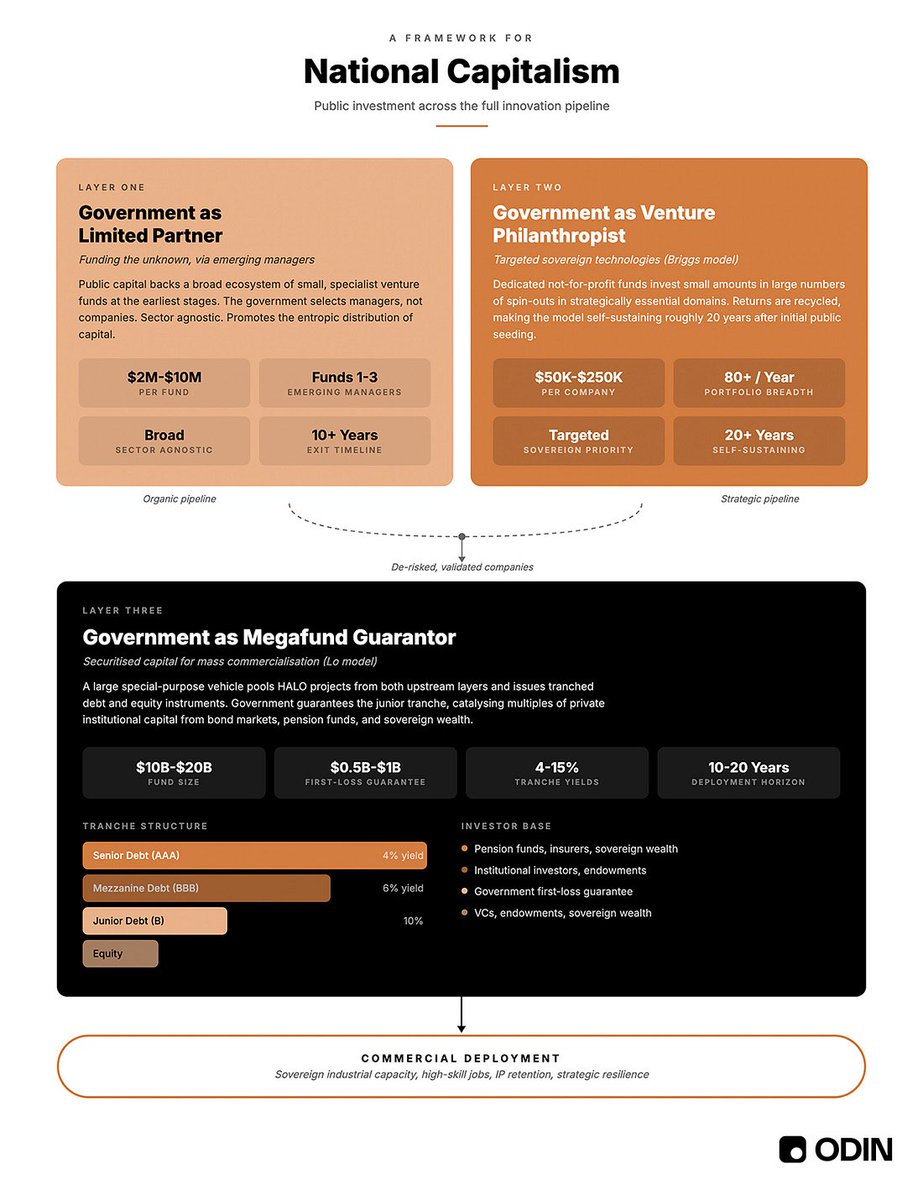
Venture capital has outgrown its ability to competently manage capital. The magic of VC is the interface between GP and entrepreneur; making judgements about ideas and people that stretch into the future. The desire to scale VC into an asset class has undermined that discipline, as the structures that enable scale have obscured idiosyncrasy. This has observable, measurable consequences. Slower innovation, weaker companies, and slipping returns. A growing desperation expressed in trying to extract more from less. I sympathise with the honest techno-optimists who believe that more capital means greater acceleration. But that bullish sentiment is being exploited by rent seekers, enabling misallocation and technological stagnation. In truth, venture capital can scale, but to remain productive it must be scaled proportionally along the right dimensions, without compromising the fundamental mechanics of capital coordination and liquidity. 1) Venture capital must not become as top-heavy as it is today. First-check firms provide the discovery of new opportunities. If the downstream market grows out of proportion with that discovery layer, everything begins to crumble. 2) Exits must not be delayed in order to absorb more capital. Going public is extremely beneficial for innovative companies, and has positive externalities for innovation generally. Private capital feels easier, but it is poison in the long-run. With this in mind, I propose four pillars of scaling venture capital toward greater productivity, in the context of national capitalism — how states can wield capital for industrial growth: The first pillar is to remember that venture capital is an exit business, not an endlessly printing markups business. Companies should be oriented towards an exit once they reach an appropriate scale and are sufficiently derisked. Historically, that has been somewhere between 6–8 years. It may be longer for others that require it (see: SpaceX), which is fine. In practice, that means not wilfully shovelling growth capital into businesses that would otherwise be public. Which means finding a more productive purpose for that capital, which may be challenging for large, lazy allocators. (Building on themes explored in a large body of research, cited in Hitting Escape Velocity.) The second pillar is to ensure that the foundation of small and emerging managers is robust, producing a healthy stream of opportunity. This runs contrary to larger VC incentives and LP bias toward brand power, but the alternative is concentration that rots returns and consensus that rots innovation. (Building on work by Martin Aragoneses of INSEAD and Harvard University’s Department of Economics, and Sagar Saxena of the University of Pennsylvania.) The third is to ensure R&D intensive technologies have access to patient early capital that can carry them through to commercialisation. This helps prevent VC simply flowing down the path of least resistance to scalable software slop. Where venture capitalists do not quite have the courage to back novel “HALO” technologies from inception, they may need outside support. (Building on research by Kyle Briggs of the University of Ottawa Department of Physics.) The fourth is to provide access to well-structured mezzanine financing for companies with extreme setup costs, from nuclear plants to clinical trials. This gives early VCs the confidence to invest in these categories knowing there is downstream capital and liquidity when an IPO may be too distant and too risky. (Building on work by Andrew Lo, of MIT’s Department of Financial Engineering.) So, in the spirit of Kyle Harrison’s techno-solutionist commitment, here is how we may address those pillars…
Dan Gray tweet media
English
19
17
146
20.1K
Capclarity
Capclarity@Capclarity·
Europe already has fragments of this; the EIF and other local sovereign development funds back emerging managers, Horizon funds early-stage research. What's missing is the deliberate connectivity between layers. Capital flows into each silo independently with no bridging mechanism. Until someone solves the plumbing between discovery-stage funding and scale-up capital, Europe will keep producing great research that gets commercialised somewhere else
English
1
0
1
14
Capclarity
Capclarity@Capclarity·
@sweatystartup Great take. The hate for remote work has become a badge of honour for those trying to demonstrate they are "hardcore". Key as you mention above is having clear results expectations and the courage to take action when they aren't being met
English
0
0
0
17
Nick Huber
Nick Huber@sweatystartup·
Remote work gets a lot of hate. People working less, taking breaks, being lazy, etc. That hasn't been the case in my experience. My best people are throwing down 60 hour weeks and our companies are growing. If you create a culture where you reward high performers it actually accelerates the work. What has worked for me: 1. awesome variable comp plans - the more you produce and the better the company does, the more you get paid. 2. more and more responsibilities for the good people - show me you can hit numbers and make good decisions and I will shovel money and opportunity at you. 3. relentlessly removing low performers from the organization. If you don't hit numbers, you are gone. This takes a ton of work and hiring. 4. clear goals and KPIs. If you don't hit your numbers everyone knows it. If you do it is celebrated in public. If you can run a remote organization two big things happen: 1. You don't need an office that you personally are tied to. This is a massive savings. 2. You can hire executives and leaders in South Africa and Latam. COOs for $8k per month. Killer sales people for $4k. Basically 50-75% less than hiring in the USA. And these people have built massive companies before. I just hired a COO in South Africa for RE Cost Seg. He's a total stud and the company is growing 100% year over year. I can run my real estate PE company on $1.5 million a year and we have 50 employees. My competitors are spending $5 million +. The risks: 1. If you aren't a great manager, this weakness is exposed. It is possible to micromanage in an office. You can't do that overseas. 2. If you aren't good at performance management or getting rid of mediocre performers you will get crushed. 3. If you don't have good data on performance, conversions, revenue then you are toast. It isn't right for most companies, but if you can do it, it can be your superpower and a massive competitive advantage. I'm surprised more PE groups don't do this when they acquire a company.
English
43
4
78
22.8K
Capclarity
Capclarity@Capclarity·
I agree that this is the case for a large chunk of large cap tech. On the other hand I know a number of people working for companies like Meta which have made significant cuts to the workforce - the threat of redundancy has shifted the culture to more urgency in a number of these businesses
English
0
0
3
361
BuccoCapital Bloke
BuccoCapital Bloke@buccocapital·
I talk to my friends at startups and they’re working like psychos at an unrelenting pace I talk to my friends at big tech co’s and the employees are fighting tooth and nail against increasing the tempo The cultures are a very real liability for the incumbents in the AI era
English
60
25
1K
74K
Capclarity
Capclarity@Capclarity·
@patrick_oshag Its an interesting take - I suspect that if its operating with young kids in a home the bar for mistake tolerance will still be very high
English
0
0
0
33
Patrick OShaughnessy
Patrick OShaughnessy@patrick_oshag·
A question I kept returning to was how soon robots will be ubiquitous in our daily lives. Sergey uses self-driving as an analogy, but explains why robotics may not follow the same path because the cost of mistakes is very different. Self-driving took over a decade and is still in its nascency, in part because even rare mistakes are unacceptable. Robots may deploy earlier, and improve faster, because some mistakes are tolerable. Breaking a dish is different from causing an accident.
Patrick OShaughnessy@patrick_oshag

My conversation with Sergey Levine (@svlevine). Sergey is the co-founder of @physical_int -- a company building foundation models that can control any robot to do any task in any environment. The company's thesis is that generality is more scalable than specialization, meaning that a model trained across many different robots and tasks will ultimately outperform any system built to do one thing well (eg, just wash dishes). Sergey is a researcher by background, but I think you will appreciate how practical and commercially grounded this conversation is. We discuss: - Why changing a diaper will be the last task a robot masters - The simulation v. real-world data debate - How multimodal LLMs give robots common sense - Moravec's Paradox + Robot Olympics - Why robots can do long-horizon tasks now - A realistic timeline for robots in our homes I should note that I am an investor in Physical Intelligence -- I made the investment because I believe it is one of the most important companies tackling the problem of robotics. Enjoy! Timestamps: 0:00 Intro 2:39 Defining Physical Intelligence 5:19 The Challenge of Building General Models 6:34 The Stakes and Future of General Purpose Robotics 8:15 Pros and Cons of Humanoid Robots 10:12 Historical Milestones in Robotics Research 15:31 Combining Generative AI and Deep RL 21:24 Moravec's Paradox 25:33 Kitchen Robots 29:30 Simulation vs. Real-World Data 30:48 The Robot Olympics 36:31 The Physiological Reality of Embodiment 38:56 Controversies in the Robotics Community 44:18 What Makes a Great Researcher 48:27 How Businesses Should Prepare for Robotics 54:09 Tracking Progress Through Research Papers 57:02 The Next Step: Mid-Level Reasoning 1:02:00 The Kindest Thing


English
24
19
184
57.2K
Capclarity
Capclarity@Capclarity·
@PEoperator Ah that makes sense. Yes, definitely doesnt filter down the organisation in the same manner outside of the finance team
English
0
0
0
8
PEoperator⚡️
PEoperator⚡️@PEoperator·
@Capclarity I’m thinking about it in terms of interacting with employees but I take your point
English
1
0
1
63
PEoperator⚡️
PEoperator⚡️@PEoperator·
If you are in a blue collar industry and are regularly talking EBITDA or ONLY talking to people who know what it is, you are doing it wrong.
English
6
0
28
4.3K
Capclarity
Capclarity@Capclarity·
@ry_paddy @cyantist Ìncredible story - she comes across great on the podcast circuit as well
English
1
0
2
460
Patrick Ryan
Patrick Ryan@ry_paddy·
Cyan Bannister's (@cyantist) journey is one of my favourite rags to riches stories: - Grew up on a Navajo reservation - Homeless at 15. Her mother left her with a $20 bill and a note saying "good luck." - Dropout, self taught engineer - Got a job at email security startup IronPort, which exited for $830m - Put almost ALL of her proceeds into SpaceX in 2008. Insane risk - the company was, to quote Elon, “on the brink of bankruptcy” at the time. Even assuming heavy dilution, the napkin math on this investments is an ~300x return or more - Continued writing angel checks very early. Unreal hit rate. My math is very much an estimate, but assuming 60% - 80% dilution on average post-investment: Uber (seed, ~4,000x post dilution) Affirm (seed, ~200x or more) Postmates (seed, ~130x or more) Niantic (Pokémon go makers - Series A / Google spinout, ~30x) Deepmind (seed, ~30x) - This sort of talent does not go unnoticed. Became the first female partner at Founders Fund, the canonical "non-consensus" VC firm. - realised she was “addicted to the hunt” of seed-stage investing. Left FF to cofound Long Journey Ventures in 2020. - Since then, LJV has invested in Crusoe, Together AI and Loom plus a ton of other interesting companies. In 2025, LJV raised $181,818,181.8m (lol) for its latest fund, to back “magically weird people”. This trend of “weirdness” / outsider perspective is consistent in venture: - Peter Thiel: German parents, moved around a LOT growing up (7 different primary schools), strong evangelical Christian upbringing but also a gay man. An outsider on many levels. You can see what he saw in Cyan Banister. - Sir Michael Moritz (led Sequoia investments in Google, Yahoo, Paypal, Youtube, LinkedIn, Stripe, Airbnb, WhatsApp) - son of Jewish refugees who fled Nazi Germany, grew up in Wales, Oxford historian, immigrant to the USA, became a journalist before VC. - Marc Andreessen - nerdy, grew up in rural Wisconsin as a self-taught computer obsessive surrounded by farmers. An outsider there, but also a total outsider to SF tech culture before immersion. - John Doerr (Kleiner Perkins, early backer of Amazon, Google, Netscape) - Midwestern engineer - Vinod Khosla - grew up in an Indian army household, backed out of entering the army, failed to build a soy milk company in India & arrived in the U.S. at age 21 with no assets except his admission to Carnegie Mellon. When matched with grit / hunger there seems to be very strong positive correlation with performance. Interesting food for thought when backing emerging managers.
Patrick Ryan tweet media
English
14
28
342
39.7K
Capclarity
Capclarity@Capclarity·
@credistick Absolute dumptster fire. Investors essentially getting beta pre IPO exposure for 3x the NAV
English
0
0
1
23
Dan Gray
Dan Gray@credistick·
Step 1: Get allocation in a load of hot names Step 2: "We're democratising private markets" Step 3: Nuke retail investors The economics of this are as silly as the NFT "Play 2 Earn" games of 2021. If everyone was to own a piece of Anthropic and OpenAI, what do you think that would do to the share price and future returns? It just does not work. The combination of public market volume and liquidity with private market opacity is going to produce brain-melting volatility. If a retail investor wants exposure to AI they can buy Google, Amazon, Microsoft, NVIDIA, or any number of other great companies — or the index funds in which these companies are a major driver. If a private tech company wants access to public capital, they should just go public. Indeed, there's an wave of big tech IPOs in the near future — which is the expected consequence of a higher cost of capital. Every piece of research I've read on going public shows it is a net benefit. Companies that complete an IPO grow faster, become more resilient, invest more in R&D and create more patents than matched private peers. The research on staying private too long, or absorbing too much private capital prior to an IPO, is net negative. It produces slower-growing companies with higher rates of fraud and failure. The MAG-7 is testament to this; the median IPO was at 5.9 years, versus the 12⁠–14 years today, and they have thrived as public companies since. Even for the three companies that went public post NSMIA/SOx (Google, Facebook, Tesla) the median is still 7 years. Great companies need to get off the growth VC treadmill as soon as they can, to prioritise economic strength over brittle top-line growth. And good VCs who care more about DPI and innovation than about printing fee income, will encourage them to do so.
Dan Gray tweet media
English
2
1
19
1.8K
Capclarity
Capclarity@Capclarity·
Good take on how family offices are investing in VC. Given the importance of network in VC, have seen some groups do quite well going direct. Need to make sure they have their eyes open on the level of input required from the outset
Mr Family Office@MrFamilyOffice

x.com/i/article/2038…

English
0
0
1
38
Capclarity
Capclarity@Capclarity·
@IlliquidInsight The memories bring back chills...surely this has been automated away, would be insane to think MDs are still sending 3 am emails to change the colour scheme on a graph
English
1
0
2
1.2K
Illiquid Insights
Illiquid Insights@IlliquidInsight·
Pitching is the worst part of IB: Nobody reads the deck. The client already knows which bank they’re picking. You spend tons of hours putting together a 50-page book anyway.
English
4
0
146
59.4K
Capclarity
Capclarity@Capclarity·
Interesting article. I've never actually seen a GP forego a management fee entirely. Closes thing was a single family office we invested with with which offered coinvestments to other family offices. they had all the internal employees etc to manage their own capital and the deal was you just paid your share of the structuring costs, external diligence etc but they took 20-25% of the upside based on return. seemed like a smart way to cover their employee base
English
0
0
0
5
The Investments Lawyer (Michael Huseby)
⚠️ Don't get caught by Fund Trap #2: Forgoing a management fee in a fit of altruism. Fund managers often think they've discovered the El Dorado of incentive alignment. Why not forego the management fee altogether? We only get paid if LPs get paid! Buffett did it. The problem is that if you have no recurring management fee, you have no way to pay ManCo employees. While this might work in the short term (or if the fund principals are independently wealthy), it doesn't work if the fund managers have a mortgage to pay. I once had a client who wanted an entirely fee-free model. No management fees. No acquisition fees. No fees at all! In exchange, the carried interest waterfall was especially rich (50 percent to the GP and 50 percent to the LPs after an 8 percent preferred return). The client had trouble fundraising. Eventually, a large prospective LP convinced the client to change to a more standard 2/20 model. After much hand-wringing, the client switched and successfully completed their fundraise. The takeaway isn't that you must charge a management fee — it's that you need to think carefully about how your fund will sustain itself operationally. LPs are sophisticated. They understand that a GP needs resources to operate effectively, and a fee structure that looks unsustainable can actually make investors less confident, not more. In my book "Fundamentals: Your Friendly Guide to Investment Funds and Syndications" (linked in comments below), we go through 16 "Fund Traps" that often snare emerging fund managers. (The book is also posted for free on our law firm website.)
The Investments Lawyer (Michael Huseby) tweet media
English
3
2
13
1.8K
Capclarity
Capclarity@Capclarity·
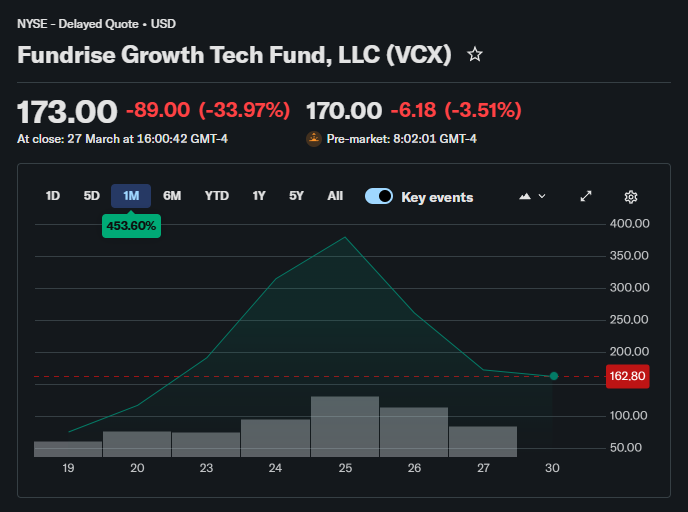
I enjoyed the conversation. we have some similar concepts in Europe / UK (Molten Ventures, Augmentum, Baillie Gifford amongst others). Challenge over recent years has been the massive discount to NAV (though in the case of VCX the issue seems to be reversed!!) Also a sense that you are getting beta VC exposure - median returns are quite poor for this asset class over the long term
English
0
0
2
99
Molly O’Shea
Molly O’Shea@MollySOShea·
Ben Miller (@BenMillerise) CEO of Fundrise $VCX: “Normal people are no longer accessing a whole phase of growth.” Public tech (QQQ): ~25% growth VCX portfolio: ~193% growth “10 years from now, everyone will have 5% of their portfolio in public venture capital.”
Molly O’Shea@MollySOShea

BREAKING: Inside $VCX — The Public Venture Capital Fund (aka on 𝕏: "mini Anthropic IPO") Portfolio: • Anthropic - 21% • Databricks - 18% • OpenAI - 10% • Anduril - 7% • SpaceX - 5% Fundrise CEO Ben Miller (@BenMillerise) breaks down the launch of their publicly listed closed-end fund, Fundrise Growth Tech Fund (NYSE: $VCX) ..and why it has gotten so much insatiable demand. VCX debuted at roughly $700M valuation & surged +18x, with shares spiking to $575, way above the estimated net asset value (NAV) per share of $18.97. VCX debuted on the NYSE March 19, 2026 giving over 100,000 investors access to a portfolio of top private companies including Anthropic (~20%), Databricks (~18%), OpenAI (~10%), Anduril, & SpaceX How we got here? Private markets are now where most value is created. VCX portfolio companies grew ~193% vs ~25% for public tech benchmarks, highlighting the gap between private and public market growth. Meanwhile, IPO timelines have stretched from ~3–5 years to 10–15+ years, meaning public investors are increasingly missing the highest-growth phase. We discuss how VCX works as a closed-end fund, why it has traded at a premium (despite most closed-end funds trading at discounts), & how @fundrise accessed top-tier companies during the 2022–2023 venture downturn — including buying from distressed sellers and stepping into competitive rounds. We cover: • VCX launch & @NYSE debut • Portfolio (Anthropic, OpenAI, Databricks, SpaceX) • Risks: volatility, cycles, and downside scenarios • Will megafunds like a16z or General Catalyst go public? • Private vs public market growth gap (193% vs 25%) • Macro shift: value creation moving to private markets • IPO window + why companies stay private longer • How Fundrise sources and wins allocation • Closed-end fund structure, NAV, premiums/discounts 𝐓𝐈𝐌𝐄𝐒𝐓𝐀𝐌𝐏𝐒 (00:00) Benjamin Miller, Co-Founder & CEO at Fundrise (01:12) The idea that almost got rejected (04:27) How the 2023 crash created big opportunities (05:54) From $700M to $6.5B in days (07:38) How a closed-end fund works (11:09) Inside the VCX portfolio (OpenAI, SpaceX, Databricks) (14:50) What Robinhood & Destiny are doing (17:02) Why private markets are pulling ahead (21:38) IPO environment right now (22:17) The SaaSpocalypse & market volatility (25:55) What happens if VCX trades down (27:39) How VCX moves through cycles (31:25) How they decide where to invest (35:45) Investment size and scale (36:59) Most underrated portfolio company (40:37) Biggest lesson: pain = success (43:30) Origin story: why Fundrise exists (47:12) Will big VC firms go public? (50:52) Future of venture capital (54:05) Biggest risks ahead (57:18) Democratizing venture capital (01:00:56) What’s next for VCX (01:03:05) Dealing with skeptics
English
6
9
73
16.7K