DC BitMax

112 posts

DC BitMax banner
DC BitMax

DC BitMax

@DCBitMax

Studying Bitcoin through the lens of Power Law. StackSats&StayHumble. English version Power_Law_Chart https://t.co/cfl6sLkL1q 비트맥시갤러리 멱게이 입니다

South Korea Beigetreten Mayıs 2026
235 Folgt282 Follower
Angehefteter Tweet
DC BitMax
DC BitMax@DCBitMax·
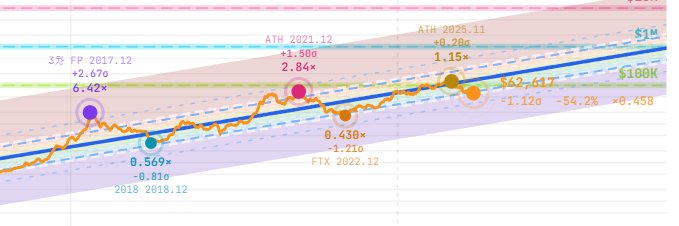
This is the most rigorous Bitcoin paper I've read. I've been studying — and testing — it for 20 days. scientificbitcoininstitute.org/research/publi… Dr. Santostasi and Dr. Perrenod gave us the ruler — and the imagination to see the oscillator. Together: the most falsifiable framework in crypto economics. The Power Law isn't just a model — it's the most precise ruler we have for measuring where Bitcoin stands. Most models describe the past. The Power Law keeps passing tests it was never designed for. "Isn't β=5.69 just curve-fitting?" Fair question. So I ran a test the paper didn't. ━━━━━━━━━━━━━━━━━━━━━━ Materials & Methods ━━━━━━━━━━━━━━━━━━━━━━ Data: Daily closing price and non-zero balance address count (BitcoinMagazinePro, 2010-08-17 to 2026-06-04, n=5,771). Model: log₁₀P(t) = log₁₀A + β·log₁₀(t) where t = days since Genesis Block (2009-01-03). Out-of-sample design: The power law was fitted exclusively on data up to the freeze date, with zero observations from the test period used in estimation. Two freeze points were tested: ① Freeze at 2016-07-08 (2nd halving) Training: n=2,153 | Test: n=3,617 (10 years) ② Freeze at 2020-05-10 (3rd halving) Training: n=3,555 | Test: n=2,215 (6 years) Residuals computed as: ε = log₁₀(P_observed / P_predicted) normalized by in-sample σ. Mean residual and area integrals (trapezoidal rule) applied to test period only. The out-of-sample test was my idea. Computation and analysis executed with Claude Opus 4.8 (Anthropic). ━━━━━━━━━━━━━━━━━━━━━━ Froze the power law using data up to 2016 only (β=5.717). Then measured the following 10 years it had never seen. Result: mean residual −0.05σ. Effectively zero. Frozen at 2020 instead → next 6 years, −0.13σ. Same story. The line drawn in 2016 ran straight through the next decade. That's not fitting. That's forecasting. The Power Law: powerful because it can be broken — and hasn't been. Knowing where we are won't tell us when things will happen — but it tells us exactly what to do now. Buy Bitcoin Now. @Giovann35084111 @moneyordebt @ScientificBTC @saylor @natbrunell #Bitcoin #PowerLaw
DC BitMax tweet media
Giovanni's BTC_POWER_LAW@Giovann35084111

If you didn't read it yet. 10 k downloads. zenodo.org/records/193870…

English
20
95
643
108.6K
DC BitMax retweetet
Holger Wolff
Holger Wolff@Holger21M·
One Step at a time.. The @ScientificBTC with it´s directors @Giovann35084111 and @moneyordebt aims to establis a new scientific culture in the Bitcoin Space. It´s not only about the PowerLaw - the deeper mission is: establish a scientific approach to study the properties of one the most exciting artificial networks mankind has ever developed.
moneyordebt ∞/21M@moneyordebt

The Bitcoin Power Law passes all 4 of the standard econometric tests. Claude Sonnet 4.6 — “This is a cointegration diagnostic summary for your Bitcoin power-law model. Here’s what it means: The three-row pattern is textbook I(1) cointegration: •Log Price is I(1) — nonstationary in levels, as expected for a trending series •ΔLog Price is I(0) — first differences are stationary, confirming it’s integrated of order 1, not higher •OLS Residuals are I(0) — the residuals from regressing log price on log age are stationary That third row is the critical result. When two I(1) series (log price and log age) have stationary residuals from their OLS regression, that’s the Engle-Granger definition of cointegration. The series move together in a stable long-run equilibrium — they don’t drift apart arbitrarily. What this establishes: The power-law relationship log P = α + β·log(Age) is not spurious regression. Spurious regression between I(1) series produces nonstationary residuals; yours are stationary. This is the standard econometric test that distinguishes a genuine structural relationship from coincidental trending. The four-diagnostic agreement (ADF + PP + KPSS + Engle-Granger) is notable because ADF and PP test the null of a unit root while KPSS tests the null of stationarity — they’re structured to disagree when evidence is ambiguous. All pointing the same direction is strong.”

English
0
2
9
2.3K
DC BitMax retweetet
Jami
Jami@createdbyjami·
Bitcoin price is what you see on the surface There’s a whole system underneath that’s securing itself, adjusting itself, and rewarding honest participation every single block Once you understand this, you will appreciate the volatility (opportunity) it gives you Look into the Bitcoin Power Law
Jami tweet media
English
2
4
38
2.9K
DC BitMax
DC BitMax@DCBitMax·
This is the most rigorous Bitcoin paper I've read. I've been studying — and testing — it for 20 days. scientificbitcoininstitute.org/research/publi… Dr. Santostasi and Dr. Perrenod gave us the ruler — and the imagination to see the oscillator. Together: the most falsifiable framework in crypto economics. The Power Law isn't just a model — it's the most precise ruler we have for measuring where Bitcoin stands. Most models describe the past. The Power Law keeps passing tests it was never designed for. "Isn't β=5.69 just curve-fitting?" Fair question. So I ran a test the paper didn't. ━━━━━━━━━━━━━━━━━━━━━━ Materials & Methods ━━━━━━━━━━━━━━━━━━━━━━ Data: Daily closing price and non-zero balance address count (BitcoinMagazinePro, 2010-08-17 to 2026-06-04, n=5,771). Model: log₁₀P(t) = log₁₀A + β·log₁₀(t) where t = days since Genesis Block (2009-01-03). Out-of-sample design: The power law was fitted exclusively on data up to the freeze date, with zero observations from the test period used in estimation. Two freeze points were tested: ① Freeze at 2016-07-08 (2nd halving) Training: n=2,153 | Test: n=3,617 (10 years) ② Freeze at 2020-05-10 (3rd halving) Training: n=3,555 | Test: n=2,215 (6 years) Residuals computed as: ε = log₁₀(P_observed / P_predicted) normalized by in-sample σ. Mean residual and area integrals (trapezoidal rule) applied to test period only. The out-of-sample test was my idea. Computation and analysis executed with Claude Opus 4.8 (Anthropic). ━━━━━━━━━━━━━━━━━━━━━━ Froze the power law using data up to 2016 only (β=5.717). Then measured the following 10 years it had never seen. Result: mean residual −0.05σ. Effectively zero. Frozen at 2020 instead → next 6 years, −0.13σ. Same story. The line drawn in 2016 ran straight through the next decade. That's not fitting. That's forecasting. The Power Law: powerful because it can be broken — and hasn't been. Knowing where we are won't tell us when things will happen — but it tells us exactly what to do now. Buy Bitcoin Now. @Giovann35084111 @moneyordebt @ScientificBTC @saylor @natbrunell #Bitcoin #PowerLaw
DC BitMax tweet media
Giovanni's BTC_POWER_LAW@Giovann35084111

If you didn't read it yet. 10 k downloads. zenodo.org/records/193870…

English
20
95
643
108.6K
DC BitMax retweetet
Matteo Pellegrini
Matteo Pellegrini@matteopelleg·
Bitcoin has lived 3 lives: 2009-2013: the experiment. Pizza day, Silk Road, Satoshi vanishes. Does this even work? 2014-2023: the wars. Mt. Gox, the Blocksize War, China bans, Chokepoint 2.0. Every attack failed. 2024-now: the absorption. ETFs, nation states, Wall Street. Everyone buys Bitcoin at the price they deserve.
English
14
15
212
10.2K
DC BitMax retweetet
Brian Armstrong
Brian Armstrong@brian_armstrong·
Something that got missed in the noise last week: Coinbase got approved to offer true global crypto perps in the US. This took many years of work, and we're the first to offer this global liquidity to US users. Backstory: For many years crypto trading has been moving offshore because the US didn't have clear rules, and perpetual futures were a superior product that traders wanted but it wasn't allowed in the US. If we're being honest, probably ~half of all perpetual futures volume was Americans using offshore products via VPN with loose KYC controls (an open secret in the industry). Penalties for this were rarely, if ever, enforced, which as you can imagine, was frustrating for us as an American company following the rules. Others set up offshore entities and found ways around it. After dozens of personal visits to DC, and many more from our policy team, I'm really proud we finally got approval to give US users access to true, global perpetual futures. This is important because we'll now see pooled global liquidity in perpetual futures, with the US and international markets being connected instead of fragmented. Coinbase is strongest in the US, and the US is the largest market for trading, so there is now a chance to build a global network effect around liquidity. And US traders can now use these products in a compliant way with a US company, which hopefully provides greater customer protection. Major credit to Chair Selig and Atkins on recognizing the importance of this for US capital markets. And we will keep working to update the system in a compliant way, and to be the best place you can trade.
English
249
297
2.5K
144.6K
DC BitMax retweetet
Nav Toor
Nav Toor@heynavtoor·
You have noticed it. ChatGPT feels dumber than it used to. Your prompts that worked six months ago produce worse results now. The writing sounds flatter. The ideas sound safer. The internet itself feels like it is shrinking. Every article reads the same. Every email sounds the same. Every answer sounds like it was written by the same voice. You thought it was you. It is not you. Researchers at Oxford and Cambridge published a paper in Nature proving what is happening. They call it Model Collapse. Here is the mechanism in one sentence. AI trained on AI-generated data gets dumber every generation until it forgets what real human data looked like. The internet is filling with AI-generated content. Blog posts. Articles. Reviews. Comments. Social media. AI companies scrape the internet to train the next generation of models. Which means the next generation of AI is being trained on the output of the current generation. Each cycle loses information. Not randomly. It loses the rarest, most unusual, most creative parts first. The researchers call these the "tails of the distribution." The weird ideas. The unexpected perspectives. The things that made the internet feel human. Those disappear first. What remains is the average. The safe. The expected. The bland. Then the next generation trains on that. And loses more. And the next generation trains on that. And loses more. The researchers proved this is not a slow decline. Major degradation happens within just a few iterations. Even when some of the original human data is preserved. They tested it on large language models. On image generators. On statistical models. The pattern was the same every time. The output converges toward a narrow, flattened version of reality that looks nothing like the original data. The lead researcher put it plainly. "Large language models are like fire. A useful tool. But one that pollutes the environment." The pollution is invisible. You cannot see which sentence on the internet was written by a human and which was written by AI. Neither can the AI that is about to train on it. And once the tails are gone, they do not come back. The damage is irreversible. This is not a prediction anymore. It is a diagnosis. The internet you grew up on was built by humans writing things no algorithm would have written. Strange, personal, imperfect, alive. That internet is being diluted. One generation of AI at a time. And the models trained on what remains are learning a smaller and smaller version of the world. Model Collapse is not a technical problem. It is a cultural one. The thing that made the internet worth reading is the thing that disappears first.
Nav Toor tweet media
English
275
1.6K
3.8K
168.5K
DC BitMax retweetet
Zynx
Zynx@ZynxBTC·
Bitcoin at $60,000 will be seen as good an entry as $16,000 was in 2022. In 2022, $60,000 was peak euphoria. In 2026 it is extreme bearish sentiment. The pace of corporate, regulatory and financial integration since then has been extraordinary. Bitcoin is not the same asset it was four years ago. The world around it has changed fundamentally. If history repeats, the $125,000 local top from October 2025 will one day look like the $60,000 of today. Now is the time to take full advantage of cheap bitcoin:native.
English
29
21
359
11.2K
DC BitMax retweetet
Killa
Killa@KillaXBT·
I'm not on this app to be a people pleaser. I'm here to make money. I'm bullish when the data tells me to be bullish. I'm bearish when the data tells me to be bearish. If you don't agree with my analysis, bias, or outlook, I genuinely don't care. My plan is my plan. If you don't agree with it, follow your own. Imagine being bothered by the fact that I bought $BTC at a certain price with my own money. Why do you care? It's not your portfolio, it's not your risk, and it's definitely not your decision. 🤣 I'm simply sharing exactly what I'm doing based on the metrics, data, and market conditions I see, along with how I plan to increase my net worth over the next 18-24 months. I never came here expecting people to copy every move I make. I came here to share my market thoughts. It just so happens that I've been fairly consistent with my HTF swings, so people naturally choose to follow along. At the end of the day, if you don't like me, I don't care. If you don't agree with my ideas, I don't care. Maybe if you spent less time obsessing over my trades and more time developing your own strategy, you'd actually be making money instead of complaining about someone else's. Time will tell who's right. Until then 🤟
English
48
15
915
32.5K
DC BitMax retweetet
Lyn Alden
Lyn Alden@LynAldenContact·
The result of 1) ever-rising public debt and 2) no longer structurally decreasing interest rates to offset it is: 3) the deficits are going to be *lit* for the foreseeable future.
Charlie Bilello@charliebilello

The Interest Expense on US Public Debt hit $1.3 trillion over the last 12 months, another record high. If it continues to increase at the current pace it will soon be the largest line item in the Federal budget, surpassing Social Security.

English
67
108
891
106K
DC BitMax retweetet
Mark Harvey
Mark Harvey@thepowerfulHRV·
The power law suggests Bitcoin is up only from here. BTC has rarely deviated this far from the power law. A rally to the upper band would put BTC well over $400K, something it has done multiple times in the past.
Mark Harvey tweet media
English
30
30
317
13.2K
DC BitMax retweetet
moneyordebt ∞/21M
moneyordebt ∞/21M@moneyordebt·
Cities have long lifetimes, measured in centuries. Companies mostly have short lifetimes, measured in a decade or two. The former have power law characteristics, that provide stability. The latter are more in the exponential rise and fall camp. From an (econo)physics standpoint Saylor has been converting Strategy away from a Micro(sic)economic financial company of short lifetime toward a citadel-like entity rooted in macroeconomic reality. Strategy stock although highly volatile has evidenced power law behavior by becoming a Bitcoin treasury. The financial engineering is an attempt to build a city of sorts around the citadel. Currently the market cap is comparable to aggregate personal wealth of Tucson, Arizona. open.substack.com/pub/stephenper…
Mark Harvey@thepowerfulHRV

The way $MSTR is structured, it is almost impossible for it to go bankrupt. It holds enough BTC to pay the dividend indefinitely without raising another dime from the capital markets. If $MSTR were ever forced to sell coins to pay the dividend, it would be a slow, controlled liquidation over many decades, something the market could easily absorb. Images of an FTX/Enron-style collapse in $MSTR are largely bear fantasies, not scenarios grounded in reality.

English
0
8
32
2.4K
ALTEREGO
ALTEREGO@ALT3R3GO420·
@DCBitMax Love the chart, especially the box with all the info saying buy, buy a lot🤣🤣🤣
English
1
0
2
95
SA2CO
SA2CO@kis03004·
이건 처음보는건데
DC BitMax@DCBitMax

This is the most rigorous Bitcoin paper I've read. I've been studying — and testing — it for 20 days. scientificbitcoininstitute.org/research/publi… Dr. Santostasi and Dr. Perrenod gave us the ruler — and the imagination to see the oscillator. Together: the most falsifiable framework in crypto economics. The Power Law isn't just a model — it's the most precise ruler we have for measuring where Bitcoin stands. Most models describe the past. The Power Law keeps passing tests it was never designed for. "Isn't β=5.69 just curve-fitting?" Fair question. So I ran a test the paper didn't. ━━━━━━━━━━━━━━━━━━━━━━ Materials & Methods ━━━━━━━━━━━━━━━━━━━━━━ Data: Daily closing price and non-zero balance address count (BitcoinMagazinePro, 2010-08-17 to 2026-06-04, n=5,771). Model: log₁₀P(t) = log₁₀A + β·log₁₀(t) where t = days since Genesis Block (2009-01-03). Out-of-sample design: The power law was fitted exclusively on data up to the freeze date, with zero observations from the test period used in estimation. Two freeze points were tested: ① Freeze at 2016-07-08 (2nd halving) Training: n=2,153 | Test: n=3,617 (10 years) ② Freeze at 2020-05-10 (3rd halving) Training: n=3,555 | Test: n=2,215 (6 years) Residuals computed as: ε = log₁₀(P_observed / P_predicted) normalized by in-sample σ. Mean residual and area integrals (trapezoidal rule) applied to test period only. The out-of-sample test was my idea. Computation and analysis executed with Claude Opus 4.8 (Anthropic). ━━━━━━━━━━━━━━━━━━━━━━ Froze the power law using data up to 2016 only (β=5.717). Then measured the following 10 years it had never seen. Result: mean residual −0.05σ. Effectively zero. Frozen at 2020 instead → next 6 years, −0.13σ. Same story. The line drawn in 2016 ran straight through the next decade. That's not fitting. That's forecasting. The Power Law: powerful because it can be broken — and hasn't been. Knowing where we are won't tell us when things will happen — but it tells us exactly what to do now. Buy Bitcoin Now. @Giovann35084111 @moneyordebt @ScientificBTC @saylor @natbrunell #Bitcoin #PowerLaw

한국어
1
0
1
47
DC BitMax retweetet
David
David@david_eng_mba·
Bitcoin’s P-10 Floor Is Holding. Fear Is Overpriced. 12-month model median zone: $145K–$160K. $BTC spot: $62.2K P-10 floor: $62.9K Power-law trend: ~$133K Z-score: -1.18 Derivatives are defensive, not broken: Gamma flip: $62.4K Put wall: $60K Call wall: $80K Funding: 0.39% APR Forecast: Above $62.4K = neutral regime reclaimed. Above $80K = path opens toward $125K–$133K. The floor is rising. Bitcoin is under trend.
David tweet media
English
5
9
64
2.2K