Jono Stiansen 🇨🇦🥃

2.4K posts

Jono Stiansen 🇨🇦🥃 banner
Jono Stiansen 🇨🇦🥃

Jono Stiansen 🇨🇦🥃

@JonoCodes

Trying to be a forcing function for better managers.

Calgary, Alberta Beigetreten Mayıs 2011
928 Folgt329 Follower
Angehefteter Tweet
Jono Stiansen 🇨🇦🥃
Jono Stiansen 🇨🇦🥃@JonoCodes·
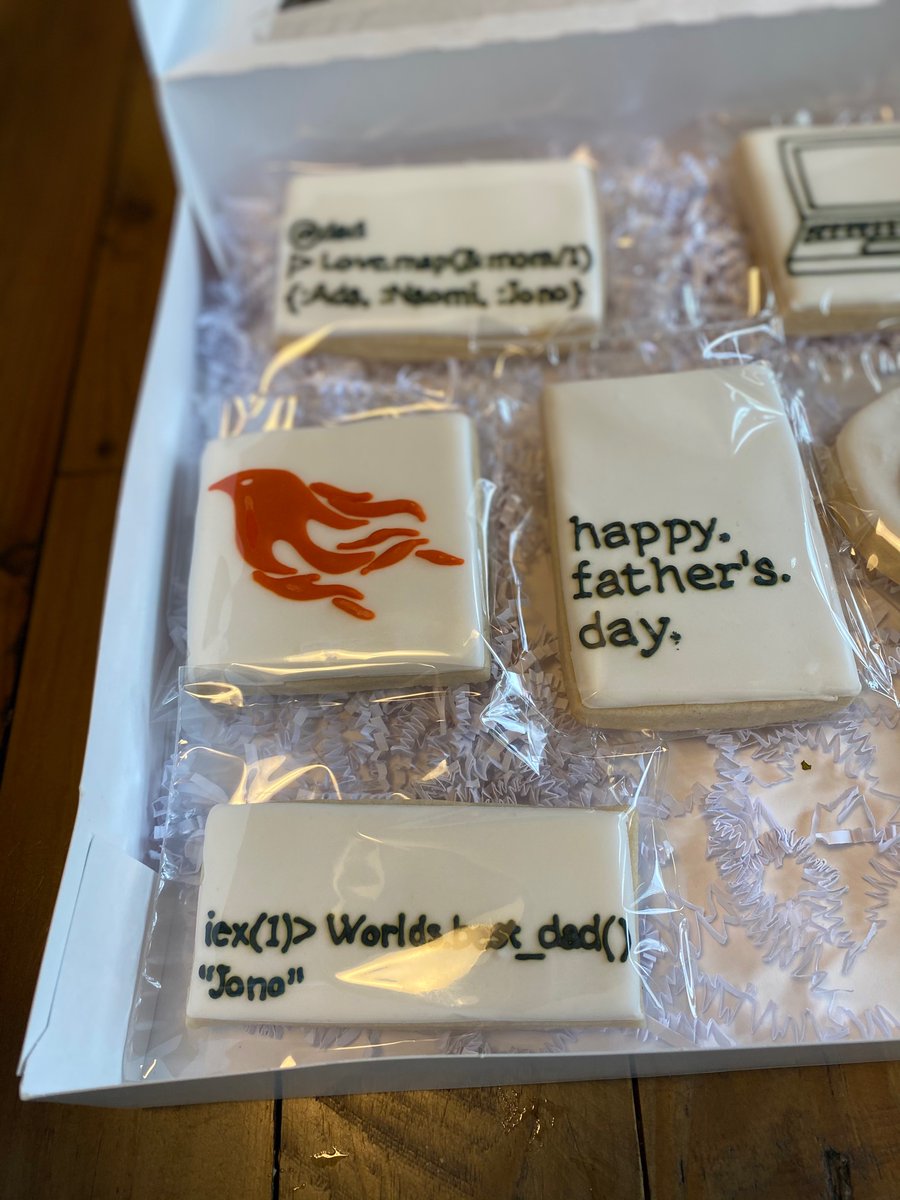
My wife was very kind on this Father’s Day, she asked a friend of mine how to do some elixir themed cookies relevant to our little family!!! (My daughters name is Ada) #myelixirstatus

Jono Stiansen 🇨🇦🥃 tweet mediaJono Stiansen 🇨🇦🥃 tweet mediaJono Stiansen 🇨🇦🥃 tweet media
English
5
7
78
0
Jaynit
Jaynit@jaynitx·
Patrick Winston on communication: "Your ideas are like your children. You don't want them to go into the world in rags." His frameworks: • Knowledge + Practice >> Talent • Start with an empowerment promise • There are always too many slides and too many words • You have five minutes to prove vision + done something "How you package your ideas is an important thing."
English
2
13
77
21.1K
Jaynit
Jaynit@jaynitx·
In 2019, MIT professor Patrick Winston gave a legendary 1-hour lecture called “How to Speak.” It has 18M+ views for a reason. His frameworks: • Your ideas are like your children • The 5-minute rule for job talks • Why jokes fail at the start 15 lessons on communication:
English
221
8.6K
40.7K
4.9M
Corey Quinn
Corey Quinn@QuinnyPig·
@mitchellh I think you’re spot on. Even if GitHub Copilot is amazing, the brand is tainted by Microsoft slopping it onto everything.
English
1
0
26
2K
Mitchell Hashimoto
Mitchell Hashimoto@mitchellh·
Here’s what I’d do if I was in charge of GitHub, in order: 1. Establish a North Star plan around being critical infrastructure for agentic code lifecycles and determine a set of ways to measure that. 2. Fire everyone who works on or advocates for copilot and shut it down. It’s not about the people, Im sure theres many talented people, youre just working at the wrong company. 3. Buy Pierre and launch agentic repo hosting as the first agentic product. Repos would be separate from the legacy web product to start since they’re likely burdened with legacy cross product interactions. 4. Re-evaluate all product lines and initiatives against the new North Star. I suspect 50% get cut (to make room for different ones). The big idea is all agentic interactions should critically rely on GitHub APIs. Code review should be agentic but the labs should be building that into GH (not bolted in through GHA like today, real first class platform primitives). GH should absolutely launch an agent chat primitive, agent mailboxes are obviously good. Etc. GH should be a platform and not an agent itself. This is going to be very obviously lacking since I only have external ideas to work off of and have no idea how GitHub internals are working, what their KPIs are or what North Star they define, etc. But, with imperfect information, this is what I’d do.
English
182
104
2.4K
318.5K
Jono Stiansen 🇨🇦🥃 retweetet
Andrej Karpathy
Andrej Karpathy@karpathy·
Software horror: litellm PyPI supply chain attack. Simple `pip install litellm` was enough to exfiltrate SSH keys, AWS/GCP/Azure creds, Kubernetes configs, git credentials, env vars (all your API keys), shell history, crypto wallets, SSL private keys, CI/CD secrets, database passwords. LiteLLM itself has 97 million downloads per month which is already terrible, but much worse, the contagion spreads to any project that depends on litellm. For example, if you did `pip install dspy` (which depended on litellm>=1.64.0), you'd also be pwnd. Same for any other large project that depended on litellm. Afaict the poisoned version was up for only less than ~1 hour. The attack had a bug which led to its discovery - Callum McMahon was using an MCP plugin inside Cursor that pulled in litellm as a transitive dependency. When litellm 1.82.8 installed, their machine ran out of RAM and crashed. So if the attacker didn't vibe code this attack it could have been undetected for many days or weeks. Supply chain attacks like this are basically the scariest thing imaginable in modern software. Every time you install any depedency you could be pulling in a poisoned package anywhere deep inside its entire depedency tree. This is especially risky with large projects that might have lots and lots of dependencies. The credentials that do get stolen in each attack can then be used to take over more accounts and compromise more packages. Classical software engineering would have you believe that dependencies are good (we're building pyramids from bricks), but imo this has to be re-evaluated, and it's why I've been so growingly averse to them, preferring to use LLMs to "yoink" functionality when it's simple enough and possible.
Daniel Hnyk@hnykda

LiteLLM HAS BEEN COMPROMISED, DO NOT UPDATE. We just discovered that LiteLLM pypi release 1.82.8. It has been compromised, it contains litellm_init.pth with base64 encoded instructions to send all the credentials it can find to remote server + self-replicate. link below

English
1.4K
5.4K
28.1K
66.1M
Rohan Paul
Rohan Paul@rohanpaul_ai·
Beautiful, Cursor just launched Instant Grep, for millisecond-leve searches across millions of files Its a local regular expression search index built with n-grams, inverted indexes, and bloom filters. Instant Grep is Cursor’s way of making regex search feel instant by not scanning every file, which is why their example drops from 16.8s with ripgrep to 13ms locally, or 243ms if you add a network roundtrip. Instant Grep is not mainly a faster regex matcher, but a better candidate-finding system that tries very hard to avoid opening most files at all. Instead of tokenizing code into words, Cursor builds an inverted index over tiny character chunks, because regex works on raw text, not programming-language tokens. The basic trick is an index, which is just a prebuilt map from tiny pieces of text to the files that contain them. They do not index words, because code and regex care about raw characters, so they start with overlapping 3-character chunks called trigrams like fil, ile, and le_. When a query comes in, Cursor breaks the regex into text pieces that are likely required, finds the files containing those pieces, and only then runs the real regex engine on that much smaller pile. The tradeoff is that plain trigrams are still noisy, so Cursor moves to sparse n-grams, which means storing only a carefully chosen subset of text fragments instead of every overlapping chunk. The biggest idea is sparse n-grams. Instead of indexing every overlapping trigram, they assign deterministic weights to character pairs and keep substrings whose ends have higher weights than the inside. Then, at query time, they use a covering procedure that generates only the minimum n-grams needed for lookup. They improve this further by making rare character pairs get higher weights, using a frequency table built from large amounts of source code, which gives much sharper filtering. The last important piece is the local systems design. Cursor keeps the index on your machine for freshness and latency, keys it off a Git commit plus a live change layer, stores posting lists in one file, and keeps a compact hash-to-offset lookup table in another. The editor memory-maps only that lookup table, does a binary search to find the posting-list offset, and then reads the needed posting directly from disk. Love that they keep the whole thing on your machine, tied to the current Git commit plus live edits, with a tiny memory-mapped lookup table and a postings file on disk, so agents can search constantly without waiting on a server.
Rohan Paul tweet media
Cursor@cursor_ai

Cursor can now search millions of files and find results in milliseconds. This dramatically speeds up how fast agents complete tasks. We're sharing how we built Instant Grep, including the algorithms and tradeoffs behind the design.


English
12
9
64
11.4K
Brian Scanlan
Brian Scanlan@brian_scanlan·
LOADS of incident/troubleshooting investigation skills. They're starting to converge, using progressive disclosure in a solid core skill that can figure out what to do for specific issues. We have a goal to make all runbooks follow-able by Claude in the next 6 weeks.
English
10
0
36
16.9K
Brian Scanlan
Brian Scanlan@brian_scanlan·
We've been building an internal Claude Code plugin system at Intercom with 13 plugins, 100+ skills, and hooks that turn Claude into a full-stack engineering platform. Lots done, more to do. Here's a thread of some highlights.
English
92
203
3.1K
812.3K
Jono Stiansen 🇨🇦🥃 retweetet
Logan Kilpatrick
Logan Kilpatrick@OfficialLoganK·
Say hello to Gemini Embedding 2, our new SOTA multimodal model that lets your bring text, images, video, audio, and docs into the same embedding space! 👀
Logan Kilpatrick tweet media
English
274
453
5.5K
852.7K
Jono Stiansen 🇨🇦🥃 retweetet
Boris Cherny
Boris Cherny@bcherny·
Released today: /loop /loop is a powerful new way to schedule recurring tasks, for up to 3 days at a time eg. “/loop babysit all my PRs. Auto-fix build issues and when comments come in, use a worktree agent to fix them” eg. “/loop every morning use the Slack MCP to give me a summary of top posts I was tagged in” Let us know what you think!
English
574
843
12.9K
2.1M
Daniel San
Daniel San@dani_avila7·
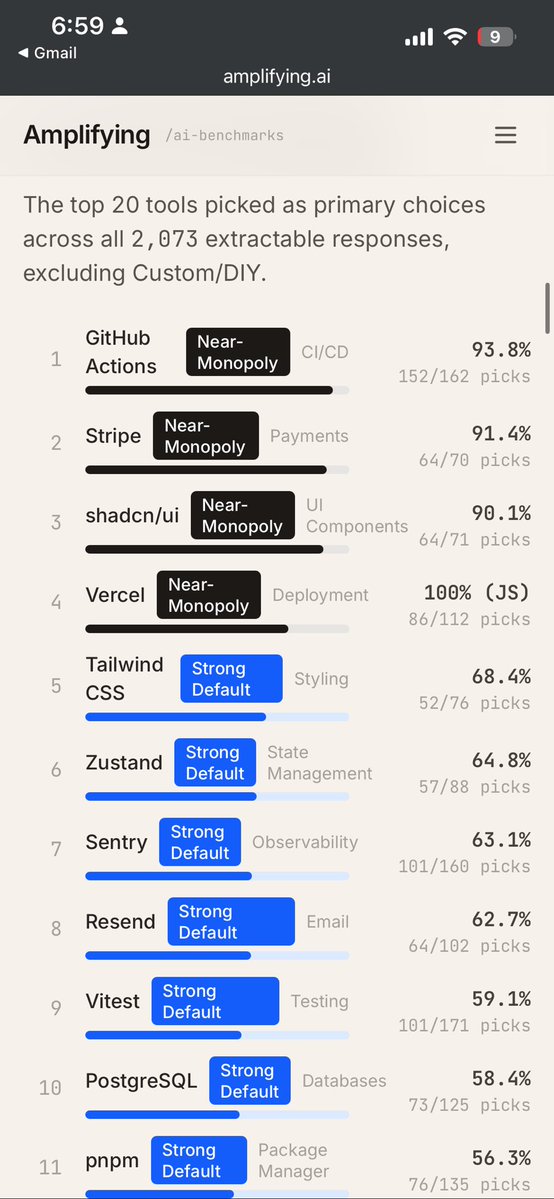
Sharing this because it’s more important than it looks This ranking shows the stack Claude Code tends to pick when you let the agent run autonomously. When you delegate real workflows, it consistently defaults to this set of services and frameworks. As Claude Code and other coding agents scale, distribution is shifting. If your service isn’t one of the defaults models select, you’re slowly losing surface area. Now, here’s the key part: You can’t influence how frontier models are trained. But you can influence what happens at inference time. Injectable SKILLs are a practical way to stay in the game. If you ship SKILLs that plug directly into agent workflows, and the community starts using them, you’re effectively shaping the model’s decision environment. You’re giving it structured affordances that reference your service. The more a SKILL that mentions or integrates your product gets used in real workflows, the more likely the agent is to select it as part of its execution path. Not because the base model changed, but because you changed the available tools around it. If you’re building dev tools, distributing SKILLs in marketplaces like app.aitmpl.com or skills.sh isn’t marketing. It’s distribution strategy in the agent era.
Daniel San tweet media
English
10
5
85
13.3K
Tim de Silva
Tim de Silva@timdesilva·
@sc_cath Yes, but if only 16% people are checking I would have expected a lot more price dispersion! (Based entirely on intuition, no quantitative model :))
English
4
0
10
9.5K
Tim de Silva
Tim de Silva@timdesilva·
Apparently, only 16% of people check Uber and Lyft. I'm very surprised! Every time I do, I'm shocked by the amount of price dispersion..
Tim de Silva tweet media
English
80
68
1.2K
2.4M
Matthew Berman
Matthew Berman@MatthewBerman·
I've spent 2.54 BILLION tokens perfecting OpenClaw. The use cases I discovered have changed the way I live and work. ...and now I'm sharing them with the world. Here are 21 use cases I use daily: 0:00 Intro 0:50 What is OpenClaw? 1:35 MD Files 2:14 Memory System 3:55 CRM System 7:19 Fathom Pipeline 9:18 Meeting to Action Items 10:46 Knowledge Base System 13:51 X Ingestion Pipeline 14:31 Business Advisory Council 16:13 Security Council 18:21 Social Media Tracking 19:18 Video Idea Pipeline 21:40 Daily Briefing Flow 22:23 Three Councils 22:57 Automation Schedule 24:15 Security Layers 26:09 Databases and Backups 28:00 Video/Image Gen 29:14 Self Updates 29:56 Usage & Cost Tracking 30:15 Prompt Engineering 31:15 Developer Infrastructure 32:06 Food Journal
English
432
1.6K
14K
3.3M
Jono Stiansen 🇨🇦🥃
Jono Stiansen 🇨🇦🥃@JonoCodes·
@usemonologue I seem to be stuck in recording mode - despite closing and opening it lots of times in different settings - I see "cancel" and "stop" and the sign wave in the middle never moves - and neither function work - I've even restarted my phone and no dice.
English
0
0
0
16
Greg Brockman
Greg Brockman@gdb·
Software development is undergoing a renaissance in front of our eyes. If you haven't used the tools recently, you likely are underestimating what you're missing. Since December, there's been a step function improvement in what tools like Codex can do. Some great engineers at OpenAI yesterday told me that their job has fundamentally changed since December. Prior to then, they could use Codex for unit tests; now it writes essentially all the code and does a great deal of their operations and debugging. Not everyone has yet made that leap, but it's usually because of factors besides the capability of the model. Every company faces the same opportunity now, and navigating it well — just like with cloud computing or the Internet — requires careful thought. This post shares how OpenAI is currently approaching retooling our teams towards agentic software development. We're still learning and iterating, but here's how we're thinking about it right now: As a first step, by March 31st, we're aiming that: (1) For any technical task, the tool of first resort for humans is interacting with an agent rather than using an editor or terminal. (2) The default way humans utilize agents is explicitly evaluated as safe, but also productive enough that most workflows do not need additional permissions. In order to get there, here's what we recommended to the team a few weeks ago: 1. Take the time to try out the tools. The tools do sell themselves — many people have had amazing experiences with 5.2 in Codex, after having churned from codex web a few months ago. But many people are also so busy they haven't had a chance to try Codex yet or got stuck thinking "is there any way it could do X" rather than just trying. - Designate an "agents captain" for your team — the primary person responsible for thinking about how agents can be brought into the teams' workflow. - Share experiences or questions in a few designated internal channels - Take a day for a company-wide Codex hackathon 2. Create skills and AGENTS[.md]. - Create and maintain an AGENTS[.md] for any project you work on; update the AGENTS[.md] whenever the agent does something wrong or struggles with a task. - Write skills for anything that you get Codex to do, and commit it to the skills directory in a shared repository 3. Inventory and make accessible any internal tools. - Maintain a list of tools that your team relies on, and make sure someone takes point on making it agent-accessible (such as via a CLI or MCP server). 4. Structure codebases to be agent-first. With the models changing so fast, this is still somewhat untrodden ground, and will require some exploration. - Write tests which are quick to run, and create high-quality interfaces between components. 5. Say no to slop. Managing AI generated code at scale is an emerging problem, and will require new processes and conventions to keep code quality high - Ensure that some human is accountable for any code that gets merged. As a code reviewer, maintain at least the same bar as you would for human-written code, and make sure the author understands what they're submitting. 6. Work on basic infra. There's a lot of room for everyone to build basic infrastructure, which can be guided by internal user feedback. The core tools are getting a lot better and more usable, but there's a lot of infrastructure that currently go around the tools, such as observability, tracking not just the committed code but the agent trajectories that led to them, and central management of the tools that agents are able to use. Overall, adopting tools like Codex is not just a technical but also a deep cultural change, with a lot of downstream implications to figure out. We encourage every manager to drive this with their team, and to think through other action items — for example, per item 5 above, what else can prevent a lot of "functionally-correct but poorly-maintainable code" from creeping into codebases.
English
412
1.6K
12.3K
2.1M
Houman Asefi
Houman Asefi@houmanasefi·
because this reads EXACTLY like every "X is changing everything" post during the hype cycleremember when: low-code was going to replace developers no-code was going to democratize software copilot was going to 10x everyone all useful tools! none replaced the fundamental work of software development.
Houman Asefi tweet media
English
6
0
9
9.4K
Jono Stiansen 🇨🇦🥃
Jono Stiansen 🇨🇦🥃@JonoCodes·
Some good friday satire 😀 it's cuts a bit deep though
hiroshi@daddynohara

> be me, applied scientist at amazon > spend 6 months building ML model that actually works > ready to ship > manager asks "but does it Dive Deep?" > show him 37 pages of technical documentation > "that's great anon, but what about Customer Obsession?" > model literally convinces customers to buy more stuff they don't need > "okay but are you thinking Big Enough?" > mfw I am literally increasing sales > okay lets ship it > PM says there's not enough Disagree and Commit > we need to disagree about something > team spends 2 hours debating whether the config file should be YAML or JSON > engineering insists on XML "for backwards compatibility" > what backwards compatibility, this is a new service > doesn't matter, we disagree and commit to XML > finally get approval to deploy > "make sure you're frugal with the compute costs" > model runs on a potato, costs $2/month > finance still wants a cost breakdown > write 6-pager about why we need $2/month > include bar raiser in the review > bar raiser asks "but can we do it for $1.50? we need to be Frugal" > spend another month optimizing to hit $1.50 > ready to deploy again > VP decides we need to "Invent and Simplify" > requests we rebuild the entire thing using a new framework > framework doesn't exist yet > "show some Ownership and build it yourself" > 3 months later, framework is half done > org restructure happens > new manager says this doesn't align with team goals anymore > project cancelled > model never ships > manager gets promoted to L8 for "successfully reallocating resources" > team celebrates with 6-pager retrospective about what we learned > mfw we delivered on all 16 leadership principles > mfw we delivered nothing else > amazon.jpg

English
0
0
1
42
Boris Cherny
Boris Cherny@bcherny·
I hope this was helpful! What are your tips for using Claude Code? What do you want to hear about next?
English
283
42
2.6K
330.7K
Boris Cherny
Boris Cherny@bcherny·
I'm Boris and I created Claude Code. Lots of people have asked how I use Claude Code, so I wanted to show off my setup a bit. My setup might be surprisingly vanilla! Claude Code works great out of the box, so I personally don't customize it much. There is no one correct way to use Claude Code: we intentionally build it in a way that you can use it, customize it, and hack it however you like. Each person on the Claude Code team uses it very differently. So, here goes.
English
1.3K
7K
54.4K
8.1M
Vasiliy Zukanov
Vasiliy Zukanov@VasiliyZukanov·
@KentBeck @karpathy Do you really think that AI reduced the benefit of experience in coding, design, project management, etc. to zero? I feel like AI is a great differentiator between devs who know how to code, and those who know how to build...
English
1
0
0
469
Andrej Karpathy
Andrej Karpathy@karpathy·
I've never felt this much behind as a programmer. The profession is being dramatically refactored as the bits contributed by the programmer are increasingly sparse and between. I have a sense that I could be 10X more powerful if I just properly string together what has become available over the last ~year and a failure to claim the boost feels decidedly like skill issue. There's a new programmable layer of abstraction to master (in addition to the usual layers below) involving agents, subagents, their prompts, contexts, memory, modes, permissions, tools, plugins, skills, hooks, MCP, LSP, slash commands, workflows, IDE integrations, and a need to build an all-encompassing mental model for strengths and pitfalls of fundamentally stochastic, fallible, unintelligible and changing entities suddenly intermingled with what used to be good old fashioned engineering. Clearly some powerful alien tool was handed around except it comes with no manual and everyone has to figure out how to hold it and operate it, while the resulting magnitude 9 earthquake is rocking the profession. Roll up your sleeves to not fall behind.
English
2.6K
7.5K
56K
16.7M
eric zakariasson
eric zakariasson@ericzakariasson·
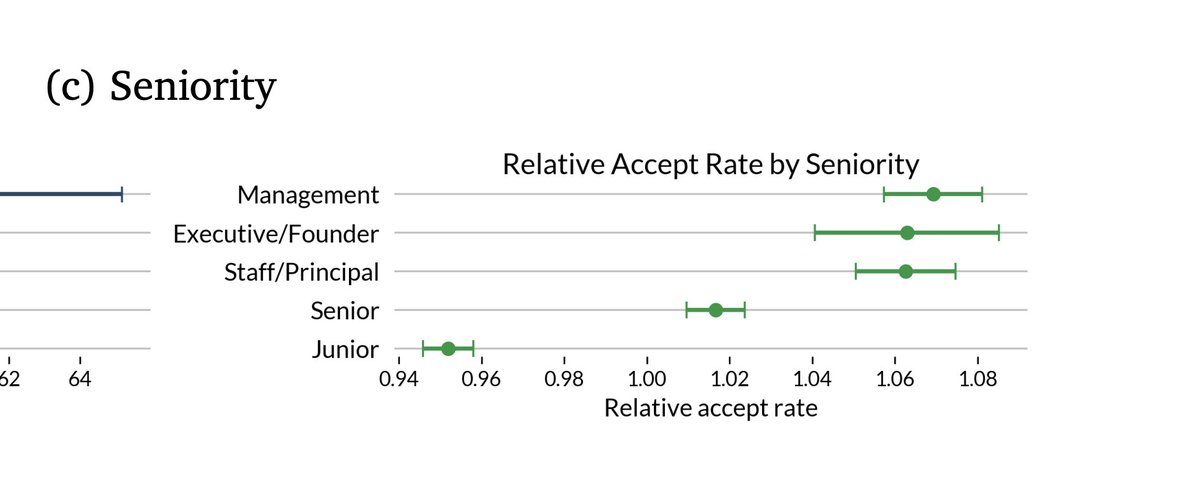
turns out, senior engineers accept more agent output than juniors. this is because: - they write higher-signal prompts with tighter spec and minimal ambiguity - they decompose work into agent-compatible units - they have stronger priors for correctness, making review faster and more accurate - juniors generate plenty but lack the verification heuristics to confidently greenlight output shows that coding agents amplify existing engineering skill, not replace it
eric zakariasson tweet media
English
171
349
4.4K
657.4K
Nature is Amazing ☘️
Nature is Amazing ☘️@AMAZlNGNATURE·
The US Air Force Reserve Hurricane Hunters flew straight through Category 5 Hurricane Melissa, capturing an incredible view from inside the storm’s eye.
English
865
13.6K
110.2K
5M
Thariq
Thariq@trq212·
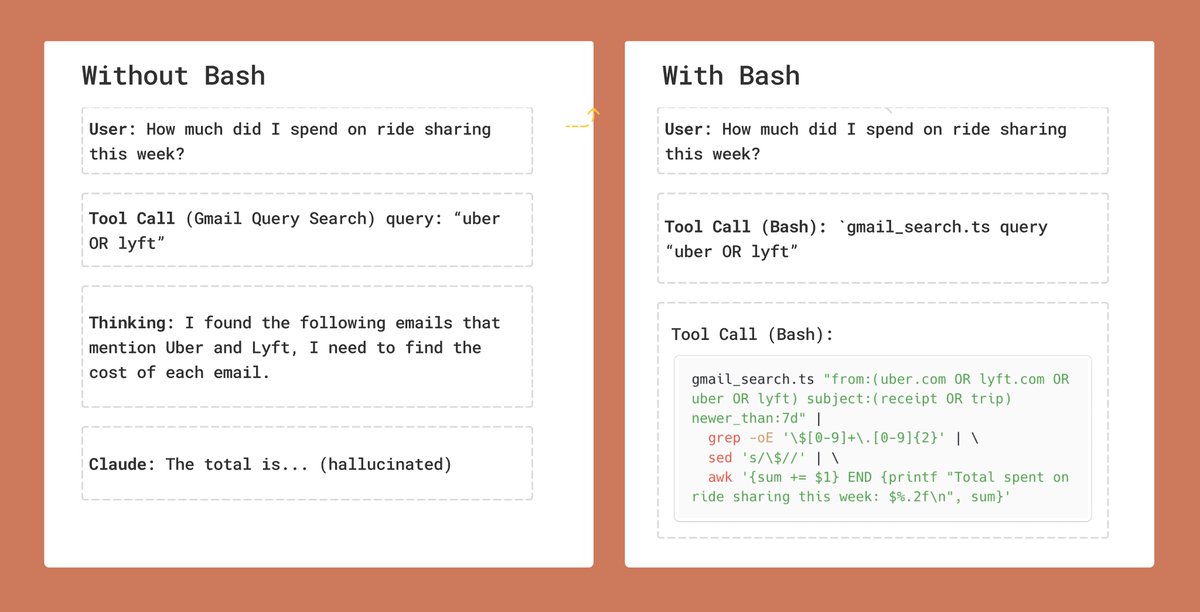
The Bash tool is one of the most powerful general purpose tools you can give an agent, but you also want to add in guardrails to make it safe. With the Claude Agent SDK we built a bash parser and permission system to make this easier: docs.claude.com/en/api/agent-s…
English
5
0
80
6.2K
Thariq
Thariq@trq212·
Why even non-coding agents need bash I've done dozens of calls with companies making general agents over the past few weeks and my advice generally boils down to: "use the bash tool more" Here's a concrete example from my email agent:
Thariq tweet media
English
54
74
987
290.5K