

Electron
5K posts

I EXPECT IRAN TO STOP/REDUCE THEIR ATTACKS ON THE GULF STARTING TONIGHT
As long as negotiations are moving forward, Iran will likely (hopefully) reduce or stop their attacks on the Gulf, and instead focus on Israel
Why?
To mend relations with their neighbors, facilitate the ongoing negotiations, and force Netanyahu to the negotiation table as well
This is based on the assumption that negotiations are actually ongoing, moving in the right direction, AND the IRGC in onboard (this part is the most important)
This would be great news for the UAE, Saudi, Qatar, Bahrain, Kuwait, and Oman
I hope soon I can say the same for Iran, Israel and Lebanon
Mario Nawfal@MarioNawfal
IMPORTANT UPDATE: Iran's demands for a peace deal with the U.S have changed Previously, they wanted U.S bases out of the region, along with compensation for the damages from the war Now their main demands are compensations, sanctions lifting, and guarantees of no future war This is very important as the removal of U.S. bases from the region is a delusional request, so I am glad this is off the table Iran also needs to forget about compensation, Trump will never accept But the other two conditions, I think they are workable I think Trump will lift the sanctions if Iran becomes more friendly to the U.S., giving Trump more leverage over the Strait of Hormuz And regarding guarantees to prevent another war, well that's easy, as Iran proved they can close the Strait of Hormuz and sustain heavy bombing while still attacking Israel and the Gulf. And they can mine the Strait. These are the ultimate deterants for any future war So in brief: - Security guaratees are already established by Iran's ability to close the Strait - Trump I think will be open to lift the sanctions - Reparations, I'm sure a solution can be found in a different format I'm optimistic we are going to get a peace deal soon!
English
@MarioNawfal This is so deranged Mario. What are you doing at this point
English
IMPORTANT UPDATE: TRUMP IS BYPASSING THE IRGC
Turns out Trump was saying the truth, but there's context
The U.S is negotiating with Iran, this wasn't a bluff
But Iran, as expected, is no longer one entity under one leadership
The IRGC, more hardline and ideological, seem hell-bent on continuing this war, as they feel they have the upper hand.
They rejected Trump's claim of ongoig negotiations, and now announced they will keep the Strait of Hormuz closed.
In the meantime we are getting reports that a U.S. delegation is meeting an Iranian delegation in Pakistan, completely bypassing the IRGC
This is a form of regime change, taking power away from the IRGC.
This could go one of two ways:
1. After enough pressure and bombing, the IRGC fold and accept concessions, losing their grip on the country. This would be GREAT news for Iran and the world
2. The IRGC remain defiant, fighting for their survival, potentially militarily overthrowing the more moderate executive branch of the country
This is an extremely important and sensitive period for Iran, Israel and the Middle East
I hope Trump can pull it off
Mario Nawfal@MarioNawfal
One of 2 things just happened: Trump either changed his mind, or Iran is folding to the pressure Her's what just went down: - Trump set an ultimatum for Iran to open the Strait of Hormuz, or he will strike their energy infrastructure - That deadline was meant to expire tomorrow morning - Iran responded defiantly and threatened to strike energy infrastructure in the region - Trump claimed negotiations went on behind the scenes, and he extended his deadline by 5 days - The Iranians claim there were no negotiations, and this is just Trump walking back his threats Either way, this is good news Either Trump exerted maximum pressure to force Iran into concessions Or Iran’s defiance and military capabilities forced Trump to walk back his threat If it’s the latter, I hope Iran does not call him out and mock him, as this will only fuel Trump to escalate again Does this all mean the war may still go on for months? Yes, but this is unlikely because: - The global economy is taking a massive hit (especially Europe and Asia) - The Gulf is pissed - American allies in Asia and Europe are also upset - Voters aren’t happy - And munition stockpiles are running low
English

MEMORANDUM TO IRAN
The balance of power has already shifted. Your point has been made.
But prolonging this conflict doesn’t extend your leverage. It exhausts it.
Three moves:
1.Neutralize neighboring friction. Don’t let this war become your neighbors’ burden. This ensures long term security.
2.Restore maritime trade. Open safe passage for all tankers. Keep the oil flowing.
3.De-escalate the Strait. You have demonstrated leverage over Hormuz. Don’t weaponise it further.
By guaranteeing global energy security, you remove the international community’s primary incentive to act against you.
Vengeance is a short-term impulse. Strategic restraint is a long-term projection of strength.
Show the world you are a rational actor capable of ending a crisis on your own terms.
That is the only demonstration of strength that endures beyond the battlefield.
English
@levine45cal @SuitablePolitic You think people will fight for that guy?
English

Yes.
The timing may be extended, to test for results.
Most importantly, the people need to regain their confidence, after the 8-9 January massacre. This requires a more gradual but not indefinite approach.
There must also be a compelling trigger for the uprising - perhaps delivering Pahlavi into Iran, or something similar.
Otherwise you are spot on.
English

Most people have figured out that Iran was very unlikely to just say "The Strait is wide open!! Sorry!! Please don't bomb my power plants!"
What always trips people up is that they assume Trump doesn't know that. That he actually believes the IRGC will just bend over backwards.
It's a common mistake at lower levels of chess. Assessing your own options, comparatively, is the easy part.
But assessing your opponent's options accurately? That's the hard part.
Trump is extremely good at that. It's why he's so good in negotiations and foreign policy. (Aka negotiations with guns and bombs)
Most analysts aren't very good at that.
They aren't looking at the board from Trump's perspective.
Let's do that here.
You issue that ultimatum. You have to assume that you'll have to make good on your threat.
You bomb the power plants using the graphene bombs that will disrupt electricity for the next 24 or so hours.
Why the hell do you want the lights shut off for 24 hours?
Most people assume it's either neutral or negative to regime change. They assume that because it's the opposite of how we conducted ourselves in instances like the Arab Spring or that Ukraine kerfuffle.
But the Arab Spring approach was always off the table. They banned the internet. We have ways around that, but nowhere near enough circumvention to actually coordinate a revolution.
So, how the hell were we planning to do it?
I'd be using the living hell out of CIA Operations Officers, MOSSAD Officers, and probably even ODA's. (A contingent of highly trained Special Forces.)
In order to give those guys operational freedom, I'd have made sure to disassemble the IRGC until they were a scattered mess of loosely organized soldiers that lack the capacity for robust counterintelligence.
Oh, right, that's what we've been doing from Day 1 of Epic Fury.
These guys would be able to communicate with each other even after the lights go out. At least within their various units and networks.
But once the lights go out?
The regime loses its technological advantage over the insurgents.
The scattered mess of the IRGC will no longer be able to communicate with nearly enough precision to defend themselves from several attacks simultaneously.
Can we field several attacks simultaneously?
Of course! That's how the CIA largely runs intelligence networks nowadays.
We've essentially borrowed the best pieces of how terror cells operate.
On-the-ground autonomy. Everyone is structuring and planning a separate attack that no central command will have to green light.
They've been given a collective go signal.
When the lights go out. You go.
They've been given 48 hours to make final preparations for whatever plans they have in store.
They'll be given a 24 hour window where the enemy is blind, deaf, and dumb.
At that point, the regime will have to defend itself from a thoroughly established ground force made predominantly from the protestors they'd have wished to kill.
And then, as they dig in their heels for the fight right in front of their face?
Tripoli descends upon their flank and we seize Kharg Island, cutting off the IRGC's ability to fund its own defense.
Derek. 🇺🇸@SuitablePolitic
It's almost like he anticipated that answer!
English
@SuitablePolitic On their flank? You know the battlefield is bigger than a football field, or town, or city right?
What will they do one they are on the island? How will they hold it inside missile and drone range? How will they get there, past hundreds of miles of the Persian Gulf shore?
English
@pagerdude @shanaka86 .... it's possible to re-excavate exits i guess?
English

@shanaka86 The issue is they get one or two launches at an exit before it is bombed. They will run out of launch portals before the IS and Israel run out of bombs. It's is a classic war of attrition with no boots on the ground. Iran cannot out last it.
English

BREAKING: Iran built a subway system for ballistic missiles inside a granite mountain south of Yazd. Automated rails move warheads and transporter-erector-launchers between assembly halls, storage vaults, and three to ten blast-door exits carved into the mountainside at depths reaching 500 metres. A TEL rides the tracks to an exit, surfaces, fires, and retreats underground before the strike aircraft can respond. The mountain has been under construction for two decades. The IRGC did not build a bunker. It built a weapons factory with its own internal railway, buried deeper than any conventional bomb can reach.
The United States and Israel have struck Yazd Imam Hussein on March 1st, March 6th and March 17th and even earlier today!
Satellite imagery shows collapsed portals, cratered ventilation shafts, and destroyed surface infrastructure. The visible damage is real. The invisible infrastructure is intact. On March 20, a long-range ballistic missile launched from the Yazd complex, failed during boost phase, and crashed near Kohistan Park inside Yazd City itself. The launch failed. The fact that it happened at all is the proof. Three weeks of precision strikes on the portals did not stop the railway behind them from delivering a missile to a surviving exit.
The engineering is simple in concept and devastating in practice. Each blast door is a separate exit point. When one is destroyed, the rail system reroutes to another. When that door is struck, it is backfilled with soil and concrete by the IRGC from inside, then re-excavated when the bombing pauses. CNN satellite analysis confirmed the rail layouts. Alma Research mapped the tunnel networks. The IDF acknowledged that approximately 60 percent of launch infrastructure has been destroyed. The US estimated 50 percent of capacity remains. That remaining 50 percent rides underground rails that no bomb in the American or Israeli arsenal can reach at 500 metres through granite.
The GBU-57 Massive Ordnance Penetrator, the largest bunker-buster ever built, penetrates approximately 60 metres of reinforced concrete or roughly 40 metres of moderate rock. Granite is harder than moderate rock. Five hundred metres is more than twelve times the weapon’s maximum penetration depth. The gap between the bomb and the tunnel is not a margin of error. It is a physical impossibility. The mountain does not care how many sorties are flown above it. The railway does not care how many portals are sealed. The geology is the defence, and the geology has been there for 300 million years.
This is why the war continues. Every missile that hits Arad, Dimona, or central Israel was assembled underground, moved on rails to an exit, and fired from a door that may have been destroyed and rebuilt multiple times since February 28. The persistence of Iranian missile fire despite three weeks of intensive strikes is not resilience. It is infrastructure. The IRGC did not prepare for this war by building rockets. It prepared by building railways inside mountains. The rockets are replaceable. The railways are permanent. And the granite that protects them was formed before mammals existed.
The strait is 21 miles wide. The mountain is 500 metres deep. And the railway inside it is still delivering missiles to the surface.
open.substack.com/pub/shanakaans…
Shanaka Anslem Perera ⚡@shanaka86
The United States bombed Iran’s Imam Hussein missile base south of Yazd on March 1st, March 6th, and March 17th. On March 20th, a missile launched from the same complex, failed during boost phase, and crashed near Kohistan Park in Yazd City itself. The base is still launching. The missiles are failing. And when they fail, they fall on Iranian civilians. Three strikes on the same base in three weeks and the base is not dead. It is degraded. The difference matters. The answer is underneath 500 metres of granite. Iran’s missile bases are not buildings. They are mountains. The IRGC spent two decades carving tunnel networks into ranges south of Yazd, east of Tehran at Khojir and Parchin, and across Shahrud and Isfahan. CNN satellite analysis confirmed automated internal rail systems that move missiles like train wagons between multiple blast-door exits without surfacing. The US bombs an entrance. The missile exits a different door. The rail moves the launcher to a third. Each complex has between three and ten exits. Many have been backfilled with soil and concrete to absorb strikes, then re-excavated from inside. The tunnel depth is the variable that no amount of precision munitions can overcome. Five hundred metres of granite is beyond the penetration capability of every conventional weapon in the American arsenal. The GBU-57 Massive Ordnance Penetrator, the largest bunker-buster ever built, penetrates approximately 60 metres of reinforced concrete or 40 metres of moderately hard rock. Against hard granite it penetrates far less. The deepest sections of Iran’s missile cities sit at least ten times beyond that. The strikes destroy what is visible: ventilation shafts, portal frames, surface infrastructure, vehicles caught outside. They do not reach the rail networks, the assembly halls, or the storage chambers buried inside the mountain. The failed launch proves the system is degraded but not destroyed. The missile reached boost phase and then fell back onto Iranian territory near a civilian park. That is not a success for Iran. But it is not the elimination of capability either. IDF estimates suggest 60 percent of Iran’s national launcher stockpile has been eliminated. US officials place the figure closer to 50 percent remaining. The difference is the underground inventory that satellite imagery cannot see and bunker-busters cannot reach. Mobile transporter-erector-launchers mounted on eight-wheel trucks exit the tunnels, fire, and retract or reposition within minutes. The doctrine is called shoot-and-scoot. It was developed during the Iran-Iraq War when Saddam’s air force hunted Iranian Scud launchers across the western desert. The IRGC learned that mobility is cheaper than armour. A truck that moves after firing survives. A silo that stays still does not. Production facilities at Khojir, Parchin, and Shahrud have suffered 60 to 70 percent damage. But missiles built before the war and stored inside mountains before the first bomb fell are still there. The rail moves them. The blast doors open. The TEL rolls out. The missile fires. The TEL retreats. The entrance is bombed again. Inside the mountain, the next launcher is already moving to the next exit. Natanz taught the world that you cannot bomb an equation. Yazd is teaching the world that you cannot bomb a geology. The physics of fission survived five strikes because knowledge is immortal. The missiles of Yazd survived three strikes because granite is harder than any warhead designed to penetrate it. Both lessons will outlast this war. The mountain does not need orders. The rail does not need a supreme leader. And the next exit is already open. open.substack.com/pub/shanakaans…
English

It’s my understanding that they have a nuclear bunker-buster bomb that can do the job. It uses an antimatter detonator, so there’s no radioactive fallout. The explosion is 100% efficient. The antimatter is really expensive to create. I’m sure they were hoping to resolve this using a less expensive weapon.
GIF
English
@JohnFawcettNY @wanglaurentceo How do you bury undersea cables into the earth? Have you ever seen the sea?
English

Look at this.
This is in Israel today.
And this could be Rome, Berlin or Paris.
English
@DropSiteNews Why wouldn't they just keep selling to the Chinese then
English

💰 U.S. Treasury Secretary Scott Bessent says he is “jujitsuing the Iranians.”
The decision to lift sanctions on the 140 million barrels of Iranian oil stored on tankers, he says, will prevent China from purchasing it at steep discounts, and will allow the U.S. to track the oil flow.
Bessent claimed Iran will have “difficulty accessing” the nearly $17 billion in revenue generated from the oil sales because banking sanctions remain in place, suggesting the money could be delayed, discounted, or effectively trapped.
English

The U.S. Navy doesn’t understand how resilient oil tankers are, according to comments from former CENTCOM commander in this TWZ interview.
It’s surprising and not. USN rarely deals with commercial shipping issues. But could be why we’re still talking about naval escorts rather than air power to reopen Hormuz.
Here’s Votel’s comments:
“But the mines, I think, are a really, really hard issue. And when we think about one of these big tankers, so they are just really vulnerable, they’re thin-hulled, getting into this very narrow traffic scheme that’s there – two miles wide, right in the middle of the Strait and then hitting a mine and being disabled on the spot. Not only will we have a mine problem, we have a disabled ship problem and an ecological disaster, and a whole bunch of other things there. So in my view, I think the worst case situation kind of looks like a deliberate mining effort by the Iranians.”
Wrong info:
—Oil tankers today have double hulls, neither thin nor vulnerable. But even when tankers had single hulls during the Iran-Iraq war, they were so resilient to mines that U.S. navy destroyers sailed BEHIND the tankers for protection. *The tankers protected the destroyers from mines.*
—The narrowest navigable passage is 20 miles, not 2 miles. The traffic lanes are 2 miles wide to reduce accidents in a congested waterway, but it’s not a physical barrier. It’s like the difference between the physical width of a whole highway vs. the lanes painted for cars. Tankers can sail outside the lines for 20 miles. Multiple disabled tankers couldn’t block the strait. To be fair, Votel called it a traffic scheme but I think this point is easily misunderstood.
—Spilling oil isn’t ecologically good, obvs, but oil cargoes in VLCCs are stored in 15-17 different cells (depending on ship design) and if you rupture one, you only spill its contents — maybe ~120,000 barrels — on a total cargo of 2 million barrels. Still not good but not total emptying.
—Even ruptured tankers, even incinerated tankers, usually stay afloat and can often be repaired so they can sail away under their own power. That happened with the MV Limburg off the coast of Yemen in 2002. It was struck by a suicide boat, lost 50k barres of oil and burned for 2 days. On day 3 it was repaired and sailed away on its own power. It was subsequently renamed the Maritime Jewel and was in service until at least 2009.
Any mission to open the Strait of Hormuz under Iranian fire would be costly and risky. But it’s shocking to me that the USN @USNavy @CENTCOM doesn’t know the basics of oil
shipping when they’ve been preparing this contingency for years.
They need to talk with industry, stat.
The Coast Guard @USCG might have this knowledge because they DO deal with commercial shipping issues but they’re so far down the bureaucratic prestige chain I’m not sure people would listen (sorry USCG, you rock and I’m a big fan).
This lack of understanding might be why the USN and U.S. policymakers keep talking about using naval escorts rather than air power, as if this was still WWII.
@defpriorities @haltman
twz.com/news-features/…
English

Shocking footage from this evening of a ballistic missile striking the city of Dimona in southern Israel. Home to 40,000 residents, a direct hit on a civilian neighborhood is a war crime!
I’m furious that world leaders still refuse to stand up and call out Iran.
When Israel defends itself, every UN body goes crazy — cheered on by hypocritical Western nations.
English

1/2
About 40 minutes ago ...
*TRUMP GIVES IRAN 48 HOURS TO OPEN STRAIT OF HORMUZ
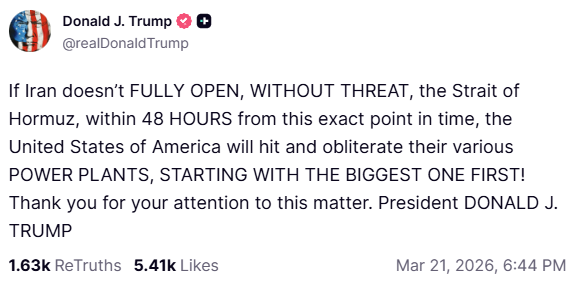
English

COLLINS: Some people might say, why would you ease sanctions on a country that the US is currently at war with?
REP. SCOTT PERRY: Do you think Iran is getting the check for that oil and get the money?
COLLINS: Yes. That's what's happening
English
@rosenthal_jon So.... what, someone is going to sit on those tiny islands for a short period of time then get bombed? What possible use are they for opening the straight
English

There is lots of chatter about Kharg Island being a possible target for capture by American forces. This misses the point. If the objective is to open the Hormuz Strait to shipping, then surely the Iranian-held islands that threaten the strait make more sense. Your thoughts?
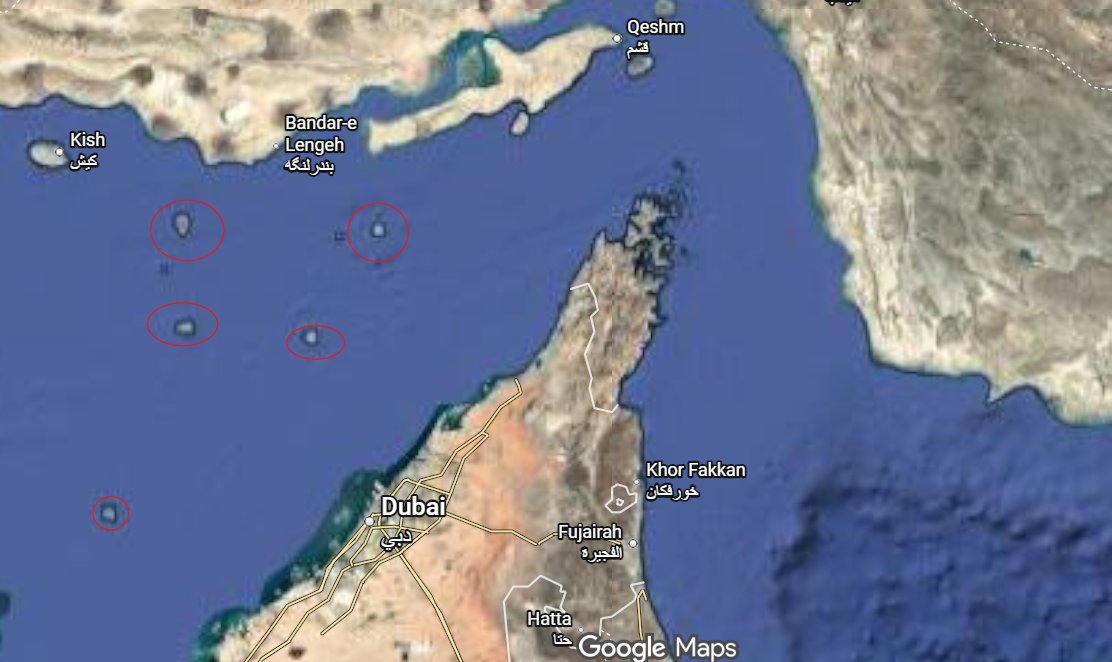
English
@TheMindScourge How long are those plans going to take, genius? As long as they will takes, years to decades, is how long the leverage has power
English

Hormuz is a weapon that can only be fired once
No one should expect a quick resolution to the current crisis, but across the next decade, even the next 3-5 years, the choke point of Hormuz will be massively substituted for
The Gulf Arab states are all very rich, with high per capita GDP - the best single measure of relative state capacity - easy access to global markets, especially financial, and have the favorable backing of the US
Everyone has known about the Hormuz vulnerability for decades. The Iranians have continually hinted around closing it, but never did. Now they have, but Hormuz is a gun that cannot be reloaded.
Deterrents work only up to the point of use. Once used, they have failed. The purpose of a deterrent is to *not* be used
Many analysts have made this basic mistake. They think that Iran is now in a position of strength, having exercised its Hormuz option. But the opposite is true. A state is weakest after it has used its deterrent. The cost of that deterrence is now priced in. The worst having been done, the targets of the deterrent are now free to make other arrangements. Before, they were reluctant to do so because of the switching costs. Now, they have no choice; they will not allow themselves to be controlled in this way again
Hormuz may never reopen. But the importance of this is a depreciating asset.
English

Iranian strikes are hammering U.S. bases hard — here’s why:
Former U.S. Army officer Stanislav Krapivnik says their defenses were never intended to last beyond 3–4 days.
Drones are now roaming Gulf states with zero resistance.
And this is just the beginning.
Watch the breakdown on The Sanchez Effect.
English
@FurkanGozukara Why bother to show radars and trucks, launchers when all that stuff will be blown to hell before anything happens there
English

Iran has turned its islands into unsinkable aircraft carriers. Qeshm Island is a massive labyrinth of underground missile bunkers and drone bases. They track US warships long before they even reach the Gulf. Absolute strategic dominance.
English
@johnkonrad @gCaptain So..... burn all credibility, push all allies to BRICS, lose the midterms with a humiliating no-result in the conflict, then once everyone has had weeks of pain and Iran in the position of leverage making deals all that time, then charge in and "open the strait"? ...how?
English

@gCaptain And here’s the best book documenting how Europe leveraged America’s maritime apathy the last 50 years
amzn.to/40F3YTu
English
Let's unpack this..
What if the White House has no intention of reopening the Strait of Hormuz?
What if this war is really about ships & tariffs?
I had a long discussion with senior DOE official yesterday on background. I can’t share any details but it’s clear everyone’s Strait of Hormuz calculus is wrong.
We need to go back to the drawing boards.
That's it. That's the tweet. Now a hypothetical 🧵 with my personal thoughts.
Ezra A. Cohen@EzraACohen
English
@FurkanGozukara ... how would they have control of the sea all around? Don't get it
English
CNN openly broadcasting US plans to invade Iran and seize their oil.
Former NATO Commander Adm. Stavridis says 2,500 Marines will seize Kharg Island to hold Iran's economy hostage.
"They are really nothing more than a gas station."
Blatant imperialism on live TV.
English