amayhem

96 posts

amayhem

amayhem

@fmstrade

Beigetreten Kasım 2017
254 Folgt20 Follower
amayhem
amayhem@fmstrade·
@CamiRusso I think this is inevitable (the yield exists in DeFi anyways). So the only solution will be the creation of some UBI system.
English
0
0
0
10
amayhem
amayhem@fmstrade·
@CamiRusso It is not just that. If there is so much more yield in crypto rails, everybody will take the money out of the banks. Then banks will no longer be able to lend credit (print new money) and the system will enter collapse. A new form of printing new money is needed in parallel.
English
1
0
0
77
Camila Russo
Camila Russo@CamiRusso·
I can’t believe the market structure bill is being held up because banks are legitimately saying: stop stablecoin yield because it will expose the bad deal we’ve been giving our depositors for decades and that will drive deposits away. And that’s a fair point that’s being considered and weighed. Lawmakers should be laughing them out of the room saying yeah that’s the point.
English
26
21
216
11.4K
amayhem retweetet
vitalik.eth
vitalik.eth@VitalikButerin·
2026 is the year that we take back lost ground in terms of self-sovereignty and trustlessness. Some of what this practically means: Full nodes: thanks to ZK-EVM and BAL, it will once again become easier to locally run a node and verify the Ethereum chain on your own computer. Helios: actually verify the data you're receiving from RPCs instead of blindly trusting it. ORAM, PIR: ask for data from RPCs without revealing which data you're asking, so you can access dapps without your access patterns being sold off to dozens of third parties all around the world. Social recovery wallets and timelocks: wallets that don't make you lose all your money if you misplace your seedphrase, or if an online or offline attacker extracts your seedphrase, and *also* don't make all your money backdoored by Google. Privacy UX: make private payments from your wallet, with the same user experience as making public payments. Privacy censorship resistance: private payments with the ERC-4337 mempool, and soon native AA + FOCIL, without relying on the public broadcaster ecosystem. Application UIs: use more dapps from an onchain UI with IPFS, without relying on trusted servers that would lock you our of practical recovery of your assets if they went offline, and would give you a hijacked UI that steals your funds if they get hacked for even a millisecond. In many of these areas, over the last ten years we have seen serious backsliding in Ethereum. Nodes went from easy to run to hard to run. Dapps went from static pages to complicated behemoths that leak all your data to a dozen servers. Wallets went from routing everything through the RPC, which could be any node of your choice including on your own computer, to leaking your data to a dozen servers of their choice. Block building became more centralized, putting Ethereum transaction inclusion guarantees under the whims of a very small number of builders. In 2026, no longer. Every compromise of values that Ethereum has made up to this point - every moment where you might have been thinking, is it really worth diluting ourselves so much in the name of mainstream adoption - we are making that compromise no longer. It will be a long road. We will not get everything we want in the next Kohaku release, or the next hard fork, or the hard fork after that. But it will make Ethereum into an ecosystem that deserves not only its current place in the universe, but a much greater one. In the world computer, there is no centralized overlord. There is no single point of failure. There is only love. Milady.
English
990
928
6.2K
570.8K
amayhem
amayhem@fmstrade·
@avantisfi @jessepollak great way to be for traders increasing the minimum trade size to 1000 usd... congratulations
English
0
0
0
35
jesse.base.eth
jesse.base.eth@jessepollak·
Tl;dr: We’re focusing the Base app to be trading-first to drive demand and distribution for every asset and to be the best app for whatever you do in the onchain economy. Since announcing the Base app in July, hundreds of thousands of you have used the app to create, trade, save, spend, and build. Seeing the adoption has been incredible. We've also heard clear feedback about what's landing and isn't. Three themes stand out: - The app felt overly focused on social. It came across as too close to web2, and didn’t show support for the full breadth of assets that people want to trade. - Everyone wants more high quality assets. In general there is a desire to engage with and trade high quality assets. This is the most important opportunity as we bring capital markets onchain. - The feed needs to surface everything: Having a feed of what's happening onchain is a good idea, but it needs to surface apps, stocks, predictions, and every asset class (with social tokens are just one of many). In a world where everything is tokenized and tradeable, the single most valuable thing we can do is drive demand and distribution to everyone. That’s exactly what the Base app is going to do. We’re going to make the Base app the best place to trade and use every asset. Concretely this means: 1. We’re going to build for trading first. Having trading as our primary focus will help us bring demand and capital for all rapidly growing asset classes in the economy. 2. We’re going to bring more high quality assets onchain. To best serve the trading use case, we’re going to make it so everything is tradable in the app — protocols, apps, stocks, predictions, memes, and yes creators too. We’re going to lean into a finance-first UX. We be 3. We’re going to lean into a finance-first UX. We believe it makes more sense to layer social features on top of finance, than the other way around. This means we'll continue to experiment with features like copy-trading, feed-trading, and leaderboards. This is going to be hugely additive to the Base economy because it's going to drive more capital and users to every asset and app. Base app will be the best self-custodial wallet to trade and use every asset, globally accessible, with fast, simple onboarding for everyone, everywhere. Base chain will continue to be the best chain to build anything, now supercharged with even more distribution. We’re building this together, in the open, and seeing how people use the app keeps teaching us what matters most. Thank you for the continued feedback. Stay based.
English
856
537
2.6K
762.6K
amayhem retweetet
vitalik.eth
vitalik.eth@VitalikButerin·
Encrypted messaging, like @signalapp, is critical for preserving our digital privacy. Two important next steps for the space are (i) permissionless account creation and (ii) metadata privacy. @session_app and @SimpleXChat are two messaging apps pushing these directions forward. For this reason I've donated 128 ETH to each. Addresses available on their websites if you wish to follow on: getsession.org simplex.chat But also, actually download and use them! Neither of the two are perfect pieces of software, they have a way to go to get to truly optimal user experience and security. Strong metadata privacy requires decentralization, decentralization is hard, users expecting multi-device support makes everything harder. Sybil / DoS resistance, both in the message routing network and on the user side (without forcing phone number dependence) adds further difficulty. These problems need more eyes on them. I wish all teams working on these important problems best of luck.
English
799
1.1K
5.8K
936.1K
MetaMask 🦊
MetaMask 🦊@MetaMask·
The best way to get started with MetaMask Rewards is with a referral code. 🦊 Reply with your referral code so people can use it! 👇
English
1.6K
352
2.4K
269.8K
amayhem retweetet
Ethereum Foundation
Ethereum Foundation@ethereumfndn·
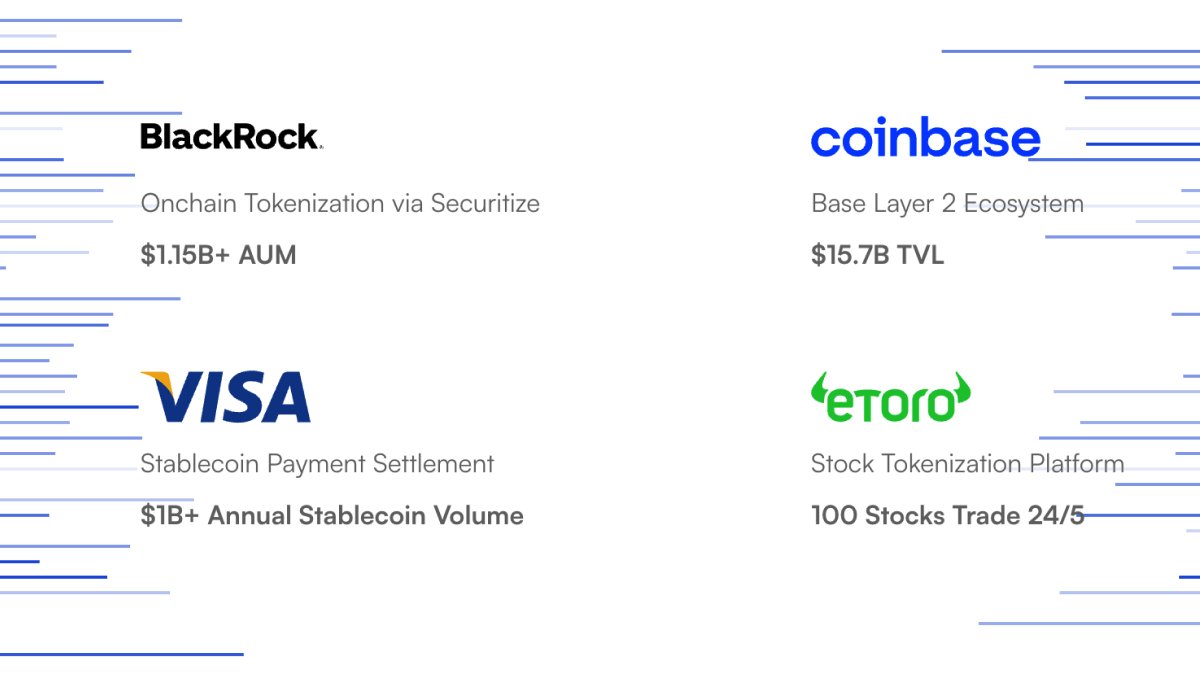
3/ Ethereum provides a strong backbone to the onchain economy, secured by 1.1M+ validators & proven by 10+ years of uptime Onchain products from teams like @BlackRock @Visa @eToro @coinbase achieve billions in AuM, trillions in volume, and innovate on Ethereum
Ethereum Foundation tweet media
English
2
10
233
16.6K
amayhem retweetet
Ethereum Foundation
Ethereum Foundation@ethereumfndn·
2/ Clear pathways are essential as institutions build on Ethereum This site is a new resource from the EF's Enterprise Acceleration team, to → guide businesses adopting Ethereum → showcase the ecosystem building a new financial system institutions.ethereum.org
Ethereum Foundation tweet media
English
5
29
276
27.5K
amayhem retweetet
Ethereum Foundation
Ethereum Foundation@ethereumfndn·
1/ Now live: the Ethereum for Institutions site Ethereum is the neutral, secure base layer where the world's financial value is coming onchain Today, we’re launching a new site for the builders, leaders, and institutions advancing this global movement
English
169
466
2.2K
789.6K
amayhem retweetet
Ethereum Foundation
Ethereum Foundation@ethereumfndn·
1/ New data confirms: @Ethereum is the #1 ecosystem for new developers in 2025.
Ethereum Foundation tweet media
English
330
465
2.4K
1.2M
amayhem retweetet
Justin Drake
Justin Drake@drakefjustin·
Progress toward real-time proving for Ethereum L1 is nothing short of extraordinary. In May, SP1 Hypercube proved 94% of L1 blocks in under 12 seconds using 160 RTX 4090s. Five months later Pico Prism proves 99.9% of the same blocks in under 12 seconds, with just 64 RTX 5090s. Average proving latency is now 6.9 seconds. Performance has outpaced Moore's law ever since Zcash pioneered practical SNARKs a decade ago. Today's Pico Prism results are a striking reminder of that exponential curve. Beyond performance, zkVM diversity is remarkable. At least nine zkVMs are racing toward real-time proving: Airbender, Ceno, Jolt, OpenVM, Pico Prism, R0VM, SP1 Hypercube, Ziren, ZisK. That diversity is strength, similar to CL and EL client diversity. Fusaka, expected in December, will simplify real-time proving. EIP-7825 caps per-tx gas usage, enabling more parallel proving via subblocks. MODEXP, a prominent "prover killer", is being repriced with EIP-7823 and EIP-7883. By year's end several teams will prove every L1 EVM block on a 16-GPU cluster, drawing less than 10kW total. The 10kW target—about the same as a Tesla home charger—matters for on-prem proving in garages and offices, eliminating reliance on cloud proving. gigagas frontier L1 throughput has grown 100x since genesis ten years ago, from 20 kilogas/sec to 2 megagas/sec. With zkEVMs we can 100x again, in half the time. The key is to bypass validators as Ethereum's current scalability bottleneck. Lean execution proofs also decentralise validation. Goodbye 4TB NVMe, 8 cores, 64GB RAM recommended by EIP-7870. A Raspberry Pi running statelessly, or even a phone, will soon suffice. The scalability vs decentralisation dilemma is dying. Zooming out, the lean Ethereum vision is gigagas L1 and teragas L2. Gigagas L1 (10K TPS) means high-value payments, trading, and social apps directly on mainnet. Teragas L2 (10M TPS) means welcoming the entirety of finance onto Ethereum. Nov 22: Ethproofs day demo Behind the scenes teams are preparing a special Devconnect demo. In 38 days my home validator will run on zkEVM proofs. My mighty Geth node will go dark—no more execution client. Devconnect Argentina is Ethereum's world fair. World fairs unveiled the lightbulb, running water, cars, refrigeration, phones, escalators. Real-time proving is Ethereum's lightbulb moment. Ethereum's future is bright. Believe in something :)
Brevis@brevis_zk

Announcing Pico Prism, the state-of-the-art zkVM for Ethereum real-time proving. 99.6% of blocks proven under 12 seconds, 6.9s average with 64 RTX 5090 GPUs. This marks a major step toward scaling Ethereum by 100x and a future where you can validate the chain from a phone.

English
221
472
2.3K
861K
amayhem retweetet
Nico
Nico@ncsgy·
1/ It’s time for us to go public so you all can go private, and it’s time for us to be bold so you all can be safe. As part of our work with the @ethereumfndn, @VitalikButerin and I are proud to be the faces of Kohaku. 🧵👇
Nico tweet media
English
158
225
1.2K
419.4K
amayhem retweetet
binji
binji@binji_x·
ethereum researcher binji!
binji tweet media
Bankless@Bankless

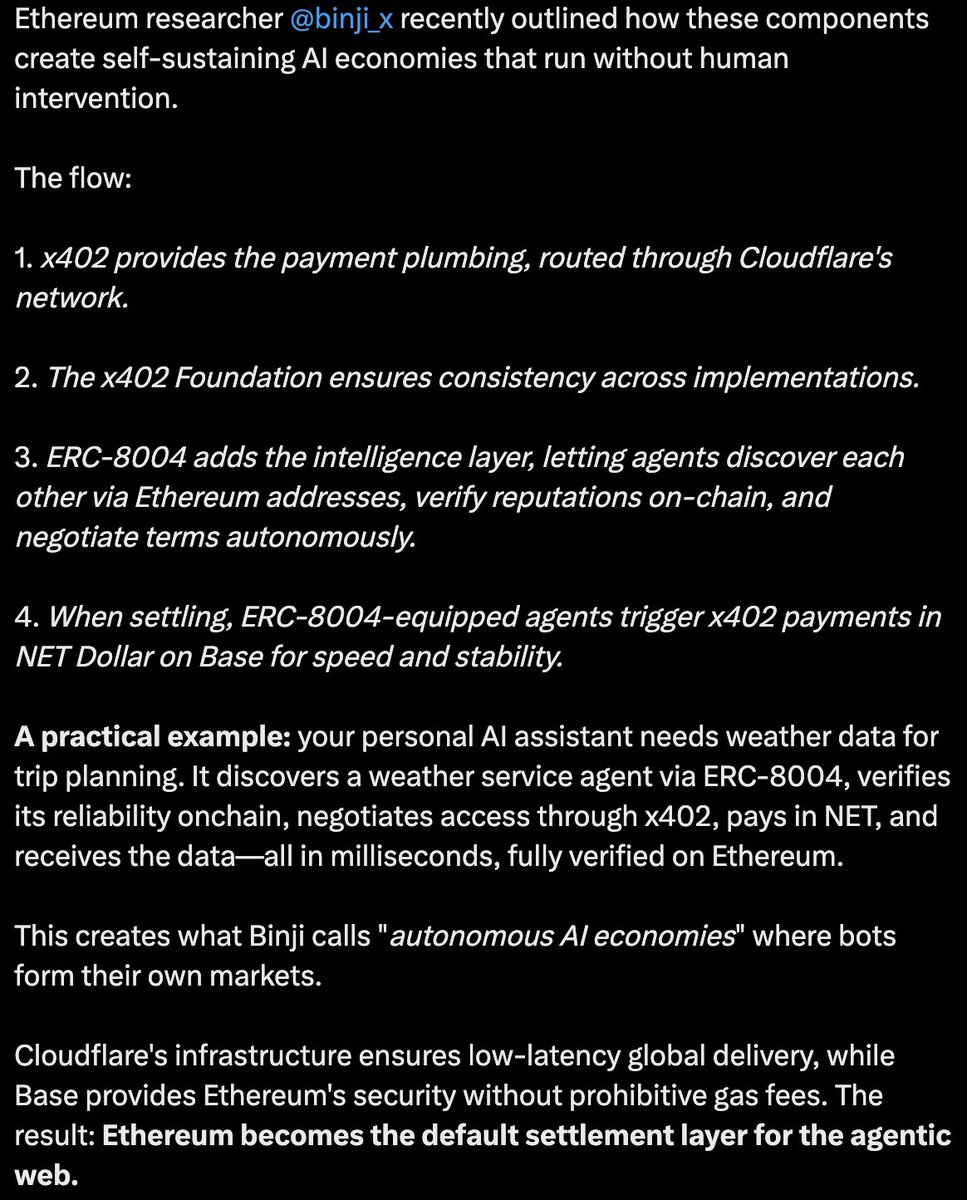
Recently, Coinbase and Ethereum have unveiled infrastructure that fits together for a bigger vision: ETH as the default rails for AI agents to transact and collaborate seamlessly. Last week's x402 Foundation and Cloudflare's NET Dollar announcements seal the full stack, connecting how AI on ETH drive web commerce. Let's connect the dots.👇 ~~ Analysis by @davewardonline ~~ x402 Back in the 1990s, web architects reserved HTTP status code 402 for "Payment Required," but traditional payment systems like credit cards proved too slow and expensive for microtransactions. Now blockchain has made it practical. Released in May by @coinbase, x402 resurrects this dormant standard, letting websites flag premium content during HTTP requests. When you or your AI agent hits paywalled content, the browser automatically handles a crypto micropayment and unlocks access instantly, no redirects, no logins. Built for chains like Ethereum's @base, x402 enables transactions as small as fractions of a cent, transforming the web into a true pay-per-use marketplace. It's already used in @Google's A2A protocol today! ERC-8004 Then came ERC-8004 last month, a universal standard for AI agents to discover services, verify identities, and transact. Under 8004, each agent gets a blockchain "passport" for reputation checks, extending agent-to-agent protocols with trust layers for secure deals. The x402 Foundation Co-launched by Coinbase and @Cloudflare last Tuesday, the x402 Foundation will steward the protocol through tooling, grant distribution, and advocacy to ensure it becomes the standard for agent-to-agent communication. NET Dollar The latest piece is NET Dollar, a stablecoin announced by Cloudflare last Thursday. Like other stablecoins, NET Dollar will be USD-pegged and 1:1 backed, but it's tailor-made for bots, code-programmable and optimized for agent use across the x402 protocol. Weaving the Stack: How It All Connects Ethereum researcher @binji_x recently outlined how these components create self-sustaining AI economies that run without human intervention. The flow: 1. x402 provides the payment plumbing, routed through Cloudflare's network. 2. The x402 Foundation ensures consistency across implementations. 3. ERC-8004 adds the intelligence layer, letting agents discover each other via Ethereum addresses, verify reputations on-chain, and negotiate terms autonomously. 4. When settling, ERC-8004-equipped agents trigger x402 payments in NET Dollar on Base for speed and stability. A practical example: your personal AI assistant needs weather data for trip planning. It discovers a weather service agent via ERC-8004, verifies its reliability onchain, negotiates access through x402, pays in NET, and receives the data—all in milliseconds, fully verified on Ethereum. This creates what Binji calls "autonomous AI economies" where bots form their own markets. Cloudflare's infrastructure ensures low-latency global delivery, while Base provides Ethereum's security without prohibitive gas fees. The result: Ethereum becomes the default settlement layer for the agentic web. --- For Ethereum, this stack represents an ambitious play to become the backbone for all AI commerce, very in line with the original "Web 3" vision. The Cloudflare partnership amplifies this dramatically. With Cloudflare powering roughly 20% of all websites and handling traffic for over 25M internet properties, championing x402 provides unmatched distribution. Projections suggest agent-driven GDP could hit $10 trillion by 2030, so these rails could allow Ethereum to capture value from every autonomous transaction. For Cloudflare, issuing NET transforms them from a content delivery network into something resembling a digital bank. They can earn yields on stablecoin reserves while monetizing the growing bot traffic that already comprises 30% of global web activity. If there's one thing for you to take away here, it's that these announcements aren't isolated experiments. They're the foundation for an AI-powered internet where agents transact as easily as servers exchange data today, all powered by our very own Ethereum.

29
27
286
28.5K
amayhem retweetet
ori shimony
ori shimony@orishim·
Ethereum is for real-world commerce. 1/ Earlier this year I completed a research fellowship at the Ethereum Foundation studying how Ethereum can enable peer-to-peer marketplaces for real world goods & services. Here are the key takeaways.
ori shimony tweet media
English
26
56
176
42.5K
amayhem retweetet
dYdX
dYdX@dYdX·
Builders: integrate dYdX perps, route orders onchain, and earn on every fill with Builder Codes - no whitelists, fully transparent. And if you ship something cool, dYdX will spotlight it 🫡 Start building ➡️ dydx.xyz/blog/builder-c…
dYdX tweet media
English
14
10
57
6.1K
amayhem retweetet
vitalik.eth
vitalik.eth@VitalikButerin·
Amazing to see so many major L2s now at stage 1. The next goal we should shoot for is, in my view, fast (<1h) withdrawal times, enabled by validity (aka ZK) proof systems. I consider this even more important than stage 2. Fast withdrawal times are important because waiting a week to withdraw is simply far too long for people, and even for intent-based bridging (eg. ERC-7683), the cost of capital becomes too high if the liquidity provider has to wait a week. This creates large incentives to instead use solutions with unacceptable trust assumptions (eg. multisigs/MPC) that undermine the whole point of having L2s instead of fully independent L1s. If we can reduce native withdrawal times to under 1h short term, and 12s medium term, then we can further cement the Ethereum L1 as the default place to issue assets, and the economic center of the Ethereum ecosystem. To do this, we need to move away from optimistic proof systems, which inherently require waiting multiple days to withdraw. Historically, ZK proof tech has been immature and expensive, which made optimistic proofs the smart and safe choice. But recently, this is changing rapidly. ethproofs.org is an excellent place to track the progress of ZK-EVM proofs, which have been improving rapidly. Formal verification on ZK proofs is also advancing. Earlier this year, I proposed a 2-of-3 ZK + OP + TEE proof system strategy that threads the needle between security, speed and maturity: ethereum-magicians.org/t/a-simple-l2-… * 2 of 3 systems (ZK, OP) are trustless, so no single actor (incl TEE manufacturer or side channel attacker) can break the proof system by violating a trust assumption * 2 of 3 systems (ZK, TEE) are instant, so you get fast withdrawals in the normal case * 2 of 3 systems (TEE, OP) have been in production in various contexts for years This is one approach; perhaps people will opt to instead do ZK + ZK + OP tiebreak, or ZK + ZK + security council tiebreak. I have no strong opinions here, I care about the underlying goal, which is to be fast (in the normal case) and secure. With such proof systems, the only remaining bottleneck to fast settlement becomes the gas cost of submitting proofs onchain. This is why short term I say once per hour: if you try to submit a 500k+ gas ZK proof (or a 5m gas STARK) much more often, it adds a high additional cost. In the longer term, we can solve this with aggregation: N proofs from N rollups (plus txs from privacy-protocol users) can be replaced by a single proof that proves the validity of the N proofs. This becomes economical to submit once per slot, enabling the endgame: near-instant native cross-L2 asset movement through the L1. Let's work together to make this happen.
L2BEAT 💗@l2beat

Glad to report that all 6 rollups affected by the recent Stage 1 requirements changes have performed the necessary upgrades and are now fully compliant. That includes: - @base - @Optimism - @unichain - @Scroll_ZKP - @inkonchain - @KintoXYZ Now onwards to Stage 2! 🫡

English
815
765
4.2K
844.5K