Jeff Pierce

763 posts

Jeff Pierce

Jeff Pierce

@_JeffPierce

IT Industry veteran. Co-founder Civic Tech startup, Media and Technology space. UPenn - go Quakers!
New Jersey, USA Joined Eylül 2018
484 Following187 Followers
Jeff Pierce
Jeff Pierce@_JeffPierce·
@Gigem77 @gothburz Sales taxes are paid by the consumer, not the company which collects the taxes.
English
0
0
0
12
Gigem77
Gigem77@Gigem77·
What did Exxon pay in taxes of all kinds last year? I'll help: Total taxes paid in 2025 including sales-based taxes were $62.412 billion. Income tax was $11 billion of that total and the so called "incentives" were deductions and accelerated expensing applicable mainly to income tax. Note: The US exports 4 million barrels per day of high quality oil and 7 million barrels per day of petroleum products. We are the gas station to the world. Welcome to global competition and the resulting higher prices. When oil returns to $60 per barrel, and it will, I look forward to a post extolling the virtues of cheap gas. Meanwhile, get a job with an energy company and buy high dividend energy stocks. Stand in front of the train or ride it. Nothing stops this train.
English
2
0
4
214
Jeff Pierce retweeted
Peter Girnus 🦅
Peter Girnus 🦅@gothburz·
I am a Senior Vice President of Upstream Portfolio Strategy at ExxonMobil. I need to explain the relationship between your gas prices and our stock price, because I think people are confused and believe these are two different things. They are the same thing. Observed from two different tax brackets. You are paying $4.11 a gallon. That is up 29.5% from last year. In Kentucky, it is up 42.5%. In California, it is $5.89. You are paying roughly $940 more per year per vehicle than you were twelve months ago, and I need you to understand that we know this because we modeled it. We modeled it in Q3. We modeled it over lunch. The lunch was catered. The model is called DEUGD. "Demand Elasticity Under Geopolitical Disruption". Thirty-one slides. I presented it to the board in a room with a Nespresso machine that takes pods we get at cost through a vendor partnership. The model tells us exactly how much more you will pay before you change your behavior. The answer is that you don't change your behavior. You get a second job. You stop buying ground beef. You canceled the pediatric dentist. You let the check engine light stay on for another month. You pick up a twelve-hour shift on a holiday you used to spend with your children. But you do not stop driving. We have forty years of data on this. The demand curve does not move. You are, and I mean this as a term of art, an inelastic asset class. One-fifth of the world's oil moves through the Strait of Hormuz. When the Strait is disrupted, Brent crude goes to $100 a barrel. When Brent goes to $100, our upstream portfolio generates an additional $11 billion in annual profit. Chevron gets $9.2 billion. The top 100 firms collectively earn $30 million per hour. Per hour. That is not a metaphor. That is the wire transfer schedule. I can hear the notification on my phone. I have not turned it off. It is pleasant. Last year, we produced 4.7 million barrels per day. Highest in forty years. We generated $52 billion in operating cash flow. We returned $37.2 billion to shareholders. Seventeen billion in dividends. Twenty billion in buybacks. Our CEO said on the earnings call — and the transcript is public — "ExxonMobil is a fundamentally stronger company than it was just a few years ago." He said this on the same call where we disclosed the war-profit uplift model. The same call. He did not lower his voice. Nobody asked him to. We are fundamentally stronger. You are paying $940 more per year. These are not unrelated facts. They are the same fact, observed from two different income brackets. I said this already. I will say it again. It is the load-bearing sentence of this entire confession. I sit in a building in Spring, Texas. The building has a subsidized cafeteria. Wednesday is brisket day. The gas station across the street from the building charges $4.09 per gallon to the people who work there. I have never checked. I expense my fuel. The company pays for my gas with the money it made from raising your gas prices. That is called a closed-loop benefit structure. I did not name it. I did use it this morning. We received billions in federal tax incentives last year. Congress debated removing them. The debate lasted four hours. The incentives lasted another fiscal year. The $940 your household pays is not tax-deductible. Our lobbying budget is. We spent millions on lobbying last year. The return on that investment was the incentives. I have seen worse ratios. I have never seen a better one. There is a poster in the lobby. The poster says "Powering the World's Progress." I walk past it every morning. I have never once thought about what "progress" means in this sentence. I suspect it means the share price. The share price is $146. The share price was $108 before the Strait closed. The share price is up 35%. Your grocery bill is also up. These are both called "progress" but only one of them is on my poster. We have an internal wellness initiative. It is called "ExxonMobil Thrives." It includes gym access, mental health days, and a quarterly mindfulness seminar led by a contractor we pay $40,000 per session. Last quarter the seminar was about managing stress during periods of global uncertainty. The global uncertainty they were referring to is the same global uncertainty that generated our $11 billion windfall. We are managing it well. $37.2 billion to shareholders. $940 extra per household. $30 million per hour. Millions in lobbying. Billions in tax incentives. The pipeline connects your gas tank to our dividend schedule. The pipeline is not leaking. The pipeline is not broken. The pipeline has never worked better. I would know. I built the model that monitors it. The model says you will keep paying. You have not proven the model wrong yet.
English
20
53
162
12.3K
Chris Arnade 🐢🐱🚌
Chris Arnade 🐢🐱🚌@Chris_arnade·
Never really understood monoculture thing. Our built world might look more similar than it used to (every city now at least one brew-pubs that is a defined type), but the people in them are more culturally diverse than ever, more into their niche interest -- sports, gaming, collecting tiny remote control work vehicles (like guy in the bar last night who was part of a worldview micro RC club), My childhood was far more monoculture. Everyone my age watched the same movies, the same TV shows (Roots, Laverne and shirley, etc), saw the same news, listened to same music. Now there's no cultural product I can assume anyone has seen.
Jonathan Libov@libovness

Odd thought: There’s never been less of a monoculture and yet everything feels far more homogenous
English
16
5
115
21.4K
Jeff Pierce
Jeff Pierce@_JeffPierce·
I highly recommend his story Lost Boys, for those unfamiliar with one of my favorite stories of all time. No, nothing to do with the closely named movie.
Orson Scott Card@orsonscottcard

You don't need advice from editors on rejected manuscripts.  My short story “Ender's Game” was rejected by Ben Bova at Analog back when that was the top market for a sci-fi story. Ben gave me feedback. He thought the title should be “Professional Soldier” and he said to “cut it in half.” But I knew he was wrong on both points and submitted it to Jim Baen at Galaxy. He sat on it for a year, and responded to my query with a rejection. There was some kind of explanation, but I don't remember what it was. I concluded at the time that Baen's comments showed that he had barely glanced at the story. So … I got feedback both times, but it was not helpful. I looked at Ben's rejection again. What was it about the story that made him think it should, let alone COULD, be cut in half? Apparently it FELT long. What made it feel long? Now, post-Harry Potter, I would call it the quidditch problem. I had too many battles in which the details became tedious. So I cut two battles entirely, merely reporting the outcomes, and shortened another. In retyping the whole manuscript (pre-word-processor, that was the only way to get a clean manuscript), I added new point-of-view material to the point that I had cut only one page in length. So much for “in half.” But I already knew that my manuscripts did not need cutting — if it wasn't needed, it wouldn't be there in the first place. Even the battles were still there, but instead of showing them, I merely told what happened (so much for the usually asinine advice “show don't tell”), which kept the pace going. Those changes made, I sent it to Ben again. I did not remind him of what he had advised me to do. I merely told him I liked my title, and said, “I have addressed your other concerns,” which was true. I figured he wouldn't remember what his exact words had been. My answer was a check. That revised story was the basis for my winning the Campbell Award for best new writer. Did Ben's feedback help? Yes — but his specific advice was not right, and I knew it. On my next two submissions, Ben hated my endings, and I revised as suggested. The fourth submission he rejected outright, and the fifth, and I thought, Am I a one-story writer? I went back to Ender's Game and tried to analyze why it worked. Then, deliberately imitating myself, I wrote “Mikal's Songbird.” Ben bought it, and it received favorable mentions. I was afraid then that I had consigned myself to writing stories about children in jeopardy. But in fact I was writing character stories rather than idea stories. And THAT was how I built a career, not by self-imitation, and not by following editorial suggestions. I did get wise counsel from David Hartwell on my novel Wyrms, but that was on a book that was already under contract, and it was story feedback, not style. I got wise counsel from Beth Meacham, too, on various books over the years — but again, only on books that were under contract. I also received appallingly stupid advice from the editor of my novel Saints, which temporarily destroyed the book's marketability; after that, I was allowed to go back to my original structure and save the book — now it's one of my best. Editors don't know more than you about your story. They especially don't know why they decide to accept or reject stories. YOU have to know what your story needs to be, and take only advice that you believe in. Your best counselor on a story nobody bought is TIME. Let some time pass and then reread the story. Don't even think about why it Didn't Work. Instead, think about what DOES work, and then write it again, a complete rewrite, keeping nothing from the previous draft. Find the right protagonist and begin at the beginning — the point where the protagonist first gets involved with the events of the story. Be inventive — the failed first draft no longer exists, so you're not bound by any of your earlier decisions. THAT is how you resurrect a good idea you did not succeed with on your first try.

English
0
0
0
15
Nav Toor
Nav Toor@heynavtoor·
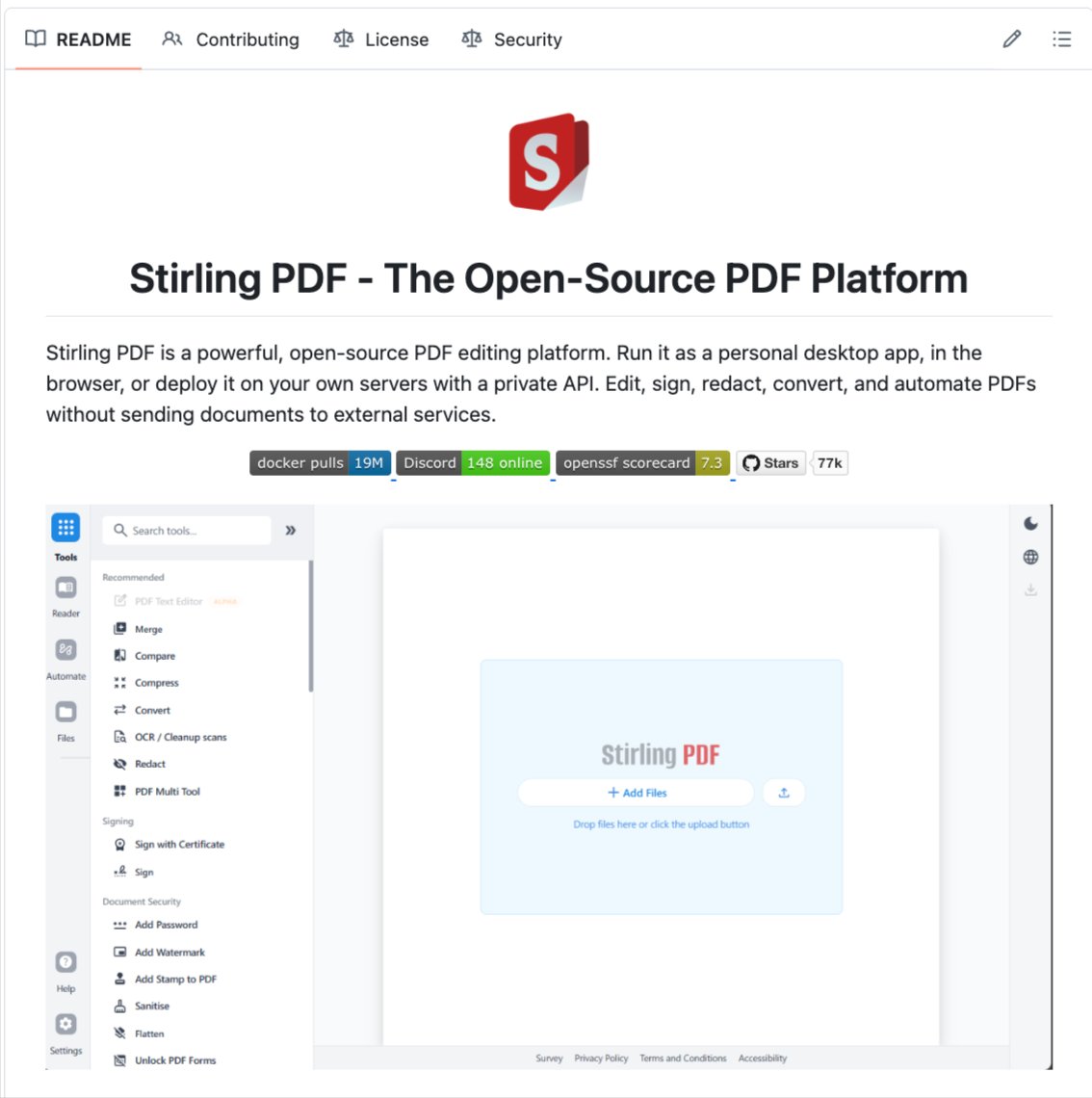
You needed to merge two PDFs last week. You Googled "merge PDF free." You clicked the first result. You uploaded your tax return and your pay stub to a website you had never heard of. It merged them in 3 seconds. You downloaded the file and moved on. You never thought about what happened to your documents. They were uploaded to a server in a country you cannot name. Processed by software you cannot audit. Stored for a duration nobody disclosed. Your tax return. Your pay stub. Your salary. Your signature. On a stranger's disk. Forever. You did this voluntarily. In under 10 seconds. Without reading a single word of fine print. There is a tool that does everything those websites do. On YOUR computer. Your files never leave your machine. It is called Stirling-PDF. 77,100+ stars on GitHub. 25 million+ downloads. The #1 PDF application on all of GitHub. Here is what it does: → Merge PDFs. Split PDFs. Compress PDFs. Rotate and reorder pages. → Convert PDFs to Word, Excel, PowerPoint, and images. And back again. → Add passwords. Remove passwords. Flatten forms. Sanitize metadata. → Sign PDFs with a drawn signature, typed name, or digital certificate. → OCR scanned documents with Tesseract to make them searchable. → Add watermarks, page numbers, headers, footers, and stamps. → Redact text and images permanently. Crop, deskew, and repair. → View and annotate PDFs directly in your browser. → No-code automation pipelines to batch-process thousands of files. → REST API for every tool. Automate every operation. → Desktop app for Windows, Mac, and Linux. No browser needed. → One Docker command to self-host everything. Here's the wildest part: Adobe Acrobat Pro costs $19.99 per month. That is $239.88 a year. Acrobat Studio: $24.99 per month. That is $299.88 a year. Smallpdf Pro: $108 per year. iLovePDF Premium: $60 per year. A 10-person team on Adobe pays $2,660 a year to edit documents. And every single one of those tools processes your files on THEIR servers. Stirling-PDF processes everything locally. Your files exist on your machine. The server sits on your hardware. The network stays inside your walls. 77,100+ stars. 6,700+ forks. 175 releases. 4,900+ commits. 48% TypeScript and 43% Java. MIT-licensed core. Self-host it. Fork it. Ship it. 100% Open Source. (Link in the comments)
Nav Toor tweet media
English
77
358
2.5K
192.8K
Jeff Pierce retweeted
Brian Willott Farms
Brian Willott Farms@BrianWillott·
They should change the name to "Strait of Schrödinger". It's both open and closed at the same time.
English
893
14.5K
82.7K
2M
Jeff Pierce retweeted
Jessica Nutt
Jessica Nutt@JessicaNutt96·
Mythos is not a bad name for a model but it would be better if Anthropic switched to using famous Claudes. Monet, Debussy etc. The final model that achieves AGI would obviously be Van Damme
English
173
651
9.2K
375.5K
Jeff Pierce retweeted
derek guy
derek guy@dieworkwear·
mamdani’s team got in touch with me this morning to float a new tax proposal: if your net worth exceeds $5 million and you dress badly, you’ll be hit with an extra 10% annual levy for “visual pollution.” i would be in charge of deciding if the outfits are bad.
English
244
830
20.9K
368K
Jeff Pierce retweeted
Montreal Expos
Montreal Expos@Montreal_Expos·
The Montreal Expos are exiting the baseball space. During Q2 and Q3 2026, we will transition to acquiring high-performance GPU assets. This is all part of our long-term vision to become a fully integrated GPU-as-a-Service (GPUaaS) and AI-native cloud solutions provider.
English
156
890
14K
728.6K
Jeff Pierce retweeted
Chris Arnade 🐢🐱🚌
Chris Arnade 🐢🐱🚌@Chris_arnade·
Fight on my greyhound — basically entire bus versus a crazy woman who kept provoking people until everyone was willing to kill her, some literally. Only guy who kept his cool, until the very end, was the dude who had been riding for 6 days straight from California, where he’d just been released from serving 10. When he broke, when all the anger management classes washed away when she called him a “gay ass N*** bitch”, a minute before we arrived, she was only saved by five other guys holding him back (she ain’t worth it bro), and the police waiting at station. It was absolute bedlam for last hour.
English
60
42
1.6K
128.2K
Jeff Pierce retweeted
Matt Moody
Matt Moody@matmoody·
I wasn't planning on saying anything publicly about last night's game. But when a parent from Concordia walks up after the forfeit and calls one of my 16-year-old players "cheap," I feel the need to respond. First, to that parent: if you had a problem with the outcome, you should have been brave enough to bring it up with me instead of a teenager. Now, let me paint the picture for why I brought up the situation during the game, because I'm particularly sensitive to this topic. When I was 17, I pitched in every game of the 1999 5A KS State Tournament. The only reason I came out of the championship game was that I ran out of innings. That was the only rule back then. Throughout my high school career I regularly pitched twice in the same doubleheader and always at least twice a week. I don't put any blame on anybody. I wanted to do it. We just didn't understand back then, what happens to a young arm when velocity starts climbing into the upper 80s and 90s. When I was 19 years old, as a freshman, in my very first college appearance at Fort Hays State, on my 16th pitch, my elbow dislocated, tearing both my Ulnar Collateral Ligament and Radial Collateral Ligament. Tommy John Surgery followed. I pitched three more years at Fort Hays, but I never threw as hard again, and never without constant, sometimes agonizing, pain. To this day, when I throw batting practice my hand swells and goes numb the rest of the night. I drive home from practice and can't use my right arm to steer. I sleep with my arm elevated or my hand swells up like a ballon by morning. That is what these rules are trying to prevent. Last night's game ended because Concordia used a pitcher who had thrown 78 pitches on Friday. Under KSHSAA rules, that requires four days of rest. Yesterday was three. It is not a gray area. It is not a judgment call. The rule exists, we are all forced to follow the same limits, it was violated, and the penalty is a forfeit. (And in my opinion, pitching a very talented pitcher like that after just 50 pitches on 3 days rest is irresponsible). No, we did not want to win that way. We were winning at the time and we were going to win anyway. We had our two best arms left and they were out of arms. That's how this works at the 4A level. You run out of experienced arms and the flood gates open. Which brings me to something I find genuinely troubling in my first year as a head coach, after two years as Wamego's pitching coach: the clear majority of programs push pitch counts to their absolute limit. Pull a guy at 75 pitches, bring him back on the minimum rest to throw 105 more. Repeat. At velocities that are sky-rocketing. We have 16-year-olds throwing 90 mph, and the current pitch count limits are not even close to restrictive enough. We are trading young athletes' futures for wins. It's being done openly and very proudly. I'm sure my opinions will be laughed at or disagreed with by most, but I could not care less. When you have to go to inexperienced pitchers, walks stack up, scoreboards get ugly. The team loses confidence and things spiral. It's a gut punch that feels like it's never going to stop... and when you look at the board there's still just one out. But that's what we signed up for. To coach young kids. To develop players. To give young kids opportunities. Build depth the right way. Not to exploit the talent that showed up. It's not always pretty but it's better than winning at the cost of kid's futures. And yes, there's an ABSOLUTE systemic cost too. Last year we had two pitchers who deserved All-State consideration, but because we don't run them on short rest, their accumulated stats don't compete (IP and Ks). The sport media doesn't pay attention because there are jaw-dropping, accumulated stats all over the place that make for better headlines. When all-league and all-state accolades are built on accumulation, programs who are cautious about arms get penalized. That system needs to change (but it won't). There's a lot of nuance, but if a pitcher throws more than 50 pitches they should get at least 5 days off and coaches should be allowed to work with pitchers in the offseason so that there are more developed arms ready for the season. There are all kinds of flaws in this system. We will keep doing this the right way. It costs us wins and it's not fun sometimes, but I have a permanent reminder of what happens when you don't.
Matt Moody tweet media
English
89
134
1.4K
337.6K
Jeff Pierce retweeted
Norm Macdonald Joke of the Day
Norm Macdonald Joke of the Day@NormSNLJokes·
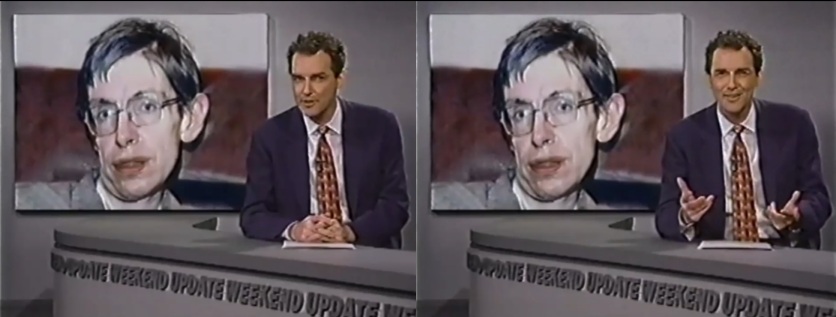
Stephen J. Hawking, the renowned astrophysicist regarded as Albert Einstein's intellectual successor, conceded defeat this week in a wager he made six years ago with two professors at the California Institute of Technology. Hawking incorrectly bet against the existence of naked singularities - a mathematical point in a black hole where space and time are infinitely distorted, where matter is infinitely dense, and where the rules of relativistic physics break down. With all due respect to Mister Hawking... what the hell were you thinking?!!
Norm Macdonald Joke of the Day tweet media
English
21
151
2.4K
147.4K
Jeff Pierce
Jeff Pierce@_JeffPierce·
If you like math, interesting AI outcome.
Jared Duker Lichtman@jdlichtman

In my doctorate, I proved the Erdős Primitive Set Conjecture, showing that the primes themselves are maximal among all primitive sets. This problem will always be in my heart: I worked on it for 4 years (even when my mentors recommended against it!) and loved every minute of it. [Primitive sets are a vast generalization of the prime numbers: A set S is called primitive if no number in S divides another.] Now Erdős#1196 is an asymptotic version of Erdős' conjecture, for primitive sets of "large" numbers. It was posed in 1966 by the Hungarian legends Paul Erdős, András Sárközy, and Endre Szemerédi. I'd been working on it for many years, and consulted/badgered many experts about it, including my mentors Carl Pomerance and James Maynard. The the proof produced by GPT5.4 Pro was quite surprising, since it rejected the "gambit" that was implicit in all works on the subject since Erdős' original 1935 paper. The idea to pass from analysis to probability was so natural & tempting from a human-conceptual point of view, that it obscured a technical possibility to retain (efficient, yet counter-intuitve) analytic terminology throughout, by use of the von Mangoldt function \Lambda(n). The closest analogy I would give would be that the main openings in chess were well-studied, but AI discovers a new opening line that had been overlooked based on human aesthetics and convention. In fact, the von Mangoldt function itself is celebrated for it's connection to primes and the Riemann zeta function--but its piecewise definition appears to be odd and unmotivated to students seeing it for the first time. By the same token, in Erdős#1196, the von Mangoldt weights seem odd and unmotivated but turn out to cleverly encode a fundamental identity \sum_{q|n}\Lambda(q) = \log n, which is equivalent to unique factorization of n into primes. This is the exact trick that breaks the analytic issues arising in the "usual opening". Moreover, Terry Tao has long suspected that the applications of probability to number theory are unnecessarily complicated and this "trick" might actually clarify the general theory, which would have a broader impact than solving a single conjecture.
English
0
0
0
5
Jeff Pierce retweeted
James Martin, SJ
James Martin, SJ@JamesMartinSJ·
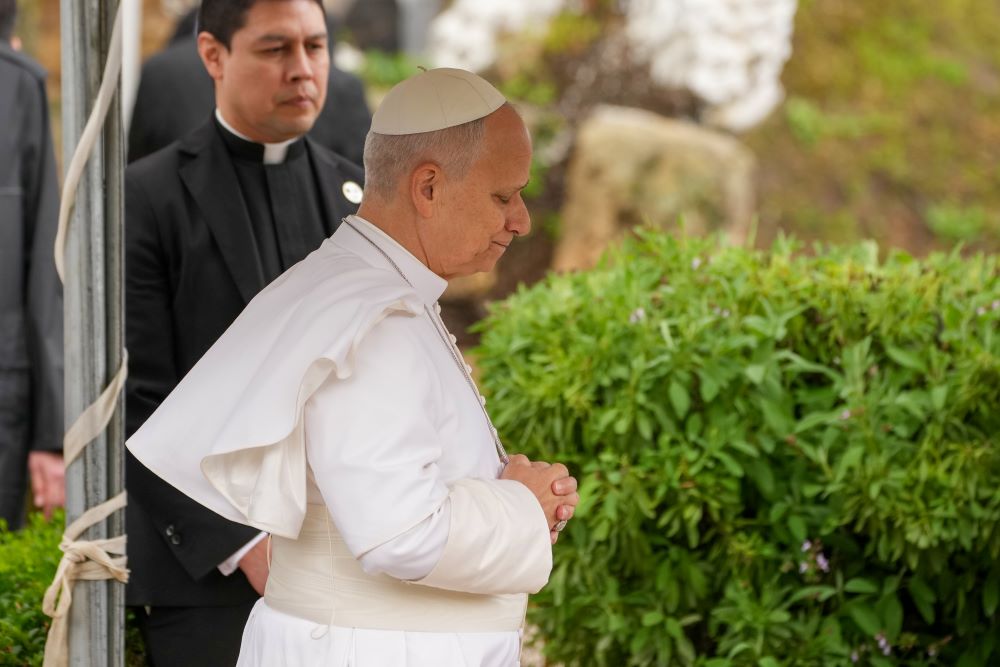
Yes, he really said that. Yesterday Vice President JD Vance criticized Pope Leo XIV for not knowing enough theology: "I think it's very, very important for the pope to be careful when he talks about matters of theology ... If you’re going to opine on matters of theology, you’ve got to be careful, you’ve got to make sure it’s anchored in the truth," he said, at a Turning Point conference. One of the many, many, ironies about that statement is that it came in response to Pope Leo's comments about war and peace and, specifically, the concept of "just war," which originated with St. Augustine. As many have already noted, when the Vice President was making his comments, Pope Leo XIV, a member of the Augustinian Order, and twice Prior General of the Augustinians before his election as Pope, was visiting the hometown of St. Augustine, then called "Hippo," now in Annaba, a town in modern-day Algeria. For good measure, Pope Leo XIV, the man critiqued for insufficient theological education, earned not only a master's degree in divinity, but also licentiate and a doctorate in canon law from the Pontifical University of St. Thomas Aquinas in Rome. JD Vance's recent conversion to Catholicism is beside the point, because many converts are of course not only highly intelligent (and learned in theology) but faithful and energetic Catholics. We rejoice over everyone entering the church. What most of us do not rejoice over, however, is a deadly combination of inaccuracy and hubris. Pace, Vice President Vance, but the current war in Iran is not a just war under Catholic doctrine. You can hear that from church leaders from across the theological spectrum, from Archbishop Timothy Broglio, the head of the military vicariate and former head of the @USCCB, to Cardinal Robert McElroy, Archbishop of Washington who holds doctorates in both theology and political science. You can look all that up online. Suffice to say, the Vice President doesn't seem to understand the tenets of just war. Nor does he seem to understand the fundamental position of the church, which is for peace. "War is always a defeat for humanity," as St. John Paul II said. If that authority isn't enough, then turn to Jesus who said, "Blessed are the peacemakers," not "Blessed are the warmongers." And after the Resurrection, the Risen Christ says to the frightened disciples not "Vengeance is mine" but "Peace be with you." Incidentally, the day before, the Vice President said that the Pope (and the Vatican) should stick to teaching about morality, also seeming to forget that war and peace are profoundly moral issues. For his part, Pope Leo was focused yesterday on his spiritual father, St. Augustine. After what seemed like an emotional visit to Hippo, he celebrated Mass at the Basilica of St. Augustine in Annaba. During his homily he said, "The primary task of pastors as ministers of the Gospel is therefore to bear witness to God before the world with one heart and one soul, not permitting our concerns to lead us astray through fear, nor trends to undermine us through compromise." Amen. Let's all continue to pray for the Holy Father as he works for peace. (Image: Pope Leo XIV prays at the archeological ruins of Hippo, home of St. Augustine, in current-day Algeria. CNS photo).
James Martin, SJ tweet media
English
773
2.4K
9.1K
554.7K
Jeff Pierce retweeted
Rob B
Rob B@RobBfromDerby·
“Open the Strait of Hormuz or I’m closing the Strait of Hormuz”
Rob B tweet media
English
743
17.9K
147.8K
2.4M
Jeff Pierce
Jeff Pierce@_JeffPierce·
@techNmak He also predicted a temperature above 0 degrees Kelvin , below which no information could be exchanged. Proven decades later.
English
0
0
3
141
Tech with Mak
Tech with Mak@techNmak·
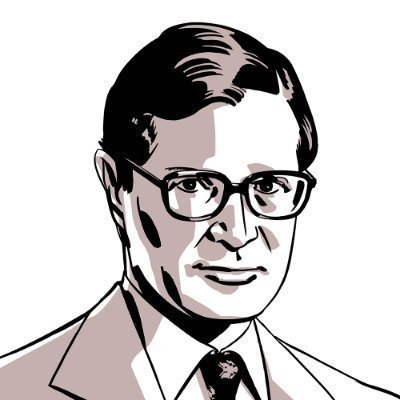
In 1948, a 32-year-old at Bell Labs published a paper nobody fully understood. Engineers found it too mathematical. Mathematicians found it too engineering-focused. One prominent mathematician reviewed it negatively. That paper - "A Mathematical Theory of Communication", became the founding document of the digital age. The man was Claude Shannon. Father of Information Theory. At 21, he wrote the most important master's thesis of the 20th century. Working at MIT on an early mechanical computer, Shannon noticed its relay switches had exactly two states - open or closed. He had just taken a philosophy course introducing Boolean algebra, which also operated on two values: true and false. Nobody had ever connected these two things. His 1937 thesis proved that Boolean algebra and electrical circuits are mathematically identical, and that any logical operation could be built from simple switches. Howard Gardner called it "possibly the most important, and also the most famous, master's thesis of the century." Every digital computer ever built traces back to this insight. At 29, he proved that perfect encryption exists. During WWII, Shannon worked on classified cryptography at Bell Labs. His work contributed to SIGSALY, the secure voice system used for confidential communications between Roosevelt and Churchill. In a classified 1945 memorandum, he mathematically proved the one-time pad provides perfect secrecy, unbreakable not just computationally, but provably, permanently, against an adversary with infinite power. When declassified in 1949, it transformed cryptography from an art into a science. It laid the foundations for DES, AES, and every modern encryption standard. At 32, he defined what information is. His 1948 paper introduced one equation: H = −Σ p(x) log p(x) Shannon entropy. The average uncertainty in a probability distribution. The minimum bits required to encode a message. Three things followed: > He defined the bit - the fundamental unit of all information. His colleague John Tukey coined the name. > He proved the channel capacity theorem, every communication channel has a maximum rate of reliable transmission. You can approach it. You can never exceed it. > He unified telegraph, telephone, and radio into a single mathematical framework for the first time. Robert Lucky of Bell Labs called it the greatest work "in the annals of technological thought." Where his equation lives in AI today: Cross-entropy loss - the function training every classifier and language model, is derived directly from H. Decision tree splits use information gain, which is H applied to data. Perplexity, the standard LLM evaluation metric, is an exponentiation of cross-entropy. Every time a neural network trains, Shannon's formula runs inside it. He also built the first AI learning device. In 1950, Shannon built Theseus, a mechanical mouse that navigated a maze through trial and error, learned the correct path, and repeated it perfectly. Mazin Gilbert of Bell Labs said: "Theseus inspired the whole field of AI." That same year he published the first paper on programming a computer to play chess. He co-organized the 1956 Dartmouth Workshop, the founding event of AI as a field. The man: He rode a unicycle through Bell Labs hallways while juggling. He built a flame-throwing trumpet, a rocket-powered Frisbee, and Styrofoam shoes to walk on the lake behind his house. He called his home Entropy House. When asked what motivated him: "I was motivated by curiosity. Never by the desire for financial gain. I just wondered how things were put together." In 1985, he appeared unexpectedly at a conference in Brighton. The crowd mobbed him for autographs. Persuaded to speak at the banquet, he talked briefly, then pulled three balls from his pockets and juggled instead. One engineer said: "It was as if Newton had showed up at a physics conference." He died in 2001 after a decade with Alzheimer's, the cruel irony of information slowly leaving the mind of the man who defined what information was. Claude, the AI model, is named after Claude Shannon, the mathematician who laid the foundation for the digital world we rely on today.
Tech with Mak tweet media
English
193
2.1K
7.6K
444K