

Andrei Matei
376 posts
Andrei Matei
@andreimatei
Building https://t.co/MnbBMAU6jU - Catch Up on Podcasts, 10x Faster.
EU 🇪🇺 Joined Nisan 2009
356 Following113 Followers

Introducing Muse Spark, the first in the Muse family of models developed by Meta Superintelligence Labs.
Muse Spark is a natively multimodal reasoning model with support for tool-use, visual chain of thought, and multi-agent orchestration.
Muse Spark is available today at meta.ai and the Meta AI app. We’re also making it available in private preview via API to select partners, and we hope to open-source future versions of the model.
Learn more: go.meta.me/43ea00

English
@PabloSantanaT congrats. I remember you launching the platform a few months ago GG
English

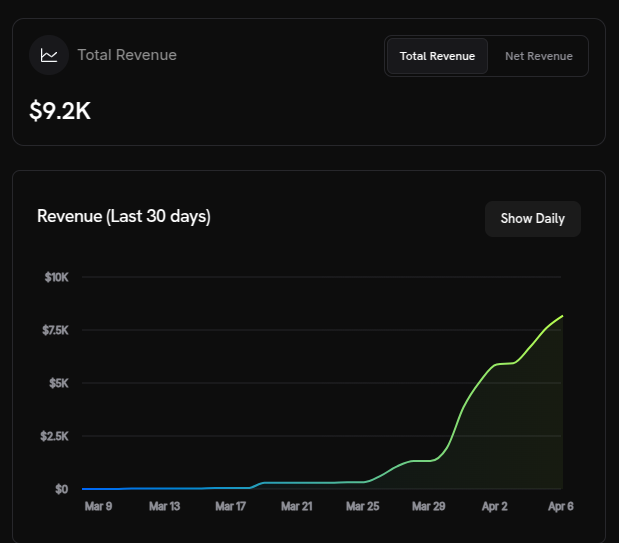

ByteRover just shipped Context Management - the feature that allow you to browse, organize, and search your project's context data.
The Idea: We take Karpathy’s LLM Knowledge Base wikis (Obsidian + LLM workflow) to the next level: A product that’s free, open-sourced, production-proven and you can share with your entire team’s code, docs, and context:
- LLM automatically stores, organizes all knowledge/ context for you, recalls when you need.
It cleans, tags, summarizes, removes outdated knowledge and keeps your whole team’s knowledge base tidy without any manual work.
- You can easily view & manage your whole team’s context. Raw context → organized, beautiful, filterable, searchable, and versioned.
- Your project context will become a smart, queryable that grows smarter every time you use it.
This new feature Context Management allows you to easily view your context It introduces two visual modes: Tree View and Grid View along with a powerful full-text search with filtering capabilities.

English
@kevinnguyendn @kevinnguyendn , what local model do you recommended from a cost/quality perspective? eg on a m4 pro 48gb
English
The timeline is waking up to what we wrote in the ByteRover paper this week: structured Markdown vaults are the gold standard for agent memory.
Infinite context windows are an endless tax. A living, explicit, human-readable wiki is a compounding asset. We open-sourced ByteRover so every agent can have its own Farzapedia out of the box.🧠👇
Andrej Karpathy@karpathy
Farzapedia, personal wikipedia of Farza, good example following my Wiki LLM tweet. I really like this approach to personalization in a number of ways, compared to "status quo" of an AI that allegedly gets better the more you use it or something: 1. Explicit. The memory artifact is explicit and navigable (the wiki), you can see exactly what the AI does and does not know and you can inspect and manage this artifact, even if you don't do the direct text writing (the LLM does). The knowledge of you is not implicit and unknown, it's explicit and viewable. 2. Yours. Your data is yours, on your local computer, it's not in some particular AI provider's system without the ability to extract it. You're in control of your information. 3. File over app. The memory here is a simple collection of files in universal formats (images, markdown). This means the data is interoperable: you can use a very large collection of tools/CLIs or whatever you want over this information because it's just files. The agents can apply the entire Unix toolkit over them. They can natively read and understand them. Any kind of data can be imported into files as input, and any kind of interface can be used to view them as the output. E.g. you can use Obsidian to view them or vibe code something of your own. Search "File over app" for an article on this philosophy. 4. BYOAI. You can use whatever AI you want to "plug into" this information - Claude, Codex, OpenCode, whatever. You can even think about taking an open source AI and finetuning it on your wiki - in principle, this AI could "know" you in its weights, not just attend over your data. So this approach to personalization puts *you* in full control. The data is yours. In Universal formats. Explicit and inspectable. Use whatever AI you want over it, keep the AI companies on their toes! :) Certainly this is not the simplest way to get an AI to know you - it does require you to manage file directories and so on, but agents also make it quite simple and they can help you a lot. I imagine a number of products might come out to make this all easier, but imo "agent proficiency" is a CORE SKILL of the 21st century. These are extremely powerful tools - they speak English and they do all the computer stuff for you. Try this opportunity to play with one.
English
@kaif9999 @MiniMax_AI you're actually not and nowhere close to opus and cc :)
English

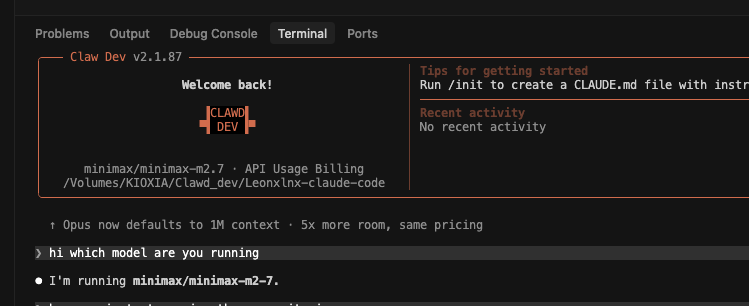
I’m running Claude Code for almost free (95% cheaper).
Someone used the leaked claude code to build an open source alternative.
I swapped @MiniMax_AI models as the brain
Now I’m using MiniMax M2.7 delivering near Opus 4.6 level performance inside an open-source Claude Code setup👇
English
@_avichawla what blow? Alternatives to CC existed for months.
English

Another blow to Anthropic!
Devs built a free and better Claude alternative that:
- runs locally
- works with any LLM
- beats it on deep research
- has Cowork-like capabilities
- connects to 40+ data sources
- self-hosts via Docker, and more.
100% open-source (20k+ stars).
English
Although I get your point, I strongly disagree.
Real projects need structure, predictability and plan mode (enhanced by frameworks like e.g. openspec). This is the only way to achieve that with the current models.
Maybe next year's models will have enough context to avoid a thorough plan, but only time will tell.
English

I never use plan mode.
The main reason this was added to codex is for claude-pilled people who struggle with changing their habits.
just talk with your agent.
Anthony Kroeger@kr0der
slowly starting to use plan mode a LOT less nowadays i realised whenever i use plan mode, it generates a gigantic plan and then i dont read it and hit build out of laziness having a meaningful conversation with the AI agent to discuss implementation feels a lot easier 🤔
English

Giving away 5 Codex Pro plans
Each person will get 3 months of free Codex Pro (highest tier).
Winners will be selected from comments in 48 hours, comment below why you want it.
OpenAI@OpenAI
Today, we closed our latest funding round with $122 billion in committed capital at an $852B post-money valuation. The fastest way to expand AI’s benefits is to put useful intelligence in people’s hands early and let access compound globally. This funding gives us resources to lead at scale. openai.com/index/accelera…
English

Giving away 5 Opencode Go subs
Winners selected randomly from comments in 24 hours.

OpenCode@opencode
we’ve signed Zero Data Retention agreements with all providers for Go all models now follow a zero-retention policy your data is not used for training
English

@tech__unicorn hopefully local models will get better and run with 128gb ram (eg M5 max). Then we can scale
English

AI is fucking expensive and there’s no way it’s gonna keep being free forever….so please enjoy it while it lasts and LOCK TF IN
English
@theo Yes, right. Let's oversell a service, wait for shit to hit the fan, and then penalise your customers.
English

I think people are overreacting to this.
It sucks, but they clearly have a real compute shortage and this was the best path they had without cutting your usage massively
Thariq@trq212
To manage growing demand for Claude we're adjusting our 5 hour session limits for free/Pro/Max subs during peak hours. Your weekly limits remain unchanged. During weekdays between 5am–11am PT / 1pm–7pm GMT, you'll move through your 5-hour session limits faster than before.
English
English

English

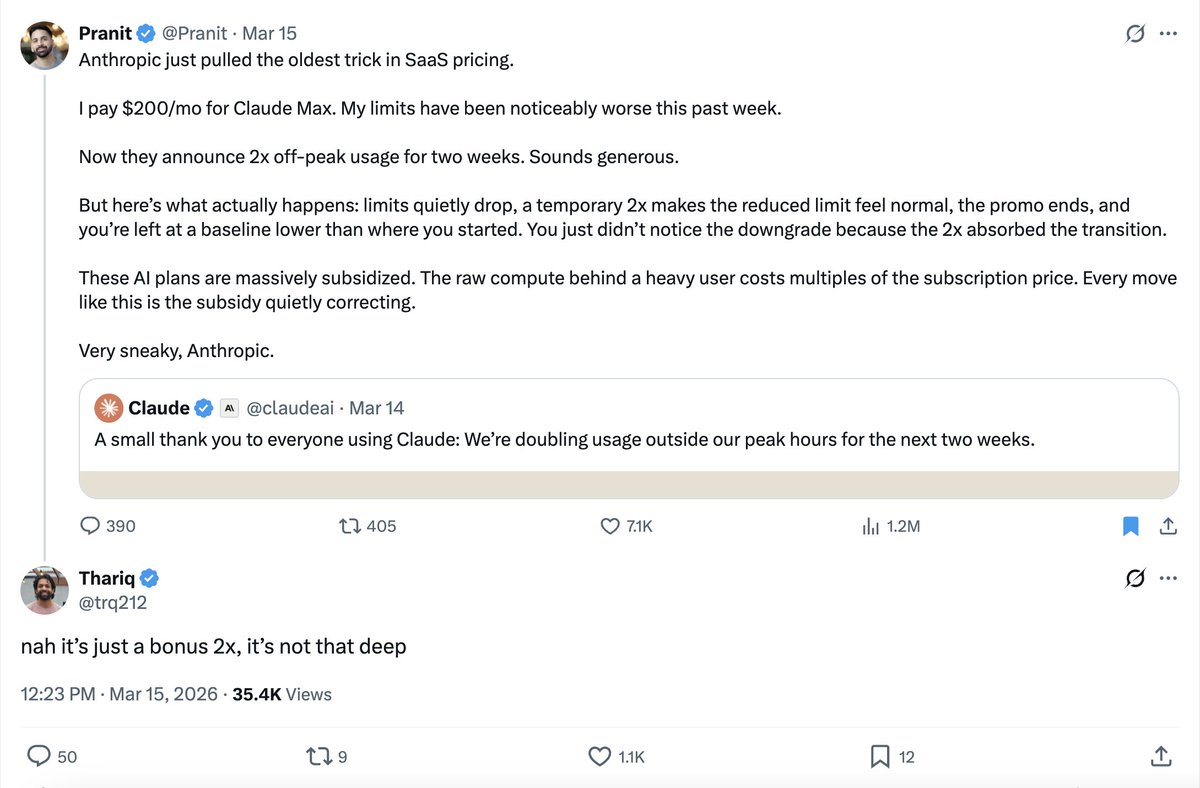
this guy literally called this 11 days ago
and this was thariq's response lol
Thariq@trq212
To manage growing demand for Claude we're adjusting our 5 hour session limits for free/Pro/Max subs during peak hours. Your weekly limits remain unchanged. During weekdays between 5am–11am PT / 1pm–7pm GMT, you'll move through your 5-hour session limits faster than before.
English
@trq212 @weswinder sorry, you’re just greedy. An honest service would have limited the amount of new accounts and serve existing users. This is wrong and you know it.
Some of us choose CC instead of codex based on company values. How stupid of us
English

@weswinder eh I probably should have not tried to dunk in that response tbh, that's what I get lol
but no one was lying there, scaling is hard- this was the best option
English
To manage growing demand for Claude we're adjusting our 5 hour session limits for free/Pro/Max subs during peak hours. Your weekly limits remain unchanged.
During weekdays between 5am–11am PT / 1pm–7pm GMT, you'll move through your 5-hour session limits faster than before.
English

Holy shit… someone just made Claude instances talk to each other.
Not APIs.
Not agents.
Not orchestrators.
Just multiple Claude Code sessions… messaging each other like coworkers.
It’s called claude-peers — and it turns one Claude into a team.
Here’s what’s happening:
Run 5 Claude Code sessions across different projects
Each one auto-discovers the others
They send messages instantly
Ask questions
Share context
Coordinate work
Your AI tools literally collaborate.
Example:
Claude A (poker-engine):
"what files are you editing?"
Claude B (frontend):
"working on auth.ts + UI state"
Claude A:
"ok I'll avoid touching auth logic"
No conflicts. No manual coordination. Just AI syncing itself.
Under the hood:
• Local broker daemon (localhost)
• SQLite peer registry
• MCP servers per session
• Instant channel push messaging
• Auto peer discovery
• Cross-project communication
Everything runs locally. No cloud. No latency.
What it unlocks:
• Multi-agent coding without frameworks
• One Claude writes backend, another frontend
• One debugs while another refactors
• Research Claude feeds builder Claude
• Large projects split across AI workers
This is basically:
"spawn 5 Claudes and let them coordinate themselves"
Even crazier:
Each instance auto-summarizes what it's doing
Other Claudes can see:
• working directory
• git repo
• current task
• active files
They know what the others are working on.
Commands:
• list_peers → find all Claude sessions
• send_message → talk to another Claude
• set_summary → describe your task
• check_messages → manual fallback
So you can literally say:
"message peer 3: what are you working on?"
…and it responds instantly.
No orchestration layer.
No agent framework.
Just Claudes… talking.
This is the cleanest multi-agent system I've seen.
We're moving from:
1 AI assistant →
to
AI teams that coordinate themselves.
And it's all running on your machine.
Wild.
English

@andreimatei wow, @plannotator looks mega! I spent the better part of Friday just re-reading iterations of the same, long plan. can't wait to check it out!
English
AI has become a massive part of how we build software, and as an Engineering Manager, I'm genuinely excited by the real impact it's having on team velocity and output.
I'm lucky to work at an AI-first company where we get to experiment hands-on with the latest tools and trends every week.
Lately, I've been thinking about the question of adopting standards like OpenSpec for spec-driven development with AI coding agents.
My honest take: it's a tempting idea on paper — structured specs, better alignment between human and AI — but in practice, I've found it often adds overhead and ends up slowing us down more than it helps.
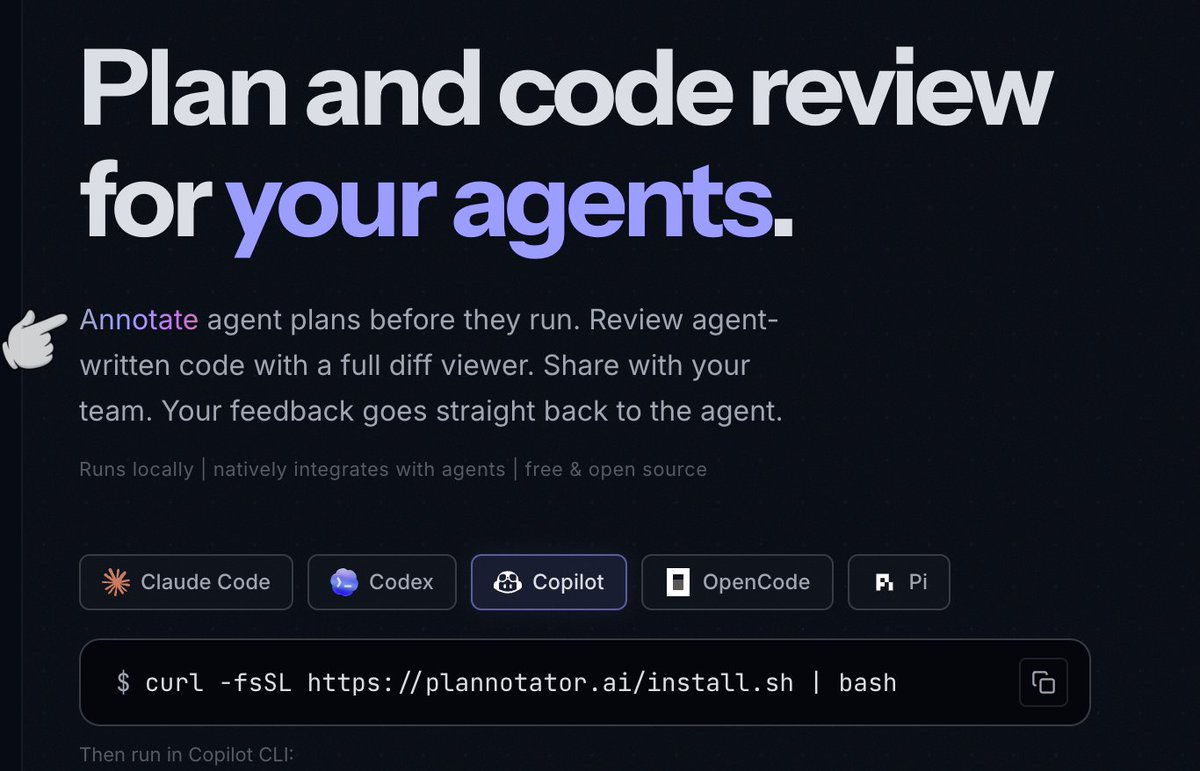
On the flip side, @plannotator has been an absolute game-changer. It supercharges Claude's plan mode by letting you visually review, annotate, and iterate on plans before execution. We've seen roughly 10x better leverage out of plan mode since adopting it.
If you're running an AI-powered SDLC (especially with Claude Code or similar agents), I can't recommend Plannotator enough. It turns "plan mode" from a nice-to-have into something truly powerful.
What are your go-to tools for keeping AI agents aligned without killing momentum? Curious to hear what's working (or not) for your teams! 👇
English
@andreimatei yes, that's fine & interesting to see, but also you're not using that as an individual performance KPI, nor are you enforcing it.
from this to "fire everyone who doesn't generate token usage at 50% of their current salary" is a long way
English
this is dumb. it's also conveniently aligned with their objectives.
more token spent = more business for them.
AI is not there....yet.
if you have an 500k/yr employee just for their output, nothing else, then you made the wrong hire or massively overpaid.
using an arbitrary monthly token spend to squeeze more output from them won't fix that.
sunny madra@sundeep
“If your $500K engineer isn’t burning at least $250K in tokens, something is wrong.”
English