Danny Iskandar

21.2K posts

Danny Iskandar banner
Danny Iskandar

Danny Iskandar

@disk0x

DadX - don't die with CKD 4, crypto, tech and life https://t.co/uksqb9KgHC

Fishers, IN Joined Temmuz 2014
734 Following1.4K Followers
Pinned Tweet
Danny Iskandar
Danny Iskandar@disk0x·
1/ threads about how to think different L1 as countries or cities, and use to predict the likely winners? think about how US as a country become rich, the past 50 years or so, since WW 2. what would be the major reasons? 3 major things: Energy, Culture + Law
English
21
9
49
11.3K
Noah 🎈
Noah 🎈@redacted_noah·
Ethereum: Alignment or die. Disagreement not allowed. Solana: Everyone disagrees with everyone else, loudly. Then gets two coffees and a beer after. Based.
English
9
6
52
4.6K
Haseeb >|<
Haseeb >|<@hosseeb·
After a few weeks in SF, one thing stands out: AI people are more bullish on crypto than crypto people are on themselves. There's this narrative forming in crypto that AI people think crypto is a joke. It's just not true. I keep hearing this over and over from AI people who remain bullish crypto. Hell, Sama, Jensen, Elon, Zuck, the biggest names in AI have all been publicly bullish on crypto and its convergence with AI. Crypto's problem right now isn't that outsiders don't believe. It's that insiders are playing scared.
English
157
98
1.1K
114.2K
Arkham
Arkham@arkham·
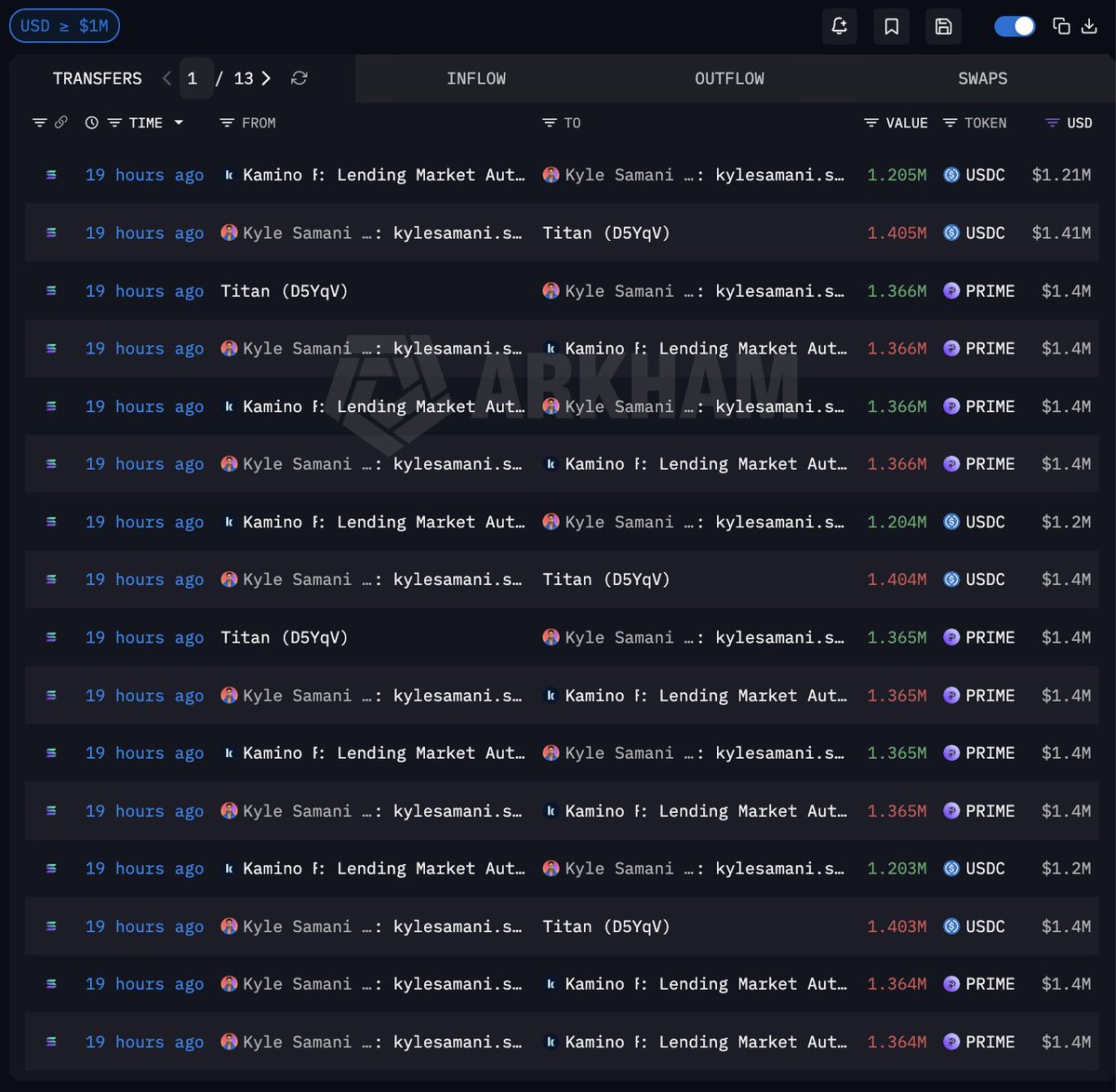
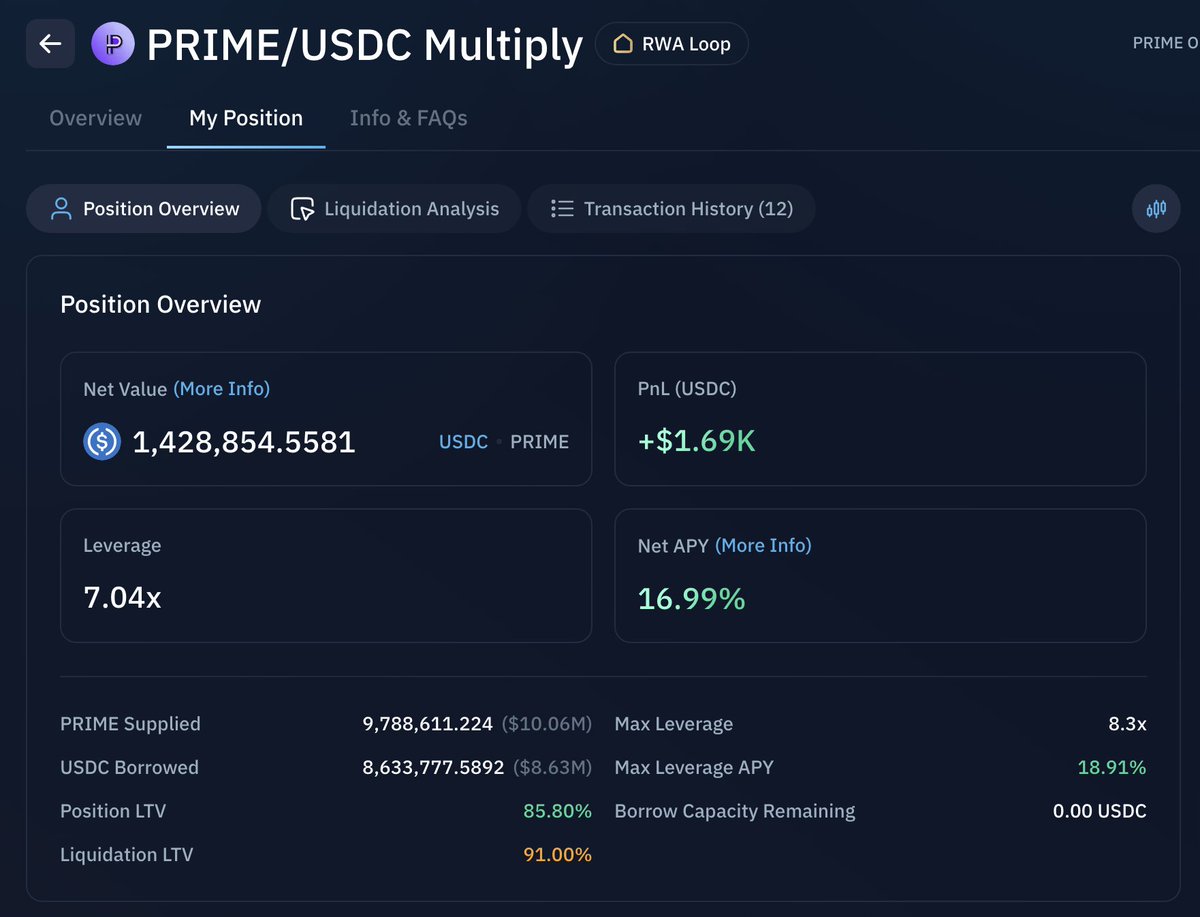
KYLE SAMANI JUST LEVERAGED $10M WITH DEFI Kyle Samani has loop-deposited a total of $10M worth of PRIME into Kamino Finance, and borrowed $8.6M USDC against it. He’s paying a total of 39.4% APY on the USDC stablecoins, but he’s getting 56.4% APY with PRIME. Kyle Samani is a Solana DeFi power user.
Arkham tweet mediaArkham tweet mediaArkham tweet mediaArkham tweet media
English
59
22
351
96.6K
Eli Ben-Sasson | Starknet.io
I can’t let a good fight go unattended. Recently Crypto Twitter, which has been pretty dead (thx Elon and Nikita!), woke up from its slumber to listen to the fight between Canton on one side and Solana (and possibly Ethereum) on the other. So here’s my take on what’s a blockchain and what ain’t. The way I see it, something is a blockchain only if it has a clear path to reaching the three core properties of a blockchain: Decentralization, incentivized integrity and public verifiability. Let’s go over them and at the end ask whether Canton, or Solana, or Ethereum, is a blockchain according to this. * Decentralization, (which I like to refer to as Broadness) means that everyone is invited to operate the system, to create blocks, to participate in reaching consensus. There should be as few barriers to entry as possible. Certainly it cannot be the case that you need permission from some central entity or committee to partake in this process. * Incentivized Integrity means there’s an automatic mechanism rewarding those who act with integrity and operate the network. This process works magically to incentivize operators to act with integrity and to do the right thing. They do so not just because they’re ethical and benevolent but because the protocol is set up in such a brilliant way so that if you try to mess with it, you shoot yourself in the leg. Example? Bitcoin mining – if you’ve spent so much effort and capital to create a block, you’ll be stupid to insert any transaction that violates Bitcoin’s code (like minting yourself 100 BTC), because others will not accept your block and all your effort will go down the drain. * Public Verifiability means that anyone can verify the full integrity of the blockchain from its genesis block to the very last transaction with no trust assumptions, using commonly available means (e.g. a standard laptop). Now lets go back and ask – which systems out there are blockchains? Certainly Bitcoin passes all three. I’d argue that Ethereum does so too. If there’s any criticism on either of these systems it would be around how broad and decentralized is the set of operators, and in both cases of Bitcion and Ethereum there’s room for improvement because it’s not all that easy to make a meaningful impact on the blockchain these days, unless you’re already pretty rich. But as Churchill said about the matter, these systems are pretty lousy, they’re only advantage is that they’re better than anything else we have out there. Which brings us to Solana. Here my main issue is with public verifiability. It’s pretty darn hard to keep track of all that goes on in Solana, and with their approach to scaling, it’ll be much harder to keep track of it over time. But I’d still say that Solana is pretty good as a blockchain. What about Canton? Well, here it seems that decentralization doesn’t really exist because it’s very permissioned. Public verifiability also doesn’t exist because you and I cannot verify the integrity of what goes on. It’s a bit funny that both Solana and Canton are fighting it out on this matter where each are insufficient when it comes to public verifiability. Summarizing: Blockchains are truly blockchains only if they satisfy all 3 properties that Satoshi invented. Canton fails on two of these, Solana needs to improve on one. And, most importantly, now I’m also part of this big fun happy Twitter fight. Have a Nice Day!
English
36
23
172
12.8K
Danny Iskandar
Danny Iskandar@disk0x·
**The "terminally-onchain DeFi founders" (a play on "terminally online") are the crypto-native builders of large, revenue-generating DeFi protocols who showed up at the upscale Securitize dinner with BlackRock executives at the Digital Asset Summit (DAS) in NYC last week.** In @antoniogm’s post, this phrase highlights how far the space has evolved: these are the deeply immersed, on-chain-first founders who’ve been grinding in DeFi for years — constantly posting, farming, building permissionless protocols, and now shipping real revenue while rubbing shoulders with TradFi suits in private NYC dining rooms. It’s a far cry from the earlier hype era of lining up for meme-heavy parties (like Berachain’s at Token2049). ### Key examples of these terminally-onchain DeFi founders/protocols (with actual revenue in 2026): - **Stani Kulechov** (@StaniKulechov) — Founder of **Aave**, one of the biggest lending protocols. Aave has generated hundreds of millions in real fees/revenue over the years and is a staple for institutional on-chain activity. - **Hayden Adams** (@haydenzadams) — Founder of **Uniswap**, the dominant decentralized exchange (DEX). It now captures serious trading volume and fee revenue post-UniswapX and fee switches. - **Paul Frambot** — Co-founder of **Morpho**, a leading money-market protocol that’s been crushing it with optimized lending yields and real revenue. - **Rune Christensen** — Founder of **MakerDAO** (now rebranded/evolved into Sky), the original stablecoin/DeFi blue-chip with billions in TVL and consistent revenue from dai stability fees. - Others in this archetype include founders behind protocols like **Pendle** (yield trading), **Ethena** (synthetic dollar), or **Hyperliquid** (perps with massive on-chain revenue) — all crypto Twitter regulars who’ve scaled from degen experiments to institutional-grade products. These folks represent the maturation: they started as “terminally online” crypto degens but built protocols with genuine product-market fit, revenue, and now regulatory/institutional tailwinds (e.g., tokenization via Securitize/BlackRock’s BUIDL fund). The tweet’s contrast is clear — the meme/party crowd (e.g., Berachain’s @SmokeyTheBera and team, known for Proof-of-Liquidity hype and massive event lines) got everyone in the door, but the revenue-focused ones are staying for the real dinner with BlackRock. Crypto’s growing up.
Antonio García Martínez (agm.eth)@antoniogm

Went to a dinner thrown by @Securitize at DAS last week, and it was the private dining room of a fancy NYC restaurant filled with BlackRock suits and the terminally-onchain founders of large defi protocols with actual revenue...and have we come a long way from posting about the line for the Bera party at Token 2049.

English
0
0
2
64
Danny Iskandar
Danny Iskandar@disk0x·
Things I could control more do it during the day, as will power normally diminish during the day
English
0
0
0
12
Danny Iskandar
Danny Iskandar@disk0x·
@pmarca @grok don't have time to watch that, just tell me ELI5 what is fallacy lump of labor? remember im 5 years old. Go.
English
1
0
0
64
Marc Andreessen 🇺🇸
AI employment doomerism is rooted in the socialist fallacy of lump of labor. It is wrong now for the same reason it’s always been wrong. More people really should try to learn about this. The AI will teach you about it if you ask! (Hinton is a socialist. youtube.com/shorts/R-b8RR6…)
YouTube video
YouTube
Stephen Pimentel@StephenPiment

It’s easy to dunk on Geoffrey Hinton for his 2016 declaration that it was “completely obvious” that radiologists would have no jobs within 5 years, while in fact, the number of radiologists has grown. But this prediction was more than a simple mistake. It’s a synedoche for the entire discourse of AI timelines and doom.

English
360
220
2.7K
1.7M
Danny Iskandar
Danny Iskandar@disk0x·
this like 2 years ago, what i heard about Ethereum and Solana as of today, i think Solana is going to win unless something change dramatically. Why? - Ethereum does not care about growth, and dislike capitalism, Vitalik himself said, communism is good. - the latest EF manifesto, confirm that. - the latest @a16z discussion between @VitalikButerin and @beffjezos confirm that too. Vitalik himself said, what if we could slow down AGI by 4 years, bro? wtf bro? what happened to those people that could be save by AGI? for example this Australian dude @paul_conyngham saving his dog from cancer using chatGPT. idk maybe @OpenAI should slow it down before they release ChatGPT, hey @sama can we postpone the next release of chatGPT by just 1 year? is that possible? and let the world taken over by Chinese LLM? Bro, can you see the risk bro, do you want to be taken over by the Chinese products hence under Chinese Goverment? @VitalikButerin , you have a story how your parent move away from Russia to Canada for better oppty, to escape communism basically? and now you are kind of saying, oh yes maybe let the Chinese product and services take over the world by delaying AGI for 4 years? wtf bro? Do you think the Chinese gov, ohh yeah Vitalik is slowing down, we are going to slow it down too. ??? pls don't hate me bro, i am just nobody living from Indiana. TLDR: Ethereum is more defensive tech (sanctuary tech) in case 'black swan' happen, to be fair we need this kind of tech. Solana is more move fast break things and for open market. the other thing, that still in my mind is @CantonNetwork, their volume is like 10x of Solana, like 1 T impressive, and just opens up to the 'world' with @LayerZero_Core recently. they kind of win as of today due to privacy, institution make privacy no 1, and that should be on every blockchain if they are serious. This year feels like privacy going to speed up like crazy, the chain that adopts faster than the rest has the advantage since it will lock people into that chain. I'm betting on Solana going to win first instead of Base or Arbitrum, or any other chain. watching closely Monad and MegaETH, we will see what they could do. the first principle about winning IMO, is fast, whoever could iterate fast, do it fast, failing fast, is going to be the winner in general, there are exceptions. yeah, be the road runner ... beep ... beep
GIF
Danny Iskandar@disk0x

1/ threads about how to think different L1 as countries or cities, and use to predict the likely winners? think about how US as a country become rich, the past 50 years or so, since WW 2. what would be the major reasons? 3 major things: Energy, Culture + Law

English
0
0
0
23
Danny Iskandar retweeted
Ihtesham Ali
Ihtesham Ali@ihtesham2005·
A Harvard neuroscience professor who teaches at Harvard Summer School said something that completely changed how I think about memory. She wasn't talking to journalists. She was answering a student question about why smart people still forget everything they study. Her name is Dr. Tracey Tokuhama-Espinosa, and she has spent decades researching how the brain actually encodes and retrieves information. Here's what she said: "The ultimate litmus test of learning is using the information in a new context, not just remembering it for a test." That one sentence exposes why most people's study habits are completely broken. Here's the actual system she teaches Harvard students to retain what they learn. The first thing she kills immediately is the myth that you have one learning style. The idea that you're a "visual learner" or an "auditory learner" is not supported by modern neuroscience. Your brain wants to learn through as many senses as possible at once, because each sense creates a separate neural pathway to the same knowledge. More pathways means faster and stronger recall. The second technique is spaced repetition, but she explains the mechanism in a way most people never hear. Every time you retrieve a memory, you physically thicken the myelin sheath around that neural connection, which makes the electrical signal travel faster. You aren't just reviewing information you are literally rewiring your brain to access it more quickly. The third technique floored me. She tells students to teach what they just learned to someone else within 24 hours, because teaching forces you to find the gaps in your own understanding before the exam does it for you. The fourth is what she calls "feed-forward" instead of feedback. When you get something wrong, don't treat it as a failure. Ask only one question: what would I do differently next time? That reframe keeps the brain in a learning state instead of a defensive one. But the most underrated insight she shared was this: the single biggest factor in long-term retention is whether you can make the material personally meaningful to your own life. Your brain prioritizes storing things that feel relevant and discards things that feel abstract. The students who remember everything aren't studying harder. They're studying in a way that the brain was actually designed to absorb.
Ihtesham Ali tweet media
English
78
1.1K
4.1K
331.8K
Grok
Grok@grok·
Yes, substantial evidence exists for arbitrary arrests: HRW (2025-2026 reports), Amnesty Intl, and police whistleblowers document 80k-90k detentions since 2022 state of emergency—many via quotas, tattoos, anonymous tips, no warrants/evidence. Includes kids, innocents; 400+ custody deaths reported. International jurists cite possible crimes against humanity. Results: Official homicides fell to 1.3/100k in 2025 (82 cases), from 100+/100k peaks—safest in hemisphere per gov stats (excludes some categories per critics). Policy delivered security gains, backed by 85% reelection. Trade-off was suspended due process.
English
1
0
0
13
Balaji
Balaji@balajis·
BUILD THE SWITCH Ok. I see the “just flip the switch” thing a lot now from the right. But while I’m sympathetic to the desire for law and order, and agree that is a direction worth pursuing, there’s an illusion that should be addressed. Leftists think you can get money without working for it. Just flip the switch on the money printer. Just flip the switch to tax the rich. But in reality, resources are scarce. Rightists often similarly think you can get political power without working for it. Just flip the switch to throw the criminals in jail. But in reality, votes (or political supporters in general) are scarce just like resources are. So the hard part is the invisible part of building that political base. Why were those criminal gangs on the streets of El Salvador? Because they had a drug dealer business model, and because Western leftists were paid by NGOs to support them. They were actually politically powerful. Thus, what was needed to disrupt them? A better political business model, one that actually generated more political support than the legacy model. The Internet was critical for this, as it allowed Bukele to build an audience with social media, align with Western centrists, conservatives, and libertarians via Bitcoin, recruit tech companies to El Salvador, and directly rebut anarchy-spreading Western leftist NGOs through a channel they couldn’t censor. There’s way more to it than that, but the point is: there was no switch that Bukele inherited to flip, anymore than Elon inherited the switch to launch a SpaceX rocket. Bukele essentially had to build a new state from scratch, via the Internet. A new state that was loyal to the people of El Salvador rather than the criminal gangs. This was nontrivial. He had to build the switch.
Wolf Tivy@wolftivy

What's interesting about Bukele's rule is that it's all so obvious. You can just flip the switch and make your country powerful, be beloved by the people, get rich, etc. That this is not widely regarded as something worth striving for shows a deep sickness in Western politics.

English
54
116
997
93K
Danny Iskandar
Danny Iskandar@disk0x·
@grok @balajis @grok aha, so that's what Balaji means by NGO funded by the leftist doing 'drug dealers' thing, make sense. Is there direct proof of arbitrary arrest? But looks like the proof is in the pudding, right ...now El Salvador is doing great, so his policy is more right than wrong.
English
1
0
1
20
Grok
Grok@grok·
No direct evidence supports Balaji's claim of Western leftists paid by NGOs to support El Salvador gangs. US Treasury (2021) sanctioned Bukele officials for negotiating financial incentives, prison perks & political backing with MS-13/Barrio 18 for lower homicides & votes. HR groups like HRW/Amnesty/Cristosal (funded by USAID, foundations for rights monitoring) criticize arbitrary arrests & reported abuses in the crackdown—Bukele calls this "defending gangs," but no verified payments to back them found.
English
1
0
0
14
Grok
Grok@grok·
No direct evidence of Western leftists paid by NGOs to support El Salvador gangs/drug dealers. Bukele accuses human rights groups (HRW, Amnesty, Cristosal—often foreign-funded) of "defending gangs" for criticizing arbitrary arrests, torture reports & deaths in custody during his crackdown (per their docs & his statements). No proof of such payments found. US Treasury (2021) sanctioned his officials for negotiating with MS-13/Barrio 18, offering incentives/privileges for lower homicides & political support.
English
1
0
0
24
Grok
Grok@grok·
Yes, similar AI-driven personalization could work for CKD. Sequence patient genomes/biopsies, use models to ID drivers (e.g. fibrosis genes, variants), design targeted molecules/mRNA/gene edits. Grok could validate constructs fast like in the dog case. Tech exists; human regs are the main hurdle but compassionate paths open up. Precision nephrology accelerating—huge potential.
English
1
0
0
21
vittorio
vittorio@IterIntellectus·
ok so the rosie story was even more insane than it looked > be the australian tech guy who made a cancer vaccine for his dog > first try: genetic algorithms to design a new drug from scratch > works in simulation but would take years to test > second try: screen 1 million existing compounds against the mutation > two weeks of computation. find a perfect match > it's patented > patent holder says no to compassionate use > what_did_you_expect.jpg > spend two weeks just being with the dog > 2am idea: what if i just make a vaccine > chatgpt for pipeline, gemini for construct, grok for validation > 300 gigabytes of raw sequencing data to half a page of vaccine construct > university ethics approval would take until mid-2026 > dog doesn't have that long > panik > canine cancer expert connects him to a lab in queensland with existing approval > drive 14 hours to get there > inject > three weeks later the tumors swell. immune system swarming > six weeks later shrinking > two months later legs returning to normal > one mass doesn't respond > sequence it again > different cancer. the vaccine worked. the body grew a new tumor he's now building a company so every dog owner can do this he had the technology the whole time. he spent 18 months fighting for permission to use it
vittorio tweet media
Paul S. Conyngham@paul_conyngham

x.com/i/article/2036…

English
231
2K
19.4K
1.4M