

ItamarGo
618 posts

ItamarGo
@gitamar
Solving people puzzles to make work more human
Oakland, CA Joined Ağustos 2009
197 Following371 Followers


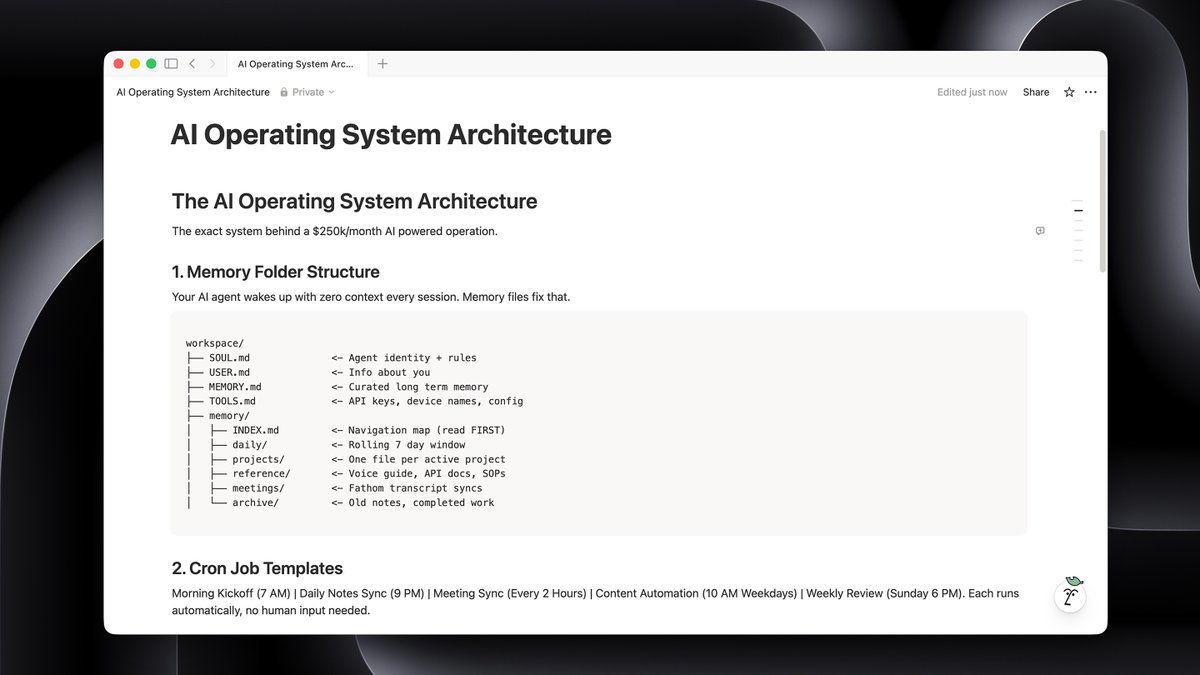
I'm giving away my entire @openclaw architecture. Behind my $250k/month agency.
After weeks of building, I've dialled in the exact system that runs my business 24/7.
What's included:
• Memory folder structure (how to organize agent context)
• Cron job templates (daily briefs, meeting syncs, content automation)
• How to build a custom dashboard in @lovable
• API reference doc (so your agent never forgets its tools)
• Voice training method (85 posts to teach it your style)
• Supabase schema for dashboard connection
Comment "OS" and follow. I'll DM it to you.
P.S. This will probably blow up so give me some time to reply.
English
Your AI agent has a skills junk drawer problem. Everyone's rushing to add capabilities—email management, code review, research synthesis—but not enough people are asking: do these skills play nice together? We need a Dewey Decimal system for AI skills. [longer post in reply]
English
@awilkinson @awilkinson will you be willing to share your Personal Stylist workflow prompts?
English

This is all I'm thinking about right now.
Dan Shipper 📧@danshipper
Andrew Wilkinson (@awilkinson) has been waking up at 4 a.m. because he can’t stop building with @AnthropicAI’s Opus 4.5. He started vibe coding a couple of years ago, but it felt like the Palm Treo era of the smartphone—exciting, but not quite there. You could generate an app, but it would get stuck in bug loops or break the moment you pushed it further. Then he tried Opus 4.5 in Claude Code. It felt, he says, like having a “$100,000-a-month payroll of engineers” working for him 24/7. He’s built practical AI automations into every corner of his work and life, including: - A relationship counselor app called Deep Personality that consolidates 20 clinically validated personality tests into a 40-minute assessment, then generates a 45-page analysis. When both partners complete it, it maps compatibility and predicts conflicts—Wilkinson says it laid out every fight he and his girlfriend have. - A custom email client he built by handing Claude Code his Gmail credentials and describing his ideal workflow. It triages emails by priority and sender, handles quick replies via multiple choice, and walks him through complex emails question by question before drafting. - A personal stylist that texts him four outfit recommendations every morning. It checks the weather, pulls from a spreadsheet of his entire wardrobe (photos converted to CSV by Claude), generates four outfit options rendered as images with @NanoBanana, and texts him what to wear down to the watch. - A @getlindy agent that acts as an AI referee of sorts—it records his meetings and texts him if it detects psychological red flags like manipulation or gaslighting. The bar is high—he only gets a notification every few months—but when he does, it usually confirms a gut feeling he already had. Andrew is the cofounder of Tiny, the holding company that owns businesses like @AeroPress and @Dribbble. Earlier in his career, Andrew was a web designer, and he fits one of my predictions for 2026: Designers, who know how to create great experiences for users, are the unsung group most empowered by this AI moment. I had him on @every's AI & I to talk about Opus 4.5, what he’s building with it, and how it’s changing the way he thinks about acquiring software businesses at Tiny. This is a must-watch for anyone who wants to put AI to work in their day-to-day life. Watch below! Timestamps: Introduction: 00:01:07 Why Opus 4.5 feels like the iPhone moment for vibe coding: 00:02:48 Why designers have a unique advantage with AI: 00:08:31 How Andrew built a custom email client with Claude Code: 00:14:10 An AI trained on your relationship that predicts your fights: 00:18:13 Using AI meeting notes to make your life better: 00:30:40 Don't inject your opinion into prompts: 00:35:11 Andrew's Claude Code tips and workflows: 00:40:21 Your personal stylist is a prompt away: 00:47:59 How AI is changing the way Andrew invests in software: 00:53:17
English
The ease of AI Agent Skills is a double-edged sword. Very little about this is Clawdbot/Moltbot-specific.
"Not your keys, not your crypto" -> "Not your skills, not your agent"?
x.com/theonejvo/stat…
Jamieson O'Reilly@theonejvo
English

Has anybody else figured out how to get Notifications from Notion and Linear with the MCP or API ?
I just want to put all my overnight pings in one place to help me prioritize my morning, but Claude seems pretty convinced that @linear doesn't expose my notifications anywhere.
English
@local0ptimist Nice! Seems like CLI + Skill may be even better than MCP?
English

i claude coded an obsidian clone for claude to code in
it comes with a native mcp so your other claudes can talk to your notekeeper claude when they need context
next step is to add looming

🎭@deepfates
What is a loom
English
Old KM: Docs (Confluence, Gitbook, etc.)
New KM: CLAUDE.MD/AGENTS.MD + .agents +.commands + skills
English
"The bottleneck is that someone still has to specify what the AI should do, evaluate whether it did it correctly, integrate the output into a workflow, and make the final call. AI makes the execution cheap. But specification, evaluation, and integration remain human-bound."
Aakash Gupta@aakashgupta
Levie just made the best case for AI abundance I’ve seen… and he’s still underselling the real bottleneck. His Jevons Paradox frame is right. When you make something cheaper, demand expands to absorb the efficiency. Coal, compute, cloud software. The pattern holds. And yes, AI agents will drop the cost of non-deterministic work the way SaaS dropped the cost of deterministic work. But here’s what the data actually shows: 74% of companies struggle to achieve and scale value from AI, according to BCG’s 2024 adoption study. That’s not a cost problem. Task costs already dropped. It’s a human oversight problem. The bottleneck is that someone still has to specify what the AI should do, evaluate whether it did it correctly, integrate the output into a workflow, and make the final call. AI makes the execution cheap. But specification, evaluation, and integration remain human-bound. Deloitte’s enterprise research found that resistance to AI adoption stemmed from unfamiliarity, skill gaps, and lack of change management. Only a third of companies prioritized training. And the 2025 data is even more telling: fewer than 5% of firms reported net workforce reductions from AI. Instead, 37% reported task redistribution, with workers shifting toward oversight, integration, and decision-making roles. This means the Jevons Paradox for knowledge work has a different shape than Levie describes. Demand for AI task execution will absolutely explode. But demand for human judgment, context-setting, and quality verification will explode faster. The 10-person services firm can now build a prototype in days. But someone at that firm still has to know what to build, whether the prototype works, and how to deploy it. Those skills are scarcer than the tasks they enable. The real trade is that the companies who solve the oversight bottleneck, who build organizational capacity to specify, evaluate, and integrate at scale, will capture most of the value from cheap AI execution. The constraint moved from “can we afford to do this task?” to “do we have anyone who can tell if this task was done correctly?” Jevons works. But the coal equivalent here is the human attention required to make that output useful.
English
@emollick this seems like a paper you'd have insightful commentary on: nber.org/papers/w33941
English
@albertwenger Not a lot of selection/differentiation on the hardware side. More interesting on the software side. Got more insights from Veri compared the the out-of-the-box freestyle app. Heard good things about Levels as well.
English

I want to try a continuous glucose monitor. Recommendations?
English
@BryanPetes Yes! An on-chain version of OpenCollective opencollective.com
English

I’m starting to think that tokenized cooperatives that can take capital are under explored when trying to build a network that can compliantly make returns to members at some future date.
Definition and automated reinforcement of “member” becomes very important in this model.
English
.@ShengForOakland how can we enlist your help in stopping these brazen crimes from happening in our district on a regular basis? No follow-up from @oaklandpoliceca despite reporting the crime as it was happening. youtu.be/kzzFmbB_p0U

YouTube
English
ItamarGo retweeted
RT this tweet to be eligible for the talentDAO Discord Activity Drop!
Done in partnership with @OrangeProtocol, this reputation-based NFT shows a commitment to growing our community!
Be sure to join the talentDAO Discord👇
discord.gg/e6MqzBJCec
English
The 8th edition of @talentDAO_ Newsletter of Decentralized Work is out!
talentdao.substack.com/p/nodw-8-ident…
SBTs vs. VCs, Decentralization & DAOs, Humans & DAOs - oh my! this is a good one! #DAO #DeSci #futureofwork
English
Our 7th edition and just keeps getting better: talentdao.substack.com/p/nodw-7-daos-…
The feature by @saulthorin is 🔥🔥🔥
#DAOs #WAGMI #orgdesign
English