

nik
21 posts



Most documentation rots because it’s expensive to maintain and easy to ignore.
Software Factory is documentation-first so teams can describe systems in English and let agents compile that intent into code.
It detects drift on every code push and keeps documentation synchronized with reality.
Context stays alive. Agents keep building.
Try it here: 8090.ai
English
@AlbertinePiels @SecretCFO Twenty has 2 ways of sending info out. 1) Webhooks on CRUD on any object say user, customer etc.
2) Typical automations.
Send to n8n AI node or create messages on the fly based on incoming api calls.
Can be extended with much larger context. Greatly simplifies automations.
English

@nikesh @SecretCFO Interesting. How do you combine them. Can you tell a bit more?
English

@gregisenberg @jaylane310 How are these moats? Distribution is a commodity as per 5 above. Agent wil do customer service, brand is not a moat is the point of your post, data is also available for everyone.
English

@jaylane310 distribution, customer service, brand, data etc
English

Here's why ColBERT embeddings are all the rage right now (at an intuitive level):
You probably already know that vector search is pretty cool.
• It allows you to search for things semantically.
• It's robust to synonyms.
But do you know what sucks about vector search?
It kind of lacks a certain degree of explainability.
The kind of explainability you'd, for example, have in keyword search:
There, you can see which keywords match between the query and the result.
ColBERT embeddings enable some explainability in vector search.
This is because
• Conventional dense embeddings: pool the token-level embeddings to a single representation.
• ColBERT embeddings: Keep the token-level embedding representation
We'll get to the technical details of ColBERT and the late interaction mechanism in another post, so stay tuned.
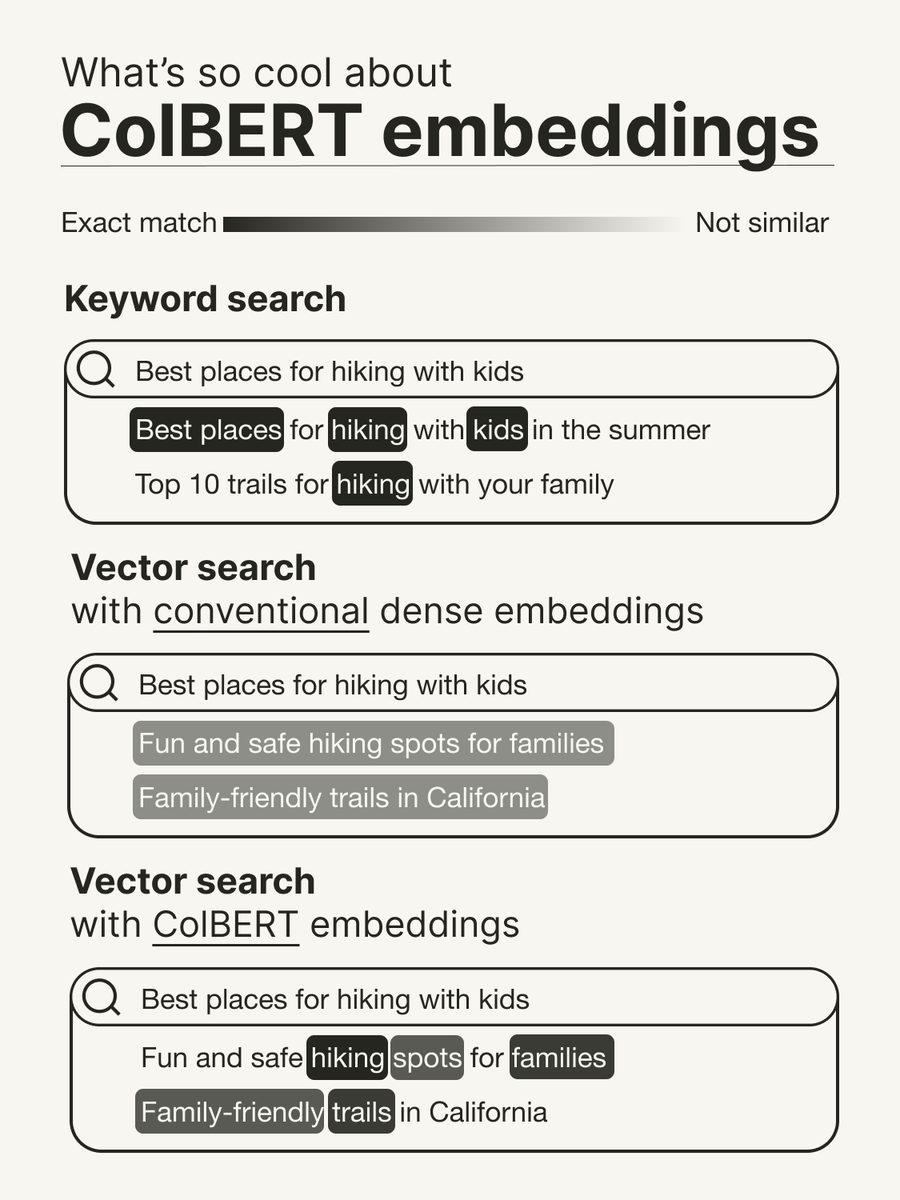
English
@SahilBloom Only share own experiences of skin in the game. This will always be some version of: I had no idea what I was doing when I started or no idea what I’m doing most of the time.
English

An idea I can't stop thinking about...
Solomon's Paradox (and how to escape it):
In the Old Testament, King Solomon was known for his incredible wisdom. He was considered one of the wisest men who ever lived.
But King Solomon's life was quite a mess:
• Hundreds of wives and partners
• Obsession with money and wealth
• Absent relationship with son and children
In short, King Solomon was great at giving advice, but terrible at taking that same advice into account in his own life.
This story gave a name to a common psychological phenomenon:
When we provide clear, rational perspectives and advice to others, but are unable to provide those same quality perspectives to ourselves, we are falling victim to Solomon's Paradox.
We've all been stuck in Solomon's Paradox at one point or another.
Why? Well, it's quite simple, really:
When you're considering someone else's problems, you are objective, rational, and balanced.
When you're considering your own problems, you are emotional, irrational, and volatile.
It's not your fault—you're human, after all!
Two core strategies to escape:
Strategy 1: Create Space
Viktor Frankl, the Austrian philosopher and Holocaust survivor renowned for his contributions to existential psychology, has a brilliant framing for the power of space:
"Between stimulus and response, there is a space. In that space is our power to choose our response."
Pause: Our immediate reactions are almost always emotional, and we make bad decisions in the heat of emotion. Force a pause (whether it's seconds, minutes, hours, or days) before reacting.
Reset: Allow yourself to feel the emotional response, but remind yourself that you are in control of what comes next. Give yourself that power.
Engage: With a more balanced perspective, engage with the situation.
Strategy 2: Zoom Out
A rule for life: When in doubt, zoom out.
You live your entire life zoomed in. This can create challenges, as struggle feels bigger than it really is and growth feels smaller than it really is.
Forced zoom outs provide perspective, on the true nature of your struggles and the impressive nature of your growth.
Mental Time Travel is a useful tool for zooming out:
Imagine yourself in the past and consider yourself in the present.
Imagine yourself in the future and consider yourself in the present.
This zoom out forces perspective that breathes new life into a situation.
***
To fight back against Solomon's Paradox:
Create space and force new perspective.
The right questions (and answers) will come to you.

English

For the next 24 hours you can STEAL 5 of my Highest Converting Landing Page templates 🔥
$5,000 value..
But today it's yours for FREE
— Guaranteed to convert
— Saves a lot of time & money
Like & comment "FREE" and I'll DM you the templates
(Must be following or I can't send)

English

99% of people aren't maximizing ChatGPT.
We organized ALL of the best resources to make money using ChatGPT into one page.
Take advantage of this life-changing opportunity with AI.
Free for 48 hrs.
Follow, Like, Retweet, Comment ‘ai’
& We’ll DM it to you, for free.

English

Learning new skills is painful, but not with AI.
It's easy to learn these high-cash skills with ChatGPT.
I've put together 5 categories.
• Coding
• Storytelling
• Copywriting
• Landing pages
• Email marketing
Like, Retweet, and Comment
"AI"
(Must follow to get DM)

English

As promised, I built a biz acquisition template with 50+ automations.
It gives the exact roadmap to get your deal done fast.
Want see how I use it to walk through the deal process?
RT & comment "biz" and I will DM you the video link.
(must follow me to get the DM).
English

I hired a team of cold callers to create and battletest the ultimate cold calling script for your agency
We were going to charge $197 for this but you can have it for free
Comment "Omni" and I'll send you access
(Must be following)
English

My answer to What are the best practices and tips for lead generation? quora.com/What-are-the-b…
English
My answer to Which platform is good for a lead generation campaign? quora.com/Which-platform…
English
My answer to Lead generation seems to encompass everything from names and email addresses to setting 'warm' appointments. Do you have a succinct definition of effective lead generation? quora.com/Lead-generatio…
English
My answer to Lead generation seems to encompass everything from names and email addresses to setting 'warm' appointments. Do you have a succinct definition of effective lead generation? quora.com/Lead-generatio…
English
My answer to How would you increase lead generation? quora.com/How-would-you-…
English
My answer to How would you increase lead generation? quora.com/How-would-you-…
English