NFW

102 posts

NFW

NFW

@NFW987

Se unió Nisan 2026
14 Siguiendo17 Seguidores
NFW
NFW@NFW987·
@CaseyGaldieri @TaxAlphaInsider Not even close. Gotham is awful. Just compare the tear sheets. Tax loss absolutely not the same on all. Would recommend getting more educated before putting your money/your clients into these
English
0
0
0
4
Harvey Daniel
Harvey Daniel@CaseyGaldieri·
@NFW987 @TaxAlphaInsider not true at all. They have been doing this for 10 years in lp format. Quan and AQR have good performance on overlay as well but completion strategy is bespoke. Tax loss going to be the same amongst all.
English
1
0
0
14
Brent Sullivan
Brent Sullivan@TaxAlphaInsider·
I don't think people realize how expensive it is to short stocks. Data from Interactive Brokers reveals something like 30-55 basis points per year for large-cap names. Prime brokers are likely much cheaper. This is possibly jarring to investors/advisers diving into tax-aware long/short strategies who are used to 20 bps (or less) all in from direct indexing. Let's assume Interactive Brokers (retail) dramatically overstates it, and cost to borrow from prime brokers (institutional) is actually 10 bps/year on average. That means a 200/100 long/short portfolio pays... • Management fee: 20-100 bps • Financing spread: 60-170+ bps (cf AQR, Aperio assumptions, Fidelity announcement) • Cost to borrow: 10-55 bps (cf IBKR) • Transaction costs: 10-55 bps (cf AQR: 10bps/dollar assumption) Easily/conservatively 100 bps. This may be well justified on an after-tax basis - I'm digging into this now - but we need to be mindful of economic substance (more on this anouther time). But even if I've missed the mark on some of these costs, they seem to be ballpark correct. Investors/advisers should ask managers how they plan to overcome these substantial costs.
English
5
1
14
1.8K
Harvey Daniel
Harvey Daniel@CaseyGaldieri·
@TaxAlphaInsider This is why it’s so important that the manager has a track record for their overlay - like Gotham. But if you are running this strategy as a “complete” which is how most are set up, you are Gambling. The extra 20mm nominal has a chance to cover the fees if run right
English
1
0
2
82
NFW
NFW@NFW987·
@askjussi 3% is way wrong any way you look at it. Total embedded energy component of CPI is more like 15%. We are definitely not currently in a disinflationary environment by any calculation
English
0
0
0
4
Jussi Askola, CFA
Jussi Askola, CFA@askjussi·
$100 oil sounds scary, but context matters. Energy is just ~3% of CPI. It does also impact other categories indirectly, but even sustained $100 oil likely adds only ~0.5–1% to inflation. Meanwhile, shelter, 35%+ of CPI, is still disinflating. The bigger force is still downward.
English
3
0
15
715
NFW
NFW@NFW987·
@cate_long @SecScottBessent You’re responsible for what you post. Reposting someone else’s slop and then pretending you aren’t in the wrong is even worse journalism
English
0
0
0
8
Cate Long
Cate Long@cate_long·
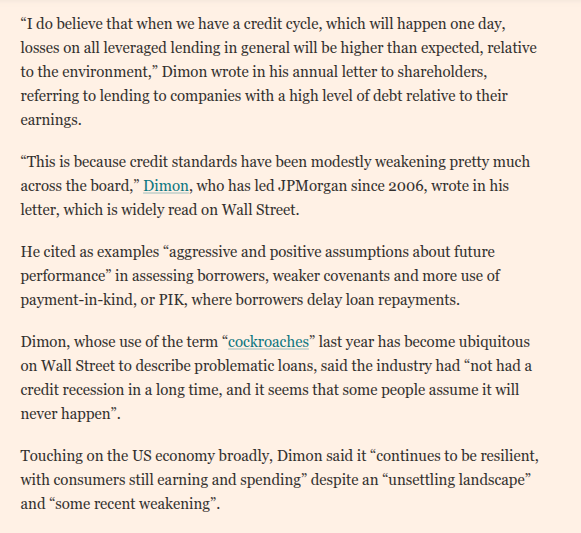
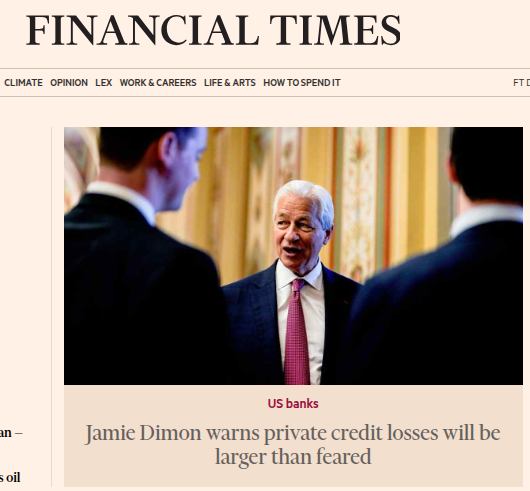
Jamie Dimon warns private credit losses will be larger than feared. JPMorgan chief raises alarm on weakening lending standards in annual shareholder letter. [Will it spill over into the banking, pension or insurance systems @SecScottBessent?] giftarticle.ft.com/giftarticle/ac…
Cate Long tweet media
English
11
17
48
6.1K
NFW
NFW@NFW987·
@kshaughnessy2 Even worse journalism on your part to repost something that’s false, add to it, and then say “not mine” when you’re called out for not even knowing what you’re reposting
English
0
0
0
8
kristen shaughnessy
kristen shaughnessy@kshaughnessy2·
More Roaches in The Private Credit Kitchen & No One Should Be Surprised “This Ends Badly.” -My warnings on the risks in shadow lending/CRE (starting with China’s Evergrande crisis in 2022) “Private Credit Losses Larger Than Feared” - Banks 2026 I’ve been sounding the alarm on the lack of transparency, hidden risks, and potential blow-up in this $2 Trillion shadow lending market since 2022, especially tying it to CRE stress and broader contagion. Now the big banks are echoing it ————— January 2024 Contagion could spread to US. ….These shadow banks are like toxic lenders and are barely regulated. x.com/kshaughnessy2/… ___________ January 2024 "The most likely source of a credit event, according to the fund managers, is the commercial real estate market.  Other possible sources include shadow banking, or non-bank financial institutions that are not subject to regulation, including hedge funds, private equity funds, investment banks and mortgage lenders, as well as U.S. corporate debt." x.com/kshaughnessy2/… ___________ January 2024 “Evergrande’s liquidation and Country Garden’s big financial troubles are expected to impact companies with exposure” From Reuters 2021 - BlackRock, HSBC among largest buyers of Evergrande debt: Morningstar
x.com/kshaughnessy2/… ____________ April 2024 “But keep telling us the economy is great. The AT&T Tower in St. Louis that sold for $205 Million in 2006 recently sold for $3.5 Million”
Direct link: x.com/kshaughnessy2/… _________ June 2024 Deutsche Bank bought 222 Broadway in Manhattan for $500 Million in 2014, Sells It for $150 Million in 2024 x.com/kshaughnessy2/… ___________ August 2024 “NYC’s Commercial Real Estate Crisis When does the media start covering all the fires that are burning?” x.com/kshaughnessy2/…
kristen shaughnessy tweet media
Financial Times@FT

Jamie Dimon warns private credit losses will be larger than feared ft.trib.al/lzBFTyn

English
11
66
177
12.1K
NFW
NFW@NFW987·
@biz_socks The rich aren’t why your $5k studio rent is up, homie. Nice try though.
English
0
0
2
633
NFW
NFW@NFW987·
@Barchart He said “larger than expected” not “larger than feared” Huge huge difference
English
0
0
0
41
Barchart
Barchart@Barchart·
JUST IN 🚨: Private Credit losses will be larger than previously feared warns Jamie Dimon 🚨🤯👀🫂
Barchart tweet media
English
64
183
970
75.1K
NFW
NFW@NFW987·
@ftfinancenews Never once says “larger than feared”. You are making up headlines to fear monger. Please show a screenshot of his letter where he says “larger than feared” Hack reported. Someone should be fired for this
English
0
0
0
57
NFW
NFW@NFW987·
@kieranwgoodwin Never once does he say “larger than feared”. Shame on FT for hack reporting and shame on you for perpetuating it. You’re a smart guy, I’m sure you read the report yourself and saw that statement is not in there, nor is that implied
English
0
0
1
167
NFW
NFW@NFW987·
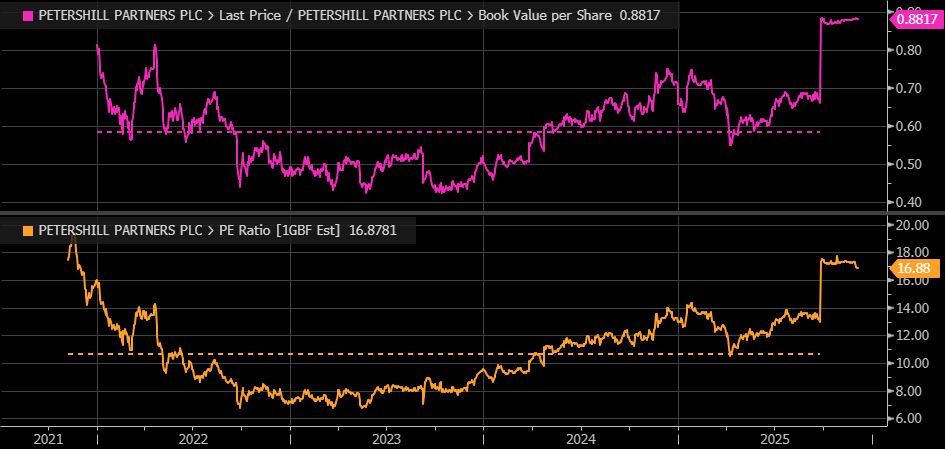
@neil_sipes4 OWL trading at like 7-8(?)x 2027 right now
English
0
0
1
93
NFW
NFW@NFW987·
@nicrypto He also said it’s not systemic and that there are good underwriters and bad. He’s not warning of some all encompassing fall out, but way to take pieces out of context to show a conclusion that he never alludes to
English
1
0
0
82
Nic
Nic@nicrypto·
Last year, Jamie Dimon warned that "cockroaches" were hiding inside private credit. Yesterday, in his annual shareholder letter, he upgraded the warning. When the credit cycle turns (and he says it will) losses will be higher than expected. Why: lenders have been quietly making aggressive assumptions about borrowers, weakening covenants, and letting companies delay repayments rather than pay cash. "The industry has not had a credit recession in a long time, and it seems that some people assume it will never happen." The cockroaches are still there. They've just been breeding.
English
11
17
145
6.8K
NFW
NFW@NFW987·
@FT Actual quote here: “I do believe that when we have a credit cycle, which will happen one day, losses on all leveraged lending in general will be higher than expected, relative to the environment.”
English
0
0
0
13
NFW
NFW@NFW987·
@FT Trash headline. Not “larger than feared” but “larger than expected” - very very different concepts, since you fear mongers say it’s all worth zero. FT reporting has become clickbait and it’s pathetic
English
1
0
3
576
NFW
NFW@NFW987·
@mcagney @coinbase @CoinbaseSupport They moved my small account from Coinbase pro to regular Coinbase during the last crypto winter (without my consent) and reset all my basis to prices at the bottom (date of move). They refuse to change it back and told me the basis is my responsibility. Prob cost me $50k in basis
English
0
0
1
741
Mike Cagney 🇺🇸
I got a 1099-misc from @coinbase custody. I have three accounts at Coinbase - I think the grand total of assets is $10. The $1099-misc said I made $1,600 last year. I called @CoinbaseSupport support. Total nightmare. You sent me the 1099-misc. "Please tell me where that money is from?" Instead I got endless runaround that ended with, "You need to consult your tax advisor". Thanks alot. I can't believe people still use them. And now that I'm on the rant, why do they get to hold up Clarity? No one in blockchain cares what they think.
English
102
16
433
78.5K
NFW
NFW@NFW987·
@jackprandelli I was interested until you referred to 2022 as a “major market crash” 😂😂
English
0
0
0
572
Jack Prandelli
Jack Prandelli@jackprandelli·
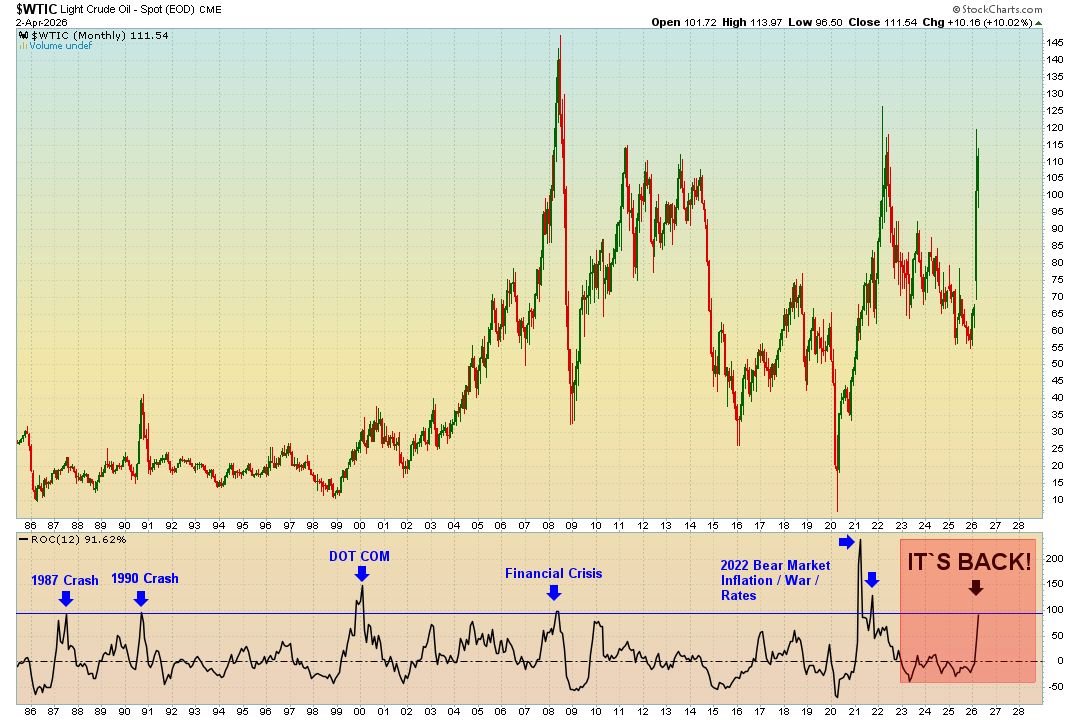
Every major market crash since 1987 was preceded by one signal. Oil's 12 month rate of change hitting 100%. We're at 91% right now. The historical record: 💥 1987 Crash — Oil ROC >100% 💥 1990 Crash — Oil ROC >100% 💥 Dot Com Bust — Oil ROC >100% 💥 2008 Financial Crisis — Oil ROC >100% 💥 2022 Bear Market — Oil ROC >100% Every Single Time. And today? Hormuz closed. We're 9 % points away from the threshold that has never failed to precede a market crash. The S&P is already down 5.4%. When oil moves this fast economies break. Will this time be different? History says no. Source: Ted @TedPillows, @marketmike
Jack Prandelli tweet media
English
92
818
2.7K
276.7K
NFW
NFW@NFW987·
@AdvisorMikeL He’s an idiot. Understands nothing that he writes/vlogs about. The commentary about the options is so hilariously wrong as well
English
0
0
0
272
Mike L
Mike L@AdvisorMikeL·
I disagree with Nick on the risk posed by Athene’s fixed-index annuity hedge portfolio. I started to reply in X but I had too much to say about how index annuities work, how insurers hedge, counterparty risk, and where I think the real trouble lies. open.substack.com/pub/investment…
Nick Nemeth (Mispriced Assets)@NickNemo17

Athene sells Fixed Indexed Annuities. The pitch to retirees: "You get some of the S&P 500's upside with none of the downside." To deliver that promise, Athene buys call options on the S&P 500 from investment banks. Market goes up, the option pays, Athene pays the retiree. The retiree thinks she owns a savings product. She owns the other side of a derivatives trade. The numbers: $8.1 billion in fair value derivative assets against $4.1 billion in capital. The derivative book alone is 2x the capital base. 78% is S&P 500 call options. 1-2 year maturities. The annuity liabilities they hedge last decades. Every year the hedges must roll — at whatever the market is charging. In a vol spike, option costs can triple. The cost of keeping the promise can exceed the profit earned on the entire investment portfolio. Two French banks — Societe Generale ($2.04B) and BNP Paribas ($1.69B) — hold $3.7B in fair value derivative exposure. Nearly the entire $4.1B capital surplus is concentrated in two counterparties. Citibank's potential exposure alone is $590 million — 15% of total capital from one name. $655 million in cash collateral posted. Hundreds of millions more in corporate bonds pledged as initial margin. In a liquidity crunch, that collateral is trapped. The NAIC's own "Potential Exposure" metric — what Athene could lose if counterparties default — is $2.1 billion. Half the capital. Estimated total notional: $120-160 billion against $4.1 billion in capital. 30-40x the capital in derivative exposure alone, stacked on top of 69:1 leverage on the invested asset portfolio. This extends beyond Athene. The dealers who sold these calls — SocGen, BNP, Barclays, BofA — delta-hedge by holding S&P 500 stocks and futures. If the economics of rolling break in a vol spike, the dealers unwind those hedges. That is a sell program the equity market does not see coming because it is embedded in the options market. Athene is one insurer. The entire FIA industry runs the same playbook through the same 8-10 dealers. The collateral is pro-cyclical — market stress reduces collateral values, triggers margin calls, forces liquidation, reinforces the decline. The derivative book is not a hedge that makes the company safer. It is a transmission mechanism connecting the S&P 500 options market, the European banking system, and American retirement savings into a single point of failure. Max pain is a simultaneous equity sell-off and vol spike — Q4 2008 conditions. Equities drop, so the call options Athene holds lose value. Vol spikes, so the cost of rolling triples. Credit widens at the same time, impairing the bond and mortgage portfolio. Collateral values fall, triggering margin calls from the same French banks. Margin calls force liquidation of illiquid private credit at distressed prices. Realized losses erode capital. Rating agencies downgrade leading to more capital calls. Headlines hit. Policyholders surrender. Surrenders require cash. More liquidation. More losses. Dealers unwind delta hedges. More equity selling. More vol. The loop feeds itself. The closest analog is AIG. AIG sold credit protection to banks. Athene buys equity protection from banks. The direction is reversed but the mechanic is the same — a massive concentrated derivative position with a handful of counterparties, on a balance sheet with insufficient capital to absorb a tail event, wrapped in an insurance company that the public trusts because the word "insurance" is in the name. AIG needed $182 billion from the Fed. Athene's balance sheet is comparable in size. This structure has never been stress-tested by a real crisis. It did not exist in 2008. This reads to me as lot like Leland O'Brien Rubinstein. Page 9,599 has the verification table. Pages 6,401 through 9,598 have every individual position. The filing is public. I am inviting every derivative structurer, risk manager, and counterparty credit analyst to open Schedule DB and tell me what I am missing. @jam_croissant The filing: athene.com investor relations, AAIA Q4 2025 Annual Statement.

English
14
7
111
39.4K
NFW
NFW@NFW987·
@Bfaviero You realize VC exists in other industries than tech, right? Not going to defend the dumb chart at all but have seen plenty of pricing at this level, give or take. Some wild successes, too - nine figure to just about a B. Great outcomes without hubris starting pricing
English
0
0
0
53
NFW
NFW@NFW987·
@oguzerkan Sorry are you saying that Ken griffin is Wall Street? That’s the most confusing part of this tweet. Citadel =\= “Wall Street”. Very very different things
English
1
0
0
216
Oguz Erkan
Oguz Erkan@oguzerkan·
Ken Griffin says AI is the most overhyped tech cycle he has ever seen. Most of Wall Street still doesn't understand where we are headed. They aren't aware that there'll be no more manual coding. They aren't aware that somebody made a cancer vaccine for his dog using AI. They aren't aware that somebody created a billion-dollar company completely alone, using just AI tools. They still don't see the potential and where we are headed.
Big Brain AI@realBigBrainAI

Citadel CEO Ken Griffin on why the AI boom might be the most overhyped tech cycle we have ever seen: This year alone, data center spending in the United States is projected to exceed $500 billion. And Griffin wants to know what all of that money is actually buying. "You're not going to generate this kind of spend unless you're going to make a promise. You're going to profoundly change the world." In his view, the scale of the capital commitment demands the scale of the promise. And when the promise has to be that big, hype becomes inevitable. "Is it hype? Of course." Griffin isn't arguing that AI is worthless. He sees real impact in certain areas like call centers and software engineering. But for the broader white collar workforce, he's far less convinced. He points to a recent Harvard paper that coined the term "AI work slop." It looks impressive on the surface, but falls apart the moment you look closer. He saw it firsthand inside Citadel. A colleague running their commodities business handed him a report generated by an AI engine. "The first few sentences like, 'Wow, that's really insightful.' And then you go down below that and it's all garbage." For Griffin, this is the defining tension of the current AI cycle. The industry needs to promise transformation to justify the investment. But the actual productivity gains, for most jobs, haven't shown up yet. We have seen this pattern before. Transformative technology attracting massive capital well ahead of proven results. When the hype finally settles, will AI have actually changed anything at all?
English
32
9
110
49.4K