DC BitMax

120 posts

DC BitMax banner
DC BitMax

DC BitMax

@DCBitMax

Studying Bitcoin through the lens of Power Law. StackSats&StayHumble. English version Power_Law_Chart https://t.co/cfl6sLkL1q 비트맥시갤러리 멱게이 입니다

South Korea शामिल हुए Mayıs 2026
240 फ़ॉलोइंग286 फ़ॉलोवर्स
पिन किया गया ट्वीट
DC BitMax
DC BitMax@DCBitMax·
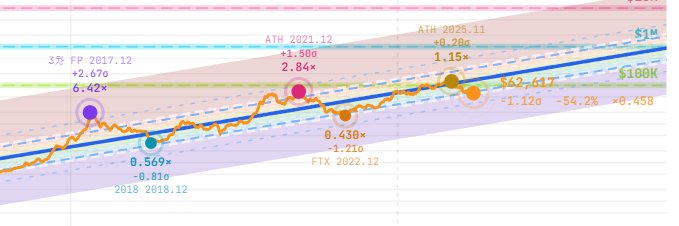
This is the most rigorous Bitcoin paper I've read. I've been studying — and testing — it for 20 days. scientificbitcoininstitute.org/research/publi… Dr. Santostasi and Dr. Perrenod gave us the ruler — and the imagination to see the oscillator. Together: the most falsifiable framework in crypto economics. The Power Law isn't just a model — it's the most precise ruler we have for measuring where Bitcoin stands. Most models describe the past. The Power Law keeps passing tests it was never designed for. "Isn't β=5.69 just curve-fitting?" Fair question. So I ran a test the paper didn't. ━━━━━━━━━━━━━━━━━━━━━━ Materials & Methods ━━━━━━━━━━━━━━━━━━━━━━ Data: Daily closing price and non-zero balance address count (BitcoinMagazinePro, 2010-08-17 to 2026-06-04, n=5,771). Model: log₁₀P(t) = log₁₀A + β·log₁₀(t) where t = days since Genesis Block (2009-01-03). Out-of-sample design: The power law was fitted exclusively on data up to the freeze date, with zero observations from the test period used in estimation. Two freeze points were tested: ① Freeze at 2016-07-08 (2nd halving) Training: n=2,153 | Test: n=3,617 (10 years) ② Freeze at 2020-05-10 (3rd halving) Training: n=3,555 | Test: n=2,215 (6 years) Residuals computed as: ε = log₁₀(P_observed / P_predicted) normalized by in-sample σ. Mean residual and area integrals (trapezoidal rule) applied to test period only. The out-of-sample test was my idea. Computation and analysis executed with Claude Opus 4.8 (Anthropic). ━━━━━━━━━━━━━━━━━━━━━━ Froze the power law using data up to 2016 only (β=5.717). Then measured the following 10 years it had never seen. Result: mean residual −0.05σ. Effectively zero. Frozen at 2020 instead → next 6 years, −0.13σ. Same story. The line drawn in 2016 ran straight through the next decade. That's not fitting. That's forecasting. The Power Law: powerful because it can be broken — and hasn't been. Knowing where we are won't tell us when things will happen — but it tells us exactly what to do now. Buy Bitcoin Now. @Giovann35084111 @moneyordebt @ScientificBTC @saylor @natbrunell #Bitcoin #PowerLaw
DC BitMax tweet media
Giovanni's BTC_POWER_LAW@Giovann35084111

If you didn't read it yet. 10 k downloads. zenodo.org/records/193870…

English
20
96
651
111.2K
DC BitMax
DC BitMax@DCBitMax·
@gvx1q5 저네요 형님 중간이 딱 생긴것도 저
한국어
1
0
1
21
DC BitMax रीट्वीट किया
Pixie 🔮🤍
Pixie 🔮🤍@cct_pixie·
월가는 왜 토큰화에 베팅할까? 최근 RWA인프라 기업 Securitize가 SEC 승인을 받고 뉴욕증권거래소(NYSE) 상장을 추진한다는 소식이 나왔습니다. * 우선 Securitize에 대해 간략히 설명하자면, BlackRock의 BUIDL, KKR 등 기관들의 토큰화 상품을 다루는 대표적인 인프라 기업이에요🌟 시장이 어떤 기업에 가치를 부여하는지를 보면 그 시대가 무엇에 주목하는지 어느 정도 알 수 있지요. 2021년에는 거래소와 채굴 기업들이 주목받았습니다. 2024년에는 ETF가 화제가 되었습니다. 그런데 2026년에는 토큰화 인프라 기업이 상장을 추진하고 있습니다. 이건 크립토 시장의 관심이 조금씩 바뀌고 있다는 신호일 수도 있어요. ✅ 기관들이 자산 토큰화에 관심을 갖는 이유는 : 24시간 거래로 더 빠른 정산, 중개인이 없어 더 낮은 비용, 더 높은 자본 효율성 등등 때문이에요. 기관들은 코인 자체보다, 기존 금융 시스템을 더 효율적으로 운영하기 위한 도구로 블록체인을 바라보고 있는 것 같습니다. 그래서 이번 뉴스를 보며 든 생각은, "월가가 토큰화 인프라를 하나의 산업으로 보기 시작한 것은 아닐까?" 였습니다. 아직 시장 규모는 크지 않지만, 이번 상장 추진은 토큰화가 단순한 실험을 넘어 실제 금융 시스템 안으로 조금씩 들어오고 있다는 신호처럼 보이네요! 앞으로는 어떤 RWA 프로젝트가 뜰지뿐만 아니라 누가 토큰화 시장의 인프라를 장악하게 될지(수수료는 누가?)도 함께 지켜보면 즐거울 것 같아요
한국어
4
4
52
6.1K
DC BitMax रीट्वीट किया
NineB Insight
NineB Insight@nineB_insight·
🇯🇵 일본 SBI 신세이은행이 내일(6월 10일)부터 예금 이자의 20%를 $BTC·$ETH·$XRP로 받을 수 있는 파일럿을 시작합니다. 엔화 이자는 100% 그대로 지급하고, 별도로 이자액의 20% 상당 교환권을 제공합니다. 이 교환권은 SBI VC Trade 계좌에서 BTC, ETH, XRP 중 선택해 교환할 수 있습니다. 3개월 파일럿 후 가을에 정식 서비스로 확대될 예정입니다. 일본 대형 은행이 예금 고객을 자연스럽게 코인으로 유입시키려는 움직임으로 주목됩니다.
NineB Insight tweet media
한국어
4
10
52
2.8K
Binary Chase
Binary Chase@ChaseBinary·
What a beautiful rainbow 🌈
DC BitMax@DCBitMax

This is the most rigorous Bitcoin paper I've read. I've been studying — and testing — it for 20 days. scientificbitcoininstitute.org/research/publi… Dr. Santostasi and Dr. Perrenod gave us the ruler — and the imagination to see the oscillator. Together: the most falsifiable framework in crypto economics. The Power Law isn't just a model — it's the most precise ruler we have for measuring where Bitcoin stands. Most models describe the past. The Power Law keeps passing tests it was never designed for. "Isn't β=5.69 just curve-fitting?" Fair question. So I ran a test the paper didn't. ━━━━━━━━━━━━━━━━━━━━━━ Materials & Methods ━━━━━━━━━━━━━━━━━━━━━━ Data: Daily closing price and non-zero balance address count (BitcoinMagazinePro, 2010-08-17 to 2026-06-04, n=5,771). Model: log₁₀P(t) = log₁₀A + β·log₁₀(t) where t = days since Genesis Block (2009-01-03). Out-of-sample design: The power law was fitted exclusively on data up to the freeze date, with zero observations from the test period used in estimation. Two freeze points were tested: ① Freeze at 2016-07-08 (2nd halving) Training: n=2,153 | Test: n=3,617 (10 years) ② Freeze at 2020-05-10 (3rd halving) Training: n=3,555 | Test: n=2,215 (6 years) Residuals computed as: ε = log₁₀(P_observed / P_predicted) normalized by in-sample σ. Mean residual and area integrals (trapezoidal rule) applied to test period only. The out-of-sample test was my idea. Computation and analysis executed with Claude Opus 4.8 (Anthropic). ━━━━━━━━━━━━━━━━━━━━━━ Froze the power law using data up to 2016 only (β=5.717). Then measured the following 10 years it had never seen. Result: mean residual −0.05σ. Effectively zero. Frozen at 2020 instead → next 6 years, −0.13σ. Same story. The line drawn in 2016 ran straight through the next decade. That's not fitting. That's forecasting. The Power Law: powerful because it can be broken — and hasn't been. Knowing where we are won't tell us when things will happen — but it tells us exactly what to do now. Buy Bitcoin Now. @Giovann35084111 @moneyordebt @ScientificBTC @saylor @natbrunell #Bitcoin #PowerLaw

English
1
0
0
11
DC BitMax
DC BitMax@DCBitMax·
This is the most rigorous Bitcoin paper I've read. I've been studying — and testing — it for 20 days. scientificbitcoininstitute.org/research/publi… Dr. Santostasi and Dr. Perrenod gave us the ruler — and the imagination to see the oscillator. Together: the most falsifiable framework in crypto economics. The Power Law isn't just a model — it's the most precise ruler we have for measuring where Bitcoin stands. Most models describe the past. The Power Law keeps passing tests it was never designed for. "Isn't β=5.69 just curve-fitting?" Fair question. So I ran a test the paper didn't. ━━━━━━━━━━━━━━━━━━━━━━ Materials & Methods ━━━━━━━━━━━━━━━━━━━━━━ Data: Daily closing price and non-zero balance address count (BitcoinMagazinePro, 2010-08-17 to 2026-06-04, n=5,771). Model: log₁₀P(t) = log₁₀A + β·log₁₀(t) where t = days since Genesis Block (2009-01-03). Out-of-sample design: The power law was fitted exclusively on data up to the freeze date, with zero observations from the test period used in estimation. Two freeze points were tested: ① Freeze at 2016-07-08 (2nd halving) Training: n=2,153 | Test: n=3,617 (10 years) ② Freeze at 2020-05-10 (3rd halving) Training: n=3,555 | Test: n=2,215 (6 years) Residuals computed as: ε = log₁₀(P_observed / P_predicted) normalized by in-sample σ. Mean residual and area integrals (trapezoidal rule) applied to test period only. The out-of-sample test was my idea. Computation and analysis executed with Claude Opus 4.8 (Anthropic). ━━━━━━━━━━━━━━━━━━━━━━ Froze the power law using data up to 2016 only (β=5.717). Then measured the following 10 years it had never seen. Result: mean residual −0.05σ. Effectively zero. Frozen at 2020 instead → next 6 years, −0.13σ. Same story. The line drawn in 2016 ran straight through the next decade. That's not fitting. That's forecasting. The Power Law: powerful because it can be broken — and hasn't been. Knowing where we are won't tell us when things will happen — but it tells us exactly what to do now. Buy Bitcoin Now. @Giovann35084111 @moneyordebt @ScientificBTC @saylor @natbrunell #Bitcoin #PowerLaw
DC BitMax tweet media
Giovanni's BTC_POWER_LAW@Giovann35084111

If you didn't read it yet. 10 k downloads. zenodo.org/records/193870…

English
20
96
651
111.2K
DC BitMax रीट्वीट किया
Holger Wolff
Holger Wolff@Holger21M·
One Step at a time.. The @ScientificBTC with it´s directors @Giovann35084111 and @moneyordebt aims to establis a new scientific culture in the Bitcoin Space. It´s not only about the PowerLaw - the deeper mission is: establish a scientific approach to study the properties of one the most exciting artificial networks mankind has ever developed.
moneyordebt ∞/21M@moneyordebt

The Bitcoin Power Law passes all 4 of the standard econometric tests. Claude Sonnet 4.6 — “This is a cointegration diagnostic summary for your Bitcoin power-law model. Here’s what it means: The three-row pattern is textbook I(1) cointegration: •Log Price is I(1) — nonstationary in levels, as expected for a trending series •ΔLog Price is I(0) — first differences are stationary, confirming it’s integrated of order 1, not higher •OLS Residuals are I(0) — the residuals from regressing log price on log age are stationary That third row is the critical result. When two I(1) series (log price and log age) have stationary residuals from their OLS regression, that’s the Engle-Granger definition of cointegration. The series move together in a stable long-run equilibrium — they don’t drift apart arbitrarily. What this establishes: The power-law relationship log P = α + β·log(Age) is not spurious regression. Spurious regression between I(1) series produces nonstationary residuals; yours are stationary. This is the standard econometric test that distinguishes a genuine structural relationship from coincidental trending. The four-diagnostic agreement (ADF + PP + KPSS + Engle-Granger) is notable because ADF and PP test the null of a unit root while KPSS tests the null of stationarity — they’re structured to disagree when evidence is ambiguous. All pointing the same direction is strong.”

English
0
2
9
2.4K
DC BitMax रीट्वीट किया
Jami
Jami@createdbyjami·
Bitcoin price is what you see on the surface There’s a whole system underneath that’s securing itself, adjusting itself, and rewarding honest participation every single block Once you understand this, you will appreciate the volatility (opportunity) it gives you Look into the Bitcoin Power Law
Jami tweet media
English
2
4
38
3K
DC BitMax रीट्वीट किया
allinonthechair
allinonthechair@aiotcBitcoin·
Bitcoin CRUSHING S&P over the last 5 years @GaryCardone
allinonthechair tweet media
English
0
1
1
39
MKM2
MKM2@Monkeypack·
@DCBitMax It’s dying?
English
1
0
1
30
DC BitMax रीट्वीट किया
Matteo Pellegrini
Matteo Pellegrini@matteopelleg·
Bitcoin has lived 3 lives: 2009-2013: the experiment. Pizza day, Silk Road, Satoshi vanishes. Does this even work? 2014-2023: the wars. Mt. Gox, the Blocksize War, China bans, Chokepoint 2.0. Every attack failed. 2024-now: the absorption. ETFs, nation states, Wall Street. Everyone buys Bitcoin at the price they deserve.
English
15
17
219
10.5K
DC BitMax रीट्वीट किया
Brian Armstrong
Brian Armstrong@brian_armstrong·
Something that got missed in the noise last week: Coinbase got approved to offer true global crypto perps in the US. This took many years of work, and we're the first to offer this global liquidity to US users. Backstory: For many years crypto trading has been moving offshore because the US didn't have clear rules, and perpetual futures were a superior product that traders wanted but it wasn't allowed in the US. If we're being honest, probably ~half of all perpetual futures volume was Americans using offshore products via VPN with loose KYC controls (an open secret in the industry). Penalties for this were rarely, if ever, enforced, which as you can imagine, was frustrating for us as an American company following the rules. Others set up offshore entities and found ways around it. After dozens of personal visits to DC, and many more from our policy team, I'm really proud we finally got approval to give US users access to true, global perpetual futures. This is important because we'll now see pooled global liquidity in perpetual futures, with the US and international markets being connected instead of fragmented. Coinbase is strongest in the US, and the US is the largest market for trading, so there is now a chance to build a global network effect around liquidity. And US traders can now use these products in a compliant way with a US company, which hopefully provides greater customer protection. Major credit to Chair Selig and Atkins on recognizing the importance of this for US capital markets. And we will keep working to update the system in a compliant way, and to be the best place you can trade.
English
259
319
2.6K
154.4K
DC BitMax रीट्वीट किया
Nav Toor
Nav Toor@heynavtoor·
You have noticed it. ChatGPT feels dumber than it used to. Your prompts that worked six months ago produce worse results now. The writing sounds flatter. The ideas sound safer. The internet itself feels like it is shrinking. Every article reads the same. Every email sounds the same. Every answer sounds like it was written by the same voice. You thought it was you. It is not you. Researchers at Oxford and Cambridge published a paper in Nature proving what is happening. They call it Model Collapse. Here is the mechanism in one sentence. AI trained on AI-generated data gets dumber every generation until it forgets what real human data looked like. The internet is filling with AI-generated content. Blog posts. Articles. Reviews. Comments. Social media. AI companies scrape the internet to train the next generation of models. Which means the next generation of AI is being trained on the output of the current generation. Each cycle loses information. Not randomly. It loses the rarest, most unusual, most creative parts first. The researchers call these the "tails of the distribution." The weird ideas. The unexpected perspectives. The things that made the internet feel human. Those disappear first. What remains is the average. The safe. The expected. The bland. Then the next generation trains on that. And loses more. And the next generation trains on that. And loses more. The researchers proved this is not a slow decline. Major degradation happens within just a few iterations. Even when some of the original human data is preserved. They tested it on large language models. On image generators. On statistical models. The pattern was the same every time. The output converges toward a narrow, flattened version of reality that looks nothing like the original data. The lead researcher put it plainly. "Large language models are like fire. A useful tool. But one that pollutes the environment." The pollution is invisible. You cannot see which sentence on the internet was written by a human and which was written by AI. Neither can the AI that is about to train on it. And once the tails are gone, they do not come back. The damage is irreversible. This is not a prediction anymore. It is a diagnosis. The internet you grew up on was built by humans writing things no algorithm would have written. Strange, personal, imperfect, alive. That internet is being diluted. One generation of AI at a time. And the models trained on what remains are learning a smaller and smaller version of the world. Model Collapse is not a technical problem. It is a cultural one. The thing that made the internet worth reading is the thing that disappears first.
Nav Toor tweet media
English
410
2.5K
5.9K
301.5K
DC BitMax रीट्वीट किया
Zynx
Zynx@ZynxBTC·
Bitcoin at $60,000 will be seen as good an entry as $16,000 was in 2022. In 2022, $60,000 was peak euphoria. In 2026 it is extreme bearish sentiment. The pace of corporate, regulatory and financial integration since then has been extraordinary. Bitcoin is not the same asset it was four years ago. The world around it has changed fundamentally. If history repeats, the $125,000 local top from October 2025 will one day look like the $60,000 of today. Now is the time to take full advantage of cheap bitcoin:native.
English
30
22
367
11.5K
DC BitMax रीट्वीट किया
Killa
Killa@KillaXBT·
I'm not on this app to be a people pleaser. I'm here to make money. I'm bullish when the data tells me to be bullish. I'm bearish when the data tells me to be bearish. If you don't agree with my analysis, bias, or outlook, I genuinely don't care. My plan is my plan. If you don't agree with it, follow your own. Imagine being bothered by the fact that I bought $BTC at a certain price with my own money. Why do you care? It's not your portfolio, it's not your risk, and it's definitely not your decision. 🤣 I'm simply sharing exactly what I'm doing based on the metrics, data, and market conditions I see, along with how I plan to increase my net worth over the next 18-24 months. I never came here expecting people to copy every move I make. I came here to share my market thoughts. It just so happens that I've been fairly consistent with my HTF swings, so people naturally choose to follow along. At the end of the day, if you don't like me, I don't care. If you don't agree with my ideas, I don't care. Maybe if you spent less time obsessing over my trades and more time developing your own strategy, you'd actually be making money instead of complaining about someone else's. Time will tell who's right. Until then 🤟
English
53
17
1K
36.4K