Catholic Nick

1.2K posts

Catholic Nick banner
Catholic Nick

Catholic Nick

@CatholicNick

Catholic Apologetics

参加日 Mayıs 2013
403 フォロー中2.2K フォロワー
固定されたツイート
Catholic Nick
Catholic Nick@CatholicNick·
Because Sola Scriptura is really about who has the better interpretation of Romans 4. If Catholicism has botched the plain teaching of Romans 4, then Rome loses all exegetical credibility and thus is unreliable as a teacher. Same goes for Protestants, except Protestants are tragically never challenged on Romans 4 by Catholics, giving Protestants the false impression of exegetical superiority. The record easily shows Protestantism folds instantly when challenged on Romans 4, since it fails as the Locus Classicus for Imputation of Christ's Righteousness
English
1
0
6
501
Catholic Nick
Catholic Nick@CatholicNick·
I've read Acts 8:14ff. It says Magus sinned later on, which is not the same as 'never truly saved'. Peter tells Magus he fell into sin and needs to repent, and Magus did pray for forgiveness. Nothing *exegetically* here suggests never truly saved. Christians often fall into grave sin later on in life and are confronted and told to repent.
English
0
0
0
12
Catholic Nick
Catholic Nick@CatholicNick·
In one of your debates you said Romans 4 was the decisive text for Protestant Justification versus Catholic. This means Romans 4 is the key battleground text, even the Locus Classicus for Imputation. If it can be clearly shown that Imputation isn't taught in Rom 4, nor any of the key Protestant assumptions about Justification, then the critical text of Protestantism falls. This is intuitively understood by Protestants and not at all by Catholics, which is why Romans 4 is never focused on and hence why no real dialog or healing has happened. Romans 4 is also the basis for which Sola Scriptura has its credibility, because in the Protestant mind the Catholic is willfully having to ignore Scripture by distracting attention away from Romans 4 (such as shifting to James 2). The reality is once Jordan & Co are forced to exegete Romans 4 in front of a well informed Catholic, then the right information will come to light and Imputation must be abandoned.
English
1
0
0
147
Ben Guptill
Ben Guptill@BenGuptill·
FYI, I put nearly zero confidence in Calvin & his writings. He was a demonic murderer. He blatantly contradicted scripture and made things up out of thin air when it suited him. That being said, there is little reason to focus exclusively on ROM 8:3 to the exclusion of all other cross references. Isaiah 53:4-6,9-12 (NASB95) 4 Surely our griefs He Himself bore, And our sorrows He carried; Yet we ourselves esteemed Him stricken, Smitten of God, and afflicted. 5 But He was pierced through for our transgressions, He was crushed for our iniquities; The chastening for our well-being fell upon Him, And by His scourging we are healed. 6 All of us like sheep have gone astray, Each of us has turned to his own way; But the LORD has caused the iniquity of us all To fall on Him. 9 His grave was assigned with wicked men, Yet He was with a rich man in His death, Because He had done no violence, Nor was there any deceit in His mouth. 10 But the LORD was pleased To crush Him, putting Him to grief; If He would render Himself as a guilt offering, He will see His offspring, He will prolong His days, And the good pleasure of the LORD will prosper in His hand. 11 As a result of the anguish of His soul, He will see it and be satisfied; By His knowledge the Righteous One, My Servant, will justify the many, As He will bear their iniquities. 12 Therefore, I will allot Him a portion with the great, And He will divide the booty with the strong; Because He poured out Himself to death, And was numbered with the transgressors; Yet He Himself bore the sin of many, And interceded for the transgressors. Look at how this says our iniquities fall on Him or He bears or carries them. It says he was numbered with the transgressors. Galatians 3:13 (NASB95) 13 Christ redeemed us from the curse of the Law, having become a curse for us--for it is written, “CURSED IS EVERYONE WHO HANGS ON A TREE”-- Ephesians 5:2 (NASB95) 2 and walk in love, just as Christ also loved you and gave Himself up for us, an offering and a sacrifice to God as a fragrant aroma. 1 Peter 3:18 (NASB95) 18 For Christ also died for sins once for all, the just for the unjust, so that He might bring us to God, having been put to death in the flesh, but made alive in the spirit; 1 John 2:1,2 (NASB95) 1 My little children, I am writing these things to you so that you may not sin. And if anyone sins, we have an Advocate with the Father, Jesus Christ the righteous; 2 and He Himself is the propitiation for our sins; and not for ours only, but also for those of the whole world. As to Calvin, an example of his contradictions is: “By predestination we mean the eternal decree of God, by which he determined with himself whatever he wished to happen with regard to every man. All are not created on equal terms, but some are preordained to eternal life, others to eternal damnation; and, accordingly, as each has been created for one or other of these ends, we say that he has been predestinated to life or to death.” (Institutes ch 21) But this is explicitly contradicted by scripture. Deuteronomy 30:19 (NASB95) “I call heaven and earth to witness against you today, that I have set before you life and death, the blessing and the curse. So choose life in order that you may live, you and your descendants, Furthermore, Calvin never gives a scripture reference for this decree of his in all of the institutes. He’s entirely invented it. In fact, Calvin’s writings were so egregiously wrong that the founding documents of the United States mention this point as a source of theological tyranny. When Thomas Jefferson wrote the Declaration of Independence, the line “we hold these truths to be self evident that all men were created equal” he was explicitly contradicting Calvin’s statements. Jefferson saw Calvin as an atheistic pretender who used religious pretext to gain tyrannical power.
English
1
0
0
23
Catholic Nick
Catholic Nick@CatholicNick·
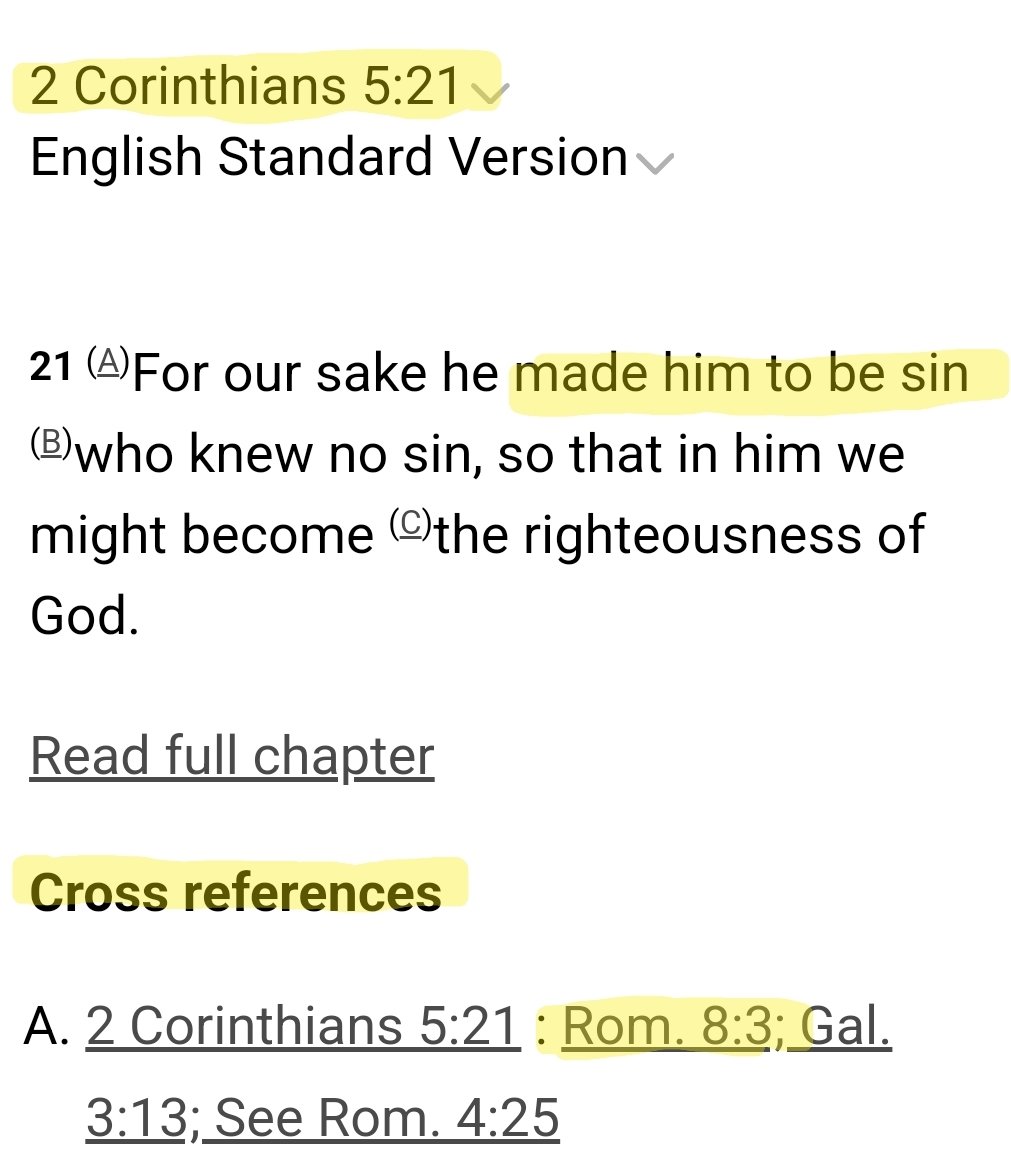
2Cor5:21 refutes Imputation, via Rm8:3, we see "made sin" means "sent in likeness of sinful flesh," thus Incarnation, not Imputation. Calvin (Inst 3.11.9): "Paul places the fountain of righteousness entirely in the incarnation: He has made him to be sin for us who knew no sin..."
Catholic Nick tweet media
English
3
0
4
1.6K
Ben Guptill
Ben Guptill@BenGuptill·
In the same way we are "made righteous" Jesus was made "to be sin." 2Co 5:21 explicitly links the two in that relationship. The passage does not use the term "sin offering." 2 Corinthians 5:21 NASB95 - 21 He made Him who knew no sin [to be] sin on our behalf, so that we might become the righteousness of God in Him. Jesus "became sin" in the same sense that we "became righteous." Surly you have no problem with sinful man undeservedly becoming righteous, so then why do you question whether a sinless Jesus can undeservedly become sin? The sacrifice in the OT was only required to be spotless to QUALIFY to begin the ritual. The animal was then spoiled by the ritual. The animal was slaughtered, skinned, bled, and burned in its death. It was unfit for reuse after the ritual, but the process of the ritual did not need to be halted the second the first spot of blood dripped on the animal, or the second the animal died. It only needed to qualify for the ritual to begin the ritual because part of the ritual was laying the sin of the nation upon the animal and ritualistically transferring the life of the animal to the offeror. Leviticus 16:21-22 NASB95 - 21 "Then Aaron shall lay both of his hands on the head of the live goat, and confess over it all the iniquities of the sons of Israel and all their transgressions in regard to all their sins; and he shall lay them on the head of the goat and send [it] away into the wilderness by the hand of a man who [stands] in readiness. 22 "The goat shall bear on itself all their iniquities to a solitary land; and he shall release the goat in the wilderness. It would not be a stretch to say "Jesus had the sin of the world laid upon him and bore on Himself the sin of the world." Romans 5:17 NASB95 - 17 For if by the transgression of the one, death reigned through the one, much more those who receive the abundance of grace and of the gift of righteousness will reign in life through the One, Jesus Christ. If we receive Christ's free gift of righteousness, 2Co 5:21 would seem to indicate Christ receives our free gift of sin. Your objections are easily addressed, and there is copious Biblical evidence that Jesus did bear our sin, so I still don't understand what reason we would have to avoid saying Jesus became sin? There seems to be no damage it does, and it aligns with all the passages in scripture in a much more coherent way than denying it.
English
1
0
2
77
Peter Leithart
Peter Leithart@PLeithart·
According to @jasonstaples, Paul interprets Lev 18:5 (in Rom 10) as a promise of :an Adam who does these things" of the law and thus “will live by them.” Lev 18:5 is instead “a prophecy about and promise to a future individual," the “just one” who Habakkuk says “will live.” Staples finds a rich anticipation of this in the final verses of Deuteronomy, “the literal end of the Torah”: Moses passes on his authority to Joshua, and the text follows with, “no prophet has risen in Israel like Moses” (Deut 34:10). Jesus/Joshua's resurrection confirms that He’s the Prophet who overcomes the curse of Torah brings the Torah to its promised end as the “one who does these things.” In sum, Lev 18:5 doesn’t establish an old covenant principle of works, but is a prophecy of a new Adam.
English
8
7
60
6.4K
Canon & Creed
Canon & Creed@Canonandcreed·
Davenant was correct about the atonement because the church historically wasn’t wrong about the atonement.
English
5
11
87
4.9K
Catholic Nick
Catholic Nick@CatholicNick·
I don't think that showing favor and acceptance is a point of contention with Rome, and ideally we should not be trying to find problems where there aren't any. The general method throughout Church history is to allow flexibility when there is general agreement. Even Athanasius said "similar substance" is allowed for those not trying to be Arian and effectively affirming homoousious.
English
0
0
0
62
Edgar Turretini🕊🇲🇽
Edgar Turretini🕊🇲🇽@EdgarTurrettini·
Very interesting notes from @ToCelestialCity “For example, when Turretin discusses Romans 4:5 in the sources of explanation, he writes, “I confess that God in declaring just ought also for that very reason to make just so that his judgment may be according to truth” (p. 770). Not only is he employing the exact same distinction of justification into constitutive justification that Baxter does (though he does not use this term), but he mirrors Baxter’s reasoning as well! In Scripture Gospel Defended, he says, “Constitutive justification is ever first: God never judged a man righteous that was not righteous,” (p. 243).”
English
2
1
19
1.4K
Catholic Nick
Catholic Nick@CatholicNick·
PSA is a specific model which holds the guilt of the elect was imputed to Christ. If the guilt of everyone was imputed to Christ then Christ would have taken all their punishment. Since God cannot punish the same sin twice, it means all people will never be subject to punishment if Christ took it in their place. So the only alternative is to change atonement models if you're holding to a (hypothetical) universal atonement.
English
1
1
1
88
Catholic Nick
Catholic Nick@CatholicNick·
@EdgarTurrettini @_matthewpearson @ToCelestialCity When Pharaoh or when Joseph? Joseph showed mercy on his brothers, he forgave them, but I wouldn't call this a "formal" cause in any sense. I don't even see imputation here other than non-imputation of sin.
English
1
0
1
102
Edgar Turretini🕊🇲🇽
Edgar Turretini🕊🇲🇽@EdgarTurrettini·
@CatholicNick @_matthewpearson @ToCelestialCity Ok so follow me with this example; when Pharaoh showed lavish favor to his brothers (giving them the best land in Egypt, wagons, provisions, and even positions over his livestock), what form of favor was shown to them despite what they did to him?
English
1
0
0
31
Provisionist Perspective 🩸🌍
Provisionist Perspective 🩸🌍@ProvisionistP·
In the fear-power paradigm curses come from all over the place (people, gods, spirits, etc.) and not necessarily the Creator. I get how you get there but I’m not seeing that clearly here and it seems theologically…risky to say “the Father cursed the Son” without SERIOUS explicit Scriptural warrant.
English
1
0
0
31
Caio Rodrigues
Caio Rodrigues@ReformedCaio·
Christ became a curse for us. Christ redeemed us from the curse of the Law, having become a curse for us—for it is written, “Cursed is everyone who hangs on a tree”— (Gal 3:13, Deut 21:23) Christ received the wrath of God on our behalf. Much more then, having now been justified aby His blood, we shall be saved from the wrath of God through Him. (Rom. 5:9) whom God displayed publicly as a propitiation bin His blood through faith, for a demonstration of His righteousness, because in the forbearance of God He passed over the sins previously committed; (Rom 3:25) Therefore, He had to be made like His brothers in all things, so that He might become a merciful and faithful high priest in things pertaining to God, to make propitiation for the sins of the people. (Heb 2:17) and He Himself is the propitiation for our sins, and not for ours only, but also for those of the whole world. (1 John 2:2) In this is love, not that we have loved God, but that He loved us and sent His Son to be the propitiation for our sins. (1 John 4:10) He knew no sin but was made to be sin on our behalf. He made Him who knew no sin to be sin on our behalf, so that we might become the righteousness of God in Him. (2 Cor 5:21)
Caio Rodrigues tweet media
English
7
2
38
3.2K
Ben Guptill
Ben Guptill@BenGuptill·
What's the difference between "becoming a curse" and "the father cursing the son?" All of the blessings and curses of Deuteronomy come from the LORD (capitalized). This is the formal abbreviation for the name of God (the Father). Galatians 3:13 NASB95 - 13 Christ redeemed us from the curse of the Law, having become a curse for us for it is written, "CURSED IS EVERYONE WHO HANGS ON A TREE" Deuteronomy 21:23 NASB95 - 23 his corpse shall not hang all night on the tree, but you shall surely bury him on the same day (for he who is hanged is accursed of God), so that you do not defile your land which the LORD your God gives you as an inheritance. It is clear, the curse for hanging "all night" on a tree is to be cursed by the Father. Jesus hung "all night" in that the Bible defines day and night as periods of light and dark, and the sky turned dark during the day while Jesus was on the cross. I didn't hang on the cross physically, nor did you physically hang on a cross. That was something Jesus did literally Himself. He had the power to prevent it (i.e. He knocked down all the soldiers in the garden), but surrendered to it. So Jesus hung all night on a tree, and was literally cursed by God. Many Christians act like this is some kind of insurmountable thing. Clearly, WE, who actually deserve the curse for our sin, can surmount the curse by Christ's righteousness... why is it such a big deal for Christ to overcome the curse by His own righteousness? In Leviticus 16, when atonement was being made, the 2 animals would be slaughtered, dismembered, skinned, and burned. The qualification as "spotless" was only necessary to qualify to BEGIN the sacrificial ritual... the sacrifice was never intended to remain spotless and without blemish throughout the ritual.... that would be impossible. No one could bring up a dead, previously sacrificed goat and say "here's my sacrifice" ... it would no longer qualify to begin the next ritual. It would now have been spoiled by the sacrificial process itself. Deuteronomy 28:1, 8, 15, 20, 61 NASB95 - 1 "Now it shall be, if you diligently obey the LORD your God, being careful to do all His commandments which I command you today, the LORD your God will set you high above all the nations of the earth. ... 8 "The LORD will command the blessing upon you in your barns and in all that you put your hand to, and He will bless you in the land which the LORD your God gives you. ... 15 "But it shall come about, if you do not obey the LORD your God, to observe to do all His commandments and His statutes with which I charge you today, that all these curses will come upon you and overtake you: ... 20 "The LORD will send upon you curses, confusion, and rebuke, in all you undertake to do, until you are destroyed and until you perish quickly, on account of the evil of your deeds, because you have forsaken Me. ... 61 "Also every sickness and every plague which, not written in the book of this law, the LORD will bring on you until you are destroyed. All of the laws (including chapter 21) culminate in the blessings and curses in chapter 27-28. God brings both the blessings and the curses for following or failing to follow all the statutes. Deu 21:23 specifically says you will be "accursed by God." I asked Grok if there were substantial disagreements among scholars as to the Hebrew meaning of "accursed of God" or "accursed by God" meaning God was or was not involved. Generally, you should not get theology from A.I. but it is acceptable to get language and translation analysis since that is Large Language Model's primary function (to understand languages). I don't know Hebrew, so I have to rely on concordances to understand the Hebrew. Here is what Grok said: ------- The Hebrew text of **Deuteronomy 21:23** reads: כִּי־קִלְלַ֥ת אֱלֹהִ֖ים תָּל֑וּי *kî-qilelat ʾĕlōhîm tālûy* The exact phrase in question is **קִלְלַ֥ת אֱלֹהִ֖ים** (*qilelat ʾĕlōhîm*). ### How the phrase is normally translated - Most English Bibles: **“for a hanged man is cursed by God”** (KJV, NKJV, ESV, NASB, NIV, CSB, etc.) - A few: **“a curse of God”** or **“accursed of God”** (older Geneva Bible, Young’s Literal Translation) ### What the Hebrew actually means grammatically The word **קִלְלַת** (*qilelat*) is a feminine noun meaning “curse” or “accursed thing.” The word **אֱלֹהִים** (*ʾĕlōhîm*) is in the genitive case after the construct form **קִלְלַת**, so literally: **“a curse of God”** or **“an accursed thing of God.”** In Biblical Hebrew, when a noun in the construct state is followed by **אֱלֹהִים** in this way, the genitive can be understood in **at least three possible ways**: 1. **Objective genitive** → “cursed **by** God” (God is the one doing the cursing) → This is how Paul reads it in Galatians 3:13 and how almost all Jewish and Christian tradition has understood it. 2. **Subjective genitive / genitive of author** → “a curse **from** God” or “a divine curse” (the curse belongs to or originates with God) 3. **Genitive of quality / superlative** → “an accursed thing in God’s sight” or “a God-accursed thing” (something that is accursed from the divine perspective, the worst kind of curse) In actual Hebrew usage, **all three nuances are present at the same time**; the language does not force us to choose only one. The phrase is deliberately terse and powerful. ### Ancient and Jewish interpretations - **Septuagint (LXX)**: βεκαταρήμένος ὑπὸ θεοῦ πᾶς κρεμάμενος ἐπὶ ξύλου → explicitly “cursed **by** God” - **Targum Onqelos** (Aramaic): חֲשִׁיב קֳדָם יוי כְּמִלְעַן → “considered before the Lord as one who is cursed” - **Philo** and **Josephus** both treat it as “cursed by God.” - **Dead Sea Scrolls** (11QTemple 64:6–13) and the Nash Papyrus apply it to crucifixion and understand it as divine curse. ### Paul’s reading in Galatians 3:13 Paul quotes the exact LXX wording and then explains: “Christ redeemed us from the curse of the law **by becoming a curse for us** …” Paul clearly takes **קִלְלַ֥ת אֱלֹהִ֖ים** to mean “cursed **by God**” (objective genitive). He sees Jesus as voluntarily coming under the divine curse that the law pronounces on covenant-breakers. ### Bottom-line answer The Hebrew **does not say explicitly “cursed by God,”** but the most natural and historically dominant reading—especially in Second-Temple Judaism and in Paul—is **“cursed by God.”** The grammar allows it, the ancient translations and interpreters all take it that way, and it is theologically the strongest reading in context (hanging on a tree exposes the corpse to public divine judgment). So: - Literally: “a curse of God” - Intended and received meaning: **“cursed by God”** -------
English
1
0
1
18
Catholic Nick
Catholic Nick@CatholicNick·
@EddyEkofo I cannot see how Baxter logically leads to Socinianism (esp Arianism). The other mainline Protestant groups didn't become Socininan despite not being Reformed or Baptist. It's a bizarre charge to make as I see it as non sequitur.
English
1
0
0
91
Edgar Turretini🕊🇲🇽
Edgar Turretini🕊🇲🇽@EdgarTurrettini·
Yes but the point is that in our Justification, the purpose is to be made right with God. PRIOR to any good work, it is the divine acceptance that precedes any internal grace. Yes our regeneration and faith logically precede our justification, and although faith may be a good a virtuous thing, it does merit it anything before the divine judgement. If we can concede the distinct meanings behind justification to include a transformation, then you, as a catholic, can also concede the fact that justification is also implicatory of a declaration of righteousness, not just renewal.
English
1
0
0
30
Catholic Nick
Catholic Nick@CatholicNick·
God's desire and intention to save comes before we were even born, yet this divine favor and intention is not to be classified as a "formal" cause. Trent would classify that as a efficient cause. This desire to save that comes prior to any saving action performed on us is distinct from Justification itself, which itself comes after Efficacious Calling per the WCF. Imputation occurs at the time of Justification.
English
1
0
0
48
Edgar Turretini🕊🇲🇽
Edgar Turretini🕊🇲🇽@EdgarTurrettini·
I understand your concern but I think you skipped a bit over what I said. You are correct in affirming that regeneration proceeds justification as only a true God-given faith can ascend to the truth of the gospel and apprehend Christ. However, I am simply stating that even the gift of regeneration by the Holy Spirit, quite clearly infers a divine favor from God before anything wrought in us. The ‘cause’ of this is either 2 things, 1. Our righteousness before God 2. God’s favor and acceptance of sinners. #1. Is against scripture, therefore the only logical formality is God’s love for us. For something to be a formal cause, it does not need to infer the literal form of transformation. You can rather use this as the material or efficient cause.
English
1
0
0
36
Catholic Nick
Catholic Nick@CatholicNick·
I still do not think the philosophical category of "formal" can be applied to external acceptance precisely because there is nothing "formed" ontologically (yet). So it is best if formal cause language isn't used if it's not being used consistently and accurately. If the contention is that imputation precedes infusion, that is a clearer claim and one which can be evaluated more easily. Here are some serious problems with the Imputation precedes infusion claim that can be put forward. First, Regeneration precedes Justification, yet Regeneration is a radical transformation of the soul, and thus infusion precedes imputation. Second, exegetically there's little basis to say imputation precedes infusion, as the inspired scripture does not go into such detail, thus it can't be turned into a church dividing issue if it's not clearly taught in Scripture. If a text like Colossians 2:11 puts the inner and outward saving effects at the same moment, who are we to say one comes prior, especially if such a minute detail causes harm to the Body of Christ?
English
1
0
0
57
Edgar Turretini🕊🇲🇽
Edgar Turretini🕊🇲🇽@EdgarTurrettini·
The point simplified is what causes us to be in God’s favor. As the Holy Scriptures say, it is not to works or anything wrought in us. Therefore our standing before God has to be his divine acceptance. As John 3:16 says, God so LOVED the world, that he sent his only begotten son to die for us. The intent on God’s part comes first, therefore our justification is solely based on his grace, subsequently our transformation follows.
English
1
0
0
147
Catholic Nick
Catholic Nick@CatholicNick·
A well written article but ultimately does not remove the tension and doubts a Christian can be hit with throughout life. Ironically, Assurance was touted as this major advantage over Catholicism, when in reality there's no such thing as infallible Assurance. Even worse is that John Calvin taught you could be given Evanescent Grace to trick you into thinking you're elect, and if you never were elect then all the believing and studying and praying were all self delusion. Catholicism teaches you can know you're objectively doing the right thing at a given moment, whereas Reformed Theology teaches nothing you do is truly good if you're not elect in the first place, meaning Assurance is always based on assumption of election.
English
0
0
2
106
Catholic Nick
Catholic Nick@CatholicNick·
As I understand "formal" cause it is that which causes a thing to take an ontological "shape" or "form" of what is being built. So a formal cause of a house would be materials arranged in such a way as to constitute a building with walls, roof, doors, windows. In the case of a righteous person, the formal cause is the grace infused into his soul so that his soul takes on a beautiful aura about it and thus fitting and welcoming for the Trinity to indwell within it. This philosophical concept of "formal" means that it is impossible by definition for something Imputed to be a formal cause since Imputation is an external status bestowed and not ontological. It is more precisely a legal category that says a person has kept the law perfectly, which is distinct from an evaluation or change in their actual being. If I'm articulating "formal cause" properly, then it's incoherent to speak of Imputation as a formal cause. It would be like saying a woman is a woman because she's imputed to be externally, whereas an actual formal cause for being a woman would be to have her created with female body parts.
English
1
0
0
56
Edgar Turretini🕊🇲🇽
Edgar Turretini🕊🇲🇽@EdgarTurrettini·
@CatholicNick @_matthewpearson @ToCelestialCity Yes because that was never the point of contention. Even other Protestants who do not wish to concede this distinct usage of justification place the inherent transformation and making righteous as a process of sanctification. It must be a necessary consequence.
English
1
0
1
58