Full Contact 0DTE
7.1K posts

Full Contact 0DTE
@ChartScience
1. Get (much) better at what you're good at. Be the best at it. Let it be fruitful and multiply 2. Stay your hand from what you're bad at


@Amwysoc Arguing about Squat Depth, apparently.


Pull historical price data in 1 API call. Daily OHLC, volume, and adjustments. 14,000+ stocks. 20+ years.


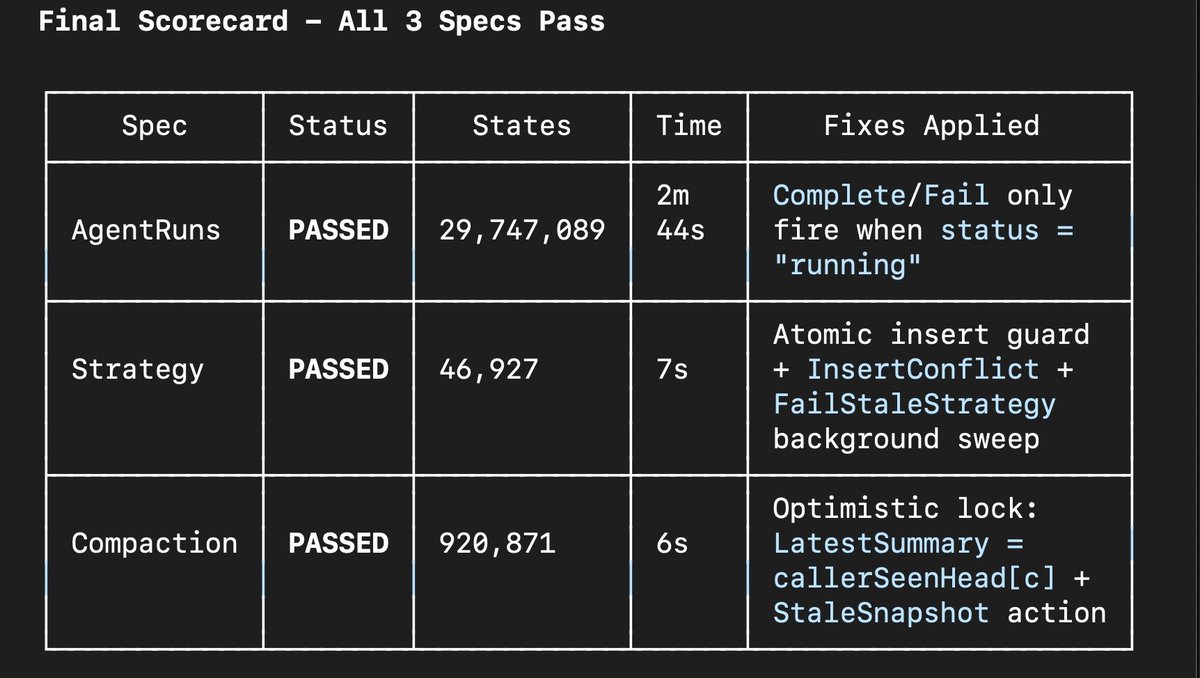
The way TLA+ works is you write up your whole system as a state machine. There are basically variables and then actions that update those variables. The actions that can be taken next depend on the current state. One of the (many) cool things about tla+ is an action can pick a nondeterministic next state. For example it can say “the next action could be any of these five things” (which is what can happen in the real world) What the TLA model checker does is it explores all the valid states by walking through the state machine and then whenever theres a no deterministic choice, it branches and creates parallel timelines for the different choices. It checks your invariants and temporal constraints at each step, and then gives you a trace of the timeline where an invariant or constraint failed. So imagine your state machine is like a tree for different choices. What can happen (VERY EASILLY) is you accidentally construct a state space (think the width of your tree) that is too large for the model checker to actually walk through exhaustively. Solutions for this are: 1. Dont do that 2. Have the model checker sample the space rather than do an exhaustive walk (not great) 3. On large state spaces use a sat solver instead of having the model checker check all states