Test test

65 posts

Test test

Test test

@TesttestI23

Test test

가입일 Mart 2019
310 팔로잉129 팔로워
Test test
Test test@TesttestI23·
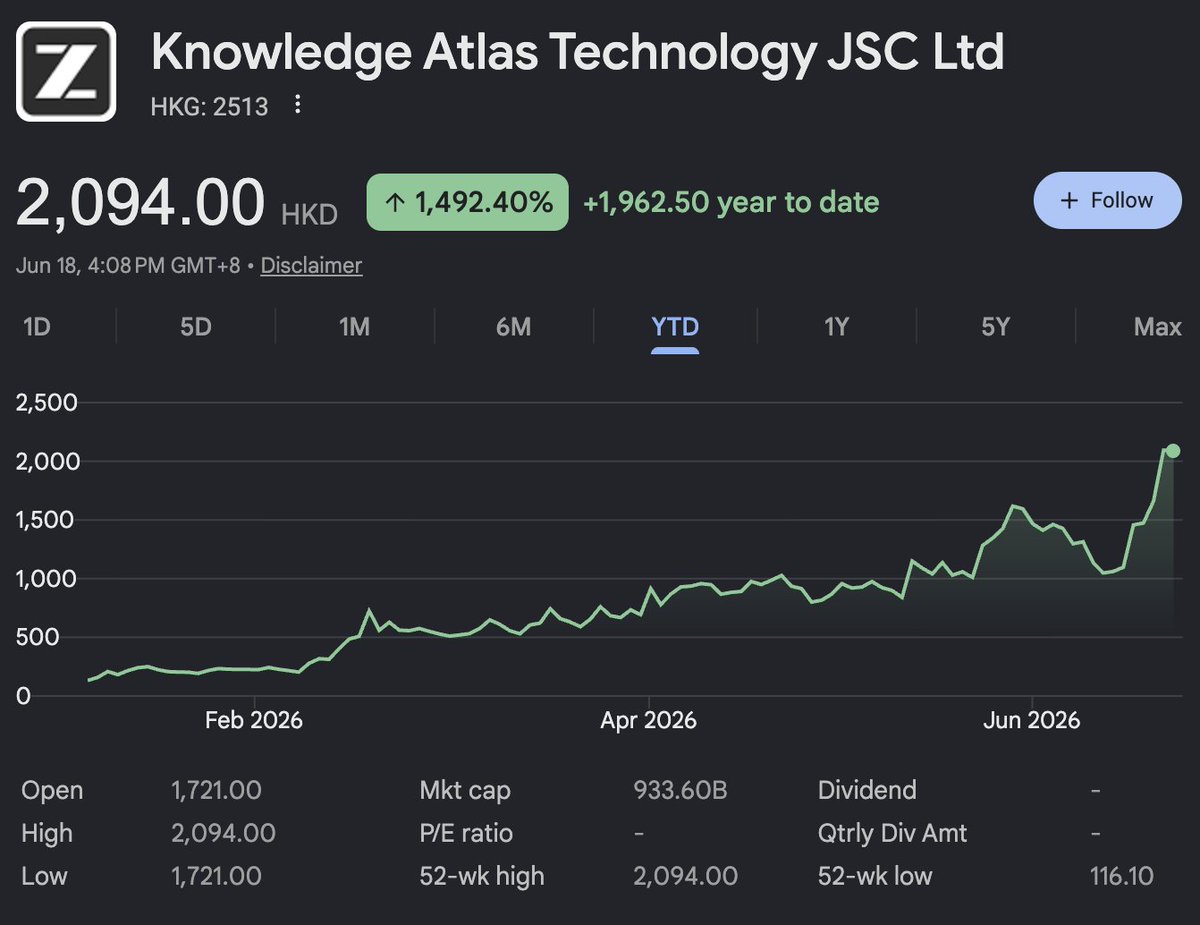
@pequityresearch What do you think about its price and future potential? I’m looking into this space as I think there is considerable alpha looking at china and its chips/ai space given recent geopolitical developments
English
1
0
0
37
Test test
Test test@TesttestI23·
@pequityresearch I was eyeing this but sat on sideline for too long…now ripping after mention from Serenity as well
English
1
0
1
47
P Equity Research 📰
P Equity Research 📰@pequityresearch·
ACM Research $ACMR in one month is up 68%. Why? CXMT & YMTC after they go public will be raising money to expand capacity for memory production. Any expansion of capacity will require equipment, such as electroplating. ACM Research is the subsisidiary of ACM Research (Shanghai) which means they don't have to worry about export controls. They already have presence in China, and whatever sales occur through the parent, will show up in the sales as part of consolidation. Their tier 1 customers include SK Hynix, CXMT, YMTC, SMIC, etc. If you have faith in China's semiconductor growth, this is a company that directly benefits from it. China is prohibited from a lot of equipment sales from U.S. WFE suppliers - Lam Research, Applied Materials. Even Tokyo Electron is seeing a decline in sales in China.
P Equity Research 📰 tweet media
P Equity Research 📰@pequityresearch

Article posted 👇 meet the beneficiary of China's DRAM manufacturing. > Customer base of YMTC, SK Hynix, CXMT > Geopolitical risk? Blacklist? > Trading ~4x P/S, growing rev 20+% > Megasonic cleaning equipment for shrinking nodes open.substack.com/pub/pequityres…

English
2
0
32
6.3K
KaizenInvestor
KaizenInvestor@Kaizen_Investor·
$MRVL to new ATH’s. Looks like I bought it just before they rocketed. Great company with a lot of tailwinds. My thesis below 👇
KaizenInvestor tweet media
KaizenInvestor@Kaizen_Investor

I decided to take a position in $MRVL last Monday. I started the position at $88.66. Here is my investment thesis With AI models now having trillions of parameters, the limiting factor in compute performance is no longer the GPU itself, but the network required to synchronize the massive clusters. Marvell addresses exactly this Compute-to-Connectivity Shift challenge. The Copper Wall At 800G and 1.6T speed, traditional passive copper cables suffer from insertion loss and skin effects, limiting their effective reach to just 2–3 meters. Optical DSP Dominance To achieve the vast distances of modern AI factories, electrical signals must be converted into light. Marvell is estimated to hold a 70% market share in the 800G optical DSP market. Moreover, their 3nm 'Ara' DSP reduces power-per-bit by over 20% compared to previous generations, ensuring a leading position in the ongoing 1.6T upgrade cycle. Scale-Up Architecture Marvell is leading the charge in Co-Packaged Optics (CPO) and Photonic Fabric technologies with their $3.25 billion acquisition of Celestial AI and $540 million acquisition of XConn Technologies. This enables optical connections inside the chip package, overcoming the memory wall and reducing power consumption enormously. Financial Outperformance & The Custom Silicon Inflection Point Marvell’s high M&A activity and R&D investments are reaping significant rewards in terms of operating leverage. Record Revenue Acceleration Marvell announced a record Q4 FY2026 revenue of $2.219 billion, a year-over-year increase of 22%. The data center segment now represents 74% of total revenue. Custom Silicon Explosion Marvell’s custom silicon revenues grew from virtually zero just a few years ago to an annualized run rate of $1.5 billion. Through the co-design of its proprietary AI accelerators such as AWS Trainium and Microsoft Maia, Marvell locks in multi-generational and extremely sticky revenue streams with enormous switching costs. Explosive Cash Generation Through the use of its capital-light fabless model, Marvell has generated an enormous $1.57 billion in trailing free cash flow. For the past five years, free cash flow has compounded at an astonishing 38.4%. Valuation Realism Marvell’s Forward P/E of approximately 24.4x represents a strategic discount to its primary custom silicon industry competitor, $AVGO, which holds a Forward P/E of approximately 31x. Through the use of Reverse Discounted Cash Flow analysis, Marvell’s current $68 billion market capitalization indicates that the company’s free cash flow will compound annually at precisely 24.5% over the next 10 years. Considering the company’s guidance of nearing $11 billion in revenue for FY2027 and $15 billion for FY2028, as well as its historical free cash flow growth rate of 38.4%, the company’s free cash flow hurdle rate of 24.5% appears extremely achievable. Conclusion $MRVL represents one of the most fundamentally strong and strategically critical companies in the global AI ecosystem. Marvell’s dominance in the optical data transmission space and its rapidly expanding custom ASIC duopoly effectively insulate the company against competitive replacement. As the second wave of the AI hardware supercycle has commenced, they represent one of the top-tier infrastructure compounders. Note: this is my own financial journey, not financial advice. Do your own research.

English
7
1
90
18.8K
Test test
Test test@TesttestI23·
@jukan05 Is this distinct from your prior projection? Bullish for $lpk
English
0
0
6
942
Jukan
Jukan@jukan05·
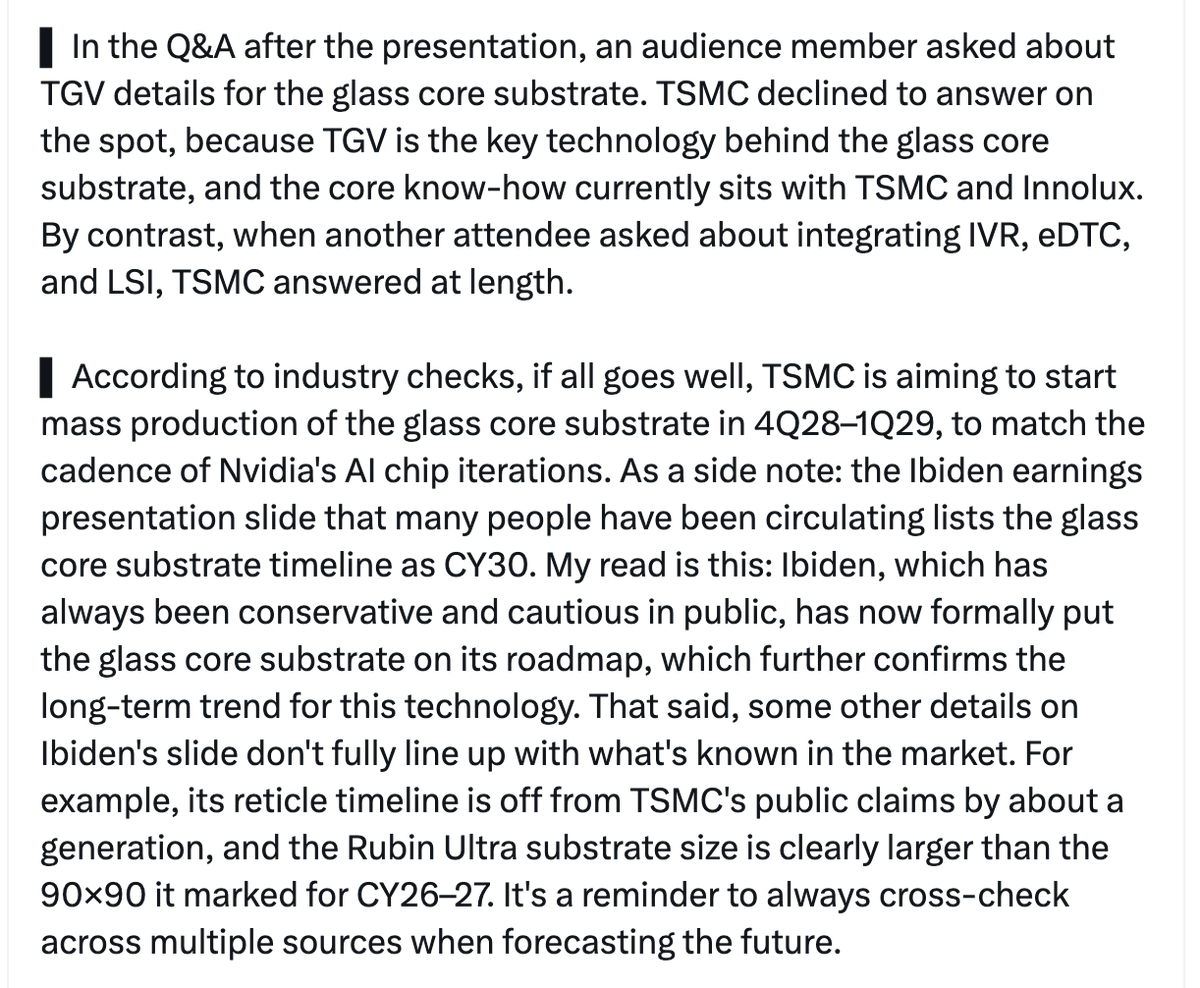
"If all goes well, TSMC is aiming to start mass production of the glass core substrate in 4Q28–1Q29, to match the cadence of Nvidia's AI chip iterations." 👀
Jukan tweet media
郭明錤|Ming-Chi Kuo@mingchikuo

Breaking down TSMC's glass core substrate slide On June 11, at JPCA Show 2026 in Japan, TSMC gave a roughly 40-slide presentation titled "Advanced Packaging Technology Essential to the Evolution of AI" (AIの進化に不可欠な先端パッケージング技術). One slide from the deck, titled "Glass Substrate Development for CoWoS," has since leaked online and widespread attention. Here's a closer read of that slide (see attached image). I'll skip the technical background that is already widely available. One thing to flag: the "COP" on the slide does not stand for Chip-on-Package. It means Coplanarity. ▌ Key conclusions: 1. TSMC has officially announced a partnership with Ibiden and Innolux to develop a glass core substrate. The structure is a three-layer design, a glass core sandwiched between two ABF build-up layers. This is the "oS" in CoPoS. 2. The market underestimates how important the glass core substrate is. It's a must-have capability for TSMC. In other words, within CoPoS the "oS" matters more than the "CoP", which is also why, when it was tested, it was paired with the existing CoW rather than with CoP. 3. The glass core substrate costs several times more per unit than existing ABF substrates. The glass processed by Innolux is very expensive per unit and is the single most critical material. Besides Nvidia, two US-based customers have also expressed strong interest. ▌ Industry checks tied to this slide: 1. The glass core substrate shown on the slide is cut from a full-size 250×250mm one. The ABF build-up layers mainly use Ajinomoto's GL107, mixed with ABF-GCP, and were tested at 24–28 layers, which is the mainstream ABF spec for AI chips in 2027–2028. 2. The CoW used in TSMC's experiment is a test vehicle. It is sufficient to validate the most challenging mechanical-structure issues that arise when working with composite materials. Good results mean TSMC, Ibiden, and Innolux have together broken through the critical technical bottleneck. 3. Ibiden currently handles cutting the 250×250mm glass core substrate. When the 510×515mm format is used for pre-mass-production simulation in 2H27, if Ibiden still wants to reduce production complexity to protect its ultra-high gross margins, it may hand the cutting over to Innolux, which is more familiar with the properties of glass. ▌ The leaked slide shows the validation results of pairing CoW with the "oS" in CoPoS, i.e., the glass core substrate (labeled "glass-SBT" on the slide). This addresses the "Substrate mechanical and electrical Dilemma" raised on the previous slide, and it strongly underscores how important the "oS" is within CoPoS. 1. Within CoPoS, what CoP solves is production efficiency / cutting economics, which ties to cost and price. What the oS solves is warpage and durability, which determines whether the chip can be made at all, and whether it can work. 2. CoP and oS complement each other well when integrated, but looking out over the next few years their technical roles still differ. CoP is a very-nice-to-have optimization, and going without it simply means a more expensive chip. But the oS is a must-have. Without it, even being able to make a usable chip is in doubt. 3. Comparing their roles isn't about elevating oS at the expense of CoP. It comes down to the practical question of which technical piece customers are willing to pay for. Details below. ▌ The real gold here is the power integrity (PI) improvement shown on the slide. This matters a great deal to customers, and it means that once glass core substrate production stabilizes, TSMC's profitability and competitive edge should rise in tandem. 1. How it works: the glass core substrate is thin → the vertical conduction path through TGV (through-glass vias) is short → conduction-path resistance (R) and loop inductance (L) both drop → PI improves. 2. Why it matters to customers: better PI → more stable power delivery → frees up power headroom → room to integrate more transistors, or to push clock speeds higher → more AI compute. 3. For customers, production efficiency is TSMC's basic responsibility, so they won't pay extra for it. But gains in AI compute translate directly into the customer's own competitiveness and profit, so customers are willing to pay for that. This is why Nvidia is so positive on the glass core substrate. 4. For TSMC, the glass core substrate raises yield and lowers cost while also boosting both the compute and the selling price of AI chips. It's both a cost-cutting tool and a pricing lever, a plus for profitability and competitiveness alike. 5. Substrate cost currently accounts for a low single-digit percentage of an AI chip's BOM, while losses from packaging yield run roughly 5–10× the substrate cost. So even if the glass core substrate ends up costing several times more than today's, its share of the BOM stays low, and it can cut the losses from packaging yield. The high unit price is therefore not expected to dampen customers' willingness to adopt it. ▌ In the Q&A after the presentation, an audience member asked about TGV details for the glass core substrate. TSMC declined to answer on the spot, because TGV is the key technology behind the glass core substrate, and the core know-how currently sits with TSMC and Innolux. By contrast, when another attendee asked about integrating IVR, eDTC, and LSI, TSMC answered at length. ▌ According to industry checks, if all goes well, TSMC is aiming to start mass production of the glass core substrate in 4Q28–1Q29, to match the cadence of Nvidia's AI chip iterations. As a side note: the Ibiden earnings presentation slide that many people have been circulating lists the glass core substrate timeline as CY30. My read is this: Ibiden, which has always been conservative and cautious in public, has now formally put the glass core substrate on its roadmap, which further confirms the long-term trend for this technology. That said, some other details on Ibiden's slide don't fully line up with what's known in the market. For example, its reticle timeline is off from TSMC's public claims by about a generation, and the Rubin Ultra substrate size is clearly larger than the 90×90 it marked for CY26–27. It's a reminder to always cross-check across multiple sources when forecasting the future.

English
17
51
429
111.4K
Test test
Test test@TesttestI23·
@aleabitoreddit $lpk is ripping!!!! I didn’t see any big news other than sdax inclusion and some potential institutional ownership
English
6
0
5
410.9K
Serenity
Serenity@aleabitoreddit·
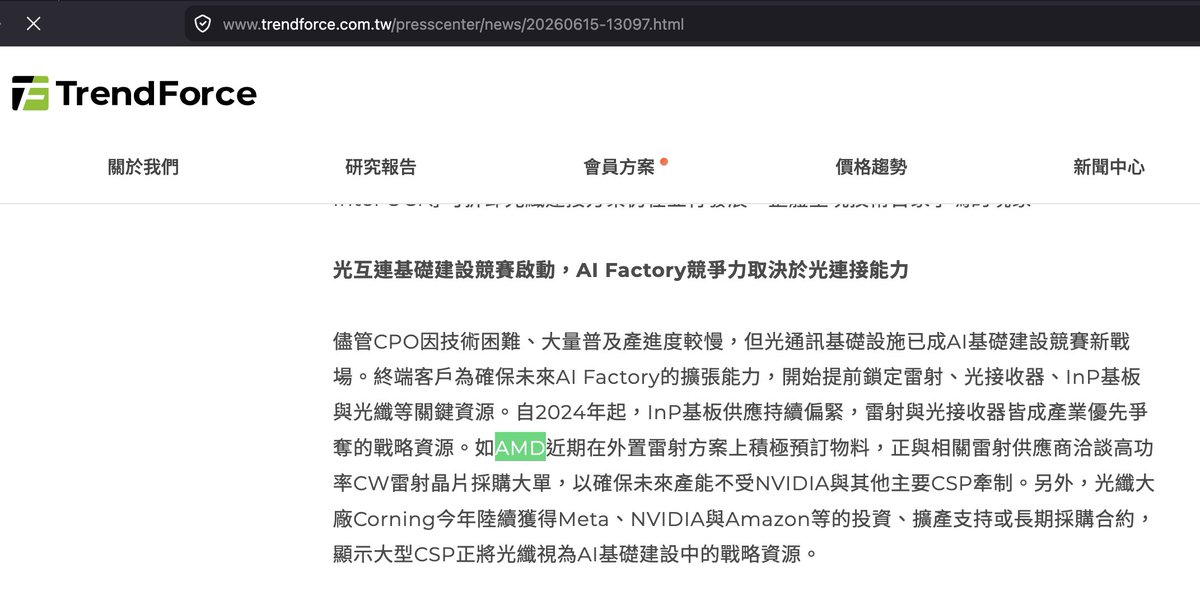
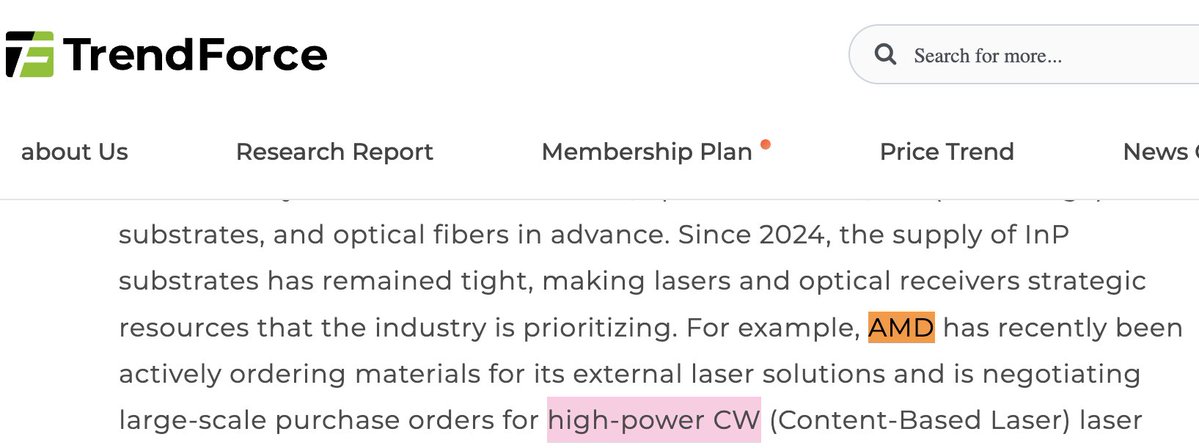
Trendforce reports that $AMD is actively trying to secure CW laser supply with multiple major procurement orders... Is probably just the start of the bottleneck? There's not much independent capacity in Western supply chains left other than $SIVE or $AAOI and maybe Macom. Especially after Lumentum/Coherent got locked up with multi-year agreements with Nvidia. (disclosure, own Sive and aaoi) Lumentum is already CW laser constrained and is likely buying off Japanese companies like Sumitomo/Furukawa if I had to guess per ER, and those are probably running at max capacity. From the Trendforce report, this is: "to ensure that its future capacity will not be constrained by NVIDIA and other major Cloud Service Providers (CSPs)." I wouldn't be surprised if other hyperscalers like Amazon, Microsoft, and others saw Nvidia / AMD signing LTAs, and are trying to secure capacity next. A lot of it is game theory on not getting choked out by competitors, and looks like AMD is tipping the first domino after Nvidia. But my opinion is that this just goes and show how invaluable this CW laser chokepoint is and the companies are inside it.
Serenity tweet mediaSerenity tweet media
English
147
115
1.5K
351.8K
Test test
Test test@TesttestI23·
@bubbleboi What does that mean? As in their won’t be shortages anymore?
English
0
0
0
1.5K
Super Future Proof
Super Future Proof@sfproof·
hey @jukan05 how late am I to the 800V power-semi trade? > seems to be one of the most crowded narratives in semis right now and the names already ran 75–210% YTD before pulling back from parabolic June spike > am I buying the second leg of a consensus narrative at triple-digit sales multiples after a 3x? 😭😭 > what gives exposure to a timeline pull-forward without handing me a busted parabola at 100x sales 😭 maybe $POWI ??
English
14
1
79
42.2K
Test test
Test test@TesttestI23·
@RJCcapital So hard to enter a position that is up over 4000% in a year mentally
English
0
0
0
770
KawzInvests
KawzInvests@KawzInvests·
I don't care about the $SPCX IPO. I want SK Hynix on Nasdaq.
English
43
35
949
76.5K
Paradis Labs
Paradis Labs@ParadisLabs·
China's control over InP exports threatens AI data centre rollout (Reuters). With 70%+ control over global output. Just as a reminder on beneficiaries: -> JX Advanced Metals: ~10% InP share -> $AXTI: InP >50% Q1'26 rev -> $LITE: maybe the cleanest large cap beneficiary -> $COHR: ~1 yr early to 6-inch InP production -> $IQE: InP is "material growth driver throughout 2026 and beyond" Sumitomo Electric win in non-Chinese InP but they're so huge that InP revenue is basically a rounding error to them. Personally treating $AXTI as a trading vehicle separately to my core hold rn after taking decent profits over the past few weeks. As core holds, I have preference to $LITE / $COHR / $IQE over $AXTI for InP-thematic exposure w/ less regulator risks. - $LITE for lower China supply beta. - $COHR for higher InP permit torque if u want it. - $IQE for the most asymmetry
Paradis Labs tweet media
English
23
20
333
41.8K
RJC
RJC@RJCcapital·
$AAOI is an easy buy here if you don’t have enough exposure
English
43
16
559
89.6K
Test test
Test test@TesttestI23·
@aleabitoreddit Talk to me about msscorp, and why it’s taken a particular beating
English
9
0
6
13.4K
Serenity
Serenity@aleabitoreddit·
Basically this… and it’s how cycles work. Retail was early and completely frontran institutions on next architectural shifts. There was close to 0 US institutional ownership on $SIVE. And now you see active institutions like JP Morgan, Fidelity Research, and others on the cap table. Happened last year with $NBIS. > I called out close to <30% institutional accumulation and said they wanted more shares. > institutions bought up majority of the float > bunch of negative articles back then, now it’s positive and ATHs. Two years before it was $RKLB > Was long at $16, but institutional analysts kept giving record low PTs and told retail to sell, although it had such a high reusable rocket rate. > retail sold, institutional ownership stocked up > now it’s ATHs I expect Foci (3363) to be a bottleneck for both $NVDA and $TSM optical programs and now there’s firms implying you to sell that at $2.5B valuations alongside $HIMX. So if you see negative sellside reports or an uncanny wave of negative news, if’s a good signal they need liquidity. Recently some smaller hedge funds have been so desperate that they’re likely even using bot farms on X that told retail to sell lol… which I’ve uncovered recently. Regardless, it’s also why I spend a lot of time doing research on individual names so people can build their own conviction in the face of noise. Unfortunately, it’s just a part of life how the modern liquidity cycles/transfers of US retail -> Institutions work. They don’t work in the best interest of retail investors.
Cyberpunk Sense 👑@napoleon21st

This really is making me wonder. What happened is retail based on @aleabitoreddit and some other frontier analysts front ran the optics/photonics cycle. Then we started seeing statements that $JPM Fidelity etc have been buying $SIVE Now we start hearing a narrative saying "you know what? You're WAY too early with that stuff. You should sell it." So they want us to sell it right as they're accumulating it 🤔

English
248
102
1.6K
575K
Test test
Test test@TesttestI23·
@aleabitoreddit What will you be buying? Taiwan stocks are being bludgeoned recently, most notably MSSCORP?
English
4
0
2
4.9K
Serenity
Serenity@aleabitoreddit·
CPO scale out earlier than expected: > Foxconn: est. units register upward and optical switches shipped early to $NVDA CPO scale up timelines from $LITE Mizuho Technology Conference today: “The company expects to start shipping Scale-Up optical products in the second half of 2027, with formal volume ramp-up in 2028” SVP $NVDA networking: “We’re going to ramp up CPO second half of this year”. No delay indications. I’m gonna go ahead and trust industry projections. Where they all reiterate faster timelines for scale out CPO H2 onward. And scale up CPO H2 2027 onward (with main growth happening 2028) Over a questionable motive analyst firm that said $MU had no share of HBM4 Rubin (causing a selloff) Where micron went out shortly later to into enter mass production. (Triple digit return shortly after) I think people going long on temporary bridge architectures from this incorrect report won’t be too happy. Appreciate the buying opportunity though.
Serenity tweet mediaSerenity tweet mediaSerenity tweet media
English
366
158
1.7K
696.9K
LIWEI_TW Capital
LIWEI_TW Capital@LIWEI_TWCapital·
@AstuteKara Honestly I’m thinking about to stop loss on MssCorp and to buy LuxNet 4979 or Lite-On 2301…
English
2
0
1
493
LIWEI_TW Capital
LIWEI_TW Capital@LIWEI_TWCapital·
The Taiwan stock market surged 1,201 points today, yet foreign investors recorded the 8th largest net selling (-NT$91.7 billion) day in history. 😱😱 Massive foreign capital is flowing out of Taiwan… Hopefully they’re just raising cash to participate in the SpaceX IPO. 🚀😱
LIWEI_TW Capital tweet media
English
11
0
27
19.3K