Alexander Lisinski

690 posts

Alexander Lisinski

Alexander Lisinski

@a_lisinski

PhD in psychopharmacology, University of Gothenburg. Resident psychiatrist, Sahlgrenska University Hospital.

Gothenburg, Sweden 가입일 Şubat 2012
243 팔로잉303 팔로워
Alexander Lisinski
Alexander Lisinski@a_lisinski·
@page_eco Sadly this is the case also on the other side of the world. One could think that the University of Gothenburg, Sweden, isn’t already losing money, when looking at their building projects.

Alexander Lisinski tweet media
English
0
0
1
14
Lionel Page
Lionel Page@page_eco·
This is a reflection of managerial capture: raising impressive buildings is the kind of visible output that can be branded as a signal of achievement in a manager’s career. Investing in high-quality research, which is less tangible and often produces visible outcomes (discoveries) only many years after a manager’s tenure, can as a result become a lower priority. The over-managerialisation of universities does not make them more efficient in a sector with little competitive pressure. It also does not lead universities to fulfil their academic missions, as academics are progressively sidelined in decision-making processes. Full diagnostic in my submission to the Parliamentary Inquiry #103. aph.gov.au/Parliamentary_…
Gearside@gearside

australian universities: we are underfunded also australian universities:

English
3
35
258
32.4K
Alexander Lisinski
Alexander Lisinski@a_lisinski·
Just 9 days to go until the highlight of psychedelic science in the Nordic countries this year 🌟 Looking very much forward to welcoming Guy Goodwin, Julie Holland, Matthew W Johnson and many others in Stockholm! borealissummit.com
English
0
0
1
28
Alexander Lisinski
Alexander Lisinski@a_lisinski·
Almost a year has passed since we published our letter detailing severe errors in this meta-analysis on psychotherapy, antidepressants, and suicide. What has happened since then? Absolutely nothing! The journal from @CambUP_Psych refuses to correct or retract the original paper.
Alexander Lisinski@a_lisinski

Does combined treatment with antidepressants and psychotherapy really cause twice as many suicide attempts than psychotherapy only? This was the conclusion of a recent meta-analysis published in Psychological Medicine. Me and @f_hieronymus took a closer look…thread below 🧵

English
0
0
0
78
Robert Howard
Robert Howard@ProfRobHoward·
@Macbeth4183781 @AnnaSylwes94870 Insulin is a good example. Developed, like ECT, before the era of modern RCT design and thinking. Nobody says, “don’t use insulin, it doesn’t have a watertight evidence base”. And, of course, there are people who have been harmed by insulin treatment too.
English
1
0
0
52
Robert Howard
Robert Howard@ProfRobHoward·
When you consider how mercilessly critical Professor Read is of the RCTs in this field, it is almost amusing to see the touching confidence he has in the precision and freedom from bias of his internet survey-based studies.
Dr John Read@ReadReadj

First of many paper from our international ECT survey just out. On all 5 measures of efficacy most recipients, and most relatives, reported that it either made no difference or made things worse. Did help a minority Paper on informed consent out on Friday dx.doi.org/10.1111/inm.70…

English
11
13
80
13.2K
Alexander Lisinski 리트윗함
Fredrik Hieronymus
Fredrik Hieronymus@f_hieronymus·
Is psilocybin as effective for depression as it seems? In a new meta-analysis we look at outcomes after treatment with three types of antidepressants: psilocybin, esketamine and SSRIs. Compared to their own control groups, psilocybin (ES/SMD: 0.70) is clearly more effective ->
English
10
12
33
9.1K
Alexander Lisinski
Alexander Lisinski@a_lisinski·
@psybalazs For me, the argument is stronger, in that this is an effect size of a treatment widely perceived as good enough for depression, rather than trying to relate this to theoretically distinguishable between-group differences.
English
1
0
1
40
Alexander Lisinski
Alexander Lisinski@a_lisinski·
@psybalazs With that said, I would select for example the SSRI-placebo difference, which in size is similar to the MCID for the HDRS, and relate any possible superiority of treatment to this effect size difference.
English
1
0
1
41
Balázs Szigeti
Balázs Szigeti@psybalazs·
🚨🍄 Major new preprint alert 🍄🚨 I think these will be important results. They are not going make me popular with my #psychedelic in-group, please do not shoot the messenger! The premise of this pre-registered meta analysis (osf.io/preprints/psya…) is that it is biased to compare open-label trials to blind trials, it is only fair to compare open-label trials to other open-label trials. In the first case the open-label trials would gain an unfair advantage by benefitting from effects related to knowing the treatment. Therefore, we compared the efficacy of psychedelic-assisted therapy (PAT), which is open-label regardless of formal blinding to open-label traditional antidepressants (tAD; such as SSRIs/SNRIs where binded trials are very close to be truly blind) for the treatment of major depression. We tested 3 prior hypothesis (MCID: minimum clinically important difference, which we set to be 3-points on Hamilton depression scale; differences smaller than this are clinically meaningless): 1. At the primary endpoint, the estimated mean difference between PAT and open-label tAD will exceed the MCID, favoring PAT. 2. At the primary endpoint, the estimated mean difference between blinded and open-label tAD trials will exceed the MCID, favoring open-label administration. 3. At the primary endpoint, the estimated mean difference between blinded and open-label PAT trials will not exceed the MCID. In contrast with our prior hypothesis, we did not find PAT to be more effective than open-label tADs (H1). Not only was the difference not clinically meaningful, but practically there was no difference at all (~0.3 HAMD units). This finding means that tAD administered knowingly to patients, which is the case in real-life medical practice, is as effective as PAT. This result was robust across variations in study selection, including when we removed PAT trials on treatment-resistant depression. The improvement from baseline to endpoint was ~12 HAMD points for both treatments. We also assessed the impact of blinding in both PAT and tAD trials. We found that for tAD (H2), but not for PAT (H3), open label is associated with better outcomes than blinded treatment. However, even in the case of tAD, the difference was much lower than the MCID. How come hypothesis 1 failed, i.e. that PAT is no ore effective than open-label tADs, given that tAD trials are famous for small drug-placebo difference (~2.4 HAMD units), while PAT trials reported large effects (~7.3 large effects)? Well, there are two major factors: 1. As we show, open-label tAD is approximately ~1.2 HAMD units more effective than blinded treatment (H2). This effect can be interpreted as the influence of knowing one’s treatment assignment, such as positive expectancy. 2. A recent meta-analysis of depression trials found that relative to tAD trials, the placebo response is 4.0 HAMD points lower in psychedelic trials (Hsu et al., 2024). This suppressed placebo response leads to an inflated between-arm difference, as the treatment arm is measured against a lower floor. The sum of these two effects is 1.2 + 4.0 = 5.2 HAMD units which equals the difference of the reported between-arm effects (7.3 - 2.4 ~ 5), explaining why hypothesis 1 failed. The suppressed placebo response in PAT trials is likely attributable to the ‘know-cebo’ effect, i.e. the disappointment when patients realize they are in the control group. In PAT trials, this placebo suppression accounts for 4.0 / 7.3 ~ 55% of the total between-arm effect. In other words, ~55% of PAT’s between-arm effect is not explained by improvement in the treatment arm, but rather by the lack of improvement in the placebo arm. In summary, we found that for the treatment of depression, PAT is no more effective than open-label SSRIs/SNRIs. Our results for psychedelics are twofold: PAT demonstrated a robust and large therapeutic effects (~12 HAMD units), which justifies optimism. On the other hand, PAT’s lack of superiority compared to SSRIs/SNRIs under equal-unblinding conditions highlights the influence of blinding integrity and presents a sobering reality check for psychedelic medicine. In collaboration with @QuantPsychiatry and Hannah Barnett 🙏🫂 👆should be of interest to @MattBurkeMD @igoreckert @bita137 @Brainclinics @bruce_lambert @thelablab @IoanaA_Cristea @GregFonzo @MFPL6 @fredemag @n_sepeda @chchatham @LGHemkens @HolBjo @NaudetFlorian @NathanHuneke @RecoveryDoctor @iainjordan @GlynLewis9 @HengartnerMP @shayla__love @f_hieronymus @And_Cipriani @FlamelingJop @JD_Rosenblat @RickZeifman @AVoineskos @LukeJelen @TehseenNoorani @a_lisinski @PloederlM @ElliotMarseille @KingFranklinIV @JulesEvans11 @EikoFried @ExistWell @singletonion @_fernando_rosas @vincepsy @hartogsohn @MichielElk @JacobSAday @BWe1ss @sdpnayak @Colloca_Luana @JeremyHowick @mattbagg @TheBorisLab @BenColagiuri
Balázs Szigeti tweet media
English
26
38
146
28.4K
Alexander Lisinski
Alexander Lisinski@a_lisinski·
@psybalazs Disregarding this, I would nonetheless prefer a drug that is 2.9 points better on the HDRS that I only had to take once.
English
1
0
1
15
Alexander Lisinski
Alexander Lisinski@a_lisinski·
@psybalazs Very clever approach, which certainly shines new light on PAT. Besides agreeing with some other comments here, I do however have to point out that the MCID is an inter-individual measure, not a between-group measure.
English
2
0
1
143
Alexander Lisinski
Alexander Lisinski@a_lisinski·
Call for abstracts now open for Borealis Psychedelic Science Summit in Stockholm September 26-27th. Take your chance to present your research for leading international and Nordic researchers! borealissummit.com/call-for-abstr…
English
0
0
0
53
Alexander Lisinski
Alexander Lisinski@a_lisinski·
@psybalazs With that said, I would not mix these methods in one paper unless I had a very good reason to do so.
English
1
0
1
28
Alexander Lisinski
Alexander Lisinski@a_lisinski·
@psybalazs My opinion after doing similar analyses on large SSRI/SNRI datasets is that when n gets large enough, there are only minor differences between baseline- and delta-based methods. My guess is that your results were divergent because you only had data from one trial.
English
2
0
1
32
Balázs Szigeti
Balázs Szigeti@psybalazs·
Do I have any colleagues with access to patient level SSRI/SNRI trial data who would be interested to look at the impact of effect size variants (see below)? I see large difference in psychedelic trials, want to check if also true for SSRI/SNRI trials. Just DM me if you are in🙏
Balázs Szigeti@psybalazs

I dug into a meta-analysis paper where something seems off to me, but its not my area, thus want to check on it. Looking at the project's data, it is clear that the effect sizes were calculated in one of two ways: - Pooled variant: (mean of endpoint-baseline scores) / (pooled SD of baseline and endpoint scores) - Delta variant: (mean of the delta scores) / (SD of the delta scores) (The paper is not explicit about it, but I guess the SMD variant was used for which they could get the data from a given trial) The nominator is the same, but not the denominator: pooled SD between baseline and endpoint is NOT the same as the SD of the change scores. Initially I thought they are probably numerically close enough that the difference is negligible, but then I applied these two ways of calculating SMDs for 3 outcomes of a trial that I happen to have: - Pooled variant SMDs: 0.8 / 0.65 / 0.35 - Delta variant SMDs: 0.62 / 0.37 / 0.84 Some of these differences are certainly not negligible, in the case of the last measure its 0.35 vs 0.84 SMD! That's a difference of ~0.5 SMD! The question is that is it normal / acceptable to mix these two definitions of SMD in a single meta-analysis? I understand the practical difficulty that you can not always extract the data you need for your meta-analysis and therefore compromises / approximations must be taken. However, realizing the large numerical difference these SMD calculations can result in, made me wonder if such meta-analysis is meaningful - effectively you add/subtract up to 0.5 SMD according to which method you use! I would be grateful for comments on the topic and/or links to blogs/youtube/papers that explore this topic. 🙏🙏🙏 #Stats #MetaAnalysis Maybe: @MatthewBJane @stats_tipton @QuantPsychiatry @f2harrell @EikoFried @DFanDaBiasedMan @NaudetFlorian @iainjordan @PloederlM @HengartnerMP @lakens @SolomonKurz

English
1
0
3
460
Alexander Lisinski
Alexander Lisinski@a_lisinski·
Vi kommer arrangera öppna möten i vår partilokal i centrala Göteborg, med start redan nu på onsdag 2/1. Föranmälan är önskvärd men ej obligatorisk. Är du intresserad av att komma vid ett senare tillfälle eller vill veta mer, kontakta mig gärna här på X. demokraterna.se/sjukvard
Svenska
0
0
0
36
Alexander Lisinski
Alexander Lisinski@a_lisinski·
Är du också trött på hur sjukvården styrs i Västra Götaland? Göteborgs och VGR:s lokala parti Demokraterna söker nu engagerade, gärna med erfarenhet av hälso- och sjukvård, för att forma en ny politik för vår region.
Alexander Lisinski tweet media
Svenska
1
0
0
64
Alexander Lisinski 리트윗함
Nicholas Fabiano, MD
Nicholas Fabiano, MD@NTFabiano·
Nearly 3 years ago, this controversial study claimed that there is “no consistent evidence of there being an association between serotonin and depression”. It has been read >1,000,000 times. Here’s what the evidence actually shows. 🧵1/17
Nicholas Fabiano, MD tweet media
English
29
198
1K
141.2K
Alexander Lisinski
Alexander Lisinski@a_lisinski·
Skriver i GP debatt idag tillsammans med kollegor från Demokraterna. Vi blir först med att ta ställning för att skrota Millennium. Hoppas på likadana ställningstaganden från övriga partier snarast. gp.se/debatt/skrota-…
Svenska
0
0
0
57
Alexander Lisinski
Alexander Lisinski@a_lisinski·
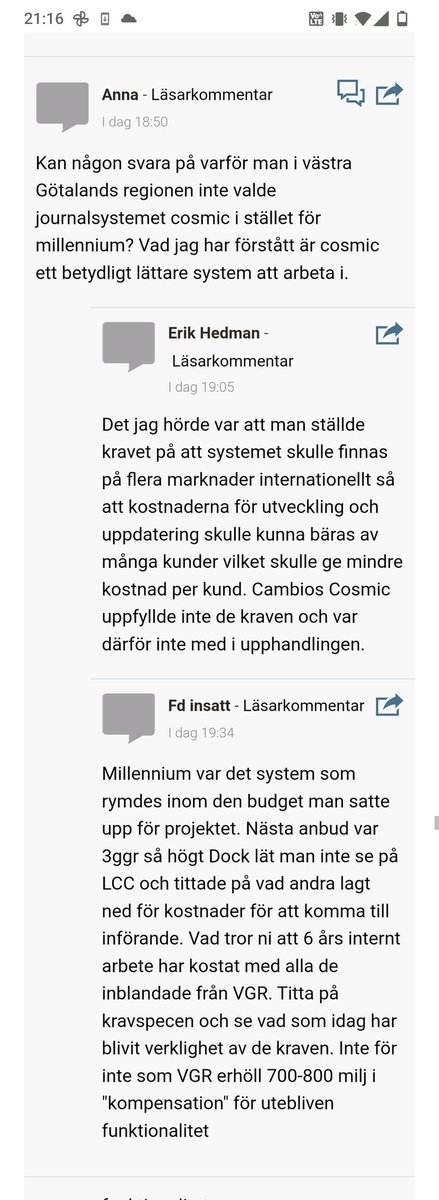
@dahlle Sjukt vad mycket mer vettig information som framkommit i en lokaltidnings kommentarsfält än från regionledning och politiker...
Svenska
1
0
2
132
Valdemar Landgren
Valdemar Landgren@dahlle·
Övriga regioners system kom aldrig på fråga i upphandlingen hos VGR - det var för billigt med cosmic!! Och man har tydligen fått tillbaka 800 miljoner för att Oracle ändå inte kunde leverera det man bad om...
Valdemar Landgren tweet media
Svenska
2
1
6
1.3K