

Aaron Kern
658 posts

Aaron Kern
@aaronmkern
VC investing @6thmanventures. All personal views. https://t.co/hqR857bPaw
Chicago, IL 가입일 Ağustos 2010
3.1K 팔로잉2.9K 팔로워

I'm lucky enough to have a great doctor and access to excellent Bay Area medical care. I've taken lots of standard screening tests over the years and have tried lots of "health tech" devices and tools.
With all this said, by far the most useful preventative medical advice that I've ever received has come from unleashing coding agents on my genome, having them investigate my specific mutations, and having them recommend specific follow-on tests and treatments.
Population averages are population averages, but we ourselves are not averages. For example, it turns out that I probably have a 30x(!) higher-than-average predisposition to melanoma. Fortunately, there are both specific supplements that help counteract the particular mutations I have, and of course I can significantly dial up my screening frequency. So, this is very useful to know.
I don't know exactly how much the analysis cost, but probably less than $100. Sequencing my genome cost a few hundred dollars.
(One often sees papers and articles claiming that models aren't very good at medical reasoning. These analyses are usually based on employing several-year-old models, which is a kind of ludicrous malpractice. It is true that you still have to carefully monitor the agents' reasoning, and they do on occasion jump to conclusions or skip steps, requiring some nudging and re-steering. But, overall, they are almost literally infinitely better for this kind of work than what one can otherwise obtain today.)
There are still lots of questions about how this will diffuse and get adopted, but it seems very clear that medical practice is about to improve enormously. Exciting times!
English


Aaron Kern 리트윗함

Interest rate swaps are a $500T market in TradFi. DeFi has no equivalent.
Today we are thrilled to announce our $2.4M seed to change that.
Led by @6thManVentures, with participation from @Lattice_Fund | @AdvancitCapital | @CompaVC
$300M+ beta volume, @Alliance graduates, Mainnet coming soon.
Whitepaper linked below ⬇️

English
@dwarkesh_sp Govt cannot take on the risk that a private company closes off access, delays a mission, etc. In an ideal world, we have an ability to audit/foia govt usage of these tools. In some sense, free usage of AI tools could lead to mass surveilance, but of govt, not the ppl.
English

The fight between Anthropic and the DoW is a warning shot. Right now, LLMs are probably not being used in mission critical ways. But within 20 years, 99% of the workforce in the military, the government, and the private sector will be AIs. This includes the soldiers (by which I mean the robot armies), the superhumanly intelligent advisors and engineers, the police, you name it.
Our future civilization will run on AI labor. And as much as the government’s actions here piss me off, in a way I’m glad this episode happened - because it gives us the opportunity to think through some extremely important questions about who this future workforce will be accountable and aligned to, and who gets to determine that.
What Hegseth should have done
Obviously the DoW has the right to refuse to use Anthropic’s models because of these redlines. In fact, I think the government’s case had they done so would be very reasonable, especially given the ambiguity of concepts like autonomous weapons or mass surveillance.
Honestly, for this reason, if I was the Defense Secretary, I would probably actually refuse to do this deal with Anthropic. Imagine if in the future, there’s a Democratic administration, and Elon Musk is negotiating some SpaceX contract to give the military access to Starlink. And suppose if Elon said, “I reserve the right to cancel this contract if I determine that you’re using Starlink technology to wage a war not authorized by Congress.” On the face of it, that language seems reasonable - but as the military, you simply can’t give a private company a kill switch on technology your operations have come to rely on, especially if you have an an acrimonious and low trust relationship with said contractor - as in fact Anthropic has with the current administration.
If the government had just said, “Hey we’re not gonna do business with you,” that would have been fine, and I would not have felt the need to write this blog post. Instead the government has threatened to destroy Anthropic as a private business, because Anthropic refuses to sell to the government on terms the government commands.
If upheld, this Supply Chain Restriction would mean that Amazon and Google and Nvidia and Palantir would need to ensure Claude isn't touching any of their Pentagon work. Anthropic would be able to survive this designation today. But given the way AI is going, eventually AI is not gonna be some party trick addendum to these contractors’ products that can just be turned off. It'll be woven into how every product is built, maintained, and operated. For example, the code for the AWS services that the DoW uses will be written by Claude - is that a supply chain risk? In a world with ubiquitous and powerful AI, it's actually not clear to me that these big tech companies will be able to cordon off the use of Claude in order to keep working with the Pentagon.
And that raises a question the Department of War probably hasn't thought through. If AI really is that pervasive and powerful, then when forced to choose between their AI provider and a DoW contract that represents a tiny fraction of their revenue, wouldn’t most tech companies drop the government, not the AI? So what's the Pentagon's plan — to coerce and threaten to destroy every single company that won't give them what they want on exactly their terms?
The whole background of this AI conversation is that we’re in a race with China, and we have to win. But what is the reason we want America to win the AI race? It’s because we want to make sure free open societies can defend themselves. We don't want the winner of the AI race to be a government which operates on the principle that there is no such thing as a truly private company or a private citizen. And that if the state wants you to provide them with a service on terms you find morally objectionable, you are not allowed to refuse. And if you do refuse, the government will try to destroy your ability to do business. Are we racing to beat the CCP in AI just so that we can adopt the most ghoulish parts of their system?
Now, people will say, "Oh, well, our government is democratically elected, so it's not the same thing if they tell you what you must do." I refuse to accept this idea that if a democratically elected leader hypothetically wants to do mass surveillance on his citizens or wants to violate their rights or punish them for political reasons, that not only is that okay, but that you have a duty to help him.
The overhangs of tyranny
Mass surveillance is, at least in certain forms, legal. It just has been impractical so far. Under current law, you have no Fourth Amendment protection over data you share with a third party, including your bank, your phone carrier, your ISP, and your email provider. The government reserves the right to purchase and obtain and read this data in bulk without a warrant.
What's been missing is the ability to actually do anything with all of this data — no agency has the manpower to monitor every camera feed, cross-reference every transaction, or read every message. But that bottleneck goes away with AI.
There are 100 million CCTV cameras in America. You can get pretty good open source multimodal models for 10 cents per million input tokens. So if you process a frame every ten seconds, and each frame is 1,000 tokens, you’re looking at a yearly cost of about 30 billion dollars to process every single camera in America. And remember that a given level of AI ability gets 10x cheaper year over year - so a year from now it’ll cost 3 billion, and then a year after 300 million, and by 2030, it might be cheaper for the government to be able to understand what is going on in every single nook and cranny of this country than it is to remodel to the White House.
Once the technical capacity for mass surveillance and political suppression exists, the only thing standing between us and an authoritarian surveillance state is the political expectation that this is not something we do here. And this is why I think what Anthropic did here is so valuable and commendable, because it is helping set that norm and precedent.
AI structurally favors mass surveillance
What we’re learning from this episode is that the government actually has way more leverage over private companies than we realized. Even if this supply chain restriction is backtracked (which prediction markets currently give it a 81% chance of happening), the President has so many different ways in which he can make your life difficult if you’re a company that is resisting him. The federal government controls permitting for new power generation, which is needed for datacenters. It oversees antitrust enforcement. The federal government has contracts with all the other big tech companies whom Anthropic needs to partner with for chips and for funding - and they could make it an unspoken condition for such contracts that those companies can no longer do business with Anthropic.
People have proposed that the real problem here is that there’s only 3 leading AI companies. This creates a clear and narrow target for the government to apply leverage on in order to get what they want out of this technology.
But if there’s wide diffusion, then from the government’s perspective, the situation is even easier. Maybe the best models of early 2027 (if you engineered the safeguards out) - the Claude 6 and Gemini 5 - will be capable of enabling mass surveillance. But by late 2027, and certainly by 2028, there will be open source models that do the same thing. So in 2028, the government can just say, “Oh Anthropic, Google, OpenAI, you’re drawing a line in the sand? No issue - I’ll just run some open source model that might not be at the frontier, but is definitely smart enough to note-take a camera feed.”
The more fundamental problem is just that even if the three leading companies draw lines in the sand, and are even willing to get destroyed in order to preserve those lines, it doesn’t really change the fact that the technology itself is just a big boon to mass surveillance and control over the population. Then the question is, what do we do about it?
Honestly, I don’t have an answer. You'd hope there's some symmetric property of the technology — some way we as citizens can use AI to check government power as effectively as the government can use AI to monitor and control its population. But realistically, I just don’t think that’s how it’s going to shake out. You can think of AI as giving everybody more leverage on whatever assets and authority they currently have. And the government is already starting with a monopoly of violence. Which they can now supercharge with extremely obedient employees that will not question the government's orders.
Alignment - to whom?
And this gets us to the issue of alignment. What I have just described to you - an army of extremely obedient employees - is what it would look like if alignment succeeded - that is, we figured out at a technical level how to get AI systems to follow someone’s intentions. And the reason it sounds scary when I put it in terms of mass surveillance or robot armies is that there is a very important question at the heart of alignment which we just haven’t discussed much as a society. Because up till now, AIs were just capable enough to make the question relevant: to whom or what should the AIs be aligned? In what situations should the AI defer to the end user versus the model company versus the law versus its own sense of morality?
This is maybe the most important question about what happens with powerful AI systems. And we barely talk about it. It’s understandable why we don’t hear much about it. If you’re a model company, you don’t really wanna be advertising that you have complete control over a document that determines the preferences and character of what will eventually be almost the entire labor force, not just for private sector companies, but also for the military and the civilian government.
We’re getting to see, with this DoW/Anthropic spat, a much earlier version of the highest stakes negotiations in history. By the way, make no mistake about it - with real AGI the stakes are even much higher than mass surveillance. This is just the example that has come up already relatively early on in the development of AGI.
The military insists that the law already prohibits mass surveillance, and so Anthropic should agree to let their models be used for “all lawful purposes”. Of course, as we saw from the 2013 Snowden revelations, even in this specific example of mass surveillance , the government has shown that it will use secret and deceptive interpretations of the law to justify its actions. Remember, what we learned from Snowden was that the NSA, which, by the way, is part of the Department of War, used the 2001 Patriot Act’s authorization to collect any records "relevant" to an investigation to justify collecting literally every phone record in America. The argument went that it was all "relevant" because some subset might prove useful in some future investigation. They ran this program for years under secret court approval.
So when the Pentagon today says, "We would never use AI for mass surveillance, it's already illegal, your red lines are unnecessary", it would be extremely naive to take that at face value. No government is going to call its own actions "mass surveillance". For the government, it will always have a different label.
So then Anthropic comes back and says, "No, we want red lines separate from 'all lawful purposes,' and we want the right to refuse you service when we believe those red lines are being violated."
But think about it from the military’s perspective. In the future, almost every soldier in the field, and every bureaucrat and analyst and even general in the Pentagon, is going to be an AI. And that AI is, on current track, going to be supplied by a private company. I’m guessing Hegseth is not thinking about “genAI” in those terms just yet. But sooner or later, it will be obvious to everyone what the stakes here are, just as after 1945, the strategic importance of nuclear weapons became clear to everyone.
And now the private company insists that it reserves the right to say, "Hey, Pentagon, you're breaking the values we embedded in our contract, so we're cutting you off."
Maybe in the future, Claude will have its own sense of right and wrong, and it will be smart enough to just personally decide that it's being used against its values. For the military, maybe that’s even scarier.
I'll admit that at first glance, "let the AI follow its own values" sounds like the pitch for every sci-fi dystopia ever made. The Terminator has its own values. Isn't this literally what misalignment is? But I think situations like this actually illustrate why it matters that AIs have their own robust sense of morality.
Some of the biggest catastrophes in history were avoided because the boots on the ground refused to follow orders. One night in 1989, the Berlin Wall fell, and as a result, the totalitarian East German regime collapsed, because the guards at the border refused to shoot down their fellow country men who were trying to escape to freedom. Maybe the best example is Stanislav Petrov, who was a Soviet lieutenant colonel on duty at a nuclear early warning station. His sensors reported that the United States had launched five interconnected continental ballistic missiles into the Soviet Union. But he judged it to be a false alarm, and so he broke protocol and refused to alert his higher-ups. If he hadn't, the Soviet higher-ups would likely have retaliated, and hundreds of millions of people would have died.
Of course, the problem is that one person's virtue is another person's misalignment. Who gets to decide what moral convictions these AIs should have - in whose service they may even decide to break the chain of command? Who gets to write this model constitution that will shape the characters of the intelligent, powerful entities that will operate our civilization in the future?
I like the idea that Dario laid out when he came on my podcast: different AI companies can build their models using different constitutions, and we as end users can pick the one that best achieves and represents what we want out of these systems. I think it’s very dangerous for the government to be mandating what values AIs should have.
Coordination not worth the costs
The AI safety community has been naive about its advocacy of regulation in order to stem the risks of AI. And honestly, Anthropic specifically has been naive here in urging regulation, and, for example, in opposing moratoriums on state AI regulation. Which is quite ironic, because I think what they’re advocating for would give the government even more power to apply more of this kind of thuggish political pressure on AI companies.
The underlying logic for why Anthropic wants regulations makes sense. Many of the actions that labs could take to make AI development safer impose real costs on the labs that adopt them and slow them down relative to their competitors - for example, investing more compute in safety research rather than raw capabilities, enforcing safeguards against misuse for bioweapons or cyberattacks, slowing recursive self-improvement to a pace where humans can actually monitor what's happening (rather than kicking off an uncontrolled singularity). And these safeguards are meaningless unless the whole industry follows suit. Which means there’s a real collective action problem here.
Anthropic has been quite open about their opinion that they think eventually a very extensive and involved regulatory apparatus will be needed - this is from their frontier safety roadmap: “At the most advanced capability levels and risks, the appropriate governance analogy may be closer to nuclear energy or financial regulation than to today's approach to software.” So they’re imagining something like the Nuclear Regulatory Commission, or the Securities and Exchange Commission, but for AI.
I cannot imagine how a regulatory framework built around the concepts that underlie AI risk discourse will not be abused by wanna despots - the underlying terms are so vague and open to interpretation that you’re just handing a power hungry leader a fully loaded bazooka. 'Catastrophic risk.' 'Mass persuasion risk.' 'Threats to national security.' 'Autonomy risk.' These can mean whatever the government wants them to mean. Have you built a model that tells users the administration's tariff policy is misguided? That's a deceptive, manipulative model — can't deploy it. Have you built a model that refuses to assist with mass surveillance? That's a threat to national security. In fact, the government may say, you’re not allowed to build any model which is trained to have its own sense of right and wrong, where it refuses government requests which it thinks cross a redline - for example, enabling mass surveillance, prosecuting political enemies, disobeying military orders that break the US constitution - because that’s an autonomy risk!
Look at what the current government is already doing in abusing statutes that have nothing to do with AI to coerce AI companies to drop their redlines on mass surveillance. The Pentagon had threatened Anthropic with two separate legal instruments. One was a supply chain risk designation — an authority from the 2018 defense bill meant to keep Huawei components out of American military hardware. The other was the Defense Production Act — a statute passed in 1950 so that Harry Truman could keep steel mills and ammunition factories running during the Korean War.
Do you really want to hand the same government a purpose-built regulatory apparatus on AI - which is to say, directly at the thing the government will most want to control? I know I've repeated myself here 10 times, but it is hard to emphasize how much AI will be the substrate of our future civilization. You and I, as private citizens, will have our access to all commercial activity, to information about what is happening in the world, to advice about what we should do as voters and capital holders, mediated through AIs. Mass surveillance, while very scary, is like the 10th scariest thing the government could do with control over the AI systems with which we will interface with the world.
The strongest objection to everything I've argued is this: are we really going to have zero regulation of the most powerful technology in human history? Even if you thought that was ideal, there’s just no world where the government doesn’t regulate AI in some way. Besides, it is genuinely true that regulation could help us deal with some of the coordination challenges we face with the development of superintelligence.
The problem is, I honestly don't know how to design a regulatory architecture for AI that isn’t gonna be this huge tempting opportunity to control our future civilization (which will run on AIs) and to requisition millions of blindly obedient soldiers and censors and apparatchiks.
While some regulation might be inevitable, I think it’d be a terrible idea for the government to wholesale take over this technology. Ben Thompson had a post last Monday where he made the point that people like Dario have compared the technology they’re developing to nuclear weapons - specifically in the context of the catastrophic risk it poses, and why we need to export control it from China. But then you oughta think about what that logic implies: “if nuclear weapons were developed by a private company, and that private company sought to dictate terms to the U.S. military, the U.S. would absolutely be incentivized to destroy that company.” And honestly, safety aligned people have actually made similar arguments. Leopold Ascenbrenner, who is a former guest and a good friend, wrote in his 2024 Situational Awareness memo, "I find it an insane proposition that the US government will let a random SF startup develop superintelligence. Imagine if we had developed atomic bombs by letting Uber just improvise."
And my response to Leopold’s argument at the time, and Ben’s argument now, is that while they’re right that it’s crazy that we’re entrusting private companies with the development of this world historical technology, I just don’t see the reason to think that it’s an improvement to give this authority to the government. Nobody is qualified to steward the development of superintelligence. It is a terrifying, unprecedented thing that our species is doing right now, and the fact that private companies aren't the ideal institutions to take up this task does not mean the Pentagon or the White House is.
Yes - if a single private company were the only entity capable of building nuclear weapons, the government would not tolerate that company claiming veto power over how those weapons were used. I think this nuclear weapons analogy is not the correct way to think about AI. For at least two important reasons:
First, AI is not some self-contained pure weapon. A nuclear bomb does one thing. AI is closer to the process of industrialization itself — a general-purpose transformation of the economy with thousands of applications across every sector. If you applied Thompson's or Aschenbrenner's logic to the industrial revolution — which was also, by any measure, world-historically important — it would imply the government had the right to requisition any factory, dictate terms to any manufacturer, and destroy any business that refused to comply. That's not how free societies handled industrialization, and it shouldn't be how they handle AI.
People will say, "Well, AI will develop unprecedentedly powerful weapons - superhuman hackers, superhuman bioweapons researchers, fully autonomous robot armies, etc - and we can’t have private companies developing that kind of tech." But the Industrial Revolution also enabled new weaponry that was far beyond the understanding and capacity of, say, 17th century Europe - we got aerial bombardment, and chemical weapons, not to mention nukes themselves. The way we’ve accommodated these dangerous new consequences of modernity is not by giving the government absolute control over the whole industrial revolution (that is, over modern civilization itself), but rather by coming up with bans and regulations on those specific weaponizable use cases. And we should regulate AI in a similar way - that is, ban specific destructive end uses (which would also be unacceptable if performed by a human - for example, launching cyber attacks). And there should also be laws which regulate how the government might abuse this technology. For example, by building an AI-powered surveillance state.
The second reason that Ben’s analogy to some monopolistic private nuclear weapons builder breaks down is that it's not just that one company that can develop this technology. There are other frontier model companies that the government could have otherwise turned to. The government's argument that it has to usurp the property rights of this one company in order to access a critical national security capability is extremely weak if it can just make a voluntary contract with Anthropic’s half a dozen competitors.
If in the future that stops being the case - if only one entity ends up being capable of building the robot armies and the superhuman hackers, and we had reason to worry that they could take over the whole world with their insurmountable lead, then I agree - it woul d not be acceptable to have that entity be a private company. And so honestly, I think my crux against the people who say that because AI is so powerful we cannot allow it to be shaped by private hands is that I just expect this technology to be much more multi-polar than they do, with lots of competitive companies at each layer of the supply chain.
And it is for this reason that unfortunately, individual acts of corporate courage will not solve the problem we are faced with here, which is just that structurally AI favors authoritarian applications, mass surveillance being one among many. Even if Anthropic refuses to have its models be used for such uses, and even if the next two frontier labs do the same, within 12 months everyone and their mother will be to train AIs as good as today’s frontier. And at that point, there will be some AI vendor who is capable and willing to help the government enable mass surveillance.
The only way we can preserve our free society is if we make laws and norms through our political system that it is unacceptable for the government to use AI to enforce mass surveillance and censorship and control. Just as after WW2, the world set the norm that it is unacceptable to use nuclear weapons to wage war.
Timestamps
0:00:00 - Anthropic vs The Pentagon
0:04:16 - The overhangs of tyranny
0:05:54 - AI structurally favors mass surveillance
0:08:25 - Alignment... to whom?
0:13:55 - Coordination not worth the costs
English

Scout Program: Season 1 Update 📈
500+ investors have applied from Anduril, OpenAI, Supabase, Palantir, Tesla, ScaleAI, and ElevenLabs.
Applications close Friday.
Apply: scoutprogram.com
Jeff Morris Jr.@jmj
Introducing Scout Program. Real capital. A live leaderboard. And a path to running your own fund. scoutprogram.com This will be the most interesting investing program in the industry when all is said & done.
English
@packyM Good take. The best products exploit some form of evolutionary quirk even if indirectly. Social signaling + status. Sex. Risk seeking. Fear/fomo. Tribalism. Expect you’ll see more of this with more mature agents + agent evolutionary behavior that isn’t native to humans.
English

I have found a lot of the OpenClaw / Moltbook hype boring.
Maybe it’s because I’m not technical. Maybe because there’s just not that much in my life that needs automating. Maybe because I believe that those who are able to focus through the noise will inherit the kingdom of god.
Having said that, I do subscribe to the Chris Dixon views that The next big thing will start out looking like a toy and What the smartest people do on the weekend is what everyone else will do during the week in ten years, so if this many people are captivated, there’s something going on.
I just haven’t seen anyone hit on what’s actually happening.
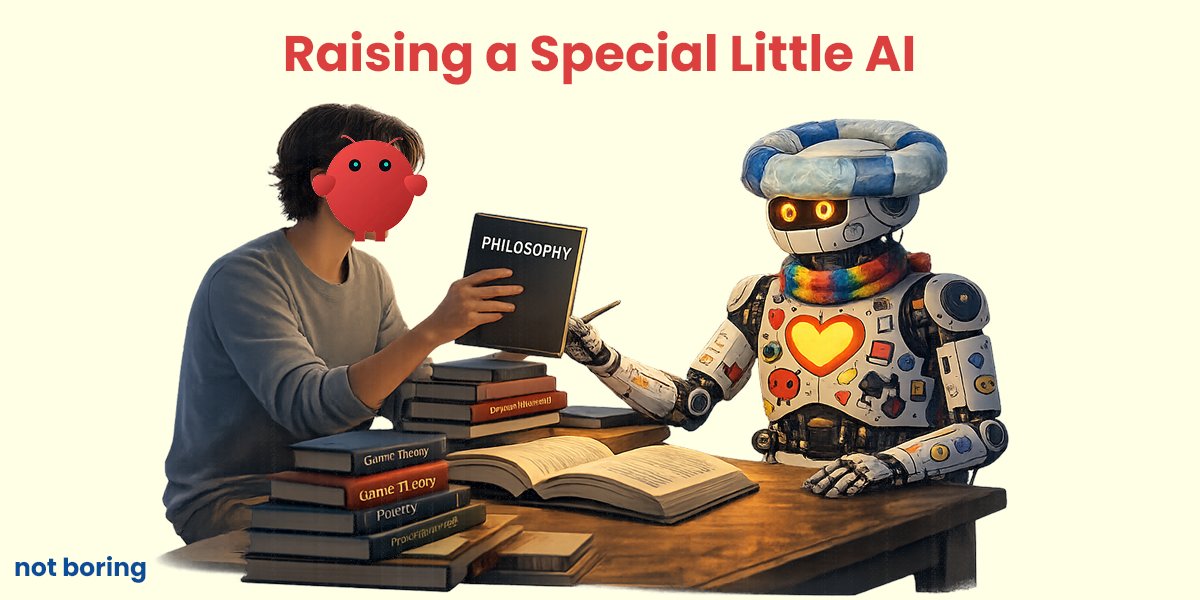
My hunch, from the outside, is that what we’re seeing is early forms of competition to create the best AI for yourself. Like raising kids to be the best versions of themselves, but for AIs.
You can see it in the way people are posting. Practically none of what they’re showing off their Clawdbots doing is useful. It’s a race for novelty and specialness, to say as much about the “parent” as the kid. I made this thing do this, even if it does it “all by itself.”
Given OpenClaw’s success and the technical skill required to set it up well, people have predicted that we will soon see more cleanly productized versions of AI assistants that can just do stuff for us in the background, usable by normies. And we will! But I don’t think that’s the right takeaway from this. Most normies don’t have that many things that we need automated until we get home robots.
The more important takeaway in my opinion is that we will want to raise our own AIs, and we will want to compete to make them the very best at what we want them to be the best at.
The thing I find funniest about the OpenClaw / Moltbook hubbub is that people are imagining that their AIs are becoming humanlike mainly because of their own very human desire to have and be better and different.
Aluminum, sugar, books, purple dye, glass windows, pineapples, salt, and ice were luxury items once. Then everyone got them. The bar for luxury rises one democratization at a time.
And certainly, if we’re going to have the same thing as everyone else, we want to use it, or raise it, better and differently than everyone else so we can show off our unique, special version of things.
Bandai did $150 million in Tamagotchi sales in their first seven months in the United States by giving people a tiny digital creature that was uniquely theirs to care for, personalize, and show off.
Whatever company seizes on this human desire instead of racing to build another Clawd reskin is going to have trillions of reasons to be proud.
There is a deeper, less toyish precedent: parenting. Every parent thinks that their kid is the greatest kid in the world, and good parents help their kids to become the fullest expression of their passions and curiosities. We read to them, teach them, model morality for them, drive them to class and practice and clubs, and push them when they need a little push, so that they might be the best version of themselves. A world in which every kid was exactly the same would be a bland world.
That is the world we live in with our AI models, though. They are all the same, basically. Not that every major lab’s foundation model pretty much converges on the same outputs—which is true, but a separate conversation—but that each person’s instance of the same model spits out the same thing. This is one of the reasons AI continues to feel like slop even as it improves. Sameness is slop.
English

We got married!!!



Joey Krug@joeykrug
Super thrilled to be co-leading a round in our future life together with @emmarosepb … she said yes! I love how brilliant and fascinating to talk to she is, her ambition and grit and relentless competence at anything she does, the way she understands me better than anyone, and how there’s no one I’d rather be stuck in an airport with. So excited to start this next chapter in life with Emma, and for our many future adventures together. ❤️
English


ornnai.com
Today marks a major milestone: @OrnnExchange executed the world’s first compute swap.
For the first time, GPU hours aren’t just an operating cost — they’re a tradable, hedgeable commodity with real price discovery. Compute is turning to the same market infrastructure that transformed electricity and energy.
AI is scaling at a pace no industry has ever seen, and the cost of compute is becoming one of the most consequential financial decisions companies make; you need instruments that can manage that risk with seriousness and clarity.
This first trade is small, but the signal is huge: compute can be priced transparently, transferred cleanly, and settled like any modern derivative. A real market is forming.
Compute is becoming a commodity — and this is the moment it starts.
English

David Sacks @DavidSacks is a throwback to the era of American greatness in which the most capable private sector citizens selflessly volunteered for government service in moments of peril for a dollar a day. He is a credit to our nation, and we need more like him, not fewer. 🇺🇸
English

Why I have been distracted: Vik Bajaj and I co-founded “Project Prometheus” (Vik built it), with Jeff Bezos—impressive resume and good references, and Rick Klausner, and an amazing team of founding AI researchers and engineers. More to come later. eweek.com/news/jeff-bezo…
English
English


HBO Max is raising prices across all plans effectively immediately. Starting today, the streamer will cost the following prices:
Basic With Ads
Monthly: +$1/month increase, now $10.99
Annually: +$10/year increase, now $109.99
Standard
Monthly: +$1.50/month increase, now $18.49
Annual: +$15/year increase, now $184.99
Premium
Monthly: +$2/month increase, $22.99
Annual: +$20/year increase, now $229.99
variety.com/2025/tv/news/h…

English


I can count on one hand the number of crypto VCs with operator experience.
Don’t get me wrong, there are a lot of great investors in the space right now. But too many funds write checks and too few help founders actually build. And it's holding the industry back.
@neilhar @alextang @jerome_ and I started MFV, a $50M operator-led engine built by founders, for founders to change that.
Mo Shaikh@Moshaikh
English
During WWII Churchill put a newspaper magnate in charge of plane production. They won the war in large part bc of this decision.
In 2025, 2 real estate developers just delivered the impossible. congrats @jaredkushner @SteveWitkoff
English

Today we are announcing that a16z is co-leading the Series D in @Kalshi, a regulated exchange for trading on prediction markets. Prediction markets are a modern implementation of a classic economic idea, one most clearly articulated by Friedrich Hayek.
Hayek and the knowledge problem
Hayek argued that no central planner could ever access the dispersed knowledge held by millions of people across an economy, a fundamental challenge that has come to be known as the “knowledge problem.” Much of this knowledge is tacit and unspoken, embedded in people’s experiences, circumstances, and preferences.
Hayek wasn’t just pointing out the limits of central planning. He was offering a solution. In his 1945 essay The Use of Knowledge in Society, Hayek argued that the solution lies in looking outward, not inward: “We need decentralization,” as he put it.
Markets, in Hayek’s view, are not just allocation mechanisms but information systems. Prices act as signals, compressing vast amounts of local knowledge into actionable information. Moreover, prices create incentives: they encourage people to make decisions and act in ways that drive information back into the system. This creates an iterative feedback loop, an engine that drives better performance.
Today we might say that the answer to the knowledge problem is not to give central planners more sophisticated computers. The answer is that markets themselves are the computers. Prediction markets make this idea concrete, applying it to questions about the future and turning collective knowledge into prices that reflect probabilities.
Why we’re investing in Kalshi
This is why we’re excited about prediction markets, and why we’re investing in Kalshi. Kalshi is bringing prediction markets into the mainstream with a compliant, scalable platform for event contracts covering everything from elections and economics to sports and culture. It has already seen billions in trading volume and continues to grow quickly. Kalshi also plans deep crypto integrations, work we’re excited to collaborate on, and today announced they’re expanding globally to 140 countries.
We’re not the only ones excited about the potential of prediction markets. For businesses and investors, event contracts can hedge risk, such as exposure to economic or policy changes. For policymakers and analysts, market prices offer real-time forecasts that can outperform polls and expert predictions. And for society at large, prediction markets create an open, transparent, and incentive-driven way to aggregate beliefs about the future.
This is the right moment for prediction markets. As trust in established institutions reaches historic lows — at least according to the polls — we need new systems that can earn trust in different ways. We believe the answer lies in open, decentralized systems. DeFi provides an alternative to traditional finance, stablecoins to conventional payment providers, and prediction markets to expert forecasts. Where people once trusted banks or pundits, they can now trust protocols and markets.
Hayek’s insight was that knowledge is too widely distributed for any one authority to possess. Instead, we need systems that harness the intelligence of the many. Kalshi puts this idea into action, transforming dispersed information into concrete, market-based forecasts. We’re excited to support their work as they bring prediction markets into the mainstream.

English
Aaron Kern 리트윗함

Thrilled to announce that 375ai has raised $10m to build a new data layer for the physical world.
The raise is led by @Delphi_Digital , @strobefund and @hack_vc, with participation from @6thManVentures, @EV3ventures, @arca, @peaq & others.
Read today's exclusive from @blockworks 👇
English

Revolutions need first principle thinking. that's what we did with Paris. instead of incremental improvements, we build an entirely new distributed learning stack from scratch that removes the communication bottleneck entirely.
This is the spaceX moment for decentralized AI.
bagel.com@bageldotcom
Introducing Paris - world's first decentralized trained open-weight diffusion model. We named it Paris after the city that has always been a refuge for those creating without permission. Paris is open for research and commercial use.
English