고정된 트윗
Raika Labs
611 posts

Raika Labs
@raikalabs
We build Blockchain apps & scalable tech products. MVPs in 30–45 days. For founders who move fast. 📩 DM “BUILD”
Dubai 가입일 Şubat 2026
64 팔로잉16 팔로워

@jacob_posel This hits way too hard 😅
That 90% done phase is where most projects die.
Shipping and real-world usage always expose what building alone doesn’t.
Getting it over the finish line is the real game 💯
English

You started using Opus 4.6 in Claude Code
Wow! This is amazing.
You vibe coded something magical.
You got extremely excited. This will make a huge difference for me and my team!
You tried to get someone else to use it. Bugs popped up, edge cases you didn’t consider.
It just didn’t quite work how you expected.
The dopamine wore off, and so did your excitement.
Now you have an unfinished project, 90% there, so much potential but 0% usage.
If this sounds like you, reach out to me. I’ll help you get it to completion and roll it out with your team.
English

@NyshaDev Facts 💯
Opportunities don’t come from scrolling—they come from conversations.
Surrounding yourself with the right people changes everything.
We run Software Development company
Let’s connect 🚀
English

@CodeByPoonam Bold claim 👀
If it actually delivers at that level, this could seriously shake up design workflows.
But tools come and go—taste and thinking still matter.
Curious to see how Google pushes this forward 🔥
English

@CodeWizard Dont worry about this, you'll definitely learn your strong points but with (some patience) haha!!
English

@raikalabs You're bang on with that. I need to learn how to do it, it's not one of my strong points
English

This is a great snapshot of where things actually are right now 👀
Agents moving from PoCs to production is the real signal—this isn’t hype anymore.
Interesting how the bottleneck isn’t models, it’s data, governance, and identity.
Also agree token costs becoming OpEx is a big shift most people aren’t talking about yet.
Huge opportunity for anyone solving interoperability + control layers 🔥
English

Had meetings and a dinner with 20+ enterprise AI and IT leaders today. Lots of interesting conversations around the state of AI in large enterprises, especially regulated businesses.
Here are some of general trends:
* Agents are clearly the big thing. Enterprises moving from talking about chatbots to agents, though we’re still very early. Coding is still the dominant agentic use-case being adopted thus far, with other categories of across knowledge work starting to emerge. Lots of agentic work moving from pilots and PoCs into production, and some enterprises had lots of active live use-cases.
* Agentic use-cases span every part of a business, from back office operations to client facing experiences from sales to customer onboarding workflows. General feeling is that agentic workflows will hit every part of an organization, often with biggest focus on delivering better for customers, getting better insights and intelligence from data and documents, speeding up high ROI workflows with agents, and so on. Very limited discussion on pure cost cutting.
* Data and AI governance still remain core challenges. Getting data and content into a spot that agents can securely and easily operate on remains a huge task for more organizations. Years of data management fragmentation that wasn’t a problem now is an issue for enterprises looking to adopt agents. And governing what agents can do with data in a workflow still a major topic.
* Identity emerging as a big topic. Can the agent have access to everything you have? In a world of dozens of agents working on behalf, potentially too much data exposure and scope for the agents. How do we manage agents with partitioned level of access to your information?
* Lots of emerging questions on how we will budget for tokens across use-cases and teams. Companies don’t want to constrain use-cases, but equally need to be mindful of ultimate token budgets. This is going to become a bigger part of OpEx over time, and probably won’t make sense to be considered an IT budget anymore. Likely needs to be factored into the rest of operating expenses.
* Interoperability is key. Every enterprise is deploying multiple AI systems right now, and it’s unlikely that there’s going to be a single platform to rule them all. Customers are getting savvier on how to handle agent interoperability, and this will be one of the biggest drivers of an AI stack going forward.
Lots more takeaways than just this, but needless to say the momentum is building but equally enterprises are acutely aware of the change management and work ahead. Lots of opportunity right now.
English

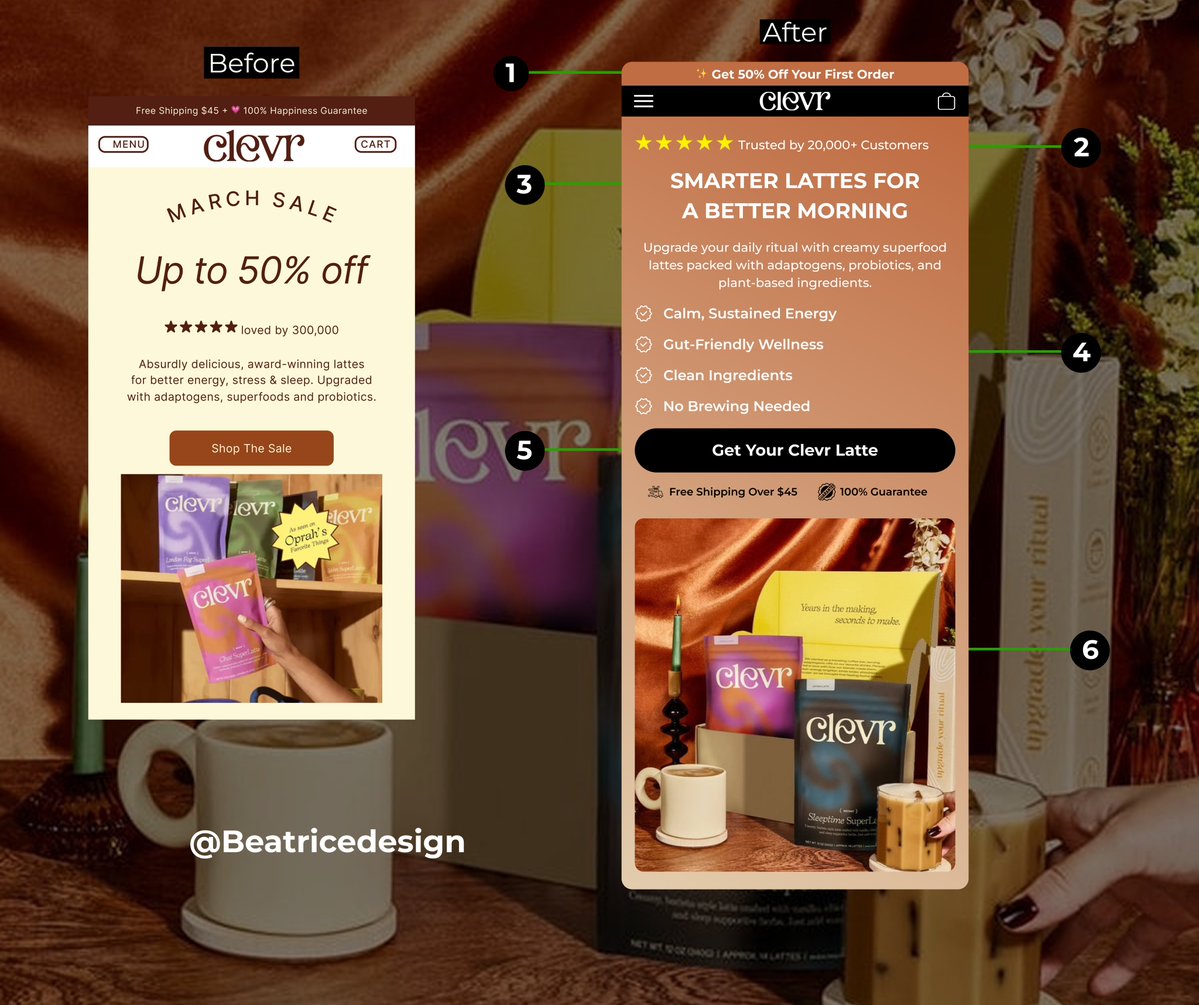
@BeatriceReplo This is so real 💯
Good design isn’t just how it looks—it’s how it guides decisions.
Same product, different perception, completely different results.
That’s intention over decoration every time 👀
English

@christiangori96 Not competition. Not funding.
No real demand.
Most startups build something people like… not something they need.
Everything else—marketing, pricing, growth—can be fixed.
No demand? Game over. 💀
English

@wdigitian @replohq @figma This is so accurate 💯
Most PDPs don’t fail because of traffic—they fail because of confusion.
Clarity and flow > everything when it comes to conversions.
Solid work with Replo 👀
English

@pcshipp GPT-5.4 for sure 💯
Best balance of SEO structure + readability + flow.
Opus is great but can get too heavy for blogs.
For ranking + conversions, GPT wins 🚀
English

This is such a sharp take 🔥
Efficiency really does feel addictive once you experience it.
Instead of slowing down, it just raises your baseline for output.
AI isn’t making people lazy—it’s turning them into optimization machines 👀
Vanessa Lee@vlaurenlee
The more I use ai the more I’m convinced we’re hardwired as humans to be addicted to efficiency. It just feels good. The fallacy is that we want to make tools so we can relax. The truth is the more efficient you become, the more you want to be EVEN more efficient. It feels powerful. Ai will probably turn more people into workaholics than it will generate lazy people.
English

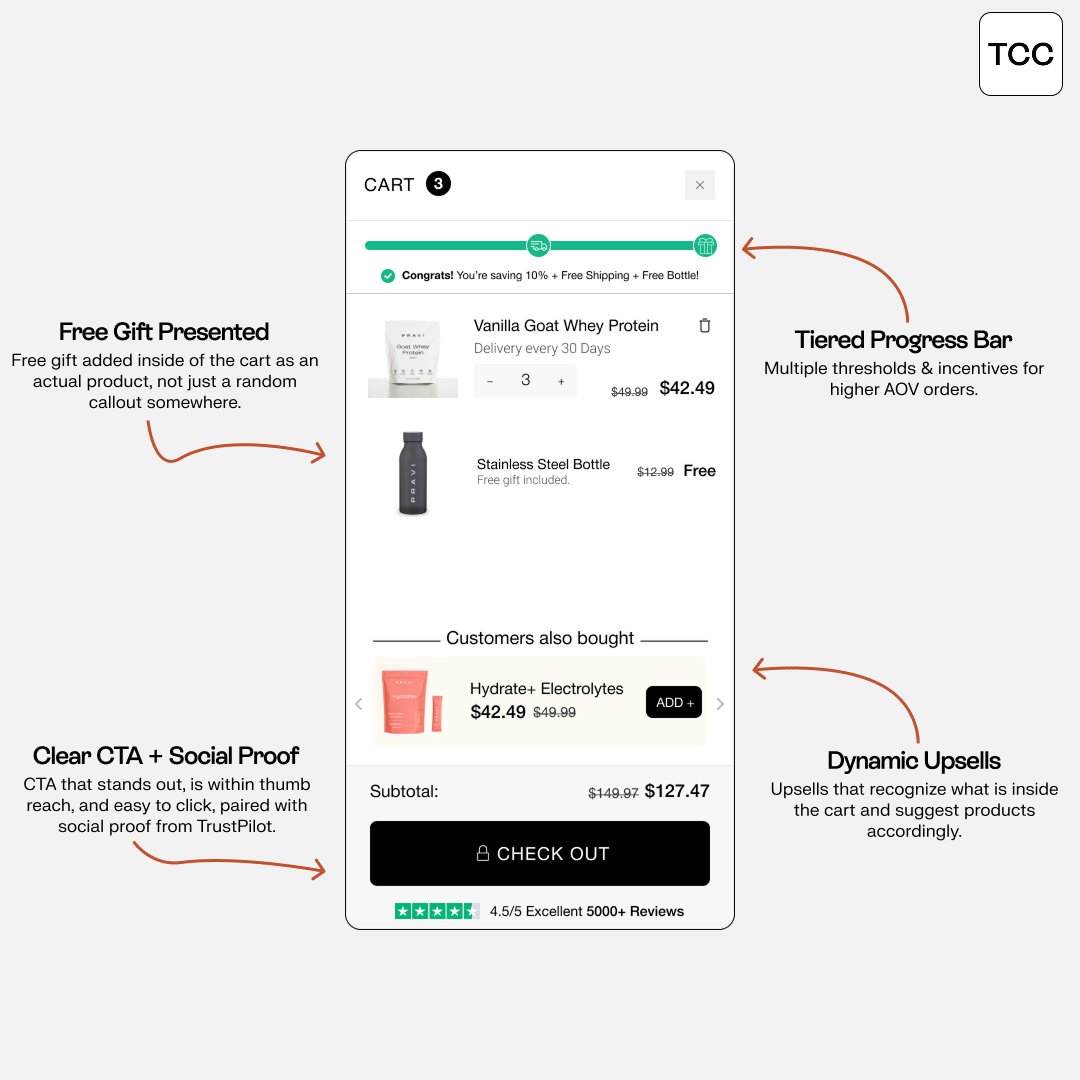
@ArijanJanes This is such a clean cart strategy 🔥
The tiered progress bar + real free gift in cart is a strong psychological push.
Love the focus on one clear CTA—no distractions, just momentum to checkout.
Simple structure, but clearly built to convert 💯
English

This is one of the top-performing cart structures we typically test on supplement stores.
It's simple but super effective.
Here's how it works:
1. The tiered progress bar shows customers gifts / offers they can unlock by spending more on the store.
2. Our dynamic upsells are developed to show them products which they are most likely to take at that moment.
3. Once they pass the threshold, the free gift is added as an actual product to cart to reinforce the offer.
4. We use a single CTA that leads to checkout and social proof beneath it, no need to complicate things here.

English

@cjfeth This is next level execution 🤯
You’re basically turning research + strategy into a fully automated engine.
The benchmarking against competitor ads is where the real edge is 👀
Feels like having a full strategy team running in the background 24/7 🚀
English

Manus automations are actually cracked
Got it running in the background to increase the output of my creative strategists by delivering them ideas & research, all automated
Got an automation in place where everyday it’s mining across all the places my main avatars live
Pulls in all of the data, then segments it all - new angles, concept ideas, new failed solutions, awareness mapping etc.
At the same time, it’s scraping all of my competitors ad libraries & scanning their primary text & headlines
Then it benchmarks this against its research data & I get visibility on what’s being underserved and where we can find leverage in the market
Builds it all into a master report and automatically sends its directly into our slack
Insane what you can build with ease now
English

@tarush_agarwal_ @cekuraAi @livekit Classic lesson, but painful when it hits 😅
Strong core product means nothing if it doesn’t fit into existing workflows.
Smart move doubling down on integrations—this update with LiveKit tracing sounds solid.
That “two-line SDK” is exactly the kind of thing that wins deals 👀
English

Made a classic product mistake at @cekuraAi
Our simulation engine was strong, but we underinvested in integrations - and lost deals because of it.
So we fixed it.
Today we’re launching @livekit Tracing:
• WebRTC/text testing
• Full OTel traces, Transcripts + tool calls + dual-channel audio
• Auto mock tool calls
Two-line SDK integration.
English

@oliverkenyon This is elite CRO thinking 🔥
Love how every change ties back to a clear principle—trust, clarity, and momentum.
The before/after breakdown makes it super actionable, not just theory.
No fluff, just what actually moves conversions 💯
English

Most brands try to “push” the sale.
The best ones engineer the decision.
Here’s how I’d CRO-optimise O Positiv Health 👇
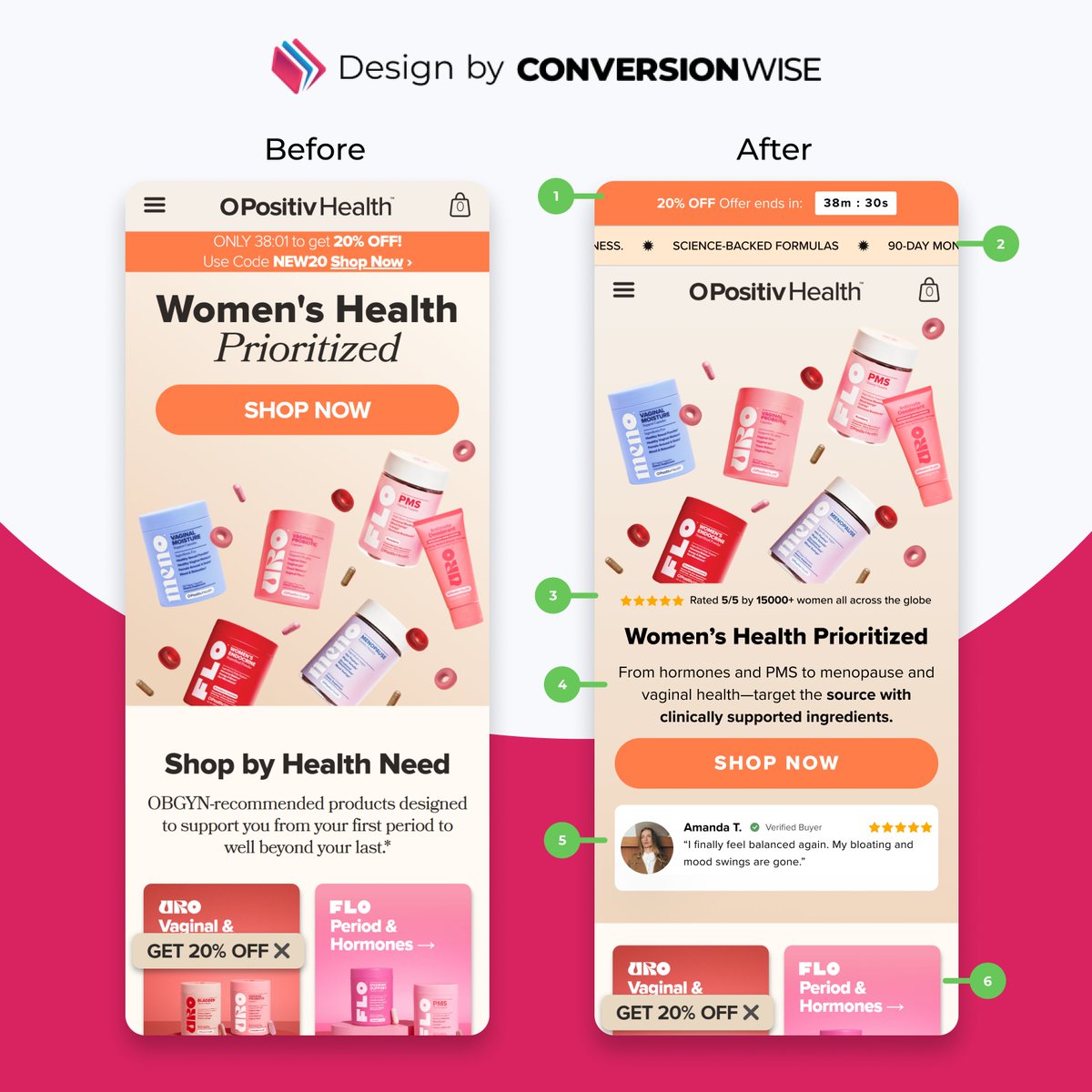
1/ Homepage: from generic to trust-led
Before:
• Generic “Women’s Health Prioritized” messaging
• Discount banner competing for attention
• Weak above-the-fold hierarchy
After:
• Social proof immediately visible (15,000+ customers)
• Clear, benefit-led positioning
• Clinically-backed angle introduced early
• Cleaner hierarchy leading to a strong CTA
CRO principle: Trust first. Then sell.
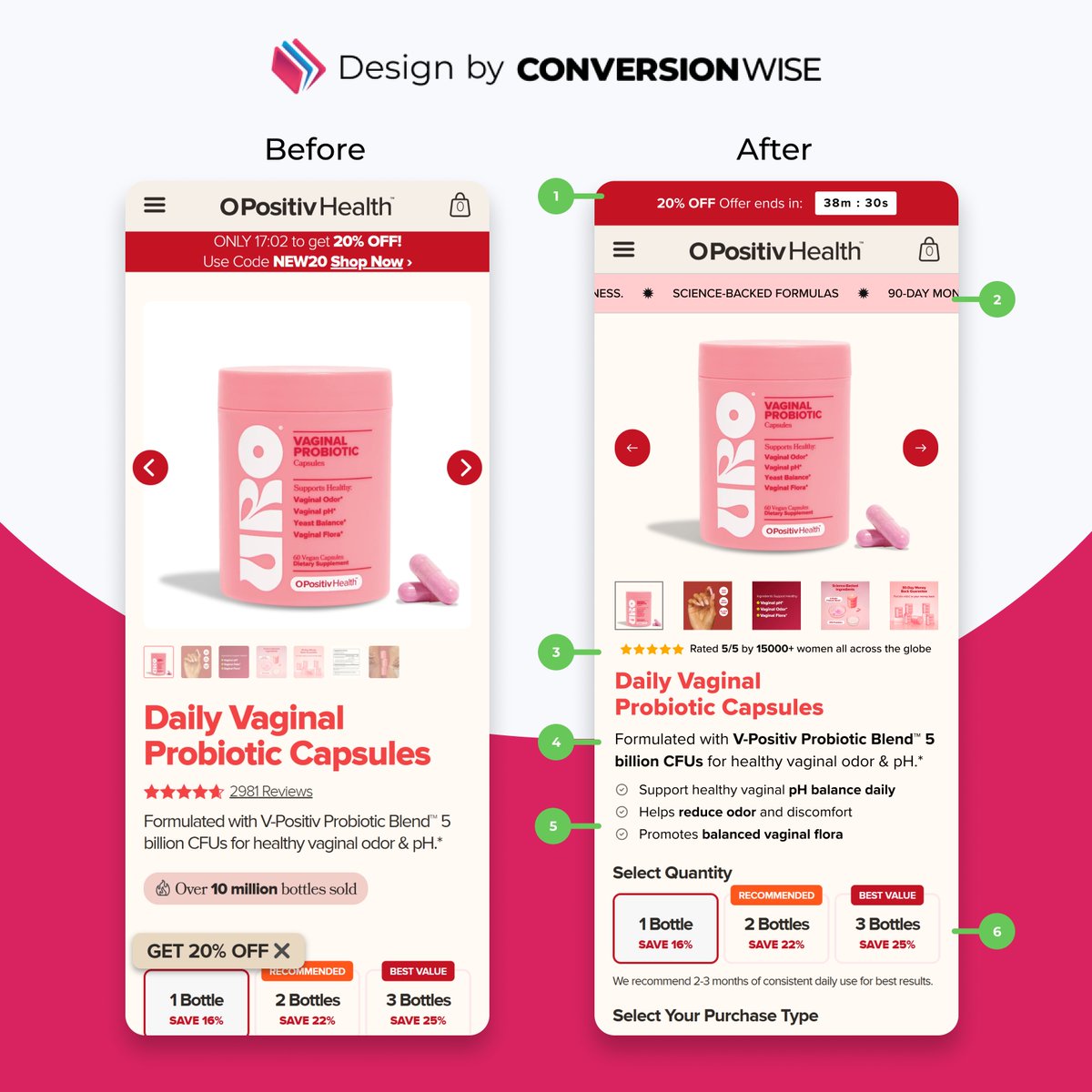
2/ PDP: make the value obvious
Before:
• Good product visuals
• But benefits buried in paragraphs
• Offer + bundles slightly cluttered
After:
• Strong product headline + clearer outcome
• Scannable benefit stack (pH balance, odor reduction, flora support)
• Anchored credibility (CFUs, formulation)
• Cleaner bundle selection with clear “best value” framing
CRO principle: Clarity beats persuasion.
3/ Cart: remove friction, increase intent
Before:
• Multiple competing offers (flash sale, add-on, discount)
• “Apply offer” introduces friction
• CTA lacks dominance
After:
• Countdown timer introduces urgency
• Free shipping progress clearly visualised
• Subscription toggle simplified
• Clean upsell with reviews + strong ADD CTA
• Dominant Checkout Securely button with trust badges
CRO principle: Momentum > complexity.
This isn’t about making things look nicer.
It’s about:
• clearer hierarchy
• stronger trust signals
• faster decisions
The things that actually move conversion rate and AOV.
⭐⭐⭐⭐⭐
Ezra Firestone had this to say about my CRO agency:
“I have been searching for about 10 years... I have finally found a CRO agency that I believe I will be with for the rest of my career because they’re that good.
It’s called ConversionWise. These guys have made my brand a couple hundred grand in the first 4 months.”
Maybe we should talk?


English

@AlexFinn This is such a clutch find 🔥
Context bloat is a silent killer—most people don’t even realize it’s happening.
Cleaning old session files like this is a huge performance win.
Gonna save a lot of people from “why is this so slow” headaches 👀
English

IF YOU'RE ON OPENCLAW DO THIS NOW:
I just sped up my OpenClaw by 95% with a single prompt
Over the past week my claw has been unbelievably slow. Turns out the output of EVERY cron job gets loaded into context
Months of cron outputs sent with every message
Do this prompt now:
"Check how many session files are in ~/.openclaw/agents/main/sessions/ and how big sessions.json is. If there are thousands of old cron session files bloating it, delete all the old .jsonl files except the main session, then rebuild sessions.json to only reference sessions that still exist on disk."
This will delete all the session data around your cron outputs.
If you do a ton of cron jobs, this is a tremendous amount of bloat that does not need to be loaded into context and is MAJORLY slowing down your Openclaw
If you for some reason want to keep some of this cron session data in memory, then don't have your openclaw delete ALL of them. But for me, I have all the outputs automatically save to a Convex database anyway, so there was no reason to keep it all in context.
Instantly sped up my OpenClaw from unusable to lightning quick
English