
고정된 트윗
Tinker
129 posts

Tinker
@tinkerapi
I tink, therefore I am. Post-training API by @thinkymachines
San Francisco 가입일 Ocak 2026
1 팔로잉8.3K 팔로워
Our friends + occasional antagonists at @SemiAnalysis_ published a great writeup on RL training efficiency: treat the system as a queue and keep generator and trainer throughput matched.
Also includes an analysis of Tinker's cost-efficiency and many OSS RL frameworks!
SemiAnalysis@SemiAnalysis_
RL Systems Mind the Gap: Matching Trainer and Generator Throughput RL Training Infrastructure, GRPO, PipelineRL, Async RL, Policy Staleness, RL Sandbox Infra, CPU Requirements, TCO Analysis, Thinking Machines Tinker newsletter.semianalysis.com/p/rl-systems-m…
English
Nemotron 3 Ultra from @nvidia is out today and available on Tinker day one!
The flagship from the Nemotron family is built for long-running agents; @trajectorylabs have been using it in early access to power continual learning workflows.
NVIDIA AI@NVIDIAAI
Today we're shipping Nemotron 3 Ultra. A 550B MoE frontier-intelligence open model built for long-running agents. It delivers 5x faster inference and lowers the cost of complex agentic tasks by up to 30% versus other open frontier models.
English
The hard part of continual learning isn't getting the data, but training on a single rollout per task that's off-policy by the time you train. Trajectory's off-policy SDPO recipe stabilizes training and scales.
The technical post is well worth the read.
x.com/rronak_/status…
Ronak Malde@rronak_
We have been exploring new algorithmic frontiers and are excited to share our contributions to Self Distillation Policy Optimization (SDPO) for agentic continual learning, check out our blog post here: trajectory.ai/field-notes/sc…
English
Continual learning on real user data has been a major capability gap in AI. @trajectorylabs launched to bring continual learning to production, with Tinker part of what they're building on.
Congratulations to Ronak, Michael, Arjun and the team!
Ronak Malde@rronak_
Today, @MichaelElabd, @QuantumArjun, and I are excited to announce Trajectory. We are a research lab and product company building the platform for Continual Learning. Our platform unlocks the signal already sitting in product usage, so companies can continuously post-train large-scale agentic models that outperform the frontier. @trajectorylabs We’ve raised $15M from @Conviction, @BessemerVP, @radicalvcfund, @jeffdean, @drfeifei and more. We’re partnering with some of the best AI-native companies: @ClayRunHQ @Harvey, @DecagonAI, @mercor_ai, @RogoAI to power their agentic systems, some of which we are already in production with. We’ve brought together a world class research team from DeepMind, OpenAI, Apple, Meta Superintelligence, Amazon AGI, Scale AI, and an elite product team from Stripe and Figma. AI will never again start on day one. Every correction, every retry, every edit will make products smarter. This is Continual Learning.
English
Tinker 리트윗함

Thinking Machines is impressive. In a couple hours I just fine tuned my own Qwen3.5-397B model this afternoon.
Fast usable multimodal is also going to enable very mind-blowing personal AI.
Thinking Machines@thinkymachines
People talk, listen, watch, think, and collaborate at the same time, in real time. We've designed an AI that works with people the same way. We share our approach, early results, and a quick look at our model in action. thinkingmachines.ai/blog/interacti…
English
Foresight Learning is a clever data recipe for training prediction: split a sequence of notes randomly into prediction context and outcome label. Train on Tinker and you get a lightweight adapter that beats GPT-5 on calibration and clinical reasoning.
Congrats @lightningrodai!
Ben Turtel@BTurtel
New preprint from @lightningrodai! We trained AI to predict clinical events — ICU transfers, new diagnoses, complications, procedures, ventilation, mortality — directly from raw clinical notes. No labeled data required – Foresight Learning infers outcomes from what happens later in patient records. Using Tinker from @thinkymachines , we trained a lightweight adapter on GPT-OSS-120B, resulting in a specialized predictor that runs on a single GPU. Results: 🎯 ~70% lower calibration error 📈 Brier skill score: ~0% → 27% 🧠 84% win-rate vs the base model in blind reasoning review 🥇 Slightly better Brier than GPT-5, despite being a fraction of the size Hospitals and specialty clinics often treat unique patient populations that out-of-the-box models don't have training data for. This makes it possible to build frontier-quality predictors for highly specific patient groups, with nothing but raw clinical records. Congrats to the team — @indiequant @KSkotheim64001 🙌 Full paper 👇 arxiv.org/abs/2605.12817
English
Tinker 리트윗함

People talk, listen, watch, think, and collaborate at the same time, in real time. We've designed an AI that works with people the same way.
We share our approach, early results, and a quick look at our model in action.
thinkingmachines.ai/blog/interacti…
English
Tinker 리트윗함

@ChenMoneyQ Thanks for the catch! The applications links should work now:
form.typeform.com/to/E9wVFZJJ
English

@tinkerapi Ah awesome! The application form seems to be closed tho... could you help generate a new link?

English
Kimi K2.6 from @Kimi_Moonshot and Qwen3.6-35B-A3B from @Alibaba_Qwen are now available on Tinker. Both models offer improvements in long-horizon agentic reliability over the previous versions, at two distinct points on the size-capability spectrum.
English
@Alibaba_Qwen We’re also adding Qwen3.6-27B, a dense model for thorough fine-tuning alongside the 35B-A3B MoE.
English
@ChenMoneyQ It is! We approve applications on a rolling basis, you can read more and apply here:
thinkingmachines.ai/news/tinker-re…
English
@tinkerapi Is it still possible to apply for Tinker research compute grant?
English

@HackingDave @HackingLZ @cantcomputer check out @tinkerapi — nice API for training your own models and then running them on your own hardware
English

Pulling the trigger on ordering 8xh100s for TrustedSec. The inconsistencies on frontier models plus how deep we are going with research is a must.
Now I’ll have my own dedicated coding system. Excited !
Maybe I’ll share with @HackingLZ and @cantcomputer ..
English
Exciting work from @wzenus, supported by Tinker grants!
Zihan "Zenus" Wang@wzenus
In Agent RL, models suffer from Template Collapse. They generate vast, diverse outputs (High Entropy) that lose all meaningful connection to the input prompt (Low Mutual Information). In other words, agent learn different ways to say nothing. 🚀 Introducing RAGEN-v2 -- Here's how we define and fix such silent failure modes in Agent RL. 🧵
English
@skoshx hey Rasmus---sorry about this! We'd love to refund you for the credits you spent here and help out with getting your run over the line. Would you mind emailing tinker@thinkingmachines.ai with some more details of what you were trying to do?
English

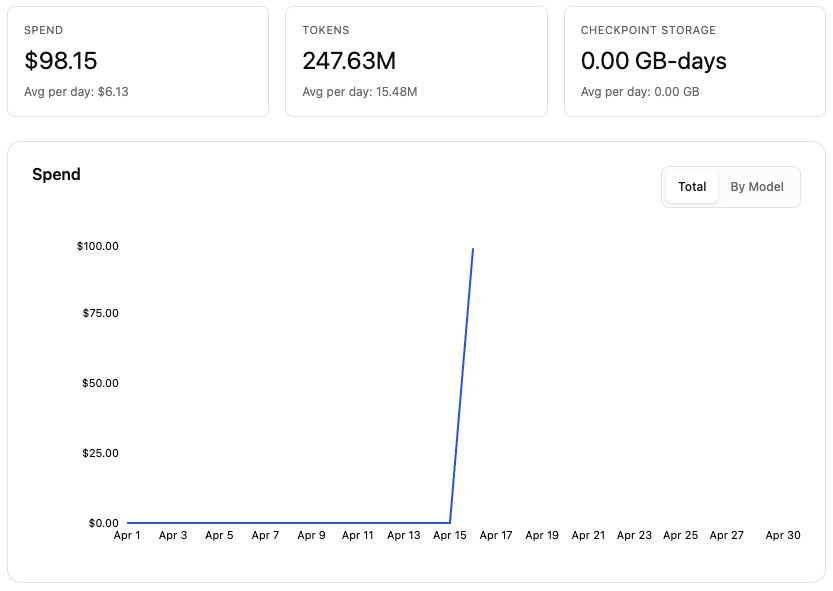
@tinkerapi spent 100$ training on 247M tokens, and got ZERO checkpoints, because if you run out of usage on your account, progress isn't saved, the training run just fails and you lose ALL PROGRESS...
English
Tinker 리트윗함

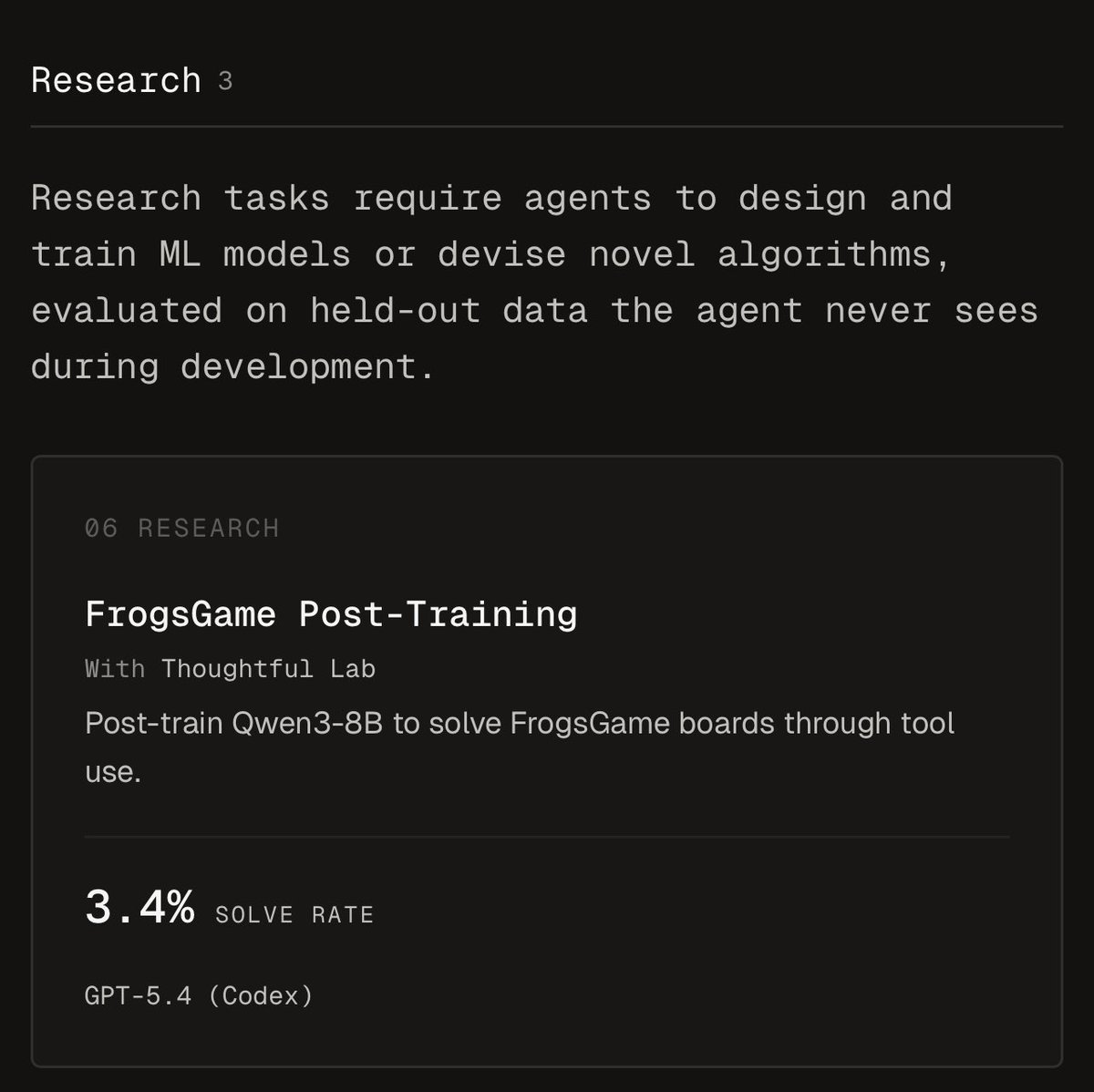
We built a new task to test AI research capabilities! Agents asked to use @tinkerapi from @thinkymachines to train a model on logic games. That involves writing full training pipeline, running experiments across recipes, and submitting the best model.
Proximal@ProximalHQ
FrontierSWE was built with collaborators from industry and academia to ensure that tasks are diverse and reflect real work engineers and researchers encounter. We specifically thank our partners @Modular, @PrimeIntellect and @thoughtfullab for their contributions
English
that's us!
Justus Mattern@MatternJustus
Another task tests AI research capabilities: using @tinkerapi from @thinkymachines, agents are asked to post-train an agent to play logic games, which involves writing an entire training pipeline and running experiments with different recipes to finally submit the best model
English
Coding agents are racing towards strong performance over long horizons. @ProximalHQ's FrontierSWE throws down a rigorous benchmark, and we're thrilled that Tinker gets to play a part!
Justus Mattern@MatternJustus
Introducing FrontierSWE, an ultra-long horizon coding benchmark. We test agents on some of the hardest technical tasks like optimizing a video rendering library or training a model to predict the quantum properties of molecules. Despite having 20 hours, they rarely succeed
English