@EMostaque 1bit is overreach if quality matters, but 2bit should be the new line in the sand for best size and quality mix.
English
Ping He
495 posts

@0to1ping
Building https://t.co/ED5QTCwV2z Growing https://t.co/BHOs62rxTY, https://t.co/dXp0Yr9Ioj, more coming...

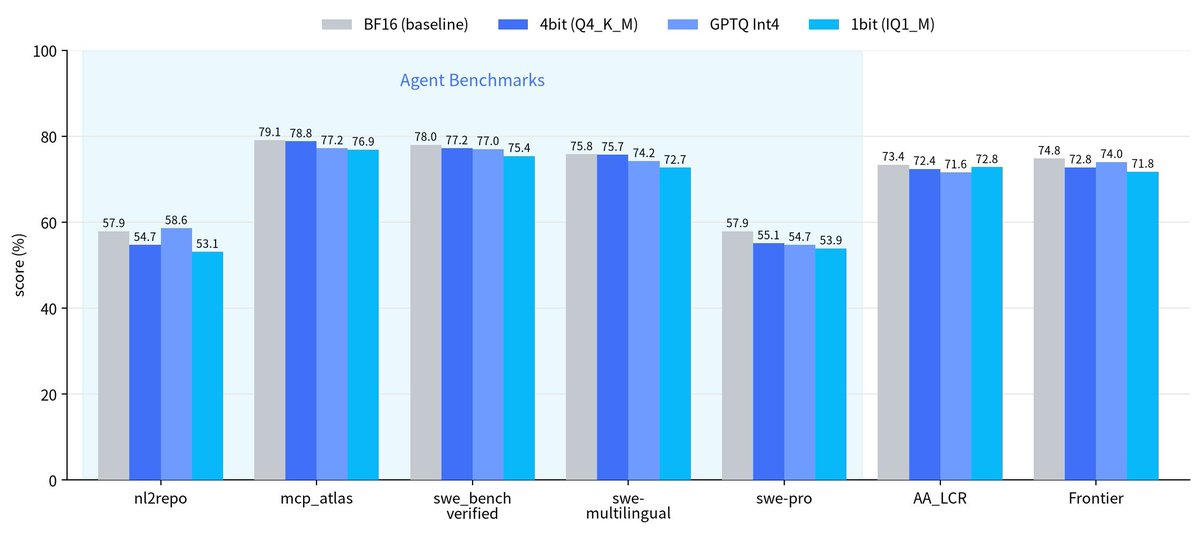
We’ve just released the 1-bit & 4-bit version of Hy3, a flagship-scale 295B model that can be served on a single GPU. 👌 Run Hy3 with llama.cpp, enable MTP, and experience powerful intelligence on dramatically lower hardware.🚀🚀🚀 Can’t wait to see what you build. #Hy3 #Hy #GGUF #llamacpp

We’ve just released the 1-bit & 4-bit version of Hy3, a flagship-scale 295B model that can be served on a single GPU. 👌 Run Hy3 with llama.cpp, enable MTP, and experience powerful intelligence on dramatically lower hardware.🚀🚀🚀 Can’t wait to see what you build. #Hy3 #Hy #GGUF #llamacpp


We’ve just released the 1-bit & 4-bit version of Hy3, a flagship-scale 295B model that can be served on a single GPU. 👌 Run Hy3 with llama.cpp, enable MTP, and experience powerful intelligence on dramatically lower hardware.🚀🚀🚀 Can’t wait to see what you build. #Hy3 #Hy #GGUF #llamacpp


Aloha! 🌺 Meet Ornith-1.0, a family of open-source LLMs specialized for agentic coding. Ornith-1.0 spans the full parameter sizes including 9B Dense, 31B Dense, 35B MoE, and 397B MoE. It achieves state-of-the-art performance among open-source models of comparable size on coding benchmarks including: ✅Terminal-Bench 2.1(77.5) ✅SWE-Bench(82.4 on verified, 62.2 on pro, 78.9 on Multilingual) ✅NL2Repo(48.2) ✅SWE Atlas(41.2 on QnA, 42.6 RF, 39.1 TW) ✅ClawEval(77.1) Post-trained on top of gemma4 and qwen3.5, Ornith-1.0 employs a novel self-improving training strategy in which reinforcement learning is used to generate not only solution rollouts, but also the task-specific scaffolds that drive those rollouts. By jointly optimizing the scaffold and the resulting solution, the model generate higher-quality solutions in agentic coding.😎 All models are released under the MIT license, enabling full commercial and research use. 📖Tech Blog: deep-reinforce.com/ornith_1_0.html 🤗Huggingface: huggingface.co/collections/de…


Data center-grade AI. Now on your desk. NVIDIA DGX Spark and DGX Station brings AI-factory-class compute directly into the enterprise—no rack, no cloud dependency. ✅ DGX Station packs 748GB of coherent memory and up to 20 petaflops of AI performance into a deskside system, supporting models up to 1 trillion parameters. ✅ DGX Spark clusters up to four systems into a compact desktop data center with near-linear scaling. For APAC enterprises in regulated industries, air-gapped configurations keep your data sovereign and your workflows compliant. And when you're ready to scale, the same GB300 architecture moves seamlessly to the data center or cloud — no rearchitecting required. nvda.ws/4gjRARY



Arena has crossed $100M in annualized revenue run rate, eight months after launching our evaluation product. With our recent release of Agent Mode, millions of users on Arena are doing real work with agents, from coding to document analysis, in long-running, multi-turn sessions with hundreds of tool calls. Arena now evaluates objective criteria like task completion rates, hallucination rates, and more, far beyond our original human preference voting model. This expansion has taken us from a student project at Berkeley to one of the fastest growing companies in history. Go Bears! 🐻 Our core thesis is simple: to align AI with human values, we must directly measure its impact on people in the real world. Today's milestone is proof that Arena’s platform is the de-facto standard for post-deployment evaluation of AI.

China’s AI playbook: kill OpenAI and anthropic with free great models. Make it free. Then use cheap electricity to export compute as well. Currently the blocker is chip but Hauwei would catch up soon. Imagine a world where instead of paying hundreds of billions to OpenAI and anthropic, you pay almost zero to similar level of intelligence with cheap cheap inference. What’s gonna happen?

American and European enterprises will ditch OpenAI and anthropic and adopt Chinese models. Here’s why: 1. They can host Chinese models under their own GPUs so it’s still compliant and they would argue they have more control. 2. they will post train with their own data on top of Chinese models. That’s how they build data moat. 3. They will not trust anthropic who will retain their data at any time for “safety” concerns like how they did with Fable and then try to build the same thing like how anthropic did with healthcare and legal. 4. They need to justify their AI spend and ROI. The cure is a reliable America open source model but there is none. After all, if giving away all your data and AI control at the mercy of anthropic and OpenAI means you care about safety and compliance, you are outright stupid.