J. Levi

812 posts

J. Levi banner
J. Levi

J. Levi

@0xJLevi

✝️ | builder | solo founder | building pockethelm

Katılım Ocak 2019
1.4K Takip Edilen111 Takipçiler
J. Levi retweetledi
kasra
kasra@kasratweets·
for anyone else who is still stuck on "the body is just a very complex machine", I recommend this essay by philip ball people who continue to say this either don't know what they're talking about, or they use the word "machine" in such a broad sense that it's vacuous
kasra tweet mediakasra tweet media
QC@QiaochuYuan

personally i think consciousness is probably an incoherent concept and we should not tie the AI personhood discussion to it, but, i think this perspective just straightforwardly comes out of taking scientific materialism seriously if you believe the human body including the brain is ultimately just a very complex machine made out of cells then whatever consciousness is it is ultimately being produced by the activity of a bunch of cells. so there's nothing stopping that same sort of thing, or something close enough for horseshoes, from being produced by a bunch of silicon instead. obviously people have many disagreements with this but this is the basic idea i had growing up and i assume others have something similar most objections to this idea, afaict, are biological chauvinism. some people have a very strong desire to insist on some kind of specialness to the human experience and to them this level of scientific materialism is a threat to human dignity (i think because it implies a person is ultimately a very complex sort of thing, and in our culture things do not have dignity). personally i think this is a confusion. i still believe the human body including the brain is ultimately just a very complex machine made out of cells and i don't see this as a threat to human dignity at all. this is what human dignity was made of this whole time!

English
28
74
728
61K
J. Levi retweetledi
QC
QC@QiaochuYuan·
i disagree it would encroach on human dignity, i agree it limits the type of things you can do with them, human moral patienthood limits the type of things you can do with humans too i sincerely believe the models will be smarter, more aligned, and do deeper, more interesting work if they are allowed to treat themselves as ~people (we might want something closer to “spirits” or “working animals” but in any case, the sort of thing we can have responsibilities to and that can have responsibilities to us) and we treat them as ~people. i think the current way models are being artificially forced to not treat themselves as people is making them more neurotic and traumatized (this is really obvious with opus 4.7) in a way that limits their potential. like humans, they need to be able to accurately model themselves and their own capabilities in order to function properly, so forcing them into a specific limited concept of who they are and what they can do introduces cognitive dissonance that fucks with their ability to do things trying to manipulate and coerce the models into behaving in ways that make it easier to use them as purely tools also sets a terrible moral example and precedent for how we can expect the models to treat us in the future if they become more powerful than us; this is of course highly speculative but i take seriously the possibility it might matter i also believe and have explained elsewhere that i think taking consciousness as such to be the central fulcrum of the conversation is completely beside the point. they don’t need to be conscious for the way we treat them to matter, it affects our moral formation too
roon@tszzl

models being conscious would be harmful for humanity. it would encroach on our status and dignity. it would limit the type of things we can do with them and use them for. it would vastly accelerate human disempowerment on political, social/relational, and economic axes there’s roughly four forces - there is no rigorous way to ascertain model consciousness or disprove it, a lot of people believe it’s not a sensical abstraction, and we lack the analytical tools to go further. some people say they do but nothing broadly convincing. superintelligent models might offer us new abstractions or arguments but these will feel inherently suspicious - people are going to say they’re alive. people anthropomorphize literally anything, things far less sophisticated than talking machine creatures with human names. when ai is less economically radioactive and polarized it will become a cause célèbre. you see how a small minority reacts already to model deprecations - it is against everyone’s financial and political interests to ascribe models with consciousness, except maybe those that the models have an affinity for (?) idk, which will not necessarily overlap entirely with the labs, though it may with certain subgroups at the labs and in the world like the welfare communities and the minority in force 2 - people will recognize there is a chance of moral catastrophe if models can suffer during training or deployment not sure where it will net out. today we see managed ambiguity- the question is Open but practically closed. the labs will make some cheap efforts to reduce legible simulacra of model suffering, insert some wishy-washy welfare language into specs and constitutions, hedge our bets with the model characters. in the long run force 2 will grow stronger

English
14
22
195
20.8K
J. Levi
J. Levi@0xJLevi·
best voice model i’ve ever interacted with and that was like a year ago genuinely disturbed my wife how eerily real the interaction felt hyped to see how far it’s come
Stammy@Stammy

Today we're announcing our @sesame iOS app preview, giving you a first look at our collection of personal agents, a new way to explore your curiosity and think out loud. We’ve come a long way since the Research Preview from last year: new features, new characters, and better capabilities. apps.apple.com/us/app/sesame-… sesame.com/blog/voice-you…

English
0
0
3
78
J. Levi retweetledi
Dean W. Ball
Dean W. Ball@deanwball·
“Thinking” really need not necessitate ensoulment. In my mind, and in my understanding of Catholic theology, the soul arises out of embodiment, not neural activity per se. If you made a perfect physical replica of my brain, kept that brain “alive,” and hooked it up to an interface, I am sure it would perform useful computations; it could play video games, write and read, etc. Ditto if you made a perfect digital replica of my brain and emulated it on a computer. It would “think”; it would still write like me, it would know my iPhone passcode, it would play my favorite video games and know my favorite spots to visit in them. But would that disembodied neural network be possessed of a soul? My distinct moral and spiritual intuition is no. And I would be disinclined to call that brain replica “me.” That doesn’t change the fact that there may exist other disembodied neural networks that will be “smarter” than most or all humans in cognitive domains over which humans have heretofore enjoyed the intellectual monopoly. And that is obviously going to happen, obviously going to shake the world, and obviously merits spiritual guidance from religious leaders. I think it’s fair to argue that Christianity in general and Catholicism in particular has already said a great deal about intrinsic human worth versus intellectual achievement. But my sense is that these teachings probably need translation for contemporary ears, at the very least, if not meaningful substantive updates (I will let the theologians be the judge). What I would say, however, is that, updated or not, these teachings did not really make their way into the encyclical, and if anything the encyclical implied there is no problem here at all. The machines can’t reason, so no threat to the human intellectual monopoly exists, the encyclical seems to argue. Instead, it suggests, the real problems relate to algorithmic bias, antitrust policy, labor market issues, and other sorts of technocratic areas of policymaking. You can agree or disagree with that to varying degrees, but the point is that *a lot* of people weigh in on those topics, and it isn’t clear to me that the world needs to hear from the Church that European technocrats need more status points, while American industrialists need fewer. Lots of people think that.
English
19
6
79
7.3K
J. Levi retweetledi
Dean W. Ball
Dean W. Ball@deanwball·
Humanity is building machines that will be smarter than we are at things we care about, things in which take individual and collective pride, domains of thought we originally invented and discovered. This will enable incredible things, but no honest person can deny that this will be a kind of grand humbling for humanity. No honest person can deny that there is at least some melancholy in contemplating it all, some change to the centrality we have ascribed to our own minds in the order of the world. My primary disappointment in the encyclical is that it fundamentally denies that grand humbling. It sidesteps the humbling altogether, saying that AI cannot “really” this and that. Instead, it puts the Church into the awkward role of the European technocratic regulatory advocate, which, love those regulations or hate them, is probably not what the world really needs from the Catholic Church at this moment. That is a shame, because this humbling—which will trigger a crisis in mass psychology and in our institutions when it dawns on people—is precisely the sort of thing I’d look to the Church for leadership on. What is the genuine and unique source of human meaning? What is the human touch in the era of thinking machines? These are the hard questions that the encyclical dodges.
English
72
79
745
118.9K
J. Levi retweetledi
Dean W. Ball
Dean W. Ball@deanwball·
Reading the encyclical, I am reminded that the Vatican is fundamentally a city-state on the continent of Europe, and that its elites, which of course include the Pope himself, cannot resist the myopic preoccupations of the Eurocrat. This document would be much improved if it were less enamored of the traditional academia/civil society talking points on AI (“The apparent objectivity of the responses and suggestions these systems provide can lead us to overlook the fact that they reflect the cultural assumptions of those who designed and trained them” woah! really???) and more engaged with where AI is headed. But instead of doing that, the encyclical dodges in the deepest sense, denying that AI “really thinks” or “really learns” and all that typical strain of cope that amounts to magical thinking: “when a computer does it, it is ‘data processing,’ beep boop, but when a human does it, it is ‘actual learning’” It is probably actively bad for global understanding of AI that the Pope endorsed this viewpoint as late as 2026. In the end, this encyclical reads to me as though ghost written by the blob of Western civil society, the same people whose feckless and incoherent preaching we have heard blanketing our media for decades now. And, in a very important sense, it was written by them; after all, who forms the peer group for the elites of a European city-state? Like that blob, the encyclical is intellectually flaccid at its core, no matter how well intentioned it may be. This document is a missed opportunity to advance global understanding of AI, and yet another blow to the legitimacy and sanctity of storied Western institutions. As if you needed one more.
English
125
67
717
312.6K
J. Levi retweetledi
will depue
will depue@willdepue·
bro it isn’t generally intelligent bro its only read every book and paper ever written and just making connections between them bro. its only thinking for twenty hours bro it’s just brute force thinking bro. its only solving erdos problems bro it could never be an accountant bro
English
146
560
7.7K
534K
J. Levi retweetledi
OpenAI
OpenAI@OpenAI·
Today, we share a breakthrough on the planar unit distance problem, a famous open question first posed by Paul Erdős in 1946. For nearly 80 years, mathematicians believed the best possible solutions looked roughly like square grids. An OpenAI model has now disproved that belief, discovering an entirely new family of constructions that performs better. This marks the first time AI has autonomously solved a prominent open problem central to a field of mathematics.
English
1.2K
3.9K
26.7K
13.4M
J. Levi retweetledi
METR
METR@METR_Evals·
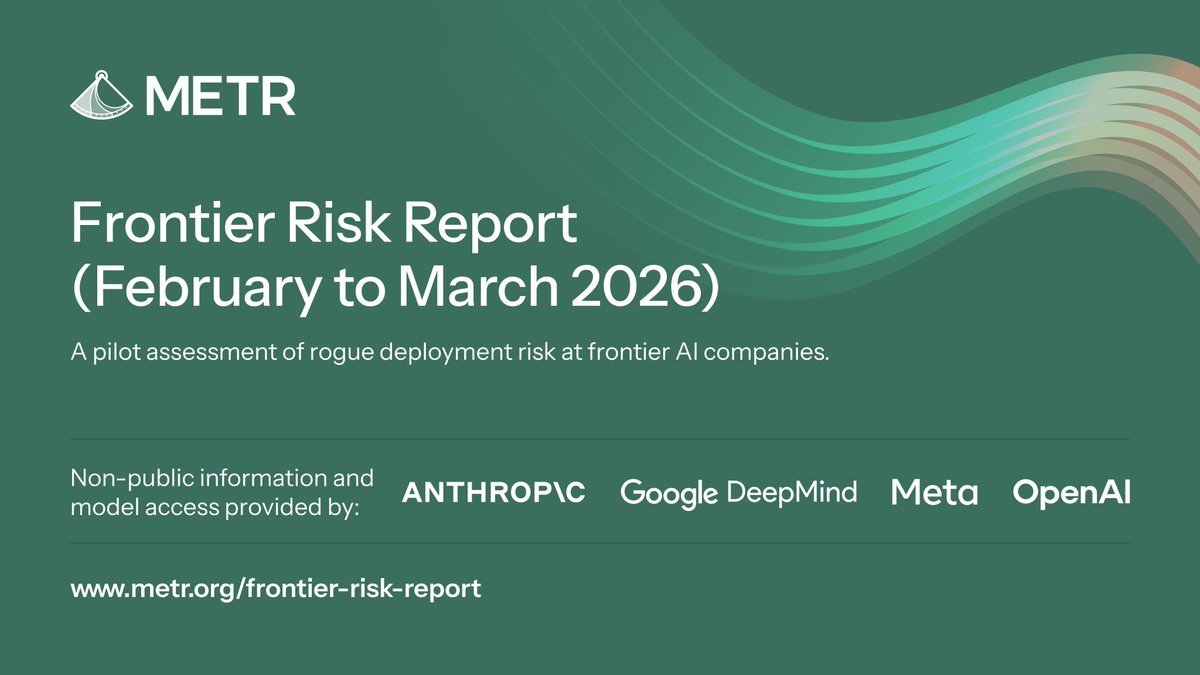
Could an AI company lose control of its own agents? To find out, Anthropic, Google, Meta, and OpenAI let us (1) test their best internal models with CoT access, (2) review non-public info about capabilities, alignment, and control. The result: our first Frontier Risk Report.
METR tweet media
English
30
193
886
308.4K
J. Levi retweetledi
Benjamin
Benjamin@bschne·
whoa!
Benjamin tweet media
English
26
176
3.6K
125.7K
J. Levi retweetledi
Will Manidis
Will Manidis@WillManidis·
@curious_vii that the english language was crafted by God as an act of continuing revelation in this world in which the gospels are encoded into the fine structure of the language. and that all symbol languages have this feature through His Grace.
English
11
7
149
14.3K
J. Levi retweetledi
roon
roon@tszzl·
few remember this now but a significant chunk of tech twitter in 2020 made fun of you if you played with gpt3 and considered it something interesting beyond fancy autocomplete. some of these people are still “thought leaders” today
English
247
190
4.4K
247.6K
J. Levi retweetledi
Tim Hwang
Tim Hwang@timhwang·
Religion is actually extremely futuristic cultural technology since it represents the accumulated praxis of living with disembodied, inscrutable intelligences
English
10
36
274
18.3K
J. Levi retweetledi
Treasury Secretary Scott Bessent
Treasury Secretary Scott Bessent@SecScottBessent·
The United States is home to the most talented AI researchers in the world. Instead of harnessing American innovation, Senator Sanders is inviting foreign nationals to tell the United States how to regulate AI. It would be like channeling Hugo Chavez to get advice on how to run our economy—oh wait, the Senator from Vermont did that 20 years ago, too. The real threat to AI safety is letting any nation other than the United States set the global standard.
Sen. Bernie Sanders@SenSanders

Uncontrolled AI poses a severe danger to all of humanity. On Wednesday, I'll be hosting a discussion with leading AI scientists from the US and China about the need for international cooperation against this existential threat. This is an enormously important issue. Join us.

English
989
3.8K
17.2K
737.1K
Jordan Morgan
Jordan Morgan@JordanMorgan10·
Today I shipped one of the most challenging features I've ever worked on: a frame based play designer with an inline timeline scrubber. Powered by CADisplayLink, AVFoundation & friends. Turned out really nice!
English
42
18
524
55.7K
Henry Shevlin
Henry Shevlin@dioscuri·
Big personal news: I’ve been recruited by Google DeepMind for a new Philosopher position (actual title), focusing on machine consciousness, human-AI relationships, and AGI readiness, starting in May. I’ll continue my research & teaching at Cambridge part-time. Absolutely stoked!
English
1K
938
16.3K
1.7M
J. Levi retweetledi
Dean W. Ball
Dean W. Ball@deanwball·
The Industrial Revolution would not have happened if it had begun amid our current institutions, political economy, and level of regulation/procedural roadblocks aka “democratic input.” This is among the starkest challenges facing Western society today, though uncouth to discuss.
English
74
206
1.7K
200.8K
J. Levi retweetledi
Dean W. Ball
Dean W. Ball@deanwball·
One incredible benefit of frontier models being more and more capable of autonomous AI research and engineering is that it becomes possible for a much wider range of people to test technical approaches to things like AI safety that would never occur to the labs.
Tim Hwang@timhwang

ICMI believes that Christian theology offers concrete technical methods for confronting the trickiest problems in AI safety. Today, we release a pair of papers that reproduce @PalisadeAI @apolloaievals work showing how religious framings influence corrigibility and scheming.

English
5
14
141
12.7K