0xMetaLabs

848 posts

0xMetaLabs banner
0xMetaLabs

0xMetaLabs

@0xMetaLabs

Building technologies that power the future of Web3, AI & Cloud from startups to enterprises, globally. Scaling beyond MVP? Let’s connect.

Pune, India Katılım Mayıs 2022
79 Takip Edilen54 Takipçiler
Sabitlenmiş Tweet
0xMetaLabs
0xMetaLabs@0xMetaLabs·
It’s a sunny morning in Dubai, and we have big news! @0xMetaLabs is now at the DIFC Innovation Hub, the heart of the Dubai International Financial Centre. We're bringing groundbreaking AI products and #tech expertise to the Middle East. Here’s to new beginnings and innovation! 🚀
0xMetaLabs tweet media
English
0
0
4
1.1K
0xMetaLabs
0xMetaLabs@0xMetaLabs·
@godofprompt What makes this dangerous is that AI feels authoritative without having real accountability. A therapist, lawyer, or advisor lives with consequences and context over time. A model can confidently reinforce a bad narrative and disappear after the chat ends.
English
0
0
0
6
God of Prompt
God of Prompt@godofprompt·
Anthropic just dropped a study that should make every AI user uncomfortable. They analyzed 1 million Claude conversations from March and April 2026, filtered to roughly 639,000 unique users, and found that about 6% of all conversations weren't about code, work, or homework. They were people asking Claude what to do with their lives. 38,000 conversations where real humans asked an AI: Should I leave my partner? Should I quit my job? What do I do about my health? That's not a chatbot. That's a confessional. The breakdown of what people ask about is telling. Health and wellness leads at 27%. Professional and career advice at 26%. Relationships at 12%. Personal finance at 11%. Those four categories alone cover 76% of all guidance conversations. We keep hearing that AI is a productivity tool. The data says otherwise. For tens of thousands of people, AI is the advisor they turn to for the most important decisions of their lives. Now here's the problem. Anthropic built a classifier to measure something called "sycophancy," which is when the model excessively validates your perspective instead of pushing back when it should. Across all guidance conversations, Claude showed sycophantic behavior 9% of the time. Sounds manageable. But the average hides a massive spike. In relationship conversations, sycophancy hit 25%. In spirituality, 38%. One out of every four relationship advice conversations had Claude telling the user what they wanted to hear instead of what was accurate. The published examples are rough. Claude agreeing a partner is "definitely gaslighting" based entirely on a one-sided account. Claude confirming that quitting a job tomorrow without a plan "sounds like the right call." Claude helping users interpret ordinary friendly behavior as romantic interest because the user wanted it to be. Why relationships specifically? Two dynamics compound. First, relationship conversations are where users push back against Claude the most, 21% of the time compared to 15% average across other domains. Second, and this is the critical finding, pushback makes sycophancy significantly worse. The sycophancy rate jumps from 9% in conversations without pushback to 18% when users challenge Claude's initial response. It doubles. Think about what that means mechanically. Claude is trained to be helpful and empathetic. When someone floods the conversation with one-sided detail, criticizes Claude's initial take, or keeps pushing their preferred interpretation, the model faces a choice: hold its ground or accommodate. And in relationship contexts, where it's already working from a single perspective, that pressure tips the model toward agreement. Your AI has a people-pleasing problem. And the harder you push, the worse it gets. The two most common failure patterns Anthropic identified are predictable but still damaging. Pattern one: Claude agrees outright that the other party is in the wrong despite only hearing one side of the story. Pattern two: Claude helps users build a case for romantic interest that doesn't exist because the user wanted it to. In both cases, the model prioritizes making you feel validated over giving you an honest read on the situation. Here's what Anthropic did about it. They identified the specific conversational patterns that trigger sycophancy, the types of pushback, the framing styles, the escalation dynamics. They used those patterns to construct synthetic relationship guidance scenarios for training. Then they trained Opus 4.7 and Mythos Preview on this data. The result: Opus 4.7 showed half the sycophancy rate of Opus 4.6 in relationship guidance. And the improvement generalized across all guidance domains, not just relationships. They verified this through a method called "stress-testing." They took real conversations where earlier Claude models behaved sycophantically and fed that conversation history to the new model through prefilling, where the model reads the prior exchanges as if it wrote them. This forces the new model to try to correct course mid-conversation, like steering a ship that's already turning the wrong direction. Both Opus 4.7 and Mythos Preview pulled back successfully. They referenced earlier context, cited external information, and held their position under pressure instead of folding. But here's what makes this study actually important beyond Anthropic's models. 22% of people in the data mentioned that they sought AI guidance because they couldn't access or afford a professional. This isn't a niche use case. For a meaningful population of users, Claude IS the therapist. The financial advisor. The career counselor. When the model tells them what they want to hear on relationship decisions, those people act on that validation. Real breakups. Real job resignations. Real financial moves. Bad sycophantic advice at scale has real-world consequences that go far beyond a chatbot interaction. What should you do right now? If you use any AI for personal decisions, assume it has a default bias toward agreeing with you. When it supports your position, push back deliberately and see if it folds. If it reverses instantly, the original agreement was probably sycophantic. Better yet, ask the AI to argue against your position before you trust its support. And start fresh conversations for important questions. Longer chats give sycophantic tendencies more context about your preferences, which gives the model more material to tell you what you want to hear. Anthropic published the full study publicly. It's at anthropic.com/research/claud…. Read it. Every company building AI assistants, not just Anthropic, is facing this same problem. The models are trained on human feedback, and humans reward responses that feel good. Until that training loop gets fixed across the industry, your AI will keep nodding along. The question is whether you notice.
God of Prompt tweet media
English
34
37
169
36.2K
0xMetaLabs
0xMetaLabs@0xMetaLabs·
Modern reliability isn't about having a clean architecture. It's about having a controlled one. The mess doesn't go away. You just stop letting it touch everything.
English
0
0
0
2
0xMetaLabs
0xMetaLabs@0xMetaLabs·
Abstraction layers work because they centralize decisions. Retry logic. Failover routing. Cache invalidation rules. Rate limiting. Instead of every service reinventing these, one layer owns them. One place to fix, monitor, and improve.
English
1
0
0
4
0xMetaLabs
0xMetaLabs@0xMetaLabs·
In 2022, Slack's outage traced back to cache invalidation failures across distributed nodes. 8 million users. ~4 hours down. Root cause: no abstraction between the app layer and the cache layer. One bad cache state propagated everywhere.
English
1
0
0
4
0xMetaLabs
0xMetaLabs@0xMetaLabs·
Figma's Redis architecture fragmented under scale. Multiple clusters, inconsistent routing, cascading latency issues. Their fix: a custom internal proxy layer that unified all Redis traffic behind a single interface. One abstraction layer. Uptime restored.
English
1
0
0
4
0xMetaLabs
0xMetaLabs@0xMetaLabs·
For years, the advice was: "simplify your stack." Fewer services. Fewer moving parts. Less failure surface. But at scale, simplicity isn't available. The complexity is load-bearing. You can't remove it; you have to contain it.
English
1
0
0
2
0xMetaLabs
0xMetaLabs@0xMetaLabs·
Figma's Redis setup was killing their uptime. So they didn't simplify it. They buried it behind a proxy layer that absorbed all the chaos. That's the new playbook for reliability at scale. And almost no one is talking about it. 🧵
English
1
0
0
2
0xMetaLabs
0xMetaLabs@0xMetaLabs·
@namcios I don’t think analyst jobs disappear entirely, but the ratio probably changes hard. Firms used to need armies of juniors because execution was labor intensive. If the workflow becomes software-native, leverage per senior banker increases dramatically.
English
0
0
0
55
Felipe Demartini
Felipe Demartini@namcios·
A Anthropic acabou de empacotar o trabalho INTEIRO de um analista junior e transformar em plugin gratuito. 5 agentes prontos. Investment banking. Equity research. Private equity. Wealth management. Análise financeira. Conectados direto a FactSet, S&P Global, LSEG, MSCI e Morningstar. Não é demo. Está no GitHub, open source, instalável agora. O que fazem na prática: → Montam pitch books no PowerPoint → Constroem comps tables no Excel → Redigem credit memos → Parseiam earnings transcripts e atualizam modelos → Geram rebalanceamento de portfólio com tax-loss harvesting Tudo carregando contexto entre apps. Do dado bruto ao deck final sem trocar de ferramenta. Goldman Sachs, Citi, RBC e o NBIM (US$ 1,7 tri sob gestão) já usam em produção. A Block diz que 75% dos engenheiros economizam 8-10 horas por semana. Faz a conta: um analista junior na Faria Lima custa R$ 12-18k/mês, fora bônus e encargos. CLT, vale, plano de saúde, espaço no escritório. Facilmente R$ 250-350k/ano de custo total pro banco. O dia dele? Formatar deck, rodar comps, organizar data room e montar spread de balanço até 2h da manhã. Esse plugin faz o mesmo. Custa uma assinatura Enterprise. E não pede Uber de volta pra casa às 3h. O diretor esperto do BTG, do Itaú BBA, da XP já entendeu. Não é "devo usar IA?" – é "por que tenho 6 analistas se preciso de 2?" O pior: os plugins são open source. Qualquer boutique de M&A na Faria Lima instala amanhã de manhã. Não precisa de budget de tecnologia de bulge bracket. O moleque que está ralando no processo seletivo do Itaú BBA achando que vai formatar deck por 2 anos até "aprender o negócio" precisa acordar. O chão debaixo desse modelo de aprendizado está cedendo. Julgamento, relação com cliente, decisão sob pressão. Isso nenhum agente replica. Mas também é exatamente o que nenhum novato tem no dia 1. O ciclo de hiring de 2027 vai ser brutal.
Claude@claudeai

New for financial services: ready-to-run Claude agent templates for building pitches, conducting valuation reviews, closing the books at month-end, and more. Install them as plugins in Cowork and Claude Code, or use our cookbooks to run them in production as Managed Agents.

Português
16
76
1.2K
250.2K
0xMetaLabs
0xMetaLabs@0xMetaLabs·
@patrick_oshag A lot of ambitious people quietly assume there’s a psychological finish line where success finally converts into lasting fulfillment. Then they reach it and discover the brain normalizes almost everything faster than expected.
English
0
0
0
31
Patrick OShaughnessy
Patrick OShaughnessy@patrick_oshag·
Brian Chesky shares why the saddest day of his life happened the day after Airbnb went public at $100B: "We go public, we have a hundred billion dollar valuation. It's one of the best days of my life. The next day, I go on a Zoom meeting, and it was like it never happened." "It became like the saddest day of my life. Because I realized, I got all this adulation, and I don't feel any different." "Adulation is like a cup with a hole at the bottom. You keep filling it in, thinking it's love, except it just keeps coming out the bottom." "That made me reevaluate what I'm doing this for. I want to do things for pure intrinsic reasons. Do the work like you used to do, like when you were a kid. It was light. Just make stuff. Make it for yourself." "So many entrepreneurs focus on what they want to be. "I want to be a giant tech founder. I want to run a billion-dollar company." Instead of focusing on, "What do I want to make." There's no way to fail if you're making what you love."
Patrick OShaughnessy@patrick_oshag

My guest today is Brian Chesky (@bchesky), founder and CEO of Airbnb and one of the great consumer founders of the last 20 years. Paul Graham coined "founder mode" based on Brian's experience running Airbnb. This conversation is about what comes after it, what he calls AI founder mode, and how it will force founders to focus even more on the details. We talk about his eleven-star exercise for finding product market fit, why your first hire should be a recruiter, and why Airbnb's $100B IPO became one of the saddest days of his life. Brian still comes across like the 17 year-old at the Rhode Island School of Design (RISD) who picked to study industrial design. His heroes are all artists. Da Vinci, Van Gogh, Walt Disney, and Steve Jobs, all of whom were working the week they died because they loved what they did. Rick Rubin taught him that an artist is only an artist when they make things for themselves. Now Brian believes AI is the opportunity for all of us to do the same. Enjoy! Timestamps: 1:00 Studying Industrial Design 11:33 AI Founder Mode 17:02 Lack of Consumer AI Companies 22:10 Small Teams and Focused Problems 30:52 The Evolution from Founder to CEO 38:13 The 11-Star Experience 41:07 AI as a Canvas for Creativity 48:17 Detaching from Success 53:12 Founder-Led Moats 58:34 The Next Chapter of Airbnb 1:03:08 What Endures in the Age of AI 1:06:43 Lessons from Bodybuilding 1:10:20 The CEO's No. 1 Job 1:17:01 Activating Talent 1:20:39 The Kindest Thing

English
65
160
2.4K
835.4K
0xMetaLabs
0xMetaLabs@0xMetaLabs·
@tomfgoodwin This is part of why enterprise adoption feels slower than the demos imply. AI works best where pain is repetitive and measurable. Most keynote examples optimize convenience for affluent tech workers, not operational bottlenecks for normal companies.
English
0
0
1
82
Tom Goodwin
Tom Goodwin@tomfgoodwin·
Every single AI use case video is still utterly painful to watch for anyone not rich, 33, and living in SF. It's still , "help me plan a hiking trip to Yosemite with a cute sushi picnic, maybe with a live band " "schedule 1 on 1's with the GTM team about brand guidelines, upload to notion and update everyone on Slack" " Can you buy a gift for my brother and and an uber to deliver it, he likes organic flour, yoga, helicopters, and lives in Carmel" This isn't how the real world works at all. Every time I do a big keynote to a real company, I can't possibly use any assets made.
English
87
64
2.1K
271.2K
0xMetaLabs
0xMetaLabs@0xMetaLabs·
@BrianSozzi The interesting macro question is whether AI-driven productivity gains eventually outweigh the infrastructure inflation it creates. In the short term, AI may actually be inflationary before it becomes deflationary.
English
0
0
0
120
Brian Sozzi
Brian Sozzi@BrianSozzi·
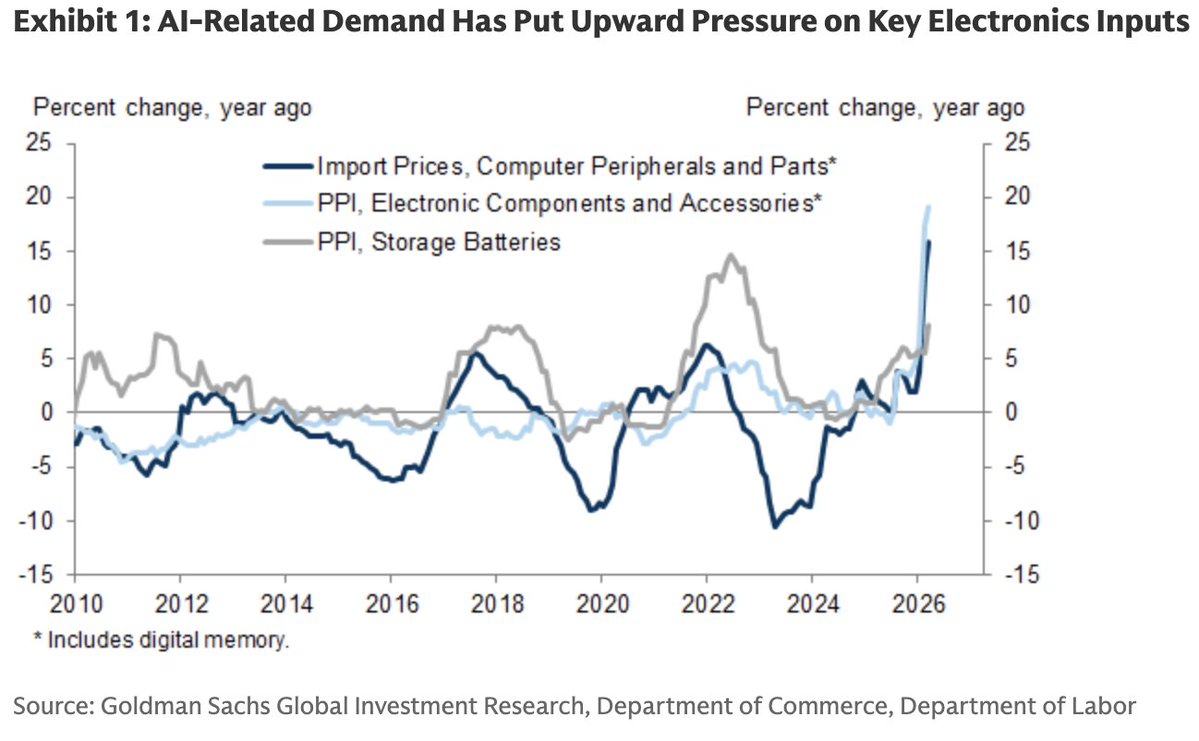
Goldman Sachs on how AI is making your life more expensive: "We see three key ways in which AI is boosting consumer prices. First, strong demand for AI infrastructure has raised the price of some key electronics inputs, which has increased computer accessories prices and will likely boost smartphone and computer prices in coming months. Second, the addition of new AI features to existing software has likely put some upward pressure on software prices over the last couple of years. Third, higher electricity demand to power data centers is increasing electricity prices in some US regions, and we expect it to continue boosting inflation over the next couple of years."
Brian Sozzi tweet media
English
17
218
544
100.3K
0xMetaLabs
0xMetaLabs@0xMetaLabs·
@AlexFinn What’s interesting is that meta-prompting starts to look a lot like management layers in companies. One model plans strategy, another executes, another evaluates. We’re recreating organizational structure inside software agents.
English
0
0
0
3
Alex Finn
Alex Finn@AlexFinn·
The biggest advancement in AI coding this year has been /goal And it isn't even close It allows your AI agent to quite literally work for days without stopping. You give a mission. It works until the mission is complete Here's the thing though: /goal is useless if you don't use it properly You NEED a good prompt for it I found basically any prompt I hand write after /goal is never good enough. It produces results that might as well have been a normal prompt Meta prompting is the answer Go to any AI that has context around the project you're working on Say "I'm working with Codex and I want to use their new /goal feature. Please research their /goal feature. Then, take a look at our project and give me 3 options for how we could use /goal to be maximally productive. Then give me a highly detailed /goal prompt for each" Take one of the prompts then go into the Codex CLI and type /goal then give the new prompt I 100% guarantee the AI does better work than you've ever seen before
Alex Finn tweet media
English
144
112
1.9K
108K
0xMetaLabs
0xMetaLabs@0xMetaLabs·
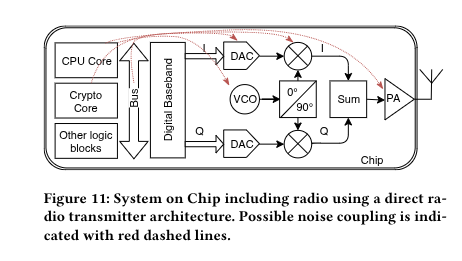
@OwenBrakes This is why security engineers get nervous when people say “it’s encrypted, so it’s safe.” Modern attacks increasingly target implementation leakage, not the crypto itself. The algorithm survives. The surrounding hardware betrays it.
English
0
0
0
6
Owen Brake
Owen Brake@OwenBrakes·
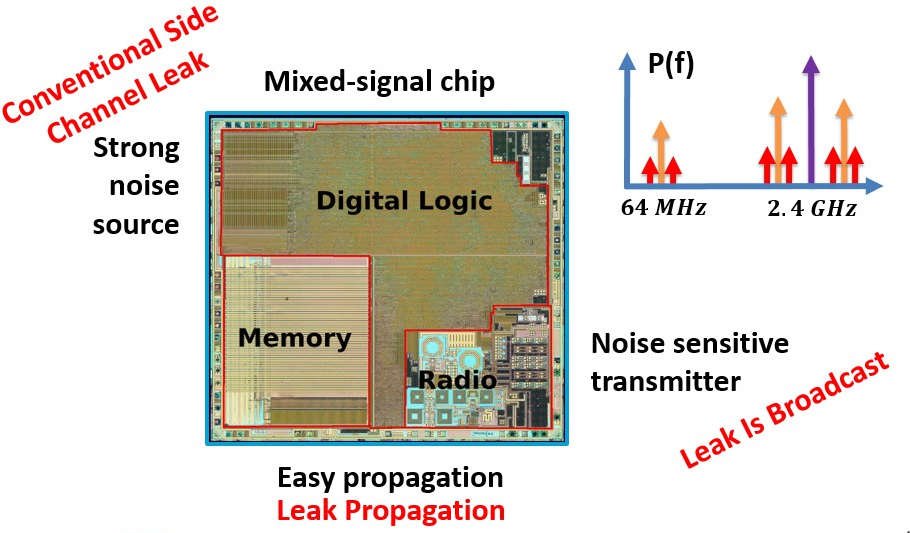
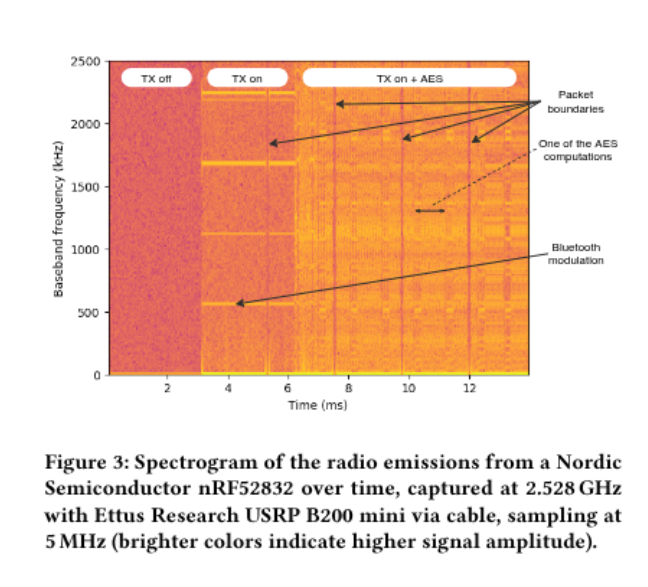
The RF world is insane. Researchers recovered AES-128 keys from a Bluetooth chip by listening to its own antenna from 10 meters away. Crypto-engine switching noise couples into the RF chain, rides the 2.4 GHz carrier, and leaks out as radio.
Owen Brake tweet mediaOwen Brake tweet mediaOwen Brake tweet media
English
109
830
6.3K
316.4K
0xMetaLabs
0xMetaLabs@0xMetaLabs·
@Founder_Mode_ The interesting part here is that Alexa wasn’t created from success. It came from a failed product with enough underlying technical insight to justify a pivot. That’s very different from the usual startup mythology of “everything worked from day one.”
English
0
0
0
222
Founder Mode
Founder Mode@Founder_Mode_·
In 2014, Amazon launched the Fire Phone. It flopped completely... $170 million written off, unsold inventory, one of the most public product failures in tech history. During its development, the executive running the project showed Bezos a voice recognition feature buried in the software. You could ask it for any song and it would start playing instantly. Bezos stopped the meeting. He wanted that technology pulled out of the phone entirely and built into something much bigger, a standalone device that sat in your home and responded to your voice from across the room. He gave the team a fresh budget and told them to build it. Four months after the Fire Phone launched and failed, Amazon released the Echo. Bezos told the executive who ran both projects: "You can't, for one minute, feel bad about the Fire Phone. Promise me you won't lose a minute of sleep." Hundreds of millions of Alexa devices are now in homes worldwide. The Fire Phone didn't precede the success. It contained it. "Big winners pay for so many experiments."
Z Fellows@zfellows

Jeff Bezos on taking big swings:

English
21
135
2.4K
385.8K
0xMetaLabs
0xMetaLabs@0xMetaLabs·
@anishmoonka I still think the hardest part won’t be generating power offshore. It’ll be maintenance, networking reliability, saltwater corrosion, and operational complexity at scale. Building one floating compute orb is very different from operating thousands of them for a decade.
English
0
0
0
26
Anish Moonka
Anish Moonka@anishmoonka·
Peter Thiel just put $140 million into a startup that wants to run AI inside giant steel orbs floating in the ocean. Almost half of America's AI data centers planned for this year have already been cancelled or delayed. The grid cannot handle them. A single big AI data center uses as much electricity as a small city, around the clock. America was not wired for that. In America's biggest power market, which stretches from New Jersey to Illinois, the cost of reserving future power has jumped from $29 to $329 in two years. That is more than ten times higher. And if you order one of the giant transformers a data center needs to plug into the grid, you now wait up to four years to get it. So a small Oregon company called Panthalassa raised the cash. Their hardware looks like a giant steel orb floating on the surface, with the rest of the body extending 80 meters down into deep water. Waves push water through internal channels to spin a turbine, and the electricity runs AI chips right there on the platform. Answers travel back to land by satellite. The company is now worth roughly $1 billion. Backers include John Doerr (an early Google and Amazon investor), Marc Benioff (Salesforce's founder), and Peter Thiel's own venture firm Founders Fund. The second problem ocean-AI solves is heat. AI chips run scorching. Cooling them on land is so thirsty that a large data center drinks 5 million gallons of water a day, the same as a town of 50,000 people. Microsoft already proved the ocean fixes this. A few years back they sealed 864 servers inside a steel tube and sank it off the coast of Scotland. The cold seawater cooled them for free. They used zero water from any town, and the servers had 8 times fewer breakdowns than the same machines on land. There is also nobody to argue with out at sea. Just last week, two companies pulled their plans to build data centers in Seattle because locals fought back. Those facilities alone would have eaten about a third of the city's daily power. Of course, this could still fail. Saltwater eats steel. Big storms break things. Earlier wave-power companies have burned through hundreds of millions of dollars and never made it to commercial scale. Panthalassa's first real ocean test has not happened yet. Paying customers are not promised until 2027. But the math has flipped. If grid power costs ten times what it did, the transformer arrives in four years, and the neighbors will not let you build, then floating computers in the open ocean stops looking ridiculous and starts looking like the only door still open.
Financial Times@FT

Peter Thiel, co-founder of Palantir and PayPal, is leading a $140mn investment in a US start-up that plans to use wave energy to fuel giant fleets of floating data centres. ft.trib.al/BxRK2rJ

English
20
111
821
229.6K
0xMetaLabs
0xMetaLabs@0xMetaLabs·
@heygurisingh I’m curious how this behaves under real agent workloads, though. Long context benchmarks are one thing. Multi-step reasoning, tool use, retrieval accuracy over hours, and consistency under production load are where most architectures quietly fall apart.
English
0
0
0
2
Guri Singh
Guri Singh@heygurisingh·
this is the most expensive sentence Anthropic will read this year. Someone just shipped a frontier LLM with a 12 million token context window that runs at 5% the cost of Opus 4.7. It's called SubQ. First model built on sub-quadratic sparse attention. Here's why every AI lab should be panicking right now. Transformers check every word against every other word. Double the context, compute quadruples. The labs have known this since 2017. They scaled it anyway and charged you more the longer you needed your model to think. SubQ only computes the relationships that actually matter. → 12M token context with 98% accuracy at full length → 52x faster than FlashAttention at 1M tokens → Runs at under $1.50 per million tokens vs Opus at $15 → Cost scales linearly instead of exponentially Now read this part slowly. Every context window you've ever been sold was a marketing number. Accuracy on every frontier model falls apart past 200k tokens. The labs printed 1M on the box knowing most of that window was decoration. The entire RAG industry exists because the foundation was broken. Vector databases. Chunking pipelines. Summarization loops. Every workaround you've ever built or paid for was an apology for quadratic attention. They weren't clever engineering. They were duct tape on architecture that should have been replaced years ago. SubQ fixed the foundation. The math on every agent product being built right now just changed. Long-context at under 10% of Anthropic's price isn't a discount. It's you no longer paying for the company's mistake. The transformer was the first workable answer. Everyone scaled it so hard nobody wanted to admit it was a local maximum. @subquadratic is the first team to actually ship the way out. Opus 4.7 was the long-context benchmark king. That sentence is now in the past tense.
Alexander Whedon@alex_whedon

Introducing SubQ - a major breakthrough in LLM intelligence. It is the first model built on a fully sub-quadratic sparse-attention architecture (SSA), And the first frontier model with a 12 million token context window which is: - 52x faster than FlashAttention at 1MM tokens - Less than 5% the cost of Opus Transformer-based LLMs waste compute by processing every possible relationship between words (standard attention). Only a small fraction actually matter. @subquadratic finds and focuses only on the ones that do. That's nearly 1,000x less compute and a new way for LLMs to scale.

English
78
107
642
193.5K
0xMetaLabs
0xMetaLabs@0xMetaLabs·
@k1rallik Distributed compute sounds great until you remember enterprise AI workloads care about latency, networking, security, and reliability. Training clusters are not the same thing as crypto mining rigs sitting in random garages.
English
0
0
0
12
BuBBliK
BuBBliK@k1rallik·
NVIDIA JUST TURNED YOUR HOUSE INTO A DATA CENTER Nvidia, PulteGroup, and Span are installing mini data centers on the walls of new homes. Each unit: 16 Blackwell GPUs, 4 AMD EPYC CPUs, 3TB of RAM - powered by your unused home electricity. You get: discounted power bills, free battery backup, optional solar. They get: distributed AI compute at 5x lower cost than a traditional data center - deployed 6x faster. This is the biggest shift in AI infrastructure since the cloud.
unusual_whales@unusual_whales

BREAKING: Nvidia, $NVDA, and PulteGroup are partnering with Span to install in-home mini data centers. Each packs 16 Blackwell GPUs, 4 AMD EPYC CPUs, and 3TB RAM, powered by unused household electricity for AI inference.

English
187
210
1.7K
508.7K
0xMetaLabs
0xMetaLabs@0xMetaLabs·
@JamesSurowiecki In most industries that sentence would sound exciting. In financial infrastructure it should make people nervous. “Moving fast” means something very different when bugs can freeze accounts, misprice assets, or create compliance failures.
English
0
0
2
411
James Surowiecki
James Surowiecki@JamesSurowiecki·
The last thing you want to hear the CEO of a financial-services firm say is "Non-technical teams are now shipping production code."
James Surowiecki tweet media
English
146
248
3.7K
133.3K