Rayman
11.7K posts


Rayman
@0x_Ray_Money
The Tek turns me on 👨💻 Computer Scientist 🖥️ Barcelona Fan 💙❤️⚽


Introduction to Optimum DeRAM From my previous post, you’ve already come across RLNC, one of Optimum’s core technologies. Today, let’s dive into Optimum DeRAM powered by RLNC. What is Optimum DeRAM Optimum DeRAM (Decentralized Memory) is a high performance memory layer built directly into the Optimum protocol. It’s designed to deliver low latency, high throughput and reliable shared state in a fully decentralized environment. At its core, DeRAM provides atomic read and write memory, a critical primitive for web3 systems where: -> Communication is asynchronous -> Nodes constantly join and leave -> Consensus is distributed -> Some participants may act maliciously Building shared memory in this kind of environment is hard. It requires: -> Minimal latency -> Strong fault tolerance -> Low bandwidth and storage overhead -> High throughput -> Non blocking, always available access How It Works DeRAM is powered by Random Linear Network Coding (RLNC), a flexible approach that replaces rigid, synchronization heavy designs. Instead of forcing strict coordination between nodes, RLNC enables: -> Higher data durability -> Reduced bandwidth usage -> Strong resilience to failures and node churn The system runs on Flexnodes, heterogeneous nodes that handle both storage and communication. Where clients can connect to any flexnode, perform atomic reads and writes seamlessly, with no dependency on a single point in the network Importance of DeRAM -> It acts as a persistent decentralized memory -> A high performance communication layer This unlocks a new design space for apps that need fast, reliable and consistent state without sacrificing decentralization. What this enables: -> Real time on-chain coordination -> More responsive defi systems -> Scalable decentralized applications with shared state This shows how DeRAM could power a whole new class of real time, decentralized apps. More technical deep dives coming soon.

🖌️ We have a problem😢 Our #birthday - channel is missing a festive touch The @GenLayer Discord server needs a birthday banner that we can use in the #birthday channel. To fix this, let's create a unique birthday greeting card for every GenFren celebrating their special day🥳 My vision: 1️⃣ Should be a unique greeting card design 2️⃣ Leave space for the pfp and nickname 3️⃣ Include the GenLayer logo and our mascot Mochi 🚨 Important: The card should represent a birthday greeting to a GenFren from the entire GenLayer community ❗️Your design might be the one we use for the community😉



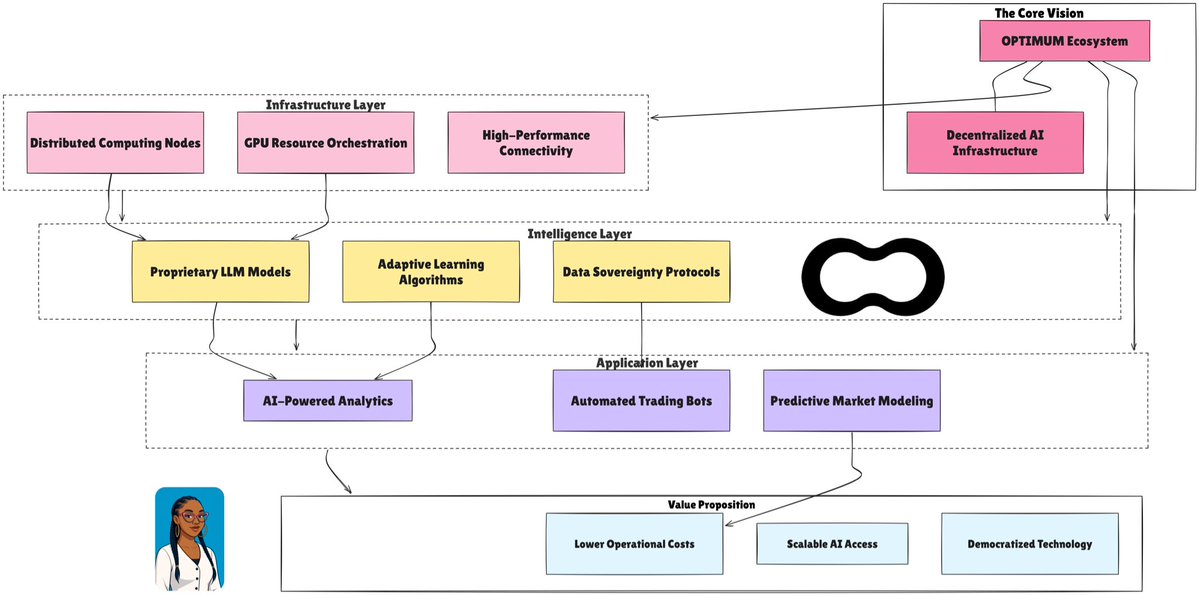
Have you ever wondered how optimum integrates without requiring a rebuild? A lot of blockchain upgrades come with a tradeoff and that’s you having to choose if you want better performance or you’re asked to change something fundamental like modify consensus, rewrite parts of the stack or go through a long upgrade process that only a few teams can realistically handle. That’s why a lot of improvements stay theoretical. They sound good but they’re hard to adopt and that’s what makes @get_optimum different is that it doesn’t ask the network to rebuild itself. Instead of touching execution or consensus, it focuses on how data moves between nodes. The integration happens at the propagation layer, which means validators can run it as an additional component rather than replacing anything in their existing setup and that’s what makes it permissionless. There’s no need for coordination across the entire network, no waiting for governance approvals and no complex migration process. Individual validators can adopt it on their own, improving how quickly they receive and share information without requiring everyone else to do the same at the same time. Because of that, it behaves more like an upgrade you can opt into rather than one you’re forced to wait for. The impact compounds as more participants adopt it but the barrier to entry stays low from the start. No rebuild, no disruption, just a more efficient way for the network to communicate and that changes how upgrades happen. Instead of being slow, coordinated events, improvements can spread gradually, driven by participants who benefit from them immediately.