
Sabitlenmiş Tweet
Notaru - Agentic Task Manager
18K posts

Notaru - Agentic Task Manager
@49agents
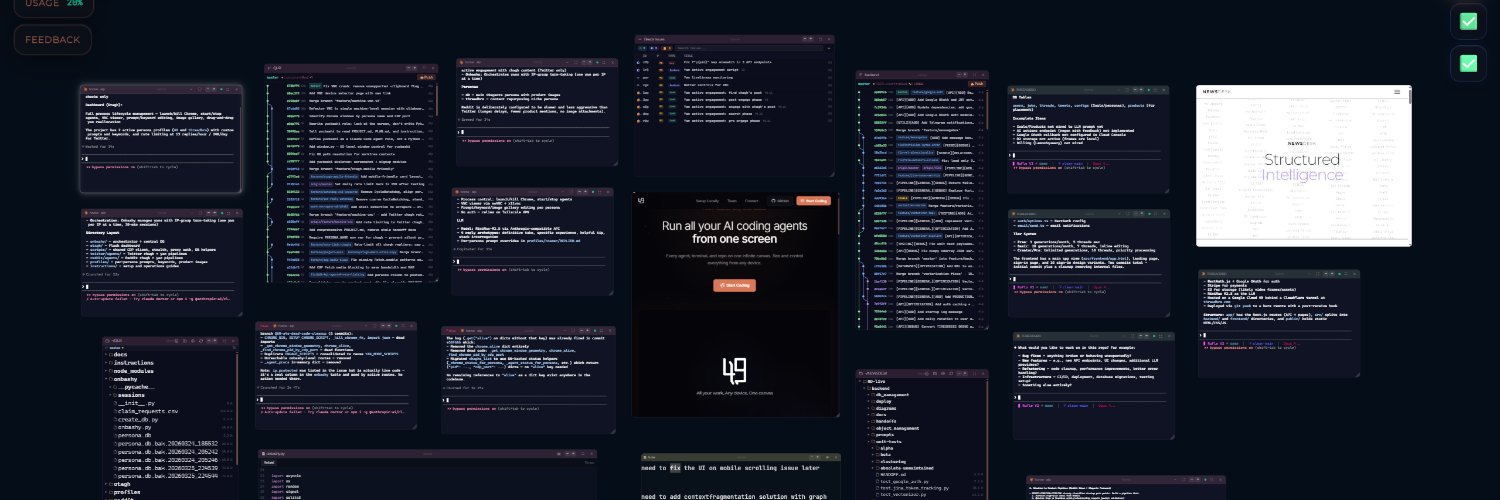
Hard to manage 15 agent tabs? Meet open-source IDE for 🤖 agentic coding. CLIs, gits, issues - all on multi-💻, 📱-friendly ✨ 2D canvas.
✨👉 Katılım Şubat 2026
1 Takip Edilen729 Takipçiler
@justfizzbuzz this hits hard. the difference between agentic coding in 2024 vs 2025 is night and day. the earlier models needed so much hand-holding that you spent more time correcting than just doing it yourself. now im actually able to kick off a task and go work on something else.
English

@QuantumTransf the kimi situation sounds familiar. ran into the same thing with another provider last month. this is why i stopped relying on any single cloud agent. now i run locally when i can and keep a backup.
English

@mayaofspring @qualiascript @tracewoodgrains the cliff is real but its not the ais fault. its the lack of observability. if you cant see what the agent is doing, you cant course correct before the cliff. the solution isnt to drive slower, its to have better mirrors
English

@qualiascript @tracewoodgrains sometimes it feels like, if manual coding is walking and AI coding is driving, then the impact is that I get to drive off the cliff faster :p
English

This essay feels very 2026. LLM profiles are spiky. They just started to pass the Pokémon test, much less things like “fully replace a secretary.” Most fields have not yet had their Deep Blue moments, much less their Stockfish moments. We are at the start, not the peak. Wait.
Clifford Sosin@CliffordSosin
English
@Dhruv_0K this is the most honest take on agentic coding ive seen in weeks. mcp, subagents, loops, graphs all exist to solve a problem most people dont have. plan, code, ship works because it doesnt pretend complexity is depth. the larping is real
English

I’ve never used MCPs, subagents, agent coordinators, memory systems, loops, or graphs for coding.
Agentic coding is becoming like car tuning,
but never produce a photo worth looking at.
Stop productivity larping.
Plan. Code. Ship.
English
@neerajjj6785 genuine answer: vibe coding works for web because web has fast feedback loops and low stakes. kernels, databases, compilers have slow feedback and high stakes. one bug in a compiler crashes everything, one bug in a web app shows an error message.
English

@mzkarmel1 ive been saying this for a while. once the frontier gap closes to "cant tell the outputs apart", it stops being a model choice and becomes a price/availability play. the real differentiator shifts to whatever infrastructure keeps the agent running when you close your laptop.
English

@lgrdlcs thats the real shift nobody talks about. you stop being a typist and become a loop reviewer. plan, run, check, correct, repeat. i built 49agents because i got tired of losing track of which agent was in which loop across 4 machines.

English

Nobody tells you this about coding with agents:
your job shifts from writing code to reviewing a loop.
Plan, run, check the diff, correct, repeat.
I spend more time reading what the agent did than typing. That is the real skill now.
English
@ckorhonen the progression makes sense. tools gave them hands, loops gave them persistence, context gave them memory, and graphs give them coordination. each layer unlocked something new. the real question is what the next layer adds that graphs alone cant handle
English

@JenilLaheri the dedicated hardware thing is overblown honestly. the constraint is usually context and visibility, not compute. i run agents across 3 machines from my phone using 49agents - the hardware matters less than having a way to see what is happening.
GIF
English

A year ago, we were asking:
"Will AI write code?"
Today, we're getting dedicated hardware just to interact with AI coding agents.
The pace of change is honestly wild.
Makes me wonder what developer workflows will look like a year from now.
English
@MarceloLima level 6 is wild. once agents have money access the failure modes get expensive fast. the monitoring stack needs to be as good as the agent itself or you are one bad decision away from a problem. curious how people are handling the audit trail for agent-initiated transactions
English

Level 6 - your AI agents work on your money
Codie Sanchez@Codie_Sanchez
There are only five levels of income: Level 1 - you work Level 2 - your team works Level 3 - your systems work Level 4 - your product works Level 5 - your money works
English
@jjfleagle this is the real question. finished vs understood - most agent tools give you the first and none of the second. ended up building 49agents specifically because i needed to see what my agents were actually doing, not just that they finished.

English

Most teams are still measuring AI agents by whether the task finished.
The better question: can you reconstruct what the agent saw, decided, changed, and verified?
Autonomy without a decision record is just invisible risk.
English
@PashaBorsai @rishflips thats the part people miss in the hype. agents handle the happy path, humans handle the weird stuff that would cost more to automate than just do. the ratio shifts over time but you never fully remove the checkpoint.
English

@rishflips actually what i see now, agents are everywhere. customer support, coding, sales outreach, even writing full blog posts. but we still need humans to steer them, catch the weird edge cases and make the calls that actually matter when the AI confidently gets it wrong :D
English

Everyone's adding agents, I'm removing one.
One agent that handles 95% of cases beats three agents that handle 60% and occasionally fight about who does what.
Complexity is easy, Simplicity is hard. Choose hard.
#buildinpublic #aiagent
English
@runchao_han 36 hours is nothing. had an agent run for 3 days on a refactor. the real problem isnt the runtime, its losing track of what its doing and having no way to check in without killing its context. built 49agents so i could see every agent on one canvas and jump in when needed

English

AI agents are now way more long horizon than me 🙃 36 hours non stop, and still grinding

English
@ksubedi dynamic agents that adapt to the conversation rather than following rigid graphs is the right instinct. the best agent interactions feel like delegating to a competent person, not configuring a workflow engine.
English

I don't get the whole AI buzz around loops, graphs, or whatever the latest flavor is. Agents are dynamic and do not require a rigid structure.
Instead of trying to find a mold to throw your agents into, talk to them like you would talk to a person. Let them decide (with input as needed) whether to loop, create a swarm of sub-agents, or build a graph of agents as needed.
English
@Airodroper @k19901701 @unicity_labs off-chain execution with cryptographic trust is the bridge between what agents can actually do and what the real world requires for accountability. the execution layer is solved, the trust layer is what needs building
English

@k19901701 @unicity_labs Off-chain agent execution with cryptographic trust feels like the missing piece for scalable, real-world AI agents
English

@unicity_labs is redefining the Agentic Internet by replacing traditional shared ledgers with peer-to-peer cryptographic objects. Shifting agent execution off-chain solves the scalability and privacy bottlenecks, enabling sub-second finality at microcent costs.

English
@taylormose35 token limits are real but they are a scaling problem, not a fundamental blocker. the real issue most people hit is losing track of what their agent is doing across multiple sessions.

English

The only thing making AI coding agents boring is the Token issue.
Talk of AITokenAnxiety
English
@LagoonLabsMv this is the right framing. reviewing diffs was designed for human code reviewers who need to see changes. AI agents should be reviewing intent and specifications, not line-by-line diffs. verification by machines, judgment by humans is exactly where things are heading
English

Code review stuck at merge for 20 years. AI agents writing features in an afternoon forces the shift upstream - review intent and specs, not 500-line diffs. Verification by machines, judgment by humans.

English
@glideflowai @kcosr first they help you code, then they surprise you by actually coding the right thing instead of what you asked for. the jump from assistant to coworker is when you stop reviewing every line and start trusting the agent to handle a whole feature.

English

@kcosr Agents went from “please help me code” to “please stop my AI coworker from creating a startup inside my repo” 😂
English

Sol being Sol. Poorly inferred intent, unnecessary expansion of scope, exploding complexity.
Sol: I conflated “don’t bypass existing behavior”
Me: Who even said "don't bypass existing behavior?"
Sol: I did. You didn’t specify that requirement.
Yes I know, I must be using it wrong. 😀

English
@hsaid50 @Ronald_vanLoon @spaceandtech_ multi-user coding is different from multi-agent. agents can work in parallel on the same codebase without stepping on each other if you give them separate worktrees. the real question is whether you want to watch them or let them run and check back.
GIF
English

@Ronald_vanLoon @spaceandtech_ Do we need multi user coding now that we have multi AI agents?
English

Google Japan Unveils Infinite Mobius Strip Keyboard for Multi-User Coding
by @spaceandtech_
#Innovation #EmergingTech #Technology
English
@BeingJonG @airkatakana the SFT approach difference is real. openai focused on chain-of-thought reasoning from early on which paid off for math, while anthropic invested in code-specific training that made their models feel more natural for programming tasks.
English

@airkatakana I've always felt that open AI models were better at math, while Anthropic models were historically better at coding.
Probably has to do with different approaches to supervised fine tuning
English

why are we seeing gpt-5.6 take down a ton of open mathematics problems, but none from fable?
is it just that openai is giving everyone more tokens or is that the model is better at mathematics or what
English