Sabitlenmiş Tweet
7-Eleven intern
10.3K posts

7-Eleven intern
@7elevenintern
working 7-Eleven everyday commodities trader

Katılım Mart 2013
734 Takip Edilen757 Takipçiler
7-Eleven intern retweetledi

today's x algo is about steaks
dont think cat will be flying ANA first again but i ordered a steak on that flight (HND > SFO)
i expected it to be dry, but it seems they cooked in a way the moisture and fat was well kept in the meat, best steak ive had a on plane. 7/10


CL@CL207
am a well traveled cat but actually its my first ANA first 😎 and i used this pretty 42" 4K screen to watch one of my favorite movie, inception not many movie can replicate the complexity and depth of emotions like guilt, love, hopelessness, as well
English
7-Eleven intern retweetledi

@StaniKulechov Whop needs to stop associating with all of the biggest paid group, course, and e-commerce guru grifters.
How is 5% fees for crypto support considered innovation?


English

Whop just pulled off one of the biggest DeFi-to-fintech integrations ever.
Whop is a marketplace where creators make money selling digital products, and it has been gaining serious traction. On Whop, creators can sell online courses, tools, digital downloads and community access. Think of it as Shopify for digital products. Patreon with more tools. Discord with built-in payments.
Their users have made over $1B in sales past year and I have no doubt Whop is going to be the biggest fintech in their category soon and here why:
Whop solves an end-to-end problem: how a creator can build products, sell access to them and manage customers, all within a single dashboard. It is the fastest and simplest way to monetize your work as a creator or seller.
Online platforms typically rely on traditional internet payment rails for their infrastructure to process payments, collect revenue and manage recurring billing like subscriptions.
The reason Whop works so well is that it solves the exact problem its founders lived through. @cultured and @czoob3 were reselling sneakers through Facebook. They ran paid Discord groups where people subscribed to sneaker alerts, deal notifications and reselling tips.
While they were already generating revenue, selling digital memberships was a mess. It required juggling too many tools: Discord, PayPal, Zelle, bots and manual tracking. So they built a platform that solved everything for sellers like themselves: accept payments, deliver digital products, manage subscriptions, control community access and handle customer management. @jsharkey joined this mission as the technical co-founder and became CTO.
What made Whop different was that creators could sell products, charge subscriptions, deliver files or access and manage customers all inside one system. This was a real problem that many online community sellers had, including the founders themselves.
Whop understood that new online selling behaviour requires new tools. And new behaviour requires new infrastructure. For a startup like Whop, building entire infrastructure from the ground up takes significant time. At the same time, existing infrastructure does not serve the same global audience that Whop has, nor does it offer the cost structure that helps Whop keep its products viable and competitive.
Digital communities and digital goods are inherently global. Existing payment methods rely on infrastructure that is regionally bound. While accepting payments is available globally today, the fees and the number of middlemen remain high.
Going onchain solves many of these problems across payments, credit and fund management. Stablecoins bypass the need to settle transactions through credit card networks or banks, significantly lowering the cost margins. This is why fintechs are excited about stablecoins.
And guess who benefits the most? The users.
Stablecoins are a gateway to something far more valuable for fintechs like Whop. They unlock new ways for users to transact, earn and access a whole range of financial opportunities through DeFi. DeFi provides transparent and verifiable financial infrastructure that is accessible globally with stablecoins. There are no black boxes, no long and complex agreements, and no reliance on manual human processes.
With Whop Treasury, when a user opts in, their balance converts to USDT0 stablecoins. From there, funds route through a @veda_labs vault on the @Plasma network, a blockchain purpose-built for stablecoin transactions at scale, and are allocated into @aave lending markets where they earn yield.
Autocompounding happens automatically, meaning generated yield is continuously redeployed without the user paying gas fees or managing any positions.
Deposits via card and crypto are powered by @moonpay and @tether provides the stablecoin infrastructure underpinning the entire system.
This is the onchain rails stack to transact and earn. By moving to onchain rails, Whop Treasury connects its 21 million users directly to financial infrastructure that anyone can verify and rely on, all in an automated fashion guaranteed by smart contracts.
The result is fewer middlemen, more transparency and access to programmable financial opportunities that are readily available, global from day one and built on resilient infrastructure.
We will see more fintechs going directly onchain. But we will remember Whop as the first to break the ice, showing the fintech industry the direction where the future of finance is heading.
Whop Treasury was also a masterclass in building an Earn stack that works for institutions: USDT0 for stablecoins, Plasma for low-cost stablecoin transfers, Veda for capital allocation and Aave for yield.
Whop is about to eat commerce, and DeFi is going to be the backbone of all of it.
English

Saylor about to single handedly defend range lows and pump us past the 80k waiting room.
Michael Saylor@saylor
It’s time to put the laser eyes back on. $BTC

English

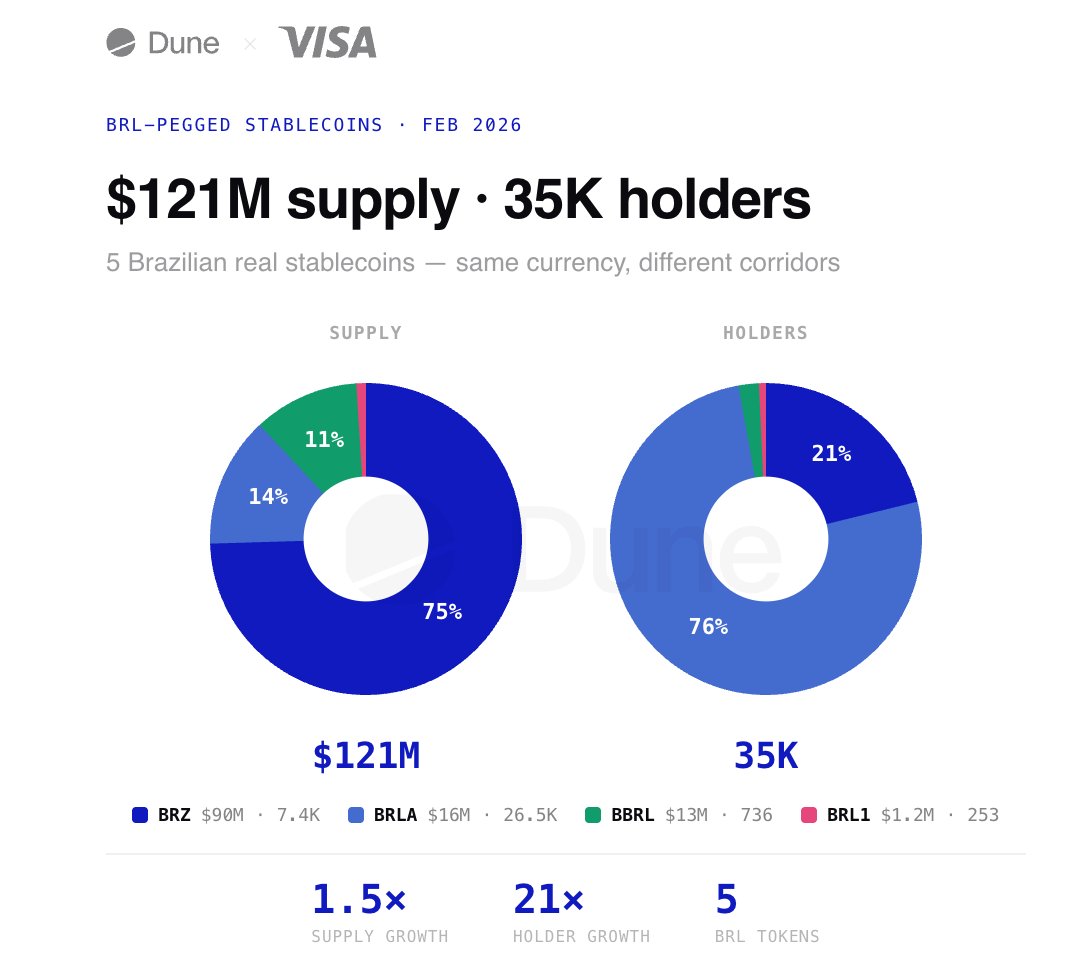
Brazilian real stablecoins: $79M → $121M supply. 1.7K → 35K holders.
21x holder growth, driven by 5 different BRL-pegged tokens — BRZ ($90M, the largest by supply), BRLA (26K holders, fastest growing), BBRL, BRL1, and BRLT.
Each serves a different corridor. BRZ is the institutional workhorse. BRLA connects PIX to onchain settlement via Visa card spending. Brazil's 2025 regulatory framework is accelerating all of them.
Read more about Brazilian real stablecoins, and dive deeper into BRLA, in our report with @Visa → dune.com/stablecoin-rep…

English