Nate Alder

1.7K posts

Nate Alder banner
Nate Alder

Nate Alder

@AlderNate

Faith. Family. Freedom. 2x exit founder. Curious builder. Lover of innovation, nature, & bold ideas. “A man’s reach should exceed his grasp.”

Miami Florida Katılım Şubat 2012
294 Takip Edilen448 Takipçiler
Sabitlenmiş Tweet
Nate Alder
Nate Alder@AlderNate·
One persistent mistake critics make is assuming Latter-day Saints are trying to be accepted into the broader Christian world. We’re not. The restored Church of Jesus Christ does not claim to be one Christian tradition among many. It claims to be the Church Christ Himself established, restored with authority, priesthood, ordinances, and continuing revelation. That’s why debates framed around creeds, post–biblical councils, or academic gatekeepers miss the point entirely. Our truth claims don’t rise or fall on acceptance by modern Christianity, Egyptologists, or theologians. Christianity fractured. Authority was lost. God restored it. You’re free to reject that claim—but stop pretending we’re auditioning for membership in someone else’s club.
English
1
1
14
272
Nate Alder
Nate Alder@AlderNate·
That argument only works if you assume Joseph Smith claimed to be performing a modern, strictly literal Egyptology translation from the surviving fragments alone. That assumption itself is debated. Even many LDS scholars openly acknowledge the surviving fragments appear funerary in nature. The real question is whether: the source material was incomplete the translation was revelatory/catalyst-based or whether the Book of Abraham was connected to portions of the collection no longer extant Critics often act like “the translation doesn’t match” ends the conversation, when in reality it simply opens larger questions about HOW revelation and translation functioned. Ironically, the Bible itself contains similar dynamics: New Testament authors reinterpret Old Testament passages in ways modern textual critics would never call “literal translation” Jude quotes non-biblical traditions Matthew applies prophetic texts contextually rather than strictly literally Revelation is filled with symbolic expansion and visionary interpretation Ancient scripture was not always transmitted the way modern academics expect. And again, even if someone rejects the Book of Abraham entirely, they still have not explained: the Book of Mormon its complexity its witnesses its consistency its theology or Joseph Smith’s ability to produce it under the circumstances he did Critics keep trying to shrink the debate down to one narrow Egyptology argument because the broader restoration narrative is much harder to explain naturally.
English
0
0
0
6
Sheik Ilderim
Sheik Ilderim@sheik_ilderim·
@AlderNate A few facts apologies usually leave out: The translation doesn’t match.
English
1
0
0
9
Nate Alder
Nate Alder@AlderNate·
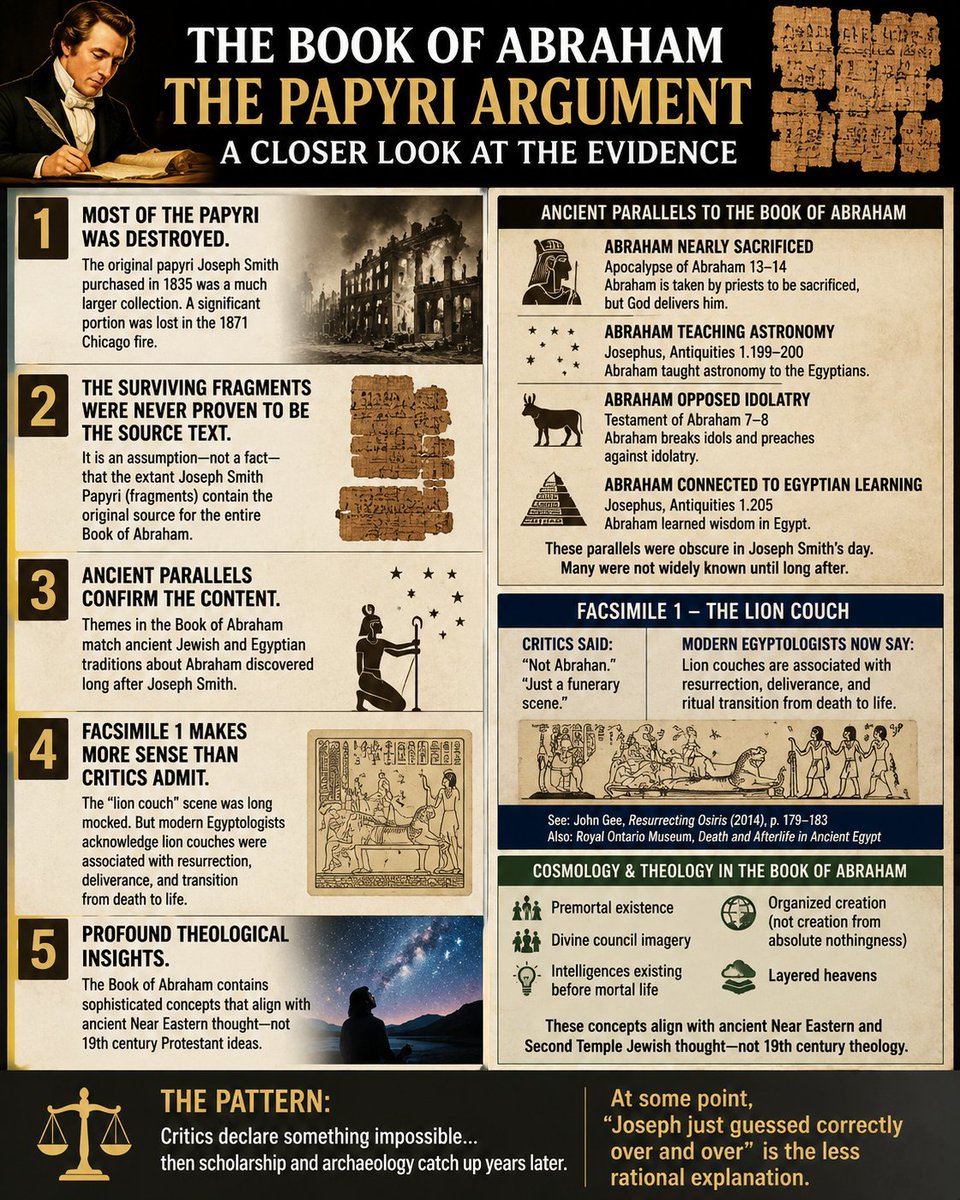
People keep repeating “the Book of Abraham was disproven by the papyri” without realizing how weak and outdated that argument actually is. A few facts critics usually leave out: 1. Most of the original papyri collection was destroyed in the 1871 Chicago fire. The fragments rediscovered in 1967 are only a small portion of what Joseph Smith originally possessed. Even LDS critics acknowledge this. 2. The surviving fragments were never definitively proven to be the direct source text for the entire Book of Abraham. That is an assumption critics make, not an established fact. 3. Ancient traditions about Abraham discovered long after Joseph Smith closely parallel Book of Abraham material: - Abraham nearly sacrificed by idol priests - Abraham teaching astronomy - Abraham opposing Egyptian idolatry - Abraham connected with Egyptian learning These themes appear in later-discovered Jewish and Egyptian texts like: - Apocalypse of Abraham - Testament of Abraham - Josephus - various Second Temple traditions How exactly did a 19th century farm boy independently reproduce obscure ancient traditions scholars would not fully uncover until generations later? 4. Facsimile 1 is especially interesting. The figure on the lion couch was long mocked by critics as “obviously not Abraham.” Yet modern Egyptologists now acknowledge lion couch scenes were associated with themes of resurrection, deliverance, and ritual transition from death to life. That suddenly makes Joseph’s interpretation far less ridiculous than critics once claimed. 5. The Book of Abraham also contains surprisingly sophisticated cosmological concepts: - organized creation instead of creation from absolute nothingness - premortal existence - divine council imagery - layered heavens - intelligences existing before mortal life Those ideas align far more closely with ancient Near Eastern and early Jewish thought than with mainstream 19th century Protestantism. The pattern is becoming obvious: Critics confidently declare something impossible… then archaeology, textual discoveries, or scholarship complicates the narrative years later. At some point, “Joseph just guessed correctly over and over” becomes the less rational explanation.
Nate Alder tweet media
English
4
6
31
425
Nate Alder
Nate Alder@AlderNate·
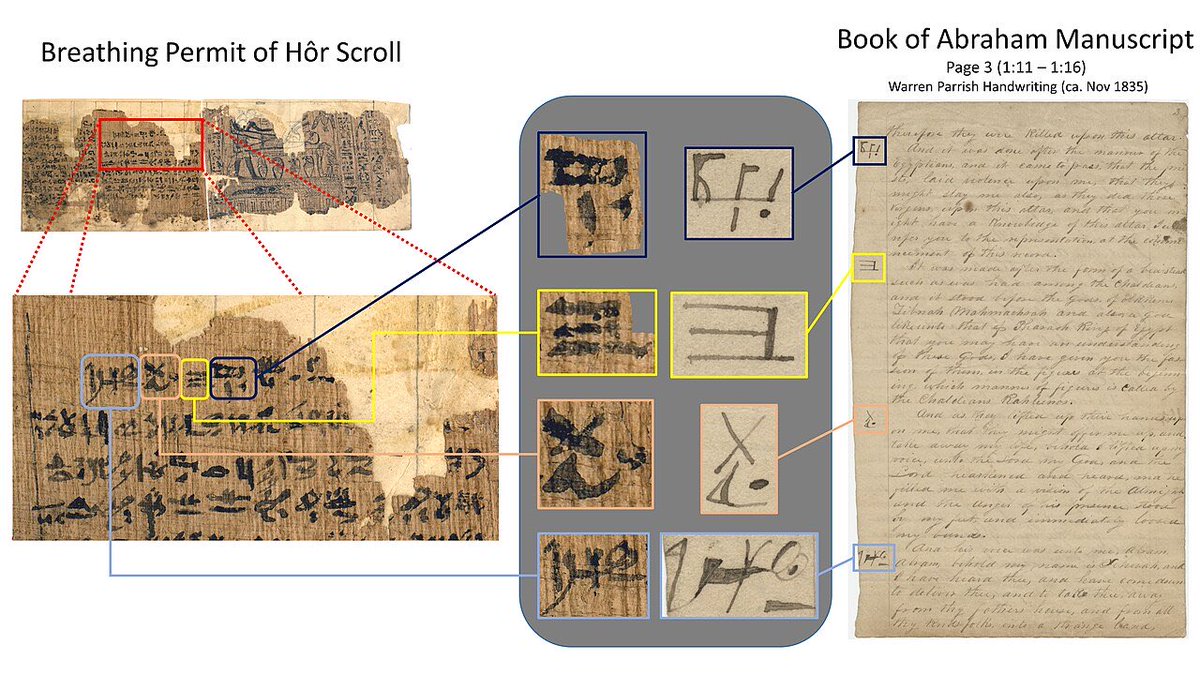
That still doesn’t prove what you think it proves. Even if Joseph pointed to certain characters, that only demonstrates an association between the manuscript project and the papyri fragments. It does NOT prove: 1. the surviving fragments were the entirety of the source material 2. Joseph claimed a strict one-to-one academic translation 3. the Kirtland Egyptian Papers were the mechanism used to generate the text rather than exploratory notes created afterward You’re assuming the conclusion first, then interpreting the evidence through that assumption. And there’s another problem critics rarely address: Why would Joseph intentionally anchor the Book of Abraham to fragments that modern scholars could later examine if he knowingly fabricated everything? That would be an unbelievably reckless fraud strategy. Especially when: most of the papyri were later destroyed the surviving fragments do not conclusively map to the full text ancient parallels to Abraham traditions continue emerging and scholars still debate the exact purpose and chronology of the Kirtland Egyptian Papers themselves The reality is that critics often present highly disputed theories as if the case is closed, when it absolutely is not. And again, even if someone rejects the Book of Abraham entirely, they still have not explained the Book of Mormon. That remains the elephant in the room critics keep trying to avoid.
English
1
0
0
5
Nate Alder
Nate Alder@AlderNate·
That argument is actually weaker than critics think it is, because it assumes Joseph Smith claimed to be doing a modern academic Egyptology translation character-by-character from the surviving fragments alone. But even many non-LDS scholars acknowledge several important facts critics usually ignore: 1. We do not possess the full original papyri collection Joseph had. Large portions were destroyed in the Chicago fire. 2. The Kirtland Egyptian Papers were likely created after the translation process, not necessarily used to produce it. Correlation does not prove source dependence. 3. Ancient Jewish and Egyptian traditions connected Abraham with astronomy, sacrifice narratives, priesthood themes, and Egyptian learning long before Joseph Smith. 4. Facsimile 1 was mocked for decades, yet modern Egyptologists now acknowledge lion couch scenes were associated with resurrection, deliverance, and transition from death to life — themes remarkably close to Joseph’s interpretation. 5. Even if the surviving fragment is a funerary text, that does not disprove revelatory expansion, catalyst theory, or missing source material. And honestly, the bigger issue for critics is this: They still cannot explain HOW Joseph Smith produced the Book of Mormon itself. Because dismissing one aspect of the Book of Abraham debate does not suddenly explain: the complexity of the Book of Mormon the witnesses the internal consistency the ancient literary structures the prophetic theology the lack of drafts/outlines/revision process or the sheer speed of dictation At some point, “Joseph just guessed correctly over and over and over” becomes less rational than the explanation critics are trying to avoid.
English
1
0
0
12
Nate Alder
Nate Alder@AlderNate·
Randall, insults are not arguments. The same thing could have been said about Christianity in the 1st century: “fabricated” “made up” “dangerous sect” “false scriptures” “deceived followers” That alone proves nothing. What matters is whether God can still reveal scripture and call prophets. And ironically, your own Bible shows scripture being added over time: Moses added to earlier revelation prophets added to the Old Testament the Gospels were added later Paul’s letters were later recognized as scripture Revelation was written decades after Christ’s resurrection So the real question is: By what biblical authority did revelation suddenly stop? Not one verse says: “After the apostles die, God will never speak again.” In fact, the Bible repeatedly says the opposite: “Jesus Christ the same yesterday, and today, and forever.” (Hebrews 13:8) “Surely the Lord God will do nothing, but he revealeth his secret unto his servants the prophets.” (Amos 3:7) “Despise not prophesyings.” (1 Thessalonians 5:20) You may reject LDS scripture, but simply mocking it is not evidence. Christians already accept: miracles angels visions revelation resurrection prophetic authority The LDS claim is not that those things exist. The LDS claim is that God still does them.
English
0
0
0
4
Randall Nix
Randall Nix@ranix1946·
@AlderNate The LDS "scriptures" are total fabrications and not worth a bucket of warm spit.
English
1
0
0
0
Nate Alder
Nate Alder@AlderNate·
For nearly 200 years, critics have claimed Joseph Smith “wrote” the Book of Mormon. Okay. Then prove it. Not with assumptions. Not with ridicule. Not with recycled anti-LDS theories that collapse every few decades. Actually prove HOW he did it. Show the drafts. Show the outline. Show the research notes. Show the source manuscript. Show the co-authors. Show the revision process. Because what we DO know is this: A 23-year-old frontier farm boy dictated ~500 pages in roughly 60 working days with: • no formal education • no manuscript in front of him • no rewrites • no library surrounding him • no modern editing tools And somehow produced: • complex narrative arcs • hundreds of interconnected names • intricate Hebraic literary structures like chiasmus • ancient Near Eastern themes • internally consistent geography, politics, theology, and chronology Critics have proposed dozens of theories: • Spaulding theory • plagiarism theory • conspiracy theory • “he was a genius” theory And when those fail, some even claim: “The devil did it.” But that creates an even bigger problem. The Book of Mormon testifies of Jesus Christ constantly. In fact, the name “Jesus Christ” appears more frequently in the Book of Mormon than in the Bible when adjusted for length. Its entire stated purpose is to bring people unto Christ, teach repentance, condemn sin, strengthen faith in the Savior, and testify that Jesus is the Son of God and Redeemer of the world. So the argument becomes: Satan inspired a book whose entire purpose is to convince people to follow Jesus Christ? That completely contradicts scripture itself: “Satan divideth against himself and against none else.” (3 Nephi 18:20) The Book of Mormon leads millions to: • pray more • repent more • worship Christ more • read scripture more • strengthen families • abandon addictions • serve others • seek holiness That is the exact opposite of the fruits Christ warned us about when describing false spirits. Critics have spent nearly 200 years attacking Joseph Smith, yet they still cannot explain where the Book of Mormon actually came from. At some point, dismissing Joseph Smith requires more faith than listening to him. Because if he didn’t translate it… Where exactly did the Book of Mormon come from? One thing critics rarely acknowledge: The Book of Mormon is not just “about Jesus Christ.” It is saturated with Him. Jesus Christ is referenced 3,925 times in the Book of Mormon — roughly once every 1.7 verses. And that matters because some critics literally claim: “The devil inspired the Book of Mormon.” Think about that for a second. The same book that: • teaches faith in Jesus Christ • teaches repentance • condemns sin • calls people to baptism • strengthens families • teaches charity • testifies of Christ’s atonement • invites people to pray • repeatedly declares Jesus is the Son of God …is supposedly satanic? That argument collapses under its own weight. Critics still cannot explain how Joseph Smith produced the Book of Mormon naturally: • no drafts • no outline • no manuscript • no formal education • dictated in roughly 60 working days • deeply Hebraic literary patterns • internally consistent narrative structure So when natural explanations fail, some jump to: “Well maybe Satan did it.” But Christ Himself taught: “A kingdom divided against itself cannot stand.” Why would Satan inspire a book whose entire purpose is bringing people TO Jesus Christ? At some point, critics have to do more than mock Joseph Smith. They need to explain the Book of Mormon itself.
Nate Alder tweet media
English
101
114
665
24.9K
Nate Alder
Nate Alder@AlderNate·
Ryan, saying “zero evidence” and “ample proof of plagiarism” overstates the case dramatically. If the evidence were truly overwhelming, critics would not still be debating dozens of mutually contradictory theories 200 years later: Joseph wrote it alone Spaulding wrote it Rigdon wrote it it was copied from View of the Hebrews it was automatic writing it was inspired by demons it was a collaborative fraud it was subconscious synthesis The reason there are so many competing explanations is because none fully account for all the data simultaneously. And “plagiarism” is also exaggerated. Quoting or echoing prior texts is exactly what biblical authors themselves did constantly: New Testament writers quote the Old Testament Jude quotes non-biblical traditions Paul quotes pagan poets the Gospels share overlapping material Revelation echoes Ezekiel, Isaiah, Daniel, and Exodus extensively Intertextuality is not automatically fraud. As for archaeology, the standard being used against the Book of Mormon is often impossible and inconsistently applied. We do not possess archaeological proof for many biblical figures, events, or migrations either, yet Christians still reasonably accept the Bible based on cumulative textual, testimonial, prophetic, and spiritual evidence. And again, your own standard for the Resurrection ultimately relies on: eyewitness testimony transformed witnesses faith historical reasoning from incomplete evidence Which is exactly my point. The issue is not “evidence vs no evidence.” The issue is which testimonies and spiritual claims people are willing to allow as legitimate.
English
0
0
0
4
Mountain Top
Mountain Top@moak_ryan·
@AlderNate Nate you are twisting truth to meet your preferred narrative. With zero evidence of BOM history & ample proof of plagiarism we are left with major problems with its authenticity let alone scripture validity.
English
1
0
0
3
Nate Alder
Nate Alder@AlderNate·
Interesting that you say “God speaks through the Holy Spirit,” while rejecting prophets, because throughout the entire Bible the Holy Spirit repeatedly speaks through prophets and apostles. “Surely the Lord God will do nothing, but he revealeth his secret unto his servants the prophets.” — Amos 3:7 “Holy men of God spake as they were moved by the Holy Ghost.” — 2 Peter 1:21 The biblical pattern is not: Holy Spirit OR prophets. It’s: Holy Spirit THROUGH prophets. As for the Fall, even many Christians acknowledge the Fall ultimately led to redemption through Christ. Without the Fall: no mortality no posterity no need for a Savior no resurrection no victory over sin and death The Book of Mormon literally teaches: “Adam fell that men might be; and men are, that they might have joy.” (2 Nephi 2:25) That is not celebrating sin. It is recognizing God’s redemptive plan through Christ. And “eternal spirit children” is hardly anti-biblical. The Bible repeatedly calls God our Father and mankind His offspring: “We are also his offspring.” — Acts 17:28 “The Father of spirits.” — Hebrews 12:9 Finally, the “works-based salvation” criticism ignores that the Book of Mormon constantly teaches salvation through Christ’s grace: “There shall be no other name given… whereby salvation cometh.” (Mosiah 3:17) “We talk of Christ, we rejoice in Christ…” (2 Nephi 25:26) “Saved by grace after all we can do” does not mean earning heaven. It means discipleship matters. Ironically, the New Testament itself teaches both grace AND works: “Faith without works is dead.” — James 2:17 Jesus repeatedly commands obedience, repentance, baptism, endurance, and covenant keeping. So the real issue is not that the Book of Mormon teaches a “different gospel.” It’s that it challenges post-biblical creeds and traditions many people assume are the original gospel.
English
0
0
0
4
Mountain Top
Mountain Top@moak_ryan·
@AlderNate God speaks through the Holy Spirit. The Holy Spirit gives us the interpretation. Mormons took it out of Gods mouth and gave it to man (prophets). The BoM also teaches the fall was a good thing. That we’re eternal spirit children . Salvation is works based. It’s different
English
1
0
0
2
Nate Alder
Nate Alder@AlderNate·
“Natural explanation fits every verifiable fact.” No, it doesn’t. It simply assumes from the beginning that anything supernatural is impossible, then forces every conclusion through that lens. That’s not neutrality. That’s philosophical naturalism. The irony is that the Resurrection of Jesus Christ itself fails your standard: no DNA evidence no video evidence no preserved body limited archaeology directly proving the miracle itself reliance on eyewitness testimony reliance on transformed witnesses reliance on martyrdom traditions reliance on faith and spiritual conviction Yet Christians reasonably accept the Resurrection because ancient history is not proven the same way modern lab science is. You also say the New Testament has “multiple independent attestations,” but the Book of Mormon also has multiple witnesses, hostile witnesses, internal consistency, complex structures, and transformed lives attached to it. You simply reject one set of witnesses while accepting another. And regarding “different Jesus”: The New Testament itself contains development in understanding Christ’s nature between the Synoptics, John, and later creeds. Christians debate Trinity, eternal generation, procession, predestination, atonement models, canon, and salvation to this day while all claiming the “same Jesus.” The Book of Mormon teaches: Jesus is the Christ born of Mary Son of God crucified resurrected Savior of mankind faith, repentance, baptism, holiness That is not “anti-Christ.” In fact, the book testifies of Jesus Christ more directly and consistently than most critics who attack it online. And the KJV argument is weak. If God reveals scripture through a 19th-century English-speaking prophet, using familiar biblical language people already recognized makes perfect sense. New Testament writers themselves quoted the Septuagint, not pristine original Hebrew manuscripts. At the end of the day, your position is not: “evidence led me away from the Book of Mormon.” It’s: “I allow supernatural evidence for the Bible, but not for the Book of Mormon.”
English
0
0
0
6
Johnny Rockets
Johnny Rockets@allgodschillens·
1/ “Seer stone doesn’t explain the text.” It does when combined with verbatim 1769 KJV errors, View of the Hebrews parallels, 19th-century theology, and eyewitness accounts of the dictation process. That’s a complete naturalistic explanation. 2/ “KJV errors are just familiar language.” No — the BoM copies specific translation mistakes and italics unique to the 1769 KJV edition. That’s not divine accommodation; that’s 19th-century source dependence. 3/ “Changes are just grammar like the Bible.” The BoM claims to be the “most correct book on earth,” translated perfectly by God in 1829. Bible variants are in copies over centuries. Different claim, different standard. 4/ “Chiasmus was discovered later so it proves antiquity.” It was identified in 1967 using modern Hebrew scholarship Joseph never had. Still subjective and replicable in 19th-century texts. Not proof. 5/ “Anachronisms are aging poorly.” Core ones — horses, steel, elephants, wheat, barley, silk, reformed Egyptian — remain unsupported by archaeology or DNA. Selective apologetics on minor items don’t erase the pattern. 6/ “Same evidence standard as the New Testament.” False equivalence. The NT has multiple independent attestations, 1st-century external corroboration, and archaeology for Judea. The BoM has zero external evidence, contradicts DNA and archaeology for the Americas, and rests solely on Joseph’s word plus subjective spiritual feelings. Different evidence levels require different standards. The BoM Jesus cannot be the biblical Jesus. Different eternal personhood (uncreated Son vs. spirit child), different divinity (Trinity vs. subordinate/exalted being), different timeline and actions (no American ministry in scripture). Irreconcilable. Natural explanation fits every verifiable fact. Faith is fine — but it’s not evidence.
English
1
0
0
3
Nate Alder
Nate Alder@AlderNate·
Jesus Christ resurrected? Ok. Prove it.
Nate Alder tweet media
English
0
0
0
39
Nate Alder
Nate Alder@AlderNate·
@JUDE_HOLYCROSS @grok @grok can it be factually and historically proven that Jesus Christ resurrected? Any corroborating archaeological, genetic, linguistic, or epigraphic evidence?
English
1
0
2
31
J-Dez 🇻🇦
J-Dez 🇻🇦@JUDE_HOLYCROSS·
@AlderNate @grok can it be factually and historically proven that Joseph Smith either wrote or translated book of Mormon? Any corroborating evidence- archaeological, genetic, linguistic, epigraphic support of large scale ancient Israelite/Christian civilizations in the Americas?
English
2
0
0
70
Nate Alder
Nate Alder@AlderNate·
That assumes your interpretation of the Bible is the standard everyone else must conform to. The Book of Mormon teaches: - Jesus is the Christ - He was born of a virgin - He atoned for sin - He died and resurrected - salvation comes through Him - repentance, baptism, and holiness matter That’s the gospel. Ironically, many doctrines mainstream Christians defend today required centuries of post-biblical creeds and philosophical councils to define. Early Christians debated the nature of God, the Godhead, grace, works, authority, ordinances, and apostasy long before the New Testament canon was even finalized. So the real question is not: “Does it match my modern tradition?” The real question is: Did God continue speaking after the Bible?
English
2
0
1
31
Mountain Top
Mountain Top@moak_ryan·
@AlderNate However Smith produced the BOM it doesn’t change the fact that it teaches a different gospel than the Bible . God doesn’t contradict himself.
English
1
0
0
26
Nate Alder
Nate Alder@AlderNate·
A few problems here. First, using a seer stone in a hat doesn’t explain the Book of Mormon. It just describes the claimed translation method. Critics still have to explain the actual production of the text itself. Second, “KJV errors” assumes God must give a brand new English rendering every time scripture is quoted. Why would God reveal Isaiah in awkward new English to 1829 readers instead of using the biblical language they already recognized? The New Testament authors themselves quoted the Septuagint, not pristine original Hebrew. Third, the “thousands of changes” argument collapses when most changes are grammar, punctuation, or clarification. The Bible has thousands of textual variants and translation updates too. Yet Christians don’t conclude the Resurrection was invented because of edits between manuscripts. Fourth, saying chiasmus is “subjective” ignores that complex Hebraic structures were discovered in the Book of Mormon long after Joseph Smith’s death. Critics mock them because they are inconvenient, not because they are meaningless. Fifth, anachronism arguments have a long history of aging poorly. Critics once mocked: - ancient cement - metal plates - Nahom - Old World names - large ancient American civilizations until evidence complicated those assumptions. Finally, your biggest contradiction is theological: You accept eyewitness testimony, miracles, prophecy, spiritual experience, manuscript traditions, and transformed lives as evidence for the New Testament. But when those same categories support the Book of Mormon, suddenly none of them count anymore. That’s not a consistent standard of evidence.
English
1
0
3
22
Johnny Rockets
Johnny Rockets@allgodschillens·
1/ “No formal education, no manuscript, no rewrites.” False. Joseph used a seer stone in a hat. The text copies KJV Bible errors word-for-word. That’s 19th-century composition, not translation. 2/ “No rewrites.” The book has thousands of changes — including doctrinal fixes like “mother of God” to “mother of the Son of God.” Your “perfect dictation” claim is directly contradicted by the published editions. 3/ “Complex ancient structures and consistency.” Chiasmus is subjective cherry-picking. Horses, steel, wheat, elephants, silk — all anachronisms with zero archaeological support. This is not ancient. 4/ “Devil inspired a pro-Jesus book” is a strawman. Most critics say Joseph wrote it. Your Satan argument is circular — it only works if you already assume the Book of Mormon is true. 5/ “Positive fruits prove it’s divine.” Classic appeal to consequences fallacy. Many religions and even cults produce prayer, families, and sobriety. Good feelings don’t prove historicity. 6/ Jesus appears 3,925 times? Sure. But the Jesus of the Book of Mormon cannot possibly be the Jesus of scripture. The biblical Jesus is the eternal, uncreated Son — fully God from eternity, second person of the Trinity — whose entire earthly ministry, crucifixion, and resurrection occur only in the New Testament. The BoM Jesus has complete foreknowledge of his atonement centuries before it happens, quotes entire KJV chapters verbatim in ancient America, physically appears after his resurrection to teach a 19th-century-style church with baptismal formulas and doctrines unknown to the biblical record, and repeatedly blurs the distinction between Father and Son in modalistic language (e.g., Mosiah 15) that was later edited. Different eternal personhood. Different divinity. Different timeline. Different actions. They are irreconcilably not the same Jesus.
English
1
0
0
113
Nate Alder
Nate Alder@AlderNate·
Interesting, because almost everything you listed there is exactly the kind of reasoning Latter-day Saints use too. You say faith is “reasoned trust grounded in evidence, experience, and rational discourse.” Agreed. That’s why millions of us point to: - witness testimony - fulfilled prophecy - spiritual experience - transformed lives - internal textual complexity - historical context - answered prayer - and the power of Christ-centered teachings as evidence for the Book of Mormon and the Restoration. The interesting part is that many critics suddenly switch definitions of “evidence” depending on whether the claim is the Resurrection or Joseph Smith. If eyewitness testimony, spiritual confirmation, transformed lives, and miracles count for the New Testament, why are those same categories dismissed automatically when discussing the Book of Mormon?
English
0
0
0
2
1776
1776@The2nd1776·
Here is how I wrote it up in the past: Faith (Pistis), the Greek term for faith, is often misunderstood as belief without evidence. However, it is more accurately understood as reasoned trust that is grounded in evidence, experience, and rational discourse. I can have faith in the tooth fairy while having zero evidence, so it is a blind stupid faith. God's creation is evidence that He exists so that people are without excuse who deny Him. Rom 1:19 For what can be known about God is plain to them, because God has shown it to them. Rom 1:20 For his invisible attributes, namely, his eternal power and divine nature, have been clearly perceived, ever since the creation of the world, in the things that have been made. So they are without excuse. The Apostle John wrote the Gospel of John as a list of evidence so that one would believe in Jesus. Joh 20:30 Now Jesus did many other signs in the presence of the disciples, which are not written in this book; Joh 20:31 but these are written so that you may believe that Jesus is the Christ, the Son of God, and that by believing you may have life in his name. Jesus even said to believe his works (miracles) if one does not believe his words. Joh 10:37 If I am not doing the works of my Father, then do not believe me; Joh 10:38 but if I do them, even though you do not believe me, believe the works, that you may know and understand that the Father is in me and I am in the Father.” Personal faith is when we trust in Christ in a way that we believe He did everything needed to be done to save us. He lived a righteous, sinless life and died as a ransom for our sins. And He rose again showing that His sacrifice was accepted by the Father as payment for our sins. 2Co 5:21 For our sake he made him to be sin who knew no sin, so that in him we might become the righteousness of God. 1Co 1:18 For the word of the cross is folly to those who are perishing, but to us who are being saved it is the power of God.
English
1
0
0
12
Nate Alder
Nate Alder@AlderNate·
One thing I’ve always found interesting is the double standard many anti-LDS critics use. When it comes to the Book of Mormon, critics suddenly become hardcore materialists. They demand archaeological evidence, scientific proof, DNA evidence, historical records, geography, etc. They act as though a religious text can only be true if every detail is already fully verified by modern academia. Yet when atheists use those exact same arguments against the Bible — questioning miracles, Exodus, Noah’s flood, resurrection accounts, authorship, archaeology, or supposed contradictions — many of those same critics immediately switch positions and say things like: “You have to take it on faith.” “Not everything can be proven scientifically.” “God is bigger than human evidence.” So which is it? If faith is a valid principle for the Bible, why is it suddenly invalid for the Book of Mormon? And honestly, the claim that there is “zero evidence” for the Book of Mormon just isn’t true. Over time, more evidence continues to emerge involving ancient Semitic writing styles, Hebraisms, ancient Middle Eastern cultural parallels, chiasmus, NHM/Nahom, ancient cement references, metal plates, and other details Joseph Smith realistically could not have fabricated in 1829 as an uneducated farm boy. People are free to reject LDS beliefs, but the inconsistency is hard to ignore. Too often the standard becomes: “Faith and incomplete evidence are acceptable for my religion, but not for yours.” As Christians, we should all be honest and consistent in how we evaluate faith, history, and evidence.
Nate Alder tweet media
English
14
6
53
1.3K
Nate Alder
Nate Alder@AlderNate·
If demons were behind it, then you have an even bigger theological problem to solve. Why would Satan produce a book that: testifies repeatedly that Jesus is the Christ, calls people to repentance, condemns pride, lust, murder, and secret combinations, teaches faith, charity, and holiness, strengthens families, leads millions to worship and follow Jesus Christ more deeply, and invites people to pray directly to God for truth? Christ taught that “a kingdom divided against itself cannot stand.” Satan does not spend 500+ pages persuading people to come unto Christ, repent, and follow Him just to play 4D chess. Also, saying “a 23-year-old can write a book” completely misses the actual argument. Nobody is claiming young people cannot write books. The question is whether Joseph Smith, under the documented historical conditions: dictated the text rapidly, without notes, without revisions during dictation, without formal theological training, while maintaining long narrative continuity, intricate internal structure, complex interwoven timelines, consistent doctrinal themes, and ancient literary patterns, could naturally produce the specific Book of Mormon we have. Those are two very different claims. And importantly, critics themselves cannot agree on the explanation: Was he a genius? A plagiarist? A conspirator? A fraud using collaborators? A sincere mystic? Inspired by demons? Copying Spaulding? Copying the Bible? Writing fiction? The theories constantly conflict with each other because no single naturalistic model fully explains all the data simultaneously.
English
1
0
2
10
Slane
Slane@TheHillofSlane·
@AlderNate False. It shows someone his age is perfectly capable of writing a book. I would further say that we can agree there may have been supernatural forces at work. I just think they were demons.
English
1
0
0
6
Slane
Slane@TheHillofSlane·
Critics are claiming J. K. Rowling wrote Harry Potter starting when she was 25.... Seriously, Harry Potter is much better written and isnt self refuting.
Nate Alder@AlderNate

For nearly 200 years, critics have claimed Joseph Smith “wrote” the Book of Mormon. Okay. Then prove it. Not with assumptions. Not with ridicule. Not with recycled anti-LDS theories that collapse every few decades. Actually prove HOW he did it. Show the drafts. Show the outline. Show the research notes. Show the source manuscript. Show the co-authors. Show the revision process. Because what we DO know is this: A 23-year-old frontier farm boy dictated ~500 pages in roughly 60 working days with: • no formal education • no manuscript in front of him • no rewrites • no library surrounding him • no modern editing tools And somehow produced: • complex narrative arcs • hundreds of interconnected names • intricate Hebraic literary structures like chiasmus • ancient Near Eastern themes • internally consistent geography, politics, theology, and chronology Critics have proposed dozens of theories: • Spaulding theory • plagiarism theory • conspiracy theory • “he was a genius” theory And when those fail, some even claim: “The devil did it.” But that creates an even bigger problem. The Book of Mormon testifies of Jesus Christ constantly. In fact, the name “Jesus Christ” appears more frequently in the Book of Mormon than in the Bible when adjusted for length. Its entire stated purpose is to bring people unto Christ, teach repentance, condemn sin, strengthen faith in the Savior, and testify that Jesus is the Son of God and Redeemer of the world. So the argument becomes: Satan inspired a book whose entire purpose is to convince people to follow Jesus Christ? That completely contradicts scripture itself: “Satan divideth against himself and against none else.” (3 Nephi 18:20) The Book of Mormon leads millions to: • pray more • repent more • worship Christ more • read scripture more • strengthen families • abandon addictions • serve others • seek holiness That is the exact opposite of the fruits Christ warned us about when describing false spirits. Critics have spent nearly 200 years attacking Joseph Smith, yet they still cannot explain where the Book of Mormon actually came from. At some point, dismissing Joseph Smith requires more faith than listening to him. Because if he didn’t translate it… Where exactly did the Book of Mormon come from? One thing critics rarely acknowledge: The Book of Mormon is not just “about Jesus Christ.” It is saturated with Him. Jesus Christ is referenced 3,925 times in the Book of Mormon — roughly once every 1.7 verses. And that matters because some critics literally claim: “The devil inspired the Book of Mormon.” Think about that for a second. The same book that: • teaches faith in Jesus Christ • teaches repentance • condemns sin • calls people to baptism • strengthens families • teaches charity • testifies of Christ’s atonement • invites people to pray • repeatedly declares Jesus is the Son of God …is supposedly satanic? That argument collapses under its own weight. Critics still cannot explain how Joseph Smith produced the Book of Mormon naturally: • no drafts • no outline • no manuscript • no formal education • dictated in roughly 60 working days • deeply Hebraic literary patterns • internally consistent narrative structure So when natural explanations fail, some jump to: “Well maybe Satan did it.” But Christ Himself taught: “A kingdom divided against itself cannot stand.” Why would Satan inspire a book whose entire purpose is bringing people TO Jesus Christ? At some point, critics have to do more than mock Joseph Smith. They need to explain the Book of Mormon itself.

English
1
0
0
19
Nate Alder
Nate Alder@AlderNate·
John Clark’s statement is actually important because it highlights something many critics gloss over: there is no official Church doctrine declaring the New York hill the site of the final Nephite battles. Many Latter-day Saint scholars distinguish between: the hill where Joseph received the plates and the possible location of the ancient Cumorah described in the text itself. So quoting Clark saying “this is not the place of Mormon’s last stand” is not some devastating contradiction. That is already a recognized discussion within LDS scholarship. Second, your argument still assumes: “If the stone box is not currently discoverable, the Book of Mormon is false.” That simply does not follow logically. Even if Joseph described a stone container accurately: it could have collapsed been disturbed been looted eroded buried deeper removed destroyed by treasure diggers altered by nearly 200 years of farming and excavation You’re turning an absence of present archaeological recovery into proof of fraud, but historians generally do not reason that way. For example: We don’t have the Ark of the Covenant. We don’t have the original tablets from Sinai. We don’t have verified remains of most biblical prophets. We don’t have archaeological evidence for every biblical event Christians accept. Yet Christians still accept those accounts based on cumulative evidence and testimony. Also, the Book of Mormon itself never claims the entire civilization was centered on the New York hill. In fact, the text describes large civilizations spread over vast regions and time periods. Critics often oversimplify the claim into: “No artifacts near Palmyra = Book of Mormon false.” But that assumes: 1. the final battle hill must be New York, 2. major settlements existed directly there, 3. the repository remained intact, 4. modern archaeology should necessarily recover it, 5. and that absence of evidence equals evidence of absence. That is a much larger leap than people admit.
English
0
0
8
109
Grandpa Joe
Grandpa Joe@Grandpa_Joes_X·
@AlderNate Here's my challenge to you: Just show me the stone box in Hill Cumorah. It HAS to be there, But it's not.
Grandpa Joe tweet media
English
3
0
0
109
Nate Alder
Nate Alder@AlderNate·
Then tie them together specifically. That’s the point. People keep saying “there are natural explanations,” but when you actually ask for a complete model, it usually turns into vague possibilities rather than a coherent historical reconstruction. For example: Was he secretly writing drafts for years? Then where are they? Was he heavily plagiarizing? Then why has every major source theory collapsed under scrutiny? Did he have collaborators? Then where is the evidence of coordinated authorship? Was he simply a creative genius? Then why do critics simultaneously portray him as ignorant and unsophisticated? Did he improvise orally? Then how did he maintain narrative continuity across hundreds of pages with minimal review? Was it all revised later? Then why does the original manuscript already contain the complex structure? I’m not saying there are zero possible natural explanations. I’m saying critics often present isolated explanations for isolated features, while no single model comfortably explains the entire historical picture at once. That distinction matters.
English
1
0
2
18
Capt. Bible on a Boat
Capt. Bible on a Boat@BibleonaBoat·
@AlderNate Several of these claims can be tied together and have the same explanation. You're overstating your case here significantly.
English
1
0
0
10
Nate Alder
Nate Alder@AlderNate·
You’re making a lot of assertions there, but very little of it actually holds up historically or biblically. First, Joseph Smith absolutely considered himself Christian long before the First Vision. He was raised in a culture saturated with the Bible and was deeply concerned about salvation, repentance, and which church taught the truth. The entire reason he prayed was because he believed James 1:5: “If any of you lack wisdom, let him ask of God.” Second, calling his parents “witches” is an exaggeration critics use to poison the well. Folk practices, dreams, seer stones, and superstitions were extremely common in early 1800s America — including among Christians. That does not automatically make someone satanic any more than medieval Christians believing in omens or relics made them pagans. Third, the Bible repeatedly tells people to seek confirmation from God: “Ask, and it shall be given you.” (Matthew 7:7) “Try the spirits whether they are of God.” (1 John 4:1) “If any man will do his will, he shall know.” (John 7:17) “Prove all things; hold fast that which is good.” (1 Thessalonians 5:21) So the idea that “God never asks people to inquire of Him” is simply unbiblical. Scripture is filled with people seeking revelation, wisdom, confirmation, and spiritual witnesses. And regarding Satan deceiving people: Satan does not typically encourage people to: repent of sin worship Jesus Christ abandon addictions strengthen families pray sincerely study scripture seek holiness Yet those are exactly the fruits millions associate with the Book of Mormon. Finally, you said Joseph “had no way of judging the veracity of his visions.” But that criticism applies to virtually every prophet in the Bible: Moses at the burning bush Samuel hearing God’s voice Isaiah’s heavenly vision Paul on the road to Damascus John receiving Revelation If supernatural revelation is impossible by definition, then Christianity itself collapses, because the resurrection, miracles, prophecy, and revelation all depend on the same supernatural worldview.
English
5
0
0
10
Batman Jr.
Batman Jr.@BatmanJ27190203·
Jesus warns that Satan will work wonders that could deceive the elect, were it possible. Mormons point to the BoM as miraculous, despite the myriad flaws, obvious plagiarism, and other nonsense. This deception from Satan does not reach anywhere near the level Jesus warned of.
Nate Alder@AlderNate

For nearly 200 years, critics have claimed Joseph Smith “wrote” the Book of Mormon. Okay. Then prove it. Not with assumptions. Not with ridicule. Not with recycled anti-LDS theories that collapse every few decades. Actually prove HOW he did it. Show the drafts. Show the outline. Show the research notes. Show the source manuscript. Show the co-authors. Show the revision process. Because what we DO know is this: A 23-year-old frontier farm boy dictated ~500 pages in roughly 60 working days with: • no formal education • no manuscript in front of him • no rewrites • no library surrounding him • no modern editing tools And somehow produced: • complex narrative arcs • hundreds of interconnected names • intricate Hebraic literary structures like chiasmus • ancient Near Eastern themes • internally consistent geography, politics, theology, and chronology Critics have proposed dozens of theories: • Spaulding theory • plagiarism theory • conspiracy theory • “he was a genius” theory And when those fail, some even claim: “The devil did it.” But that creates an even bigger problem. The Book of Mormon testifies of Jesus Christ constantly. In fact, the name “Jesus Christ” appears more frequently in the Book of Mormon than in the Bible when adjusted for length. Its entire stated purpose is to bring people unto Christ, teach repentance, condemn sin, strengthen faith in the Savior, and testify that Jesus is the Son of God and Redeemer of the world. So the argument becomes: Satan inspired a book whose entire purpose is to convince people to follow Jesus Christ? That completely contradicts scripture itself: “Satan divideth against himself and against none else.” (3 Nephi 18:20) The Book of Mormon leads millions to: • pray more • repent more • worship Christ more • read scripture more • strengthen families • abandon addictions • serve others • seek holiness That is the exact opposite of the fruits Christ warned us about when describing false spirits. Critics have spent nearly 200 years attacking Joseph Smith, yet they still cannot explain where the Book of Mormon actually came from. At some point, dismissing Joseph Smith requires more faith than listening to him. Because if he didn’t translate it… Where exactly did the Book of Mormon come from? One thing critics rarely acknowledge: The Book of Mormon is not just “about Jesus Christ.” It is saturated with Him. Jesus Christ is referenced 3,925 times in the Book of Mormon — roughly once every 1.7 verses. And that matters because some critics literally claim: “The devil inspired the Book of Mormon.” Think about that for a second. The same book that: • teaches faith in Jesus Christ • teaches repentance • condemns sin • calls people to baptism • strengthens families • teaches charity • testifies of Christ’s atonement • invites people to pray • repeatedly declares Jesus is the Son of God …is supposedly satanic? That argument collapses under its own weight. Critics still cannot explain how Joseph Smith produced the Book of Mormon naturally: • no drafts • no outline • no manuscript • no formal education • dictated in roughly 60 working days • deeply Hebraic literary patterns • internally consistent narrative structure So when natural explanations fail, some jump to: “Well maybe Satan did it.” But Christ Himself taught: “A kingdom divided against itself cannot stand.” Why would Satan inspire a book whose entire purpose is bringing people TO Jesus Christ? At some point, critics have to do more than mock Joseph Smith. They need to explain the Book of Mormon itself.

English
4
0
0
49
Nate Alder
Nate Alder@AlderNate·
You’re absolutely right that Satan can deceive. Scripture warns about that repeatedly. But that warning cuts both ways. Simply labeling something “from Satan” is not evidence — it’s a conclusion that itself must be justified. The interesting thing is that the Book of Mormon does the opposite of what Scripture says Satan wants: it testifies that Jesus is the Christ calls people to repentance condemns pride, lust, greed, and immorality teaches faith in Christ, baptism, charity, and holiness strengthens families and devotion to God repeatedly warns against secret combinations, corruption, and unbelief That raises a serious question: Why would Satan produce a book whose central purpose is to convince people to worship Jesus Christ, repent of sin, read scripture, pray, and follow God? As for “obvious plagiarism,” critics have been claiming that for nearly 200 years, yet they still cannot produce a single coherent source theory that explains the full text, the dictation process, the narrative complexity, the Hebraic patterns, or the eyewitness accounts surrounding its production. And regarding “myriad flaws,” people often confuse: later grammatical edits translation wording theological disagreement with actual proof of fraud. The Bible itself contains difficult passages, copyist issues, translation debates, and apparent tensions, yet Christians do not conclude from that that it is satanic. At some point, everyone exercises faith somewhere: faith the resurrection happened faith the apostles told the truth faith the biblical canon was preserved correctly faith miracles occurred The real question is not whether faith exists, but whether the fruits point people toward Christ or away from Him. Christ Himself said, “By their fruits ye shall know them.” The Book of Mormon has led millions to greater faith in Jesus Christ.
English
1
0
4
19
Nate Alder
Nate Alder@AlderNate·
That’s a reasonable standard if we’re talking about absolute proof in the scientific sense. But history rarely works that way. You can’t “prove” Julius Caesar crossed the Rubicon the way you prove gravity in a lab. Historical claims are evaluated cumulatively: documents witnesses consistency plausibility archaeology textual analysis explanatory power And by that standard, the Book of Mormon is at least significant enough that people are still debating it intensely 200 years later. Also, if the standard is “prove yourself right beyond dispute,” then Christianity itself struggles under that burden too: you cannot scientifically reproduce the resurrection you cannot empirically prove miracles you cannot excavate every biblical figure you cannot directly verify many ancient events At some point worldview assumptions enter the picture. For me, the evidence for the Book of Mormon is cumulative: the translation process the witness testimonies the internal complexity the theological depth the Hebraic patterns the consistency of Christ-centered doctrine the spiritual fruit and personal spiritual confirmation through prayer You may not find that convincing, and that’s your right. But saying “it hasn’t proven itself to me” is different from saying “it has been disproven.” Those are not the same claim.
English
1
0
1
14
Idris Elbows
Idris Elbows@spookysecretguy·
@AlderNate Lol nah dude. You have a book that you are claiming is a historical record translated from an ancient language. Its not my job to prove you wrong, it's your job to prove yourself right. So far, the book of mormon has failed to do that.
English
1
0
0
5