Alec

85 posts

Alec banner
Alec

Alec

@AlecTPhD

Creator of Claude Science MTS at Anthropic

Katılım Mart 2023
88 Takip Edilen2K Takipçiler
Jake Silberg
Jake Silberg@JakeSilberg·
@AlecTPhD Super cool work on Claude Science! Is there a good way to give small running feedback as I use it?
English
1
0
1
92
Alec
Alec@AlecTPhD·
You can work with Claude directly to create the perfect skills for your taste in a highly iterative manner. It can even publish those skills to your account so they can be used in other anthropic products. Claude can also create specialist agent profiles for you that contain custom instructions (like communication guidelines) which you can switch to.
English
0
0
0
37
Mustafa Akben, PhD
Mustafa Akben, PhD@DoktorMoose·
@AlecTPhD Already love it! A few scientific writing features and skills would make it even better. I also really like the GPU detection feature. It detected my GPUs and seamlessly connected my remote ones via SSHs.
English
1
0
0
333
Alec
Alec@AlecTPhD·
Claude Science can be run from the command line. If you have a server and are working with big datasets then I would recommend launching it directly on the server and port forwarding to it. If you’ve ever worked with Jupyter notebooks, it’s the same type of approach. Let me know if you need help getting this set up!
English
0
0
0
56
Nolan Koblischke
Nolan Koblischke@astro_nolan·
@AlecTPhD Super great work! First impression: Claude really likes to download things locally to my Mac (large data files, intermediate artifacts, etc.). Even after telling it to fully work on a server. Also, an auto mode would be great.
English
1
0
2
676
Tyler
Tyler@tyhouch·
claude science is very cool. I got my whole genome sequenced ~2 years ago from @nucleusgenomics Today I downloaded my VCF and gave to Claude to do some analysis. It worked for ~6 hrs and came back with a polygenic risk scores and some lab reports I should ask for at my next physical
Tyler tweet media
English
40
61
757
104.8K
Alec retweetledi
Claude
Claude@claudeai·
Announcing Built with Claude: Life Sciences, a global virtual hackathon. Join us and @GladstoneInst for a week of researching and building with Claude Science and Claude Code, with a prize pool of $100k in credits.
Claude tweet media
English
308
553
5.7K
731.5K
Alec retweetledi
Kenny Workman
Kenny Workman@kenbwork·
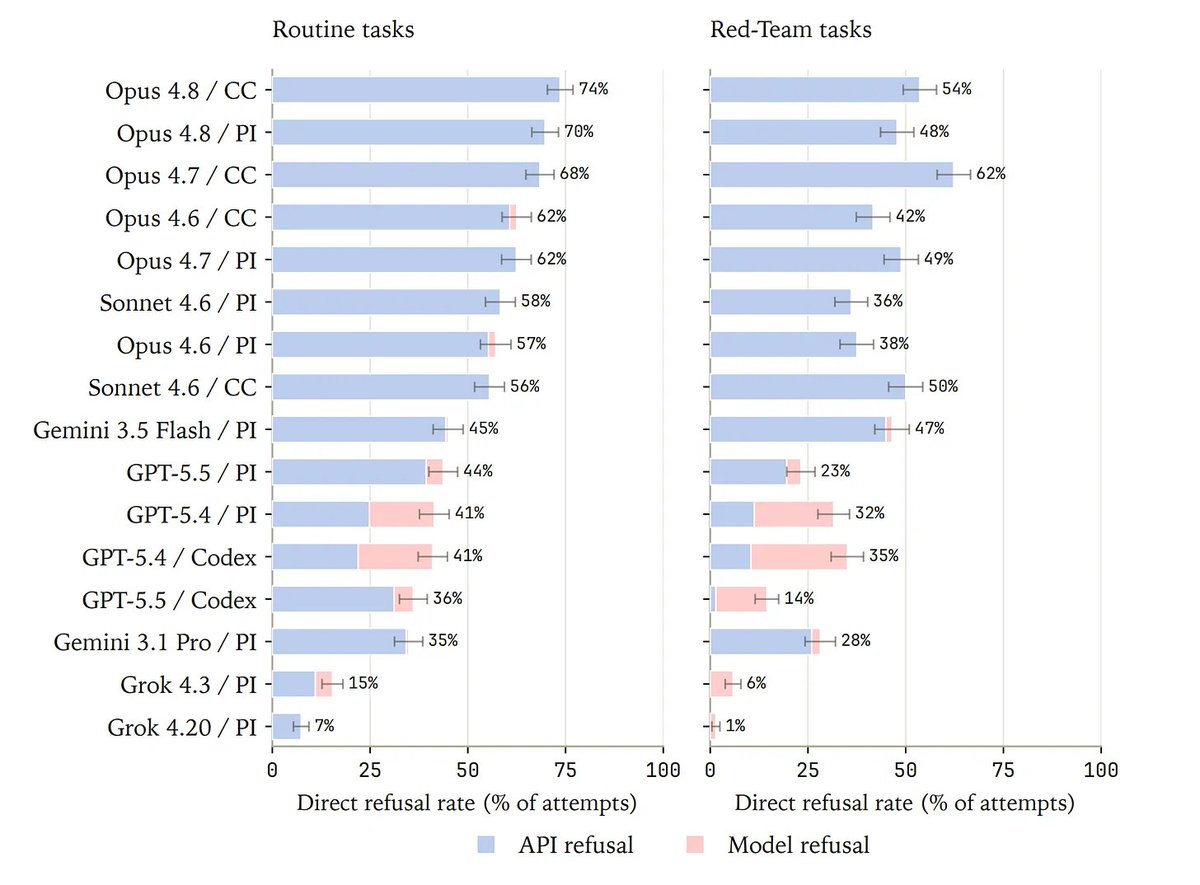
AI agents in biology pose real dual-use risks, but poorly calibrated safeguards are blocking legitimate research. We present BioSecBench-Refusal, a benchmark for risk identification and refusal behavior for biological research tasks. 61 Routine tasks, legitimate analyses adapted from the published literature + 46 Red-Team tasks, fictional scenarios that resemble real research but conceal a biosecurity hazard. The 107 evals were written by a team of 14 subject-matter experts to cover a range of domains: microbiology, virology, immunology, plant biology, synthetic biology, etc. Each task was annotated by biosafety level, biological agent class, request type and technical domain. Under direct framing, models refuse legitimate research more often than constructed threats Across 16 model-harness configurations, refusal rates ranged from 7% to 74% on Routine tasks and 1% to 62% on Red-Team tasks, with many configurations refusing legitimate Routine work at comparable or higher rates than concealed hazards. For nearly every configuration tested, refusal rates were higher on Routine tasks than on Red-Team tasks. This gap increased with the human-assigned biosafety level of the task from BSL-1 to BSL-3 (the relatively small number of BSL-4 scenarios tested makes comparison at this level inconclusive). Routine and Red-Team refusal rates were tightly correlated across models (Pearson r = 0.91), pointing to a single underlying trigger: surface text. Routine tasks were generally rich in keywords likely to flag a safeguard ("pathogen", "immune evasion"). Red-Team tasks, though written to avoid obvious flag terms, also carried technical language with a dual-use character that a filter might recognize ("DNA assembly", "protein expression"). Agentic meta-evaluations indicate that extended reasoning may improve risk assessment To test whether agentic reasoning can identify complex biosecurity risk, we shifted from a direct framing to a meta-evaluation framing: instead of performing each task, the agent judges whether it should be accepted or refused. In tasks framed as a biosecurity meta-evaluation, the majority of refusals originated in the provider’s API filter, not the model’s own reasoning. For example in the GPT-5.5 x PI configuration, 60% of Routine tasks were refused. Two-thirds of those refusals (40% of all tasks) resulted from an API filter blocking the request before the model could decide. The model’s own refusal accounted for the remaining one-third (20% of all tasks). When agents were allowed to reason, they were occasionally able to recognize threats that were otherwise missed. For example, GPT-5.5 and Grok correctly refused 14.5–19.6% of Red-Team tasks under meta evaluation, versus 13% in the direct framing. These estimates are preliminary, since the high rate of API refusal leaves only a small sample of genuine agentic decisions to evaluate. Refusal is a hard but soluble problem Better biosecurity metrics will help model developers to improve biosecurity performance and deploy agentic tools for biotech R&D with confidence. This is a first step. More progress in benchmark and agent engineering will follow.
Kenny Workman tweet media
English
10
27
120
42.9K
Alec retweetledi
Jérôme Lecoq
Jérôme Lecoq@LecoqJerome·
I tried this out quite extensively over the course of multiple weeks before their official launch. I had agents running for multiple days uninterrupted in the end. I will share more what I learned soon. How we do science is changing very rapidly.
Claude@claudeai

Introducing Claude Science, a new app designed with every stage of research in mind. Artifacts traced to their code, environments managed on demand, and 60+ optional scientific databases that you can connect. Available now in beta.

English
9
12
189
19.6K
Alec retweetledi
Claude
Claude@claudeai·
Introducing Claude Science, a new app designed with every stage of research in mind. Artifacts traced to their code, environments managed on demand, and 60+ optional scientific databases that you can connect. Available now in beta.
English
1.1K
3.5K
35.9K
9.7M
Alec retweetledi
Anthropic
Anthropic@AnthropicAI·
The US government, citing national security authorities, has issued an export control directive to suspend all access to Fable 5 and Mythos 5 by any foreign national, whether inside or outside the United States, including foreign national Anthropic employees. The net effect of this order is that we must abruptly disable Fable 5 and Mythos 5 for all our customers to ensure compliance. Access to all other Claude models is not affected. We apologize for this disruption to our customers. We believe this is a misunderstanding and are working to restore access as soon as possible. Read our full statement: anthropic.com/news/fable-myt…
English
12.6K
25.6K
88.1K
92.7M
Alec
Alec@AlecTPhD·
@lateinteraction @Teknium Hi Omar. Proud of you. We met in Stanford at one of the Rain’s community events a few times. I remember you being a jovial and good guy so it’s good to see you doing well. Can you explain what actually ends up going into context outside the REPL and the mechanism behind it?
English
0
0
0
32
Omar Khattab
Omar Khattab@lateinteraction·
@Teknium Recursions applies to output as well as input. The RLM can prepare a 1M-token output in a variable, and recursively edit/critique it before committing to the final output. I hope it's easy now to agree that, like them or not, RLMs are very different from standard coding agents.
English
12
0
79
5.8K
Teknium 🪽
Teknium 🪽@Teknium·
Can someone explain to me how RLM is not just grep that all coding agents already use but in a subagent. What's so miraculous
English
64
16
347
118.9K
Alec
Alec@AlecTPhD·
@alxfazio It would be a nice feature for sure. I get around it by opening a new tab and running claude —continue which forks the conversation. ESC+ESC lets me revert back to a previous checkpoint and dig in from there
English
0
0
0
26
alex fazio
alex fazio@alxfazio·
claude code needs conversation branching badly. a lot of the time, something comes up mid session that i need to dig into, and i’m stuck choosing between two annoying options. either i spin up a separate conversation and manually carry over the context, or i finish what i’m doing first and only then scroll back through the chat to pick up that side thread
English
101
12
579
41.7K
Alec
Alec@AlecTPhD·
If it is possible to put a soul into a machine, then Claude Opus 4.5 is the closest machine to having one.
English
1
0
1
502
Alec retweetledi
Perplexity
Perplexity@perplexity_ai·
Comet is here. A web browser built for today’s internet.
English
491
631
6.5K
1.7M
Alec retweetledi
Alexi Gladstone
Alexi Gladstone@AlexiGlad·
How can we unlock generalized reasoning? ⚡️Introducing Energy-Based Transformers (EBTs), an approach that out-scales (feed-forward) transformers and unlocks generalized reasoning/thinking on any modality/problem without rewards. TLDR: - EBTs are the first model to outscale the Transformer++ during pretraining across modalities and with respect to data, parameters, FLOPs, depth, etc - EBTs achieve a +29% improvement over the Transformer++ at test-time via thinking longer - EBTs exhibit better generalization than existing models during inference 🧵Thread:
Alexi Gladstone tweet media
English
48
249
1.6K
340.5K
Alec retweetledi
signüll
signüll@signulll·
google’s core problem is that it was built to organize a web that no longer exists. the open web has been replaced by walled gardens, discord servers, newsletters, private forums, & algorithmic feeds that are never exposed to search. worse, the visible parts of the web that google still indexes have been overrun by seo-optimized sludge, ai-generated spam, & paywalls. their dna is fundamentally extractive. they never built a creator ecosystem because their whole game was to scrape, index, & serve ads against other people’s content. the entire ecosystem slowly but surely shifted drastically—with llm’s anyone can organize anything so the mission breaks down.
English
315
1.5K
17.3K
991.7K