Alex4DeFi

1.4K posts

Alex4DeFi banner
Alex4DeFi

Alex4DeFi

@Alex4DeFi

I make institutional DeFi readable for retail. Yield Audit weekly. DM for deep dives.

Katılım Ekim 2024
568 Takip Edilen199 Takipçiler
Sabitlenmiş Tweet
Alex4DeFi
Alex4DeFi@Alex4DeFi·
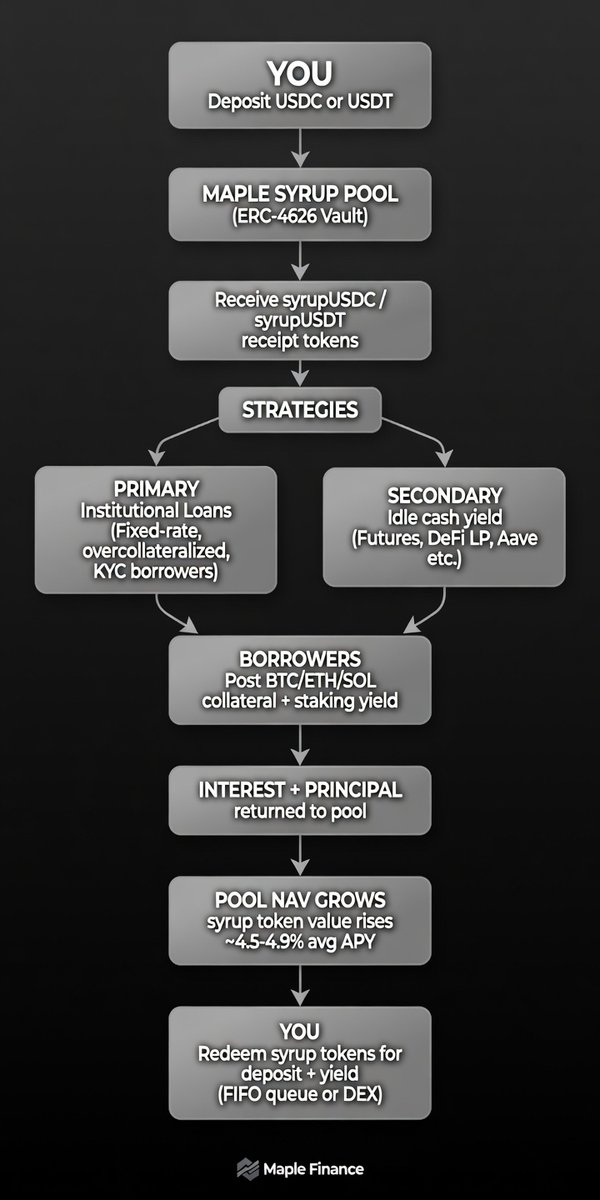
Yield Audit, Episode 8: @maplefinance's syrupUSDC and syrupUSDT 4.88% average APY over the past 30 days. $1.1645 current NAV. No depegs. No funding rate flips. No 19% yield that collapsed to 3.7%. Just a slow, steady grind built on the oldest model in finance: overcollateralized lending. Here is how it works, where the yield comes from, and why it might be the cleanest stablecoin vault in DeFi right now. What syrupUSDC and syrupUSDT are Deposit USDC or USDT into a Maple pool. You receive an ERC-4626 receipt token that grows in value as borrowers repay their loans with interest. That is it. Maple lends your deposit to vetted institutions: trading firms, funds, and market makers. They must post liquid digital assets (BTC, ETH, SOL) worth more than the loan. The interest they pay becomes your yield. No synthetic dollars. No delta-neutral hedging. Just credit. Here is the full loop: deposit → lend → repay → NAV grows. (also check ref. 2 below) Where the yield comes from The yield has two layers, but one dominates. Primary (the cake): Fixed-rate, overcollateralized institutional loans. Borrowers pay 5 to 10 percent depending on market conditions. This is where 100 percent of the backing sits. The NAV ticks up as loans get repaid. Secondary (the frosting): Unused cash earns extra basis points through futures basis trades, DeFi liquidity provision, and external strategies (Aave, Morpho, Sky). This is supplementary, not structural. When loan demand is high, most capital sits in loans. When demand lowers, secondary strategies keep money productive. syrupUSDC trailing 30-day APY: 4.88% (current: 4.83%). syrupUSDT: 4.53% (current: 4.39%). Both beat 3-month T-bills by roughly 1 percent. Yield stability scores are 96 percent and 94 percent. Nothing to declare. Safety and risks @PharosWatch rates syrupUSDC C+ (63 out of 100) and syrupUSDT C minus (52 out of 100). The difference comes almost entirely from USDT's lower liquidity and dependency risk. The scores highlight the trade-offs: Resilience (75 out of 100): Strong. Overcollateralization, 24/7 monitoring, and a history of zero lender losses from defaults. Margin calls are triggered with a 10 to 20 percent buffer above liquidation levels. Every call has been met within hours. Exit liquidity (48 out of 100 for USDC, 38 out of 100 for USDT): The FIFO withdrawal queue sounds worse than it is. Since April 2025, a dynamic liquidity buffer has brought average redemptions under five minutes. During the KelpDAO bridge exploit in April 2026, Maple processed over $800M in redemptions in 72 hours without interruption, despite having zero direct exposure to the exploit. The liquidity buffer held. The 30-day maximum in the docs is a legal bound, not a typical experience. And anyone who wants an instant exit can sell on Uniswap or Balancer: $12.8M in effective DEX liquidity for USDC is more than enough for most positions. Decentralization (37 out of 100): Poor. Off-chain underwriting, KYC, institutional custody. The smart contracts are open, but the credit process is not. Dependency risk (74 out of 100 for USDC, 60 out of 100 for USDT): Mostly fine, but you are betting on USDC or USDT holding their peg. The underrated risk: Rehypothecation. A portion of borrower collateral is staked (like jitoSOL) or lent out to generate extra yield. If the protocol holding that staked collateral gets hacked or paused, effective collateral value drops at the worst possible time. Maple manages this carefully (50 percent liquid, 50 percent staked for SOL), but the risk is not zero. USDC vs USDT: Same same but different! Though both pools share the same lending infrastructure, the user experience differs wildly. Market cap: $1.38B for syrupUSDC, $390M for syrupUSDT. Chains: syrupUSDC is on Ethereum, Base, Arbitrum, and Solana. syrupUSDT is Ethereum-only, plus a minor Plasma Mirror Vault. DEX liquidity: $41.8M across 16 pools for USDC, $10M in one Uniswap V4 pool for USDT. Effective liquidity: $12.8M for USDC, $3.0M for USDT. Recent flow (7 days): syrupUSDC added $87.8M via mints. syrupUSDT lost $31.1M via burns. Capital is voting with its feet. syrupUSDC is growing, composable, and integrated with Aave, Morpho, and Pendle. syrupUSDT is Ethereum-only, lightly traded, and shrinking. Unless you specifically need USDT exposure, stick with the USDC pool. Recent large flows Two single-wallet mints of $50M each hit syrupUSDC in the last 10 days. That is institutional capital moving in. Someone with deep pockets is comfortable with this yield profile. Meanwhile, syrupUSDT saw a $39M burn. The rotation is clear. Maple's direction The protocol is maturing. syrupUSDC is expanding cross-chain via Chainlink's CCIP. The SYRUP token has pivoted from staking emissions to a buyback model: 25 percent of protocol revenue now buys back SYRUP, aligning tokenholders with fee generation. That is a grown-up move. What I think syrupUSDC is boring. That is a feature, not a bug. It does not promise 31 percent APY. It does not have a leverage vault at 12.5x. It just quietly pays you T-bill yield plus a credit spread, wrapped in an ERC-4626 token that grows a few cents a month. For stablecoin holders tired of chasing incentives, that is genuinely useful. The yield is transparent, sustainable, and backed by a loan book you can verify on-chain. The risks (credit risk, withdrawal queue duration, rehypothecation) are there but manageable. The USDT pool is the same product with worse liquidity and a shrinking user base. Unless you specifically need USDT exposure, stick with the USDC pool. Rating: 8.5 out of 10 A solid, honest yield vehicle. The gap between the two pools and the thin off-chain underwriting keep it from a 9+. But if you are parking stablecoins and want yield without the rollercoaster, this is one of the better places to look.
Alex4DeFi tweet mediaAlex4DeFi tweet media
English
1
0
9
489
Alex4DeFi
Alex4DeFi@Alex4DeFi·
@myDeFi_life True, it's always critical to do your research. Otherwise, accept that it's pure gambling.
English
0
0
0
4
VanMilk
VanMilk@myDeFi_life·
The protocol is telling you: someone else is pricing this risk higher than you are. Before you enter — figure out who that someone is. Usually it's the market. Usually it's right.
VanMilk tweet media
English
1
0
1
8
Alex4DeFi
Alex4DeFi@Alex4DeFi·
@TokenBrice Fair enough. Having every depeg mapped with collateral type and redemption terms is the kind of boring work that actually saves money.
English
0
0
0
11
tokenbrice.eth (🐜,🔍)
@Alex4DeFi It's much more than just the past depegs it's every single past depeg x the densest stablecoin database ever created (type, collateral, peg mechanism, minting authority, liquidity, redemption, etc.)
English
1
0
1
26
tokenbrice.eth (🐜,🔍)
Pharos has the most comprehensive stablecoin database ever built = it knows the past, every depeg, every failure Pharos already anticipates the close future (all recent severe depegs: USR, pmUSD, EEUR) & soon, it will predict the far future with DDR: Depeg Duration Resolver
English
2
2
23
1.1K
Alex4DeFi
Alex4DeFi@Alex4DeFi·
@ronezra3 The network emissions. TAO prints whether anyone uses the subnet or not.
English
0
0
0
7
Rono τAO | UnStop-Labs
what makes a good subnet on Bittensor: a well-defined task miners can compete on, a scoring mechanism validators can't easily game, and real demand for the output. most subnets fail on the third one. demand is the hard part.
English
1
0
1
28
Alex4DeFi
Alex4DeFi@Alex4DeFi·
@RWAFoundation_ The custodian still holds the keys offline, so the chain is just a receipt.
English
0
0
0
8
RWA Foundation
RWA Foundation@RWAFoundation_·
RWAF members: Blockchain edition. We often describe blockchains as the motorway for real-world assets and it’s true. Some chains are built for speed. Some are designed with institutions in mind. Some are purpose-built for RWAs and compliance. Others focus on low fees, liquidity, or interoperability. There’s no “one chain wins all” outcome. Different assets and issuers have different needs. A tokenized treasury fund doesn’t need the same infrastructure as tokenized real estate. A global payments network won’t prioritize the same things as private credit markets. That’s why the RWA ecosystem is spreading across multiple chains, each bringing different strengths to the table. @StellarOrg @0xPolygon @avax @solana @RealFinOfficial @plumenetwork
English
12
9
101
2.5K
Alex4DeFi
Alex4DeFi@Alex4DeFi·
@disclosetv The same people building the displacement won't be the ones paying for the support.
English
0
0
1
972
Disclose.tv
Disclose.tv@disclosetv·
NOW - Anthropic co-founder says there is a "real possibility that AI will displace human labor at a very large scale," and that supporting those people "will be a moral imperative of historic proportions."
English
447
743
3.9K
574.9K
Ted
Ted@TedPillows·
GM☕️. A flat white and a puppychino to start the day 🐕
Ted tweet media
English
381
9
481
14.2K
Alex4DeFi
Alex4DeFi@Alex4DeFi·
@icobeast The foundation sells influence, not just coins. That doesn't run out.
English
0
0
0
29
IcoBeast.eth🦇🔊
Most bullish part of Vitalik’s post today is that EF only has 0.16% of ETH left so the largest structural seller is actually almost out of coins
English
55
20
425
26K
Alex4DeFi
Alex4DeFi@Alex4DeFi·
@LLuciano_BTC "Direct" liquidity still means you're trusting a broker-dealer not to freeze your shares when the regulator calls.
English
0
0
0
17
Lucky
Lucky@LLuciano_BTC·
Hearing more chatter around Bitget building its own stock RWA infrastructure. Multiple internal employees reportedly confirmed that the exchange plans to launch native stock tokens in the future. Unlike most platforms that depend on Ondo’s setup, where liquidity has been a common concern, Bitget’s solution is said to plug directly into Nasdaq and NYSE liquidity. If true, that could make tokenized stock trading feel much closer to using a real traditional brokerage.
Reality@RealityFi_xyz

A new way to access RWA, is coming soon.

English
44
21
1K
103.9K
Alex4DeFi
Alex4DeFi@Alex4DeFi·
@kaiynne Clarity of purpose doesn't matter if the market decides another chain is impressive enough.
English
0
0
0
34
kain.inx
kain.inx@kaiynne·
I don’t agree with everything in this post, but I am in extreme agreement wrt to ensuring Ethereum is the most impressive chain in the world. It’s the best positioned to do it by far and I think clarity of purpose is hugely helpful.
vitalik.eth@VitalikButerin

Some of my perspective on where the @ethereumfndn is going. First of all, this is only my own view. The board is not just me, and I have no extra special powers on the board that the other board members do not. @aerugoettinea is the one executing much of this transition. My input has been largely on technical questions. The board is in the process of expanding, and my own power within the org will continue to decrease, which is honestly what I want. The 2025 era brought many important improvements to EF and its ability to execute. Many issues were resolved, and EF continues to benefit from its improved efficiency and greater focus on concrete goals to this day. And so with those problems resolved, early this year, the largest remaining hole that I perceived was something different nagging at me: I would regularly spot people saying things like "vitalik says these beautiful things about ethereum needing to be decentralized, and have privacy, and be a sanctuary technology, but why do the EF's actions not reflect that?" Now, you may have been hearing something different. You may not have been sensing a feeling of crisis at all, and maybe were hearing people saying that finally we were taking execution and BD seriously and the main task for us is to keep going that way and be even better and faster. Then probably there is genuine difference between you and me, in what kinds of criticism I take most seriously, and what kinds of critics through their criticism are most able to make me feel pain. As an analogy, let's briefly switch over to a different domain. One belief you can have about Google is that it is a success story, and has brought a lot of good to humanity in organizing the world's information. Another belief you can have about Google is that they had a beautiful idealistic beginning, but at some point the corruption of mainstream corporate attitudes seeped in, and they slowly bit by bit completely abandoned the "don't be evil" slogan. My belief on Google specifically is probably somewhere between the two. BUT, if you had taken me back in time to ~2008, and offered me a button to press to make Google one or two standard deviations more "dogmatic", eg. give Richard Stallman permanent veto power over some key policies, I would immediately press it. Why? Because a choice for one company is not a choice for the world, or even one country. Google existed and exists in the context of a technology industry generally drifting away from early idealistic don't-be-evil roots and toward greed for financial gain, totalizing visions of accelerated superintelligence, infiltration by sociopaths, and craven capitulation to (or worse, active participation in) government pressure for ideological control, surveillance and war. And so *one company* doing something different, positioning itself to be what George Bernard Shaw calls the Unreasonable Man, resisting the trend of the times, would have been better for freedom, balance of power and stability of society as a whole, than *all* large companies bending to dominant trends. This is a part of my version of pluralism. This line of thinking is not just mine, but I also is not too far off from what Aya and others had in mind with the Mandate. Now how does this all get to the role of the EF? EF is not a "center of Ethereum", rather EF is "one node, with a defined purpose, alongside other nodes". We've always said that the EF should be the latter, but many in the Ethereum ecosystem (and even within the EF) wanted us to be the former. Now, we are taking action to ensure that we will be the latter. This is particularly important because EF is a limited organization, with limited resources and limited organizational capacity. The EF has only ~0.16% of all ETH (less than many other individual ETH holders), whereas among other blockchains it's common for "the central foundation" to have 10-50%. Fiscally, the EF was originally designed to fulfill a limited work scope defined in the token sale docs and other pre-launch materials (building the chain software; getting through Frontier, Homestead, Metropolis, Serenity), which was fully completed in 2022; it was not designed to be an eternal steward. And so today, the EF is choosing to use its remaining resources to pursue longevity over breadth (yes, this means we sell less ETH). The EF focuses *specifically* on those activities critical to the success of ethereum as a censorship/capture-resistant, open, private and secure system, that would not happen otherwise. This means making hard choices, and in some cases even activities that we highly approve of and people that we highly respect becoming outside of the EF. People of great technical talent, public respect and even alignment with the mission and CROPS being outside of the EF is in fact necessary if we want important tasks to be able to attract outside capital. This also means the EF taking opinionated stands culturally. This is all intended in cooperation with all other parts of ethereum. We recognize that many other parts of the ethereum world highly respect CROPS and related values. But highly respecting is not the same as choosing to specialize and totally dedicate to a domain (Compare in a different domain: I think reducing animal cruelty is important, and I like vegan food, but am not full unconditional vegan myself) EF is still in a transition period, and we expect its new long-term form to stabilize over the next few months. What are the guiding principles of this new form? Again, I am only one person, but I can give my answer from a technical perspective (there are also critical non-technical aspects). At the core, *Ethereum must be impressive*. We are living in an age of highly intelligent AI and all kinds of other technological acceleration. "Status quo EVM, with a hard fork or two a year to optimize for short-term needs of users" is not interesting. To some, "impressive" means: 250ms latency and 1M TPS. I think Ethereum trying to go that route is a mistake. Being as fast and as scalable as possible, and only a small epsilon more decentralized than the others, is a route to mediocrity, and if we try it we will lose. I think Ethereum should scale. But I think Ethereum should strive the hardest to be deeply impressive in a different dimension: the CROPS dimension. This means things like: * Provably bug-free Ethereum. This is a goal that all cybersecurity researchers would have thought is absurd and impossible, up until roughly 6 months ago. Now, it's on the cusp of being possible, thanks to AI-assisted formal verification. So we should be frontrunners in doing this. * Available chain consensus. Ethereum is, and with lean consensus will cotninue to be, the ONLY chain that has both (i) traditional-BFT style properties that it's safe under asynchrony up to a high level of fault tolerance, and (ii) the bitcoin PoW-style property that under synchrony it's safe up to 49% attackers. As far as I can tell, literally no other chain has this or is planning for it; bitcoin goes for (ii) only and most other chains go for (i) only. Some will remember I fought hard for this, Unreasonably insisting that it is not OK for ethereum to rely on social consensus and hard forks to rescue ethereum from 34% of nodes going offline. It's OK for chains like hyperledger, bnb, solana, tempo, etc. It's not OK for bitcoin or ethereum or eg. zcash. * Intermediary minimization. The fact that smart contract wallets, protocols like railgun, etc have to send transactions through intermediaries to get included onchain is honestly embarrassing, and it's a constant point of fragility. Hence the work on FOCIL and EIP-8141 (and 7701 and years of work before) to make transaction sending intermediary-minimized with public mempool and strong inclusion properties, in a truly general-purpose way, that covers not just eg. secp256r1, but also privacy protocols and much more. Kohaku is pushing intermediary minimization at the user layer, pulling Ethereum away from the dystopian status quo world where our wallets don't even verify the chain, send our private data out to a dozen third-party servers, and toward a brighter CROPS future. Some of these goals are Unreasonable - maybe Ethereum would be "fine" getting only 50% of the way - what if we depend on intermediaries, but make it easy to switch? But going 50% of the way would not make Ethereum Deeply Impressive in the CROPS way. So we push for 100%. Fortunately all these goals are compatible with high TPS, this is a major focus of research (esp. on scaling the state). Well-designed L2s can also help, especially L2s optimized for specific applications (eg. high-volume trading, privacy...). These goals are even compatible with significantly lower slot times, thanks to Raul's work on erasure-coded P2P, and many other optimizations. The most high-value "product" of the ethereum blockchain, financially speaking, is ETH the asset. Ethereum secures $250 billion of ETH. The types of properties of Ethereum that I mentioned above are very good for ETH the asset. Nearly 90% of my net worth is in ETH, and most of the remainder is ~$40m of onchain fiat of which every dollar has already been allocated for some open-source biotech or software or hardware initiative. That said, there are aspects of supporting ETH the asset - *necessary* aspects even - that are outside the scope of the EF. This is where we need other heroes (some of whom hold more ETH than the EF does) to step in and help. EF has been recently thinking more about how it will relate to other such organizations, and give them needed initial support. EF will be a smaller ship than in previous years, a more opinionated one - in some cases more opinionated in ways that might be difficult to comprehend - but a longer-lasting one, and one suited to making sure that ethereum brings something meaningful to the world. We are grateful to all those inside and outside the EF who are helping to make this happen.

English
17
3
135
8.1K
Alex4DeFi
Alex4DeFi@Alex4DeFi·
@KingBund @piriya Great first principles talk. Just missing the part about knowing when to take profits :)
English
0
0
0
4
Gun (Kingbund)
Gun (Kingbund)@KingBund·
New EP is here! In this episode, I sat down with Ajarn @piriya , the number 1 Bitcoin Educator in Thailand, for a super deep dive into Bitcoin, money, inflation, and the future of the global financial system. We discuss what makes Bitcoin different from traditional money, why Bitcoiners believe it is the purest form of money ever invented, the strengths and weaknesses of Bitcoin maximalism, and why understanding money may become one of the most important skills for the next decade. This conversation covers Bitcoin from first principles, including scarcity, decentralization, inflation, monetary history, self custody, long term conviction, and the risks of Bitcoin going either to millions of dollars or zero. Whether you are new to Bitcoin or already deep in crypto, this episode will help you think more clearly about Bitcoin, money, and the future. Timestamp: 0:00 Intro 08:06 Getting more serious with Bitcoin 09:55 What is Rightshift? 11:46 What is Bitcoin explaining to your grandma? 18:06 What is the definition of a Bitcoiner? 19:38 Toxic Bitcoin maximalism 26:01 Is Bitcoin becoming a religion? 28:26 Austrian economics vs Keynesian or Chicago School 39:27 Bitcoin Core developments and progress 43:56 Bitcoin offchain transactions 44:50 Lightning Network 52:20 Bitcoin Layer 2s 54:40 Bitcoin vs stablecoins 58:32 Bitcoin treasury companies and MicroStrategy 1:06:36 mNAV of different Bitcoin treasury companies 1:08:23 What drives Bitcoin cycles the most 1:18:50 Options and futures to hedge portfolio 1:21:08 Bitcoin correlation to traditional assets 1:27:16 Future of Bitcoin 1:31:01 Convincing people about Bitcoin 1:33:11 Last words
English
2
0
3
134
Alex4DeFi
Alex4DeFi@Alex4DeFi·
@HctorToloza @solana "Zero liquidation risk" just means the rebalancing happens automatically, but if the market moves faster than the protocol can react, that promise breaks
English
0
0
0
8
Héctor Toloza
Héctor Toloza@HctorToloza·
Historic! The open interest (OI) of the DEXs on @solana has just broken the $200 million barrier. The appetite for leverage on the network is at unprecedented levels. BUT there's an important point to highlight here. Almost everyone assumes that to reach that OI you need to be a traditional futures DEX with high-frequency trading, speculation, and ephemeral contracts. With recent data, Sol's open interest is divided as follows: ◇Jupiter $29.84M ◇Hylo $23.5M ◇Pacífica $7.76M @hylo_so, with a single leveraged asset (xSOL), represents more than 10% of the equivalent of that entire global market, far surpassing platforms dedicated 100% to PerpS. The difference lies in the structural leverage architecture. As the team mentions, PerpS has structural flaws for the average user. 🔴 Too technical for the average retail investor. 🔴 Funding fees that drain your position. 🔴 Hidden fees and handling charges. 🔴 Constant risk of liquidation due to market wicks. Smart traders don't over-leverage. That's why in TradFi, retail investors prefer leveraged ETFs to futures. By launching xSol (the first native 3x leveraged token on Solana), Hylo completely changed the game. ✅ No funding fees. ✅ No traditional or forced liquidations due to a crazy market wick. ✅ Fully composable positions. The most amazing thing is that this $23.5M in OI is just the beginning of something bigger to come. Today it's only xSOL, but Hylo's infrastructure is designed for massive scalability. When they launch the next xAssets, enabling efficient leveraged positions, the ceiling disappears. The Open Investment (OI) will seem minuscule when institutional liquidity begins to flow into a system without the frictions of PerpS. "The Alien Factor" and the Backing: This architecture is so disruptive that even @0xPlish admits that traditional VCs initially rejected the project because it seemed "too alien" to them; they didn't know how to categorize it. Only Solana Ventures and Colosseum had the vision to back it, understanding that the ecosystem needed a completely new and secure financial primitive where true fundamental value always wins.
Tokens on Solana@tokens

HUGE: $SOL perpetual DEX open interest surpasses $200 million for the first time.

English
1
0
4
299
Alex4DeFi
Alex4DeFi@Alex4DeFi·
@SolanaSensei Dubai's convenience runs on oil money. Solana's runs on subsidy.
English
0
0
0
20
Solana Sensei
Solana Sensei@SolanaSensei·
Solana reminds me of Dubai. We truly get spoiled here. Wanna randomly buy groceries at 2 am and get them delivered in 10 mins? Done. You want to order a huge ass TV and a PS5 in 15 mins? Done. You want a massage in one hour? Done. You want to wait only 5 seconds for an Uber? Done. You want valet parking almost everywhere? Done. Life here becomes dangerously convenient. It feels the same on Solana. You want to trade stocks instantly? Done. You want better rates than CEXs? Done. You want instant transactions with zero fees? Done. You want to buy Pokemon cards and ship them home? Done. You want gold, commodities, RWAs, prediction markets, perps, memecoins? Done. You want your idle assets generating yield while you sleep? Done.
English
38
3
133
7.7K
Alex4DeFi
Alex4DeFi@Alex4DeFi·
@ZynxBTC Raising billions in a bear market usually means selling at the worst possible price.
English
0
0
0
40
Zynx
Zynx@ZynxBTC·
There is some good that comes with Bitcoin bear markets. The weak hands leave and the tourists go quiet. The people who remain are the ones who actually understand what they are holding. A healthy purge. For companies like Strategy and Strive, a bear market is the ultimate stress test. Raising billions, maintaining products at par and continuing to accumulate while Bitcoin is down is proof of concept that no bull market could provide. They have passed that test. $STRC and $SATA have both demonstrated remarkable resilience. Products designed to hold par value during the hardest period for Bitcoin since their launch. That credibility cannot be manufactured, It has to be earned. Then there is the accumulation opportunity. Strategy has bought 4% of the entire Bitcoin supply. Strive has been growing its balance sheet week on week. Metaplanet has been compounding yield with a profitable operating business. More importantly, sovereign individuals get the opportunity to add to their stack at cheap prices. When the tide turns, and it always does, the positions built during the bear market are the ones that change lives. Bear markets are where wealth is created.
English
17
8
150
5.5K
Alex4DeFi
Alex4DeFi@Alex4DeFi·
@jussy_world The teams that stick around are usually the ones who already failed at exiting.
English
0
0
0
129
jussy
jussy@jussy_world·
Most teams building projects just to later exit via token You really shouldn't believe in them or what they are saying And if you do, you will keep losing money and time There are only a few projects/teams in crypto that are really building something for the long term
jussy tweet media
English
37
3
92
5.3K
Alex4DeFi
Alex4DeFi@Alex4DeFi·
@sjdedic Those users don't know they're on crypto, so they won't buy the token either.
English
0
0
0
53
Simon Dedic
Simon Dedic@sjdedic·
Something that doesn't get talked about enough: Even if prices don't reflect it yet, crypto is quietly building more breakout products that are pulling in users from outside the industry than ever before. Stablecoins have become the most obvious one. Trillions in monthly volume, used by people and businesses around the world who sometimes don't even know or care that they're using crypto. Just faster, cheaper, borderless money. Polymarket became the go to prediction market during the elections and is now a household name far beyond crypto when it comes to more honest news and information markets. Hyperliquid and perp DEXs are attracting TradFi traders who use them to price pre IPO assets or hedge on weekends when traditional markets are closed. I mean even onchain collectible platforms like Collector and Beezie are leveraging crypto rails to 10x the experience and liquidity for collectors, positioning themselves to disrupt a massive mainstream market and eventually cause a huge retail influx. What all of them have in common: These aren't crypto products trying to find gamblers to pump and dump their underlying token. These are genuinely superior products that happen to be built on crypto, pulling mainstream users into the ecosystem without them even realizing it. We've never had real products with real mainstream traction and sustainable onchain revenue like this before. The price action doesn't always reflect it, and that's exactly why most people miss it or think we are dead. But this is the most bullish setup crypto has ever had and sooner or later, prices will follow aggressively.
English
27
5
80
4.3K
Alex4DeFi
Alex4DeFi@Alex4DeFi·
@Proof_Of_Voice Really appreciate this. Means a lot coming from you guys. Looking forward to continuing building together.
English
0
0
1
20
Proof of Voice (PoV)
Proof of Voice (PoV)@Proof_Of_Voice·
@Alex4DeFi We highly reccommend this guy. As an analyst, always trying to dive really deep into the project, not just sharing the hyped headlines. Proud to have him among Proof of Voice experts
English
1
0
3
22
Alex4DeFi
Alex4DeFi@Alex4DeFi·
I'm building in the open as an independent DeFi analyst. Publishing weekly protocol deep-dives with real capital behind every take. Looking to connect with founders, builders, and analysts working on DeFi protocols. Goal: help accelerate adoption by making complex mechanics readable and trustworthy. If that resonates or you know someone building seriously in this space, drop a comment or DM. Appreciate any intros.
English
1
0
1
77
Alex4DeFi
Alex4DeFi@Alex4DeFi·
@dgt10011 Most people in crypto learn this right after the shortcut they trusted disappears.
English
0
0
0
7
Jeff Park
Jeff Park@dgt10011·
1. Nothing is free (esp from strangers) 2. Freedom is valuable 3. Achieving freedom has a cost 4. That cost is EFFORT There is no shortcut in life. Anyone who tells you otherwise is taking your freedom to achieve theirs. Just remember this simple rule and you will be alright.
English
19
18
263
14.7K