At hypergrowth companies like Vercel, Harvey, and Cognition, executives face a brutal challenge: keeping pace with a company that might grow 5-10x in a year. That means hiring aggressively without lowering the bar, figuring out how to mature the org without slowing down, operating at different altitudes, solving novel problems, and much more. Their role changes quarter to quarter, and the margin for error is razor thin.
I'm really excited to launch our newest podcast, Executive Function, which explores a simple question: what is the difference between a good and truly great scaleup executive? We learn what these exceptional execs are doing differently, how they approach their work, how they make decisions, and how they make a difference for their companies.
The first episode drops later this week. Learn more at: review.firstround.com/executive-func…
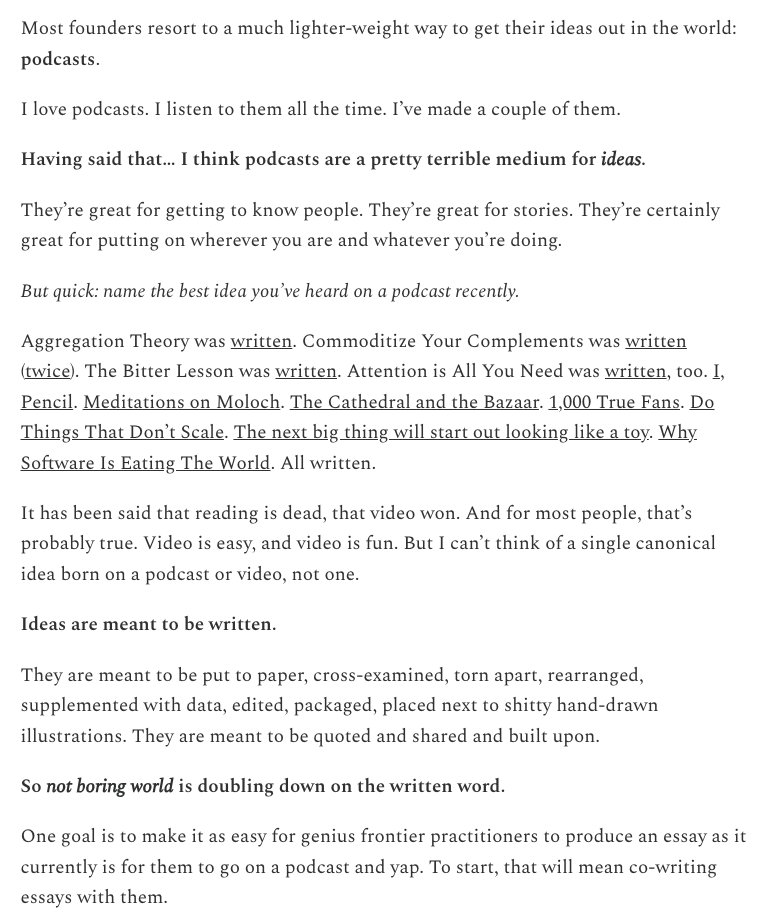
Ideas are meant to be written.
After six years of fully free, I'm launching a paid piece of not boring: not boring world.
Where the world’s smartest founders, researchers, investors, creatives, and general geniuses, the ones I couldn’t hire as a full-time writer for a million bucks, write their best ideas.
Here’s the master plan.
Geniuses bring their genius ideas, I help write them. Call it a Cossay or a Joint or something. Whatever we call it, make it as easy to for busy practitioners to share their insights in the essay format those insights deserve as it is for them to spill them on a podcast.
We get all the geniuses in one place, and then we grow from there. This world is biological; your guess re: how it evolves is as good as mine. But it will, and I want you to be a part of it.
We are making a few bets. That ideas are meant to be written. That people who are out there doing things earn ideas you can’t find in LLMs. That the most biased narrator, the one betting his or her livelihood on his or her idea, is the most reliable narrator. That when it’s easier than ever to get mediocre outputs on-demand, the best thing you can feed your brain is high-quality inputs from high-quality people.
That the future can be full of both means and meaning, and that we can create the home for this good future online. A place that’s smart and weird and, hopefully a little magical.
I mean, it’s a newsletter, so we’ll see. But that’s what I’m going for.
My biggest learnings from Jeanne DeWitt Grosser (ex-Chief Business Officer at @Stripe, now @Vercel COO):
1. What failed seven years ago now works with AI. In 2017, Jeanne tried to build a system at Stripe that would automatically personalize outbound emails based on company data. Despite working with world-class data scientists, it failed due to too many errors. Today, that exact same approach works. This shows how AI has made previously impossible ideas suddenly viable.
2. A single GTM engineer at Vercel reduced a 10-person sales team to 1 (in just 6 weeks). Jeanne’s team at Vercel had an engineer build an AI agent that handles inbound lead qualification, outbound prospecting, and deal loss evaluation. The agent costs $1,000 per year to run versus over $1 million in salaries for the sales team. The nine displaced team members moved to higher-value work rather than being laid off, and the remaining salesperson is 10 times more efficient.
3. Their AI deal-loss bot has become better at understanding what went wrong than humans. When Jeanne analyzed her biggest loss of the quarter, the salesperson blamed pricing. But an AI agent reviewed every email, call transcript, and Slack message and discovered the real reason: they never spoke to the person who controls the budget, and when ROI came up, the customer clearly didn’t believe the value claims. They are now using AI to analyze sales calls in real time and send alerts like “You’re halfway through the sales process and haven’t talked to a budget decision-maker yet.”
4. Wait until $1 million in revenue before hiring your first salesperson. Founders should continue selling themselves until they reach around $1 million in annual revenue with a repeatable process. The key is having a defined ideal customer profile—customers who look alike.
5. Segment customers on what drives their buying decisions, not just company size. OpenAI has roughly 3,000 employees, which would typically put them in the “mid-market” category. But they’re a top-25 website globally by traffic, so Vercel treats them as enterprise customers requiring complex sales. Effective segmentation combines company size with growth rate, web traffic, workload type, and industry—because selling to e-commerce companies requires completely different language than selling to crypto companies.
6. Most customers buy to avoid risk, not to gain opportunity. About 80% of customers purchase to reduce pain or avoid problems, while only 20% buy to increase upside. This means you should focus your sales messaging on what could go wrong without your product—like falling behind competitors or damaging their reputation—rather than just talking about exciting features. This is especially true when selling to larger companies, where individual careers are on the line.
7. Sales teams should be indistinguishable from product managers—for a bit. Jeanne hires salespeople who have such deep product knowledge that if you put one in front of a group of engineers, it should take 10 minutes to realize they’re not a product manager. This credibility allows sales teams to serve as an extension of research and development—a 20-person sales team talks to hundreds of customers weekly and can translate those conversations into product insights at scale.
8. Building your own AI sales tools may beat buying off-the-shelf software. Because AI is so new and every company’s sales process is unique, Jeanne finds that building custom internal agents often delivers more value than buying vendor solutions. A single go-to-market engineer built their deal analysis bot in just two days, perfectly tailored to their specific workflow. These engineers shadow top salespeople to understand their workflows, then build automation that would have taken months or been impossible just a few years ago.
9. Make every sales interaction great, whether customers buy or not. Jeanne replaced boring discovery calls at Stripe with collaborative whiteboarding sessions where customers drew their payment architecture. Many customers had never visualized their own systems before. They left with a useful asset and a feeling of collaboration, regardless of whether they bought. Many returned years later to purchase. Think about your go-to-market process like a product, not just a sales function.
10. Product-led growth has a ceiling—no $100 billion company runs on it alone. While product-led growth (where users can sign up and start using a product without talking to sales) works well for early growth, customers generally won’t spend a million dollars through a self-service flow. Every major technology company eventually builds a sales team for larger deals. The mistake is waiting too long, since building a predictable sales process takes time.
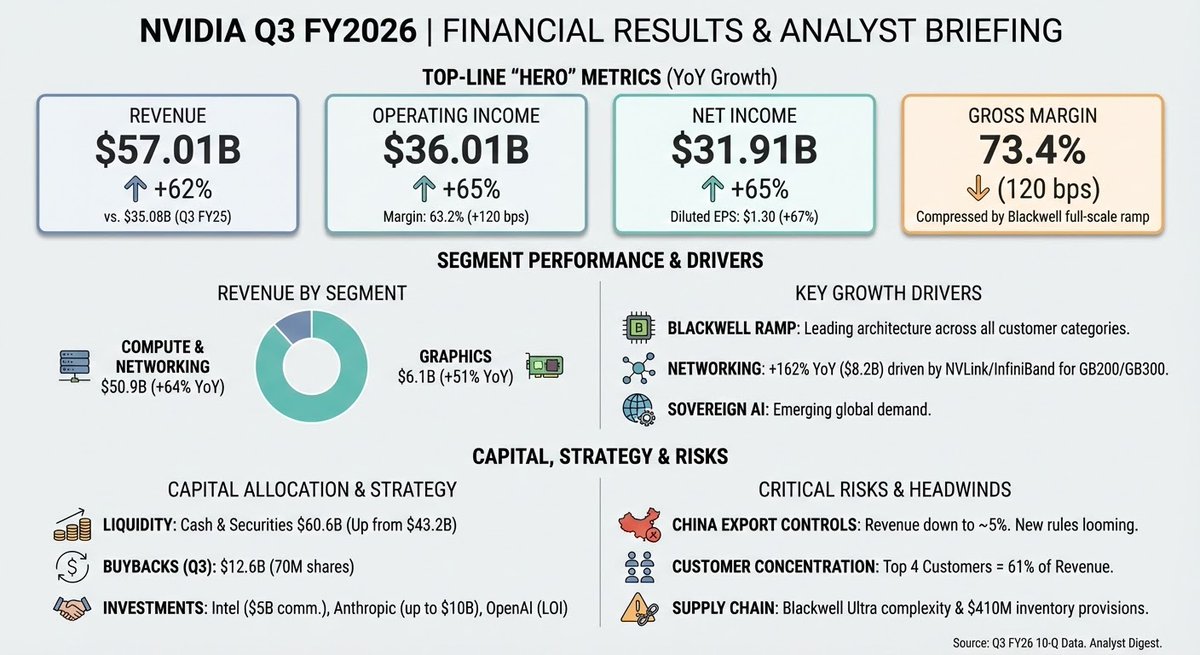
You went 🍌🍌 for Nano Banana. Now, meet Nano Banana Pro.
It’s SOTA for image generation + editing with more advanced world knowledge, text rendering, precision + controls. Built on Gemini 3, it’s really good at complex infographics - much like how engineers see the world:)
Check out my holiday gift guide for tech people with taste 🤌
Over 90 high-quality, non-obvious ideas. No slop here.
Including products for the home, kids, parents, gadget lovers, your stressed founder friend, and for the PM who just cashed out their OpenAI stock.
I'd grab these items soon before other readers snatch them up: lennysnewsletter.com/p/a-holiday-gi…
One of my favorite lessons I’ve learnt from working with smart people:
Action produces information. If you’re unsure of what to do, just do anything, even if it’s the wrong thing. This will give you information about what you should actually be doing.
Sounds simple on the surface - the hard part is making it part of your every day working process.
Ye olde CEO playbook I used in building @HubSpot is broken. From Jensen Huang’s 60 direct reports to the way Elon runs his empire to Brian Chesky’s founder mode – it's a reboot.
This new playbook is something I’m very curious about so I started a special interview series with some of the best CEOs out there to try to learn what new plays are working from startup to scaleup and beyond.
If you are a CEO or future CEO, join me on the Long Strange Trip series starting on Thursday with @parkerconrad of @rippling’s own Long Strange (CEO) Trip.
Black Friday has finally arrived - this is the biggest weekend in retail for brands of all sizes. We built the Shopify Live Globe so you can watch commerce happen live, in real-time, around the world.
Every firework shows when a brand new entrepreneur gets their first sale on @Shopify - five years from now these could be the biggest brands in the world.
A new golden age of retail is here, and it’s happening on @Shopify.
Well, I couldn't write a better headline myself.
Let me summarize this article: The enterprise migration is happening. The biggest and best brands are coming to @Shopify.
bloomberg.com/news/articles/…
New episode just dropped!
@katieeperry sat down with @Shopify President @harleyf to talk about:
• The company's recent growth
• The importance of executive personal branding
• Partnerships to enhance merchant experiences
$SHOP
Watch here: youtube.com/watch?v=BGpSX2…
Just wrapped the @Shopify Q4 2023 Earnings call. 2023 was an incredibly strong year for Shopify and our merchants.
We powered $236 billion in annual GMV, released hundreds of products, had even more success with the best-converting checkout, and we continue to have the best brands come over to build with us.
@Shopify is fundamentally transforming the way businesses and consumers do commerce. Commerce moves fast, but @Shopify moves faster.