Aleksei Balchunas
6.2K posts

Aleksei Balchunas
@AlexeyBalchunas
Built 10+ products, sold 2, killed the rest. Now posting the stories with the numbers left in. Teardowns, real ops, applied AI. Small ambition is the trap.

Phuket, Thailand Katılım Ekim 2009
289 Takip Edilen2.9K Takipçiler

@kimmonismus A classroom forces one teacher to average the lesson across a group. An AI tutor can stay with one student until every piece clicks. That is exactly how I learn new topics now: I keep asking until I understand the mechanism. What a time to be alive.
English

I often think about how AI is truly changing the world. When I was still in school, Wikipedia was the first place people turned to when they wanted to learn something. At the same time, schools frowned upon it because its sources supposedly could not always be fully verified and students were expected to “think for themselves.”
Today, the situation is entirely different. From an early age, every child has access to the world’s collective knowledge, tailored to their level of understanding, adapted to what they already know, and able to respond to follow-up questions at any time. A chatbot never gets tired or annoyed by repeated questions. It remains patient, polite, and friendly. Children’s curiosity can always be satisfied. Every question receives a personalized, age-appropriate answer. This encourages learning because access to knowledge is virtually unlimited.
And this is only the most superficial beginning. We all know what agents are already capable of. Today’s generation of children will grow up in a world of unlimited, personalized access to knowledge. Schools and universities will have to reinvent themselves completely.
I graduated from university in 2019, before ChatGPT took the world by storm. I can hardly imagine how much more effectively and purposefully I could learn today. The world will never be the same again. And I am excited about it and looking forward to what comes next.
English

@AlexeyBalchunas Voice makes me feel like I'm at the front of the change...
English

You can raise before you start the company.
4 investors and accelerators accept founders at pre-idea or idea-only:
- @join_ef
- @southpkcommons
- @AntlerGlobal in selected locations
- @villageglobal
Early money deserves extra scrutiny on dilution.
English

@zdogmode Building things is so much fun. Why the hell do you need weekends?!
English

@petergostev People just got used to $200/m, give them some time
English

@AradhyeAgarwal And then ignoring the AI warning to revoke the key.
English

@blelbach Teach the invariants: decomposition, tests, debugging, data models, security, and recognizing a wrong answer. Syntax is becoming optional; judgment is not. I once learned more by building a compiler in assembly than from years of routine development.
English

I don't know how to teach software engineering anymore. What made sense two years ago doesn't make sense today.
vik@vikhyatk
we’re in uncharted territory. there is no book that teaches you how to build software in 2026. everyone is learning from first principles

English

@charliermarsh Slightly more complex projects are not solved yet. They still require far fewer software engineers than they did a year ago.
English

@PrajwalTomar_ Founders constantly trade security for speed because moving too carefully can lose the market. I would make it risk-based: auth, payments, permissions, backups, and user data are never "later"; polish and architecture often can be.
English

Vibe coders are getting sued.
People are shipping apps with real users and skipping the boring stuff that kills them.
A 20+ year dev shared the pre-launch checklist every AI builder needs.
I added what I learned after shipping 60+ apps at the agency.
Don't skip this:
1. Protect yourself, not just your app. The moment you collect user data you're in legal territory (GDPR, CCPA). Have a privacy policy. Know where user data lives.
2. Row Level Security. Without RLS, anyone can open DevTools and read your entire database. Supabase → Auth → Policies. Zero policies means your app is naked. 5 min to fix.
3. Test the failure path, not just the happy path. Wrong password 5x. Reset for an email that doesn't exist. Verification link clicked twice. Signup with an existing email. Catches 80% of auth bugs.
4. Security baseline in 2 min. Prompt your AI: "Review my app as a security specialist and make sure I have strong security headers and a solid baseline security posture."
5. OWASP. Prompt: "Review my app against OWASP standards and highlight vulnerabilities." This is where SQL injection, XSS and auth bugs actually get caught.
6. Client-side validation is UX, not security. Attackers disable JS and hit your API directly. Validate again on the server. Every time.
7. AI code leaks data in 3 spots: .env values in the frontend, API responses returning too much, secrets in logs. Prompt: "Check my app for credential or sensitive data leaks in frontend or API routes."
8. API keys in the frontend means game over. If it's in the browser, assume it's already taken. Move it server-side or proxy it.
9. Rate limits before someone burns your API bill. Cap every endpoint hitting a paid API. I've watched a Supabase bill jump from $20 to $200 in a day.
10. CAPTCHA on public forms (Cloudflare Turnstile is free) plus CORS locked to your domain. 10 min, kills bot floods.
11. Error messages that don't leak. "User not found", not "SELECT * FROM users failed". Log full errors server-side, show users generic messages.
Build fast. Just don't ship naked.
(full breakdown in my article below)

Prajwal Tomar@PrajwalTomar_
English

SOMEONE BUILT A TOOL THAT TURNS ALL YOUR OLD SCREENS INTO ONE BIG SYNCED DISPLAY
everyone has a pile of dead screens sitting around, old phones, tablets, ipads, monitors, a tv nobody uses.
this turns all of them into one group of synced screens that work together as a single surface
> lay them out however you want and they sync up as one display
> each one shows its own widget, or they all work together to show one thing across every screen
> content flows across the gaps between them like theyre one continuous panel
> it works with basically anything with a screen, and you can mix them all together
> nothing new to buy, you just use whatever youve already got lying around
everyone has 3 or 4 devices that still work perfectly, they just got replaced. this gives them an actual purpose again instead of slowly dying in a drawer
people are already planning wild setups with it, one guy immediately clocked that you could turn a group of screens into a cinema
taking hardware everyone already owns and already gave up on, and making it useful again, thats a great product idea
English

@mfishbein This looks useful, but not very valuable as a business. The whole system is easy to copy once the workflow is public.
English

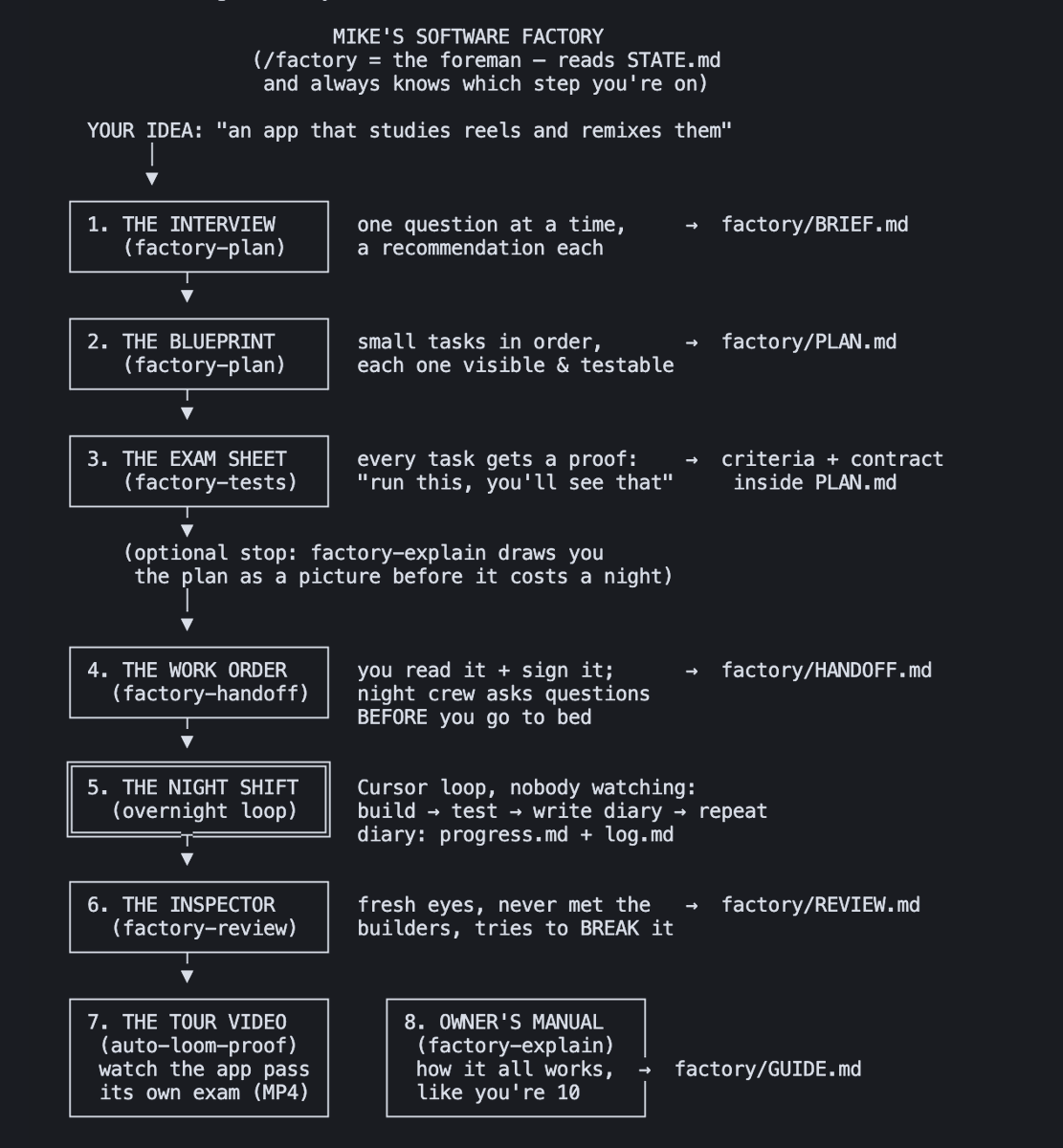
This is my personal software factory.
It turns ideas into working products while I sleep. No babysitting coding agents with prompts all day.
Cursor and Claude Code made writing code way easier. The harder problem is building a system that can context engineer and manage itself.
My factory starts with a Skill called `/factory`. It's the foreman that remembers where the project stands and sends in the right worker for the job.
Factory runs this assembly line:
1. `/factory-plan` - the interviewer
Reads the existing codebase (if there is one), extracts missing context from me via interview, and writes a product brief.
2. `/factory-plan` - the planner
The same skill turns the approved brief into small, testable features and development tasks.
3. `/factory-tests` - the professor
Before anyone writes code, every task gets an exam. This skill defines the success criteria for each task, and how the coding agent can prove to itself that what it built works or needs iteration.
4. `/factory-explain` - the presenter
Explains the plan to me like I'm 10, with visual metaphor and mermaid charts. Now that coding agents can write more code, faster than any human ever could, the new bottleneck is human understanding of the code. This skill solves that.
5. `/factory-handoff` - from CTO to SWE
This packages the brief, plan, tests, safety rails, and stop conditions into one work order. Factory uses the best models for the planning in the previous steps above, then hands the work order to a lower token usage model like Grok 4.5 for execution.
6. Cursor or Claude Code `/loop` - the coffee
The night shift picks one task, builds it, takes its exam, records what happened, iterates if needed, then moves onto the next task. If it gets stuck, circuit breakers stop it from confidently digging a deeper hole while I sleep.
7. `/factory-review` - the teacher grades the homework
The student doesn't grade it's own homework. A fresh agent that never met the builder tries to break the result. The reviewer rereads the original plan, reruns tests, and finds anything that's broken.
8. `/auto-loom-proof` - shows the evidence
Uses browser use and screen records itself performing the tests and adds an 11labs voiceover explaining what's being proven. It sends me the narrated demo video.
9. `/factory-explain` - the code
The factory updates a plain-language owner's manual explaining what actually got built. I understand my own codebase, so I can make decisions without becoming the bottleneck or outsourcing my thinking to AI.
NOTE ON BUILDING AI
Cursor and Claude Code have made writing code dramatically easier. But getting AI to work reliably and at scale for you can't be fully automated.
LLM-as-judge helps, but a judge needs a rubric, examples, and input from someone with subject matter expertise. You still need a human reviewing the work and teaching the system how to perform better.
You can check out my factory on github in the post below.

English

@pcshipp Seems like industry converged towards to 3 days. However, better test it for your particular case.
English