
Alexis Sirkia

602 posts

Alexis Sirkia banner
Alexis Sirkia

Alexis Sirkia

@AlexisYellow

Captain @Yellow

https://www.yellow.org Katılım Aralık 2018
197 Takip Edilen4.7K Takipçiler
Alexis Sirkia retweetledi
Yellow
Yellow@Yellow·
You may have heard how we talk about securing funds in "escrow" to ensure transactional processes can work safely using AI agents. Think of escrow as a security deposit - and here's a full explanation of how it works. @AlexisYellow @modernfintech
English

24
9
133
26.8K
Alexis Sirkia
Alexis Sirkia@AlexisYellow·
Growing up in Andorra before the Euro, money was anything but abstract. Every shopkeeper had cash drawers overflowing with French francs, Spanish pesetas, and Deutschmarks. Because local banks were slow to update their rates, price discrepancies happened every day. My grandmother noticed and started doing FX arbitrage on the road. She’d withdraw a stack of pesetas from one bank, walk three streets over to another, and sell them for more francs than she started with. Then she'd do it again and again. Looking back at the success of GSR and now Yellow, I realize just how much that Pyrenean environment shaped my beliefs about markets, and how it helped attract the right people. @modernfintech had a similar spark when his grandmother gifted him a cache of silver coins. It forced him to look past the surface and understand the true nature of value. That curiosity eventually led him to Bitcoin, Ripple, and now, his quest continues with us. Obvious in retrospect, it takes a steady mind to remain persistent and push through with an idea that will only bear fruit in five or ten years. Until then, you just focus on doing it well today.
English
8
8
28
3.2K
Alexis Sirkia
Alexis Sirkia@AlexisYellow·
My co-founder at GSR taught me what it means to be "long-term greedy." Long-term greedy is an old Goldman Sachs concept coined by Gus Levy. It means you don’t prioritize short-term profit. Instead, you obsess over customers, deliver exceptional service, and win the long game because you’ve built unshakeable trust. In other words, if your incentives favor short-term gains, you inherently destroy long-term growth. Since the start of 2026, more than 30 crypto companies have closed their doors, many with investments, and only a fraction of them did it publicly. Tally, Leap Wallet, Nifty Gateway, Parsec, Slingshot, Magic Eden Wallet. The list grows every week because the financial layer killed their products, which is the consequence of lacking a long-term greedy mindset. When a product is built around a volatile financial asset from day one, it attracts speculators. Magic: The Gathering and Pokémon have survived for decades because people came to play the games. The secondary financial value of the cards came much later. Placing a live price chart between the player and the game attracts a completely different crowd. Once that happens, there's rarely a way back. Any tweak to game mechanics moves the asset price. Any new feature redistributes wealth. The team stops building a product and starts managing a market. In crypto, a year is short-term. 10 years is the long game. And as you already know failing to be long-term greedy has its brutal consequences. When we built Yellow, we decisively refused to take the speculator shortcut. We chose to build a company designed to be cash-flow positive and self-sustaining from day one. To protect this vision, we refunded nearly 100% of our external VCs (totaling $8M), retaining only those who acted strictly as long-term ecosystem advisors like Coinsilium or syndicated through Republic. This paved the way for us to build an unshakeable foundation. Today, the Yellow Network sits at the center, supported by the Yellow SDK powering 500+ apps in the ecosystem. More recently, we introduced Yellow Pro, with several new developments well on their way. Yellow is the utility token that ties it all together, ensuring settlement, staking security, and governance participation across our ecosystem. We implemented a non-inflationary fee model to ensure value scales with genuine usage. Building this way is harder. It always takes longer than expected and often requires turning down easy money. But if you want to survive the graveyard of short-term speculation, you have to choose utility and be long-term greedy.
Diego Yellow@DiegoMYellow

Traditional finance has always fascinated me in a sense how institutions know more than anyone about the power of incentives and how to keep people motivated to grow alongside the company. There's a book called Long Term Greedy that explains the triumph of Goldman Sachs and the role that this exact philosophy plays at the center of the company.

English
19
18
59
5.4K
Alexis Sirkia
Alexis Sirkia@AlexisYellow·
Eonian is the yApps built on Yellow to level up your festival experience. - Users pay, shop, and earn anywhere with one app, and one ID. - Vendors get instant 0% payouts - Brands gain real IRL data and insights on autopilot It's great to see how builders @rahim_unlu are focusing on real users and generate real value with yApps. The settlement layer in the works. Now it's time to build on top of it!
CryptoRob@CryptoRob35

Eonian processed thousands of micro-transactions at a live event using Yellow Network infrastructure. Not a pilot. Not a test environment. A real event, real users, real value moving in real time. That's the proof of concept most people are still waiting for. It already happened.

English
11
8
39
801
Alexis Sirkia
Alexis Sirkia@AlexisYellow·
SDK lets developers build brokerages, trading apps, and liquidity‑sourcing tools on top of @Yellow network. It improves liquidity in three ways: 1. SDK lowers barriers to onboarding liquidity providers. Brokers and market makers can plug once into Yellow, then connect to multiple chains and venues. As more venues and LPs join the network, the liquidity pool gets bigger for everybody. 2. SDK enables streaming of money via state channels. Brokers can offer tighter spreads and higher order‑throughput, which in turn attracts more traders and more liquidity. 3. SDK makes cross‑chain liquidity bridgeless because it routes transfers through Yellow ClearNet. Liquidity moves between chains without extra counterparty risk or custody, which encourages institutions to keep capital deployed across chains inside the Yellow ecosystem, rather than withdrawing to a single chain. SDK multiplies the velocity and reach of your existing liquidity by letting many different apps and brokers reuse the same settlement layer. If you are in the business of liquidity, SDK is the growth flywheel.
MR SHIFT 🦁@KevinWSHPod

500+ projects building on @Yellow Network's SDK Liquidity fragmentation is one of crypto's oldest problems - Yellow is actually solving it @eddybitcoin has been in since the 2022 SAFT. The March launch delivered @CoinsiliumGroup

English
17
15
53
3.1K
Alexis Sirkia retweetledi
Yellow
Yellow@Yellow·
AI agents will be just as discerning as humans when it comes to choosing good products at the right price - @AlexisYellow
English
40
22
184
41.4K
Alexis Sirkia
Alexis Sirkia@AlexisYellow·
Centralized exchanges kept falling like dominoes: Justcoin, Bitfinex, CoinCheck, Mt. Gox. One morning, my business partner messaged me: "Another is down," and it was the lightbulb moment for me. I realized that many of these exchanges were on a bad quest to spread fragile infrastructure, as @foundersfund puts it. Eventually, @camille_yellow, @0xYellow, and I united to pursue a better quest now known as @Yellow. Yellow lets anyone trade across networks without having to trust a third party.
English
17
43
81
3.3K
Alexis Sirkia retweetledi
Yellow
Yellow@Yellow·
"By trusting the code you have assurances that you'll get a result and people will be able to take more risks, and choose young companies and new solutions - it will be amazing for innovation" - @AlexisYellow with @modernfintech
English
39
41
152
38.8K
Alexis Sirkia
Alexis Sirkia@AlexisYellow·
To trust or not to trust — that is the question shaping agentic economy and its products.
Steven Zeiler@modernfintech

Do you trust your AI agent? I would be puzzled if asked. Let's say there are layers of trust. - Would you trust your agent to write a social post for you? - Level up: buy you a ticket? - Sending money to your relatives is yet another step up. - Trading $5,000 on your behalf where you set stop losses and take profit limits? - Managing hundreds of thousands of dollars across capital markets in 2027? I don't like the idea of trusting my agents, even if the agent has an impeccable track record, is fully verifiable, available at all times, confirmed and accepted by the surrounding agents, even tradable as an asset. We approach the issue of trust from a different side: We exclude the very need to trust at @Yellow. You don't have to trust agents because they put up collateral every time, and you don't carry the risk of them misbehaving whatsoever. Because if they do, you only gain. Yellow Protocol is building the infrastructure for a world where billions of agents can work together without needing to know or trust each other first. The market is still absorbing the idea, so you have time to join the agentic economy with us.

English
14
5
48
5.3K
Alexis Sirkia
Alexis Sirkia@AlexisYellow·
3/ We've spent years on what we call the hardest problem in decentralized systems. Before any trade is matched on Yellow, collateral is cryptographically verified. This makes it mathematically impossible to trade against uncollateralized liquidity. If one party tries to back out, the smart contract adjudicates based on the signed proofs and penalizes the dishonest actor. Both parties have posted collateral, so cheating carries a real, immediate cost. This mechanism makes sure every trader has a guarantee that the other side will deliver. It's the difference between an agent that can pay and an agent that can be trusted.
English
3
0
26
619
Alexis Sirkia
Alexis Sirkia@AlexisYellow·
2/ When you see a payment rail for agents, what you're seeing is the ability to initiate a transfer. An agent can be instructed to pay or receive payment. That's necessary infrastructure. But it answers only one question: can value move? There's no built-in mechanism to enforce stakes proportional to obligations. It's of course possible to integrate agent reputation via on-chain standards like ERC-8004, and a bunch of other technologies allowing agents to filter peers without collateral slashing. Not without its downsides. So @Yellow relies on the collateral mechanism instead.
English
5
0
27
706
Alexis Sirkia
Alexis Sirkia@AlexisYellow·
1/ Seeing AWS Bedrock AgentCore go live is genuinely exciting. It's a milestone for the whole industry! But I want to offer a perspective I think is critical for anyone building in this space: moving value and guaranteeing delivery are different problems.
AWS Newsroom@AWSNewsroom

🆕 AWS announces new features in Amazon Bedrock AgentCore that take developers from an idea to running agents in minutes. Declare and run a working agent in three decisions, operate in the same terminal, and get AgentCore context in your coding assistant. Read more from @techzine: go.aws/4sMWwkZ

English
13
5
43
2.5K
Alexis Sirkia
Alexis Sirkia@AlexisYellow·
In 2014, many institutional investors passed on Ethereum because their ways of thinking were different. Fast forward to 2026 they still don't see the whole picture. Majority of the audience at an institutional summit I recently attended failed to understand a very simple price-value loop. Is the utility stronger if the value of the coin goes up? If the answer is yes, it's a good investment for a utility token like Bitcoin, Ethereum, or Yellow.
Alexis Sirkia@AlexisYellow

Bitcoin's security is a beautifully simple mechanism, but people still don't get it. the coin goes up the reward grows miners spend more to protect the network the network gets harder to attack the coin holds its value. A miner holding a $300,000 Bitcoin reward will sign that transaction correctly every time. Because the person on the next block is watching, and they will take it if they don't. Price and utility feed each other in a loop. I've been explaining this for twelve years. Yet comes a panel with institutional investors, and they still can't see it. It frustrates me so much because their understanding has barely moved in over a decade. Investors analyze the company behind the token. They ask about the team. But they miss the most important question: does this coin become more useful as its price rises? If yes — you have something. If the price going up or down changes nothing about how the network works, you have a marketing campaign. Bitcoin: yes. Ethereum: yes. Yellow: yes.

English
17
8
42
4.7K
Alexis Sirkia
Alexis Sirkia@AlexisYellow·
Bitcoin's security is a beautifully simple mechanism, but people still don't get it. the coin goes up the reward grows miners spend more to protect the network the network gets harder to attack the coin holds its value. A miner holding a $300,000 Bitcoin reward will sign that transaction correctly every time. Because the person on the next block is watching, and they will take it if they don't. Price and utility feed each other in a loop. I've been explaining this for twelve years. Yet comes a panel with institutional investors, and they still can't see it. It frustrates me so much because their understanding has barely moved in over a decade. Investors analyze the company behind the token. They ask about the team. But they miss the most important question: does this coin become more useful as its price rises? If yes — you have something. If the price going up or down changes nothing about how the network works, you have a marketing campaign. Bitcoin: yes. Ethereum: yes. Yellow: yes.
English
18
10
49
4K
Alexis Sirkia
Alexis Sirkia@AlexisYellow·
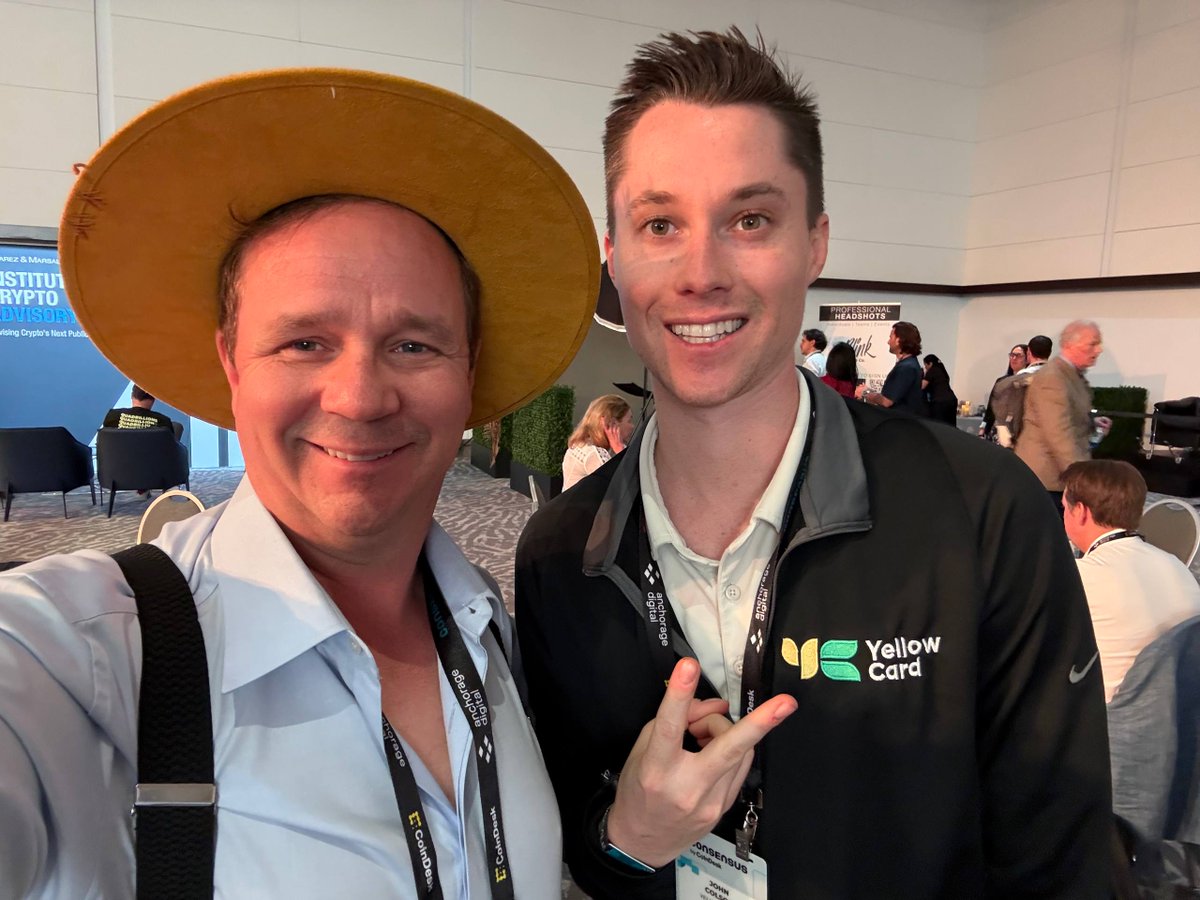
Another day, another panel. Miami Consensus so far: > Tokenization and RWAs > Everyone asking about the institutional strategy > Token buyers are more selective than ever > Prediction markets are on the rise
Alexis Sirkia tweet mediaAlexis Sirkia tweet media
English
17
10
57
1.7K