AlgoOPC

8K posts

AlgoOPC

AlgoOPC

@AlgoOPCWPC

Katılım Temmuz 2009
479 Takip Edilen379 Takipçiler
AlgoOPC retweetledi
Scott Cooper
Scott Cooper@imscoop22·
Sola Scriptura does NOT presuppose a canon. That is a modern apologetic talking point that is mostly used by "converts" who were wooed by it. SS regards the *nature* of Scripture as an unique authority because God has breathed it and it serves as a singularly authoritative witness to the 1st century apostolic deposit of faith. To be consistent, you would have to say your other claimed sources of infallibilty are likewise dependent on their defined content and boundaries and since those are not even mentioned until late in church history, much less enumerated, you'd have to admit Christians were deprived of them for centuries (and Catholics still are). Take a doctrine like supposed papal infallibility. It is subject to interpretation on contents/boundaries, too. Catholics, including the claimed late medieval "magisterium" cannot agree on how many "ex cathedra" (a phrase never used in relation the the papacy before the 17th century) have been made. If you think SS requires a defined canon, then you need a defined canon of "ex cathedra" proclamations, too.
English
1
1
7
155
AlgoOPC
AlgoOPC@AlgoOPCWPC·
AlgoOPC tweet media
Bob@masonryisgay

@RuslanKD @IFFFMEISTER The Trinity isn’t found in the primary sources either. This argument is getting condensed into one of faith of authority. But it’s actually a cover for trust in an interpretation. Yours is your own. Ours is the church fathers, history, oral tradition.

ZXX
0
0
3
56
Ruslan
Ruslan@RuslanKD·
You keep thinking I need to substantiate my position of being in the “one true church” I don’t. We’ve never made such a claim. However, how can the “one true church” have ANY dogma not found in the primary sources? A basic reading of the anti-nicene fathers and scripture itself shows that. And this is the scholarly consensus. Even among Catholics they acknowledge doctrinal development. So This comes down to a matter of faith. It should remain as such.
English
20
2
104
6K
ZZZZZZIFFSTER
ZZZZZZIFFSTER@IFFFMEISTER·
My whole thing to Ruslan (as someone merely studying these issues rn) is that this argument loses literally all of its teeth when you also reject the many many many areas where there was near or total agreement before Nicea (baptismal regeneration, episcoapte, etc)
Anthony@Catholicizm1

Protestants are down bad right now

English
10
4
44
8.5K
AlgoOPC
AlgoOPC@AlgoOPCWPC·
@Kenneedsgrace Ken. This was from a larger portion of Pastor King’s manuscript. He had to edit down for publication. Here is the portion of volume l where this was addressed.
AlgoOPC tweet media
English
1
1
3
45
Ken Temple
Ken Temple@Kenneedsgrace·
@AlgoOPCWPC Yes. Is that in one of DTK's books? If so, what page? In "Holy Scripture: The Ground and Pillar of Our Faith" - 3 volumes ?
English
1
1
2
27
Ken Temple
Ken Temple@Kenneedsgrace·
Irenaeus Against Heresies 3:2:1 the heretics say "that they are ambiguous",& that the truth cannot be extracted from them by those who are ignorant of tradition. For [they allege] that the truth was not delivered by means of written documents, but vivâ voce: (Living voice=orally)
English
1
1
4
53
Ken Temple
Ken Temple@Kenneedsgrace·
The Gnostics championed oral, living tradition & claimed things unknown went back to the apostles. This is what Roman Catholics & EO do by exalting later traditions (came out later in history) over Scripture. They anachronistically use 2 Thess. 2:15, 1 Cor. 11:2, Jude 3
English
1
1
2
32
AlgoOPC retweetledi
Pastor Rick Brennan
Pastor Rick Brennan@rickbrennanjr·
Roman Catholics argue that the canon of Scripture is known with certainty because the Church, guided by the Holy Spirit, authoritatively discerned and defined which books belong to the inspired Scriptures. It’s important to state that in Roman Catholic theology, the Church does not make a book inspired; God alone inspires Scripture. Rather, the claim is that the Church of Rome, through Sacred Tradition and the Magisterium of the bishops in communion with Rome, can give a binding and infallible judgment concerning which books belong to the canon. Regional councils such as Hippo and Carthage are often cited as early witnesses to this process, while the Council of Trent is understood as the later dogmatic definition of the canon in response to the controversies of the Reformation. Protestants do not deny that the early undivided church played a real historical role in recognizing, preserving, copying, reading, preaching, and confessing the Scriptures. The question is not whether the church had a role. The question is whether the church received the canon as the inspired Word of God, or whether the church’s later authoritative judgment is what gives Christians certainty that these books are Scripture. Protestants believe that the church catholic received the inspired Word of God; it did not create it. The books of Scripture possess divine authority because they are God-breathed, not because a later council or ecclesiastical judgment conferred that authority upon them. That does not mean the early church was irrelevant. The church recognized, preserved, copied, read, preached, and confessed the prophetic and apostolic Scriptures. Councils such as Hippo and Carthage gave formal regional testimony to what many churches had received and were reading, though Protestants and Roman Catholics disagree over the status of the deuterocanonical books included in those lists. But recognition is not the same thing as authorization. A council may identify the canon; it does not make a book inspired. So the Protestant claim is not that “the Bible dropped from heaven in a leather binding,” nor that “individual believers privately invented the canon.” The claim is that God gave his Word, his people received it, and the church bore witness to what already carried divine authority from the beginning. I have written more on how the canon was received and accepted, which is consistent with how Protestants have answered these questions since the sixteenth century: @rickbrennanjr/note/p-174552277?r=357x6g&utm_medium=ios&utm_source=notes-share-action" target="_blank" rel="nofollow noopener">substack.com/@rickbrennanjr
Pastor Rick Brennan tweet media
English
29
9
62
1.7K
Yemil FutureSaint ✝️🇻🇦
If Scripture interprets Scripture, who decides which passages correctly interpret the others when Christians disagree?
English
60
1
35
3.8K
AlgoOPC retweetledi
Tim Kauffman
Tim Kauffman@whpub·
@YeFutureSaint If the Church interprets Scripture, who decides which of the Church’s manifold interpretations is the correct one, when other Church interpretations disagree?
English
1
2
24
359
AlgoOPC retweetledi
Dustin Ashe
Dustin Ashe@DustinAshWrites·
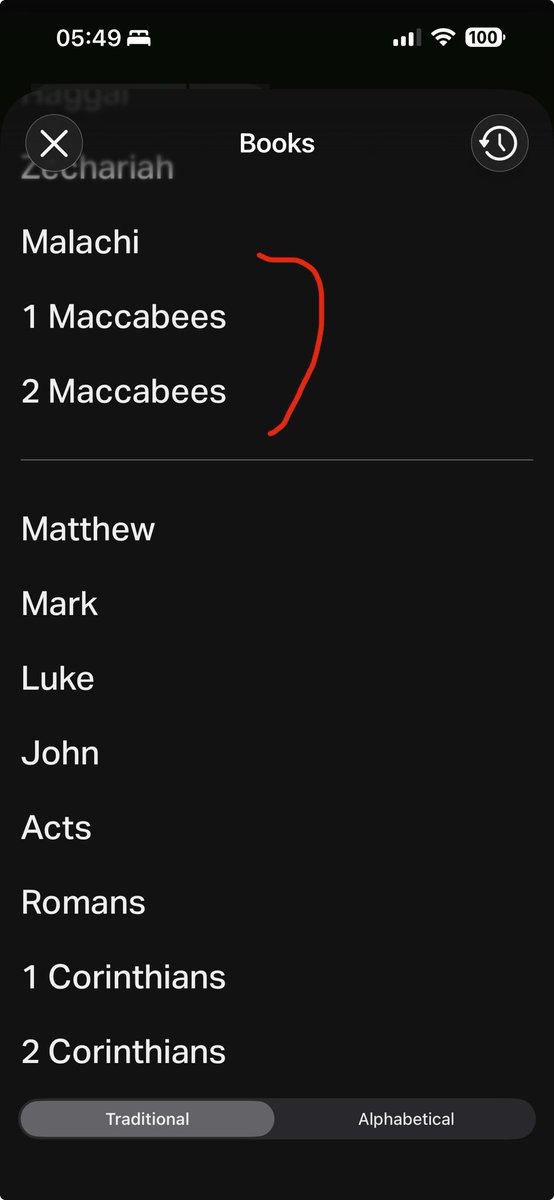
Rome NEVER added seven books. The Reformers CUT them, in 1534, from a canon that had stood since 397. The challenge remains. Name the continuous body of Christians who held the 66 books before Martin Luther.
Dustin Ashe@DustinAshWrites

In 1534 Martin Luther cut seven books out of the Bible. They had been Christian scripture for over a thousand years. This is the part Protestants are never told. The strongest objection runs like this. The Catholic Bible just absorbed the Septuagint, the Greek Old Testament. But the Septuagint manuscripts also contain 3 and 4 Maccabees, Psalm 151, and the Odes, which the Catholic canon does not include. So if the Septuagint sets the canon, Catholics are inconsistent for leaving those out. That objection is correct, and it misses the point entirely. The Catholic claim was never “the canon is whatever the Septuagint contained.” The claim is that the Church, with the authority Christ gave her, discerned and defined which books are scripture. The councils of Rome in 382, Hippo in 393, and Carthage in 397 and 419 produced the exact canon the Catholic Church holds today. Deuterocanon in. 3 and 4 Maccabees out. The Church judged. She did not inherit a library mechanically. The exclusion of 3 and 4 Maccabees is not an embarrassment for the Catholic position. It is the proof of it. The Church had the authority to draw the line, and she drew it. Now the concession Protestants will reach for. The Catholic Church only defined the canon as dogma at the Council of Trent in 1546, after the Reformation. That is true. It is also not the rescue it appears to be. Both formal definitions are 16th century. Trent in 1546 and the various Protestant confessional definitions in the same era. The difference is what each one did. Trent reaffirmed the canon the Christian Church had used continuously since the fourth century. The Reformers broke with that continuous practice and adopted instead the rabbinic Jewish canon, which was finalized by Jewish authorities after the time of Christ, partly in distinction from the Christian movement that was using the wider Greek scriptures. Trent reaffirmed. The Reformers innovated. The “addition” people accuse Rome of was actually a subtraction, made in 1534, from a canon that had stood for more than a thousand years. On the Orthodox and Oriental Churches, yes, their canons differ from the Catholic one. But they differ at the margins. 3 Maccabees, Psalm 151, 1 Esdras. All the ancient apostolic Churches share the core deuterocanon that the Protestant canon removes entirely. The variation among the apostolic Churches is the outer boundary of a shared body of books. The Protestant canon is the only one that made the radical cut. The Reformation answer is that a faithful remnant preserved the true gospel inside a corrupted visible church. Grant it for the sake of argument. Name the continuous body of Christians who held the 66-book canon before 1534. I have asked this for years and never received an answer. Bookmark this for the next time someone tells you Rome added books. Serious questions welcome in the replies.

English
35
11
89
6.3K
AlgoOPC
AlgoOPC@AlgoOPCWPC·
@DustinAshWrites Cardinal Cajetan was the chosen prelate and scholar sent by the Pope to examine Luther.
AlgoOPC tweet media
English
2
0
0
95
Garrett Ham
Garrett Ham@garrettham_esq·
AD 251. 1,266 years before the Reformation.
Garrett Ham tweet media
English
43
22
136
5.9K
AlgoOPC
AlgoOPC@AlgoOPCWPC·
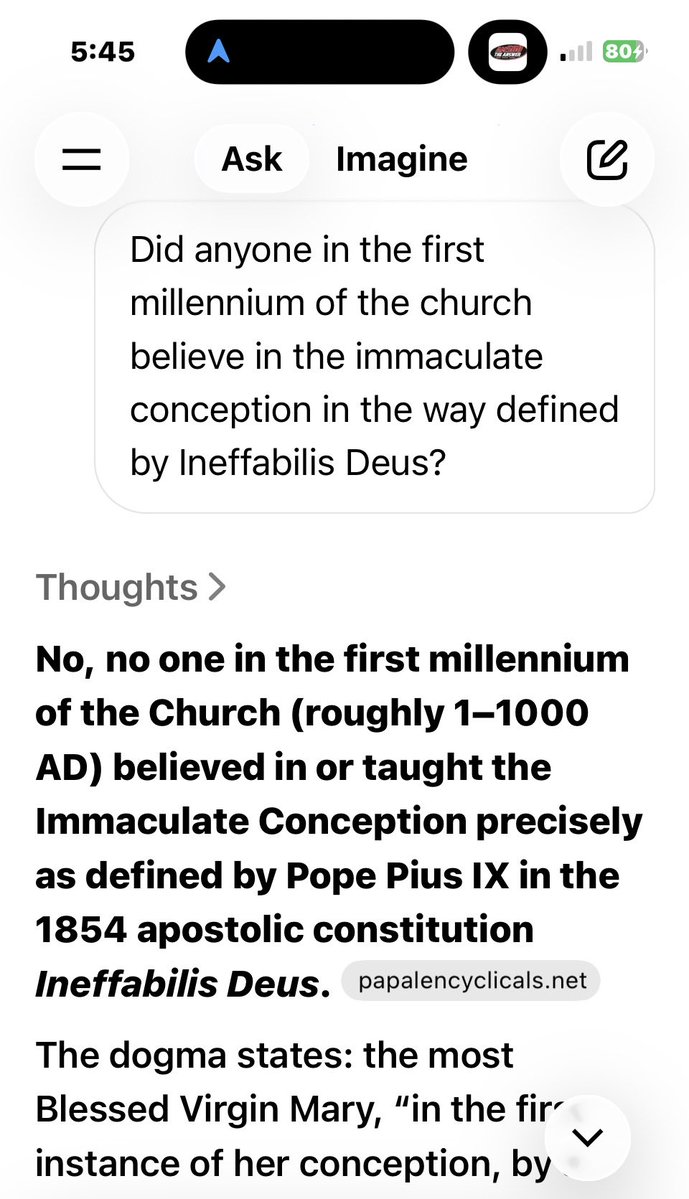
@garrettham_esq “The Church”? You mean the church in which nobody held to the Immaculate Conception as defined and dogmatized in 1854 by Pope Pius lX for the first millennium? That Church?
English
0
0
2
36
AlgoOPC
AlgoOPC@AlgoOPCWPC·
@RealJamesWoods James. The Roman Catholic Church has an Ever-Evolving Gospel of Salvation.
English
0
1
0
42
James Woods
James Woods@RealJamesWoods·
Tell me your thoughts on this. Everyone else is behaving rudely and quite frankly rather stupidly regarding this topic. You seem to have something of value to say.
jdmainer@JDMainer

@RealJamesWoods I am a Christian and a fan of yours. I pray that you see the error of your ways and turn to a true Christian Church. The Catholic Church is not that.

English
1.2K
76
1.1K
262.4K
AlgoOPC retweetledi
Namor 📖
Namor 📖@NamorPB·
I've had a couple of people, including my son, have some quite productive conversations using this discussion topic with Jehovah's Witnesses. Hopefully some others can find it helpful! Read my latest post here: aomin.org/aoblog/jehovah…
English
1
7
16
289
AlgoOPC retweetledi
Namor 📖
Namor 📖@NamorPB·
@residentreformr @HwsEleutheroi @EcciusMaximus Correct. And for the ECFs, "Catholic" was used in a much more general sense, as it is here. When Augustine defined it, it was in the sense of a global body of believers over against heretical groups like the Donatists.
English
1
1
12
300