Example #4317 of why you should never trust AI summaries: Dante, famously, despite being Florentine, is *not* buried in Florence, because they EXILED him. He's buried in Ravenna; this comment is picked up from a TripAdvisor post by a Sri Lankan tourist. (A monument, not tomb.)
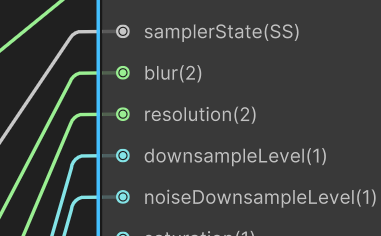
Unity kept crashing on me with a graphics error and I was confused as to why my shader was causing it. I realized in my Shader Graph I switched up the order of the int2 blur iteration count with the int2 screen texture resolution...
💀 Meaning it was being told to run a ~8.3 million sample loop every frame on the GPU and exploding.
@ShriramKMurthi Aside from the ridiculously short memories many people have, they’re also largely inattentive and willing to jump to conclusions about the whys, what’s, and who’s. But what’s really aggravating in all of this, is how it gets recast as “he’s working hard to rescue it”. Ridiculous.
I have read several articles that mention that Trump is trying to figure out how to restore TikTok, and literally not a single one has pointed out that he STARTED this whole mess (unless I'm mis-remembering?). There was that whole "Oracle will buy TikTok" boondoggle? NO mention!
Was listening to a podcast where a fashion historian referred to a piece of clothing as an "inverted triangle" and was reminded yet again of the stubborn misconception that triangles have a "flat side at the bottom"—because that's how they're drawn in texts and by teachers.
I have a soft spot for religious billboards. It’s tempting to think they are an American Christian phenomenon, but I remember seeing an electronic billboard of the Lubavitcher Rebbe above the Decarie Expressway back in my home town of Montreal.
that’s why the right to a fair trial isn’t a human right (requires labor of judges) nor is freedom of movement (requires maintained roads and transit systems) or right to public safety (sorry, police, EMTs, firefighters), right to access food and water, right to an education. 🤷🏻♂️
@leopd Mahalanobis distance reshapes the data using the covariance matrix into a lower-dimensional, uncorrelated space - seems useful for scaling anomaly detection, clustering, or other ML tasks.
Mahalanobis distance is a great alternative to Euclidean distance, especially if you're trying to quantify how unusual an element is within a population. Euclidean distances can get confused by strong correlation along dimensions, while Mahalanobis more accurately understands if something is out of distribution because it's "off axis". (See diagram with dotted contour lines of equal Mahalanobis distance. The red dot is clearly an outlier in Mahalanobis distance, but if you use standard L2/Euclidean distance to measure how far it is from the centroid then there's nothing unusual about it.)
I've been thinking through how to speed up applying this technique at scale, and last night in a dream it dawned on me that if you do PCA on your data first to reduce the dimensionality, then the Euclidean distances are the same as Mahalanobis distances - as long as you do the "whitening" step in PCA. Because then the covariance matrix is the identity, and the distribution is fully isotropic / spherical.
One of these realizations that if you can follow what I'm talking about is perhaps already obvious to you. But it wasn't to me. Maybe this nugget of high-dimensional statistical intuition might be useful for you in some ML problem?
int (*)[3] is a pointer to an array of 3 ints.
int (*[3])() is an array of 3 pointers to functions taking no parameters and returning an int.
[Disclaimer: This post does not endorse, condone, or in any other way support the abovementioned syntax. Poster is not responsible for negative consequences arising from use of said syntax, including but not limited to, software failure, security vulnerabilities, loss of profits, or accidental opening of a portal to a demonic hell dimension.]
@DMeville Once on the table, merchant makes comments about the quality and appropriateness of the fish for him (ie inspecting it). If he’s happy with it, he throws some coins at you, and throws t the fish in a basket.
@DMeville NPC dialog reveals what kind of fish they’re looking for. Sometimes overly, sometimes subtly. Having the right kinds of fish yields better rewards from merchants. Merchants needs change over time. As for interaction UI, you place the fish on a table in front of the merchant.
My game loop: Catch fish, sell fish, upgrade/buy cosmetics/decor, repeat. Thinking about how to sell things . I don't want to "Press A to talk to shopkeep and choose items to sell from a UI", because that feels so lame. What are some cooler ideas that feel more "in world"?
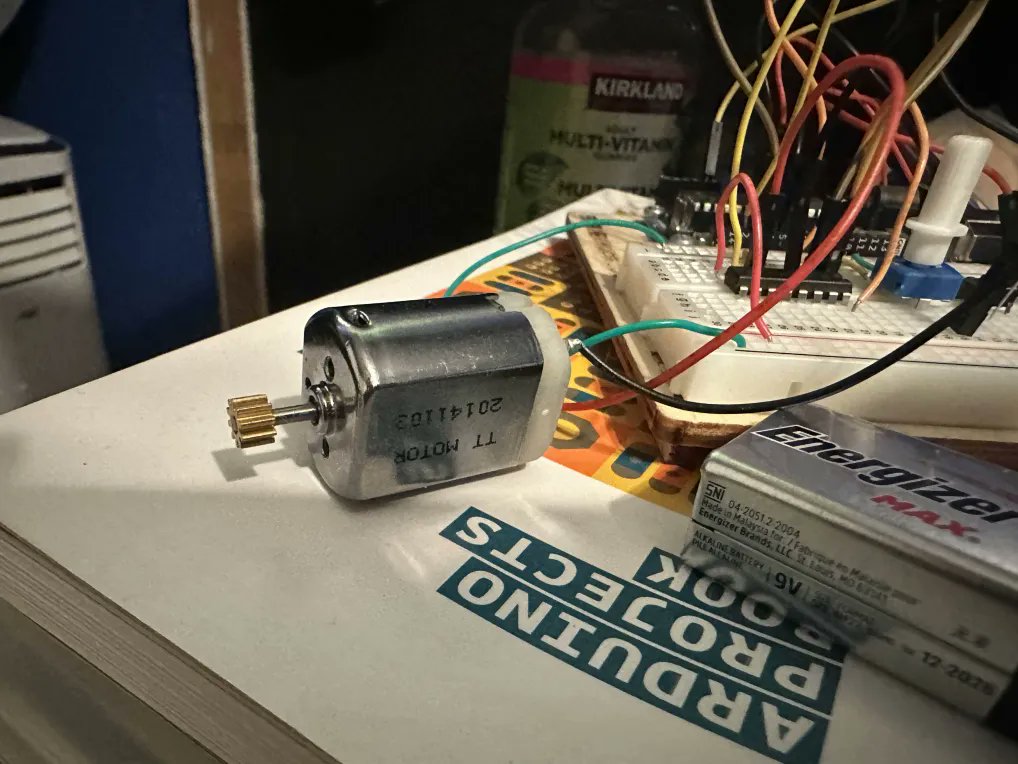
Anyone familiar with hobby electronics/Arduino? I have a 3d print project I'm working on that requires a slow motor to spin a thing. The DC motor I have (that came with the Arduino starter kit) spins WAAAY too fast, and trying to slow it down causes it to stall. Need suggestions-
It's actually a bit more complicated than that. Have a Transform variable with an exposed 3D gizmo. This gizmo can be scaled/rotated, and I want to draw a box at that transform. Then get a world space position inside this box at random. Moving the root object should also work
Having one of those days where it takes you 8 hours to solve a problem that seems like it should be stupid simple. I'm just trying to get a random point in a box, but the box is ROTATED and SCALED
@norootcause Sometimes fast, approximate, incorrect answers are useful - but only if you have the knowledge and context to adapt them and recognize where they’re wrong. The main risk is newcomers to any field/domain lack that, and are likely to accept LLM answers as authoritative.
I find LLMs useful for technical questions when it takes less effort for me to check the LLM’s answer than to research the answer myself. For example: “how is feature X implemented in open source project Y”. Even though it’s often wrong, it points me in the right direction.