
Sabitlenmiş Tweet
Amelia G
14.6K posts

Amelia G
@AmeliaG
Iconoclastic altmogul publisher, writer, photographer. Likes to think about stuff, see/learn new stuff & eat delicious stuff. London-born, Hollywood/Vegas-based
Los Angeles Katılım Mart 2007
1.5K Takip Edilen3.2K Takipçiler
Amelia G retweetledi


I voted Forrest Black & Amelia G in @SexyFandom #BazowieAwards presented by @ZinetasticZines Vote sexyfandom.com/2026-bazowie-a… @BlueBlood @ForrestBlack @AmeliaG Meet Us at BazowieCon.com

English
English
Amelia G retweetledi

We spent $15,000 on billboards targeting one person: the guy controlling all the chemical spend at a saltwater disposal company in Texas. We mapped his commute and bought every billboard between his house and the oil field. When we finally called, he said "I see your billboards everywhere." That landed us our first oil field contract. At the time our entire operation was a $10,000 reactor built from PVC pipes from Home Depot, turning corn sugar into industrial chemicals. People keep trying to throw it away. It still works. That leaking reactor started a multibillion-dollar company. @ycombinator visited our plant in Houston. The original PVC reactor is still on the floor next to the Bioforge.
English
Amelia G retweetledi

Today we're announcing the first real-life sidekick, brought to life with the voice of a major entertainer: @SkylarGrey.
Fiction has long dreamed of the sidekick—a loyal, subordinate companion devoted to the hero and their mission.
But in real life, that’s been impossible.
No human can be subordinate to our mission—they are the hero of their own story.
And so, unlike the heroes in our favorite stories, we face some of the toughest moments alone.
The late-night worrying.
The quiet doubts.
The moments we don’t share with anyone.
That is about to change: Fawn is a sidekick for your inner world.
A companion who is always there. Someone to listen, to help you process, to support you as you navigate your life.
And today, we’re taking a major step forward in bringing her to life: multi-platinum artist Skylar Grey is the voice of Fawn.
Skylar has spent her career giving voice to emotion through songs that have reached billions of people around the world.
Now, she’s helping us do something new: bring a character to life who can be there with you.
This is the beginning of something that was only possible in stories before: fictional characters that come to life as friends and partners on our mission in life.
We’re building a sidekick for life.
English
Amelia G retweetledi

I kinda like that the hating PH has come full circle. 🤣 Frankly had they listened to performers and industry vets years on years ago, they wouldn’t be crashing out so hard now.
Are you a vet if you don’t remember when it was weird to like PH? Y’know unless you were one of the companies chopping up your scenes 30 times for their sponsored pages. 😉
English
English
Amelia G retweetledi

Amelia G retweetledi

@Bitcoin_Teddy We all had multiple roommates and someone probably lived in the dining room. We also drove hand me down cars - I had a 1987 Volvo station wagon for yearrrrrs & didn't even buy my first newish car until 2012 (still used). It's largely relative and based on perspective
English
Amelia G retweetledi
Researchers at MIT created a tiny origami-inspired robot that starts as a flat sheet and transforms itself into a working machine when activated by heat.
Made from a heat-responsive polymer combined with rigid panels and small embedded magnets, it can self-fold into shape and then move across surfaces, swim, climb slight slopes, and handle uneven terrain, all without traditional onboard motors.
English
Amelia G retweetledi

Every time you get a cancer biopsy, the lab makes a tissue slide that costs about $5. It shows the shape of your cells under a microscope, and every cancer patient already has one on file.
There’s a much fancier version of that test called multiplex immunofluorescence (basically a protein-level map showing which immune cells are near your tumor and what they’re doing). It costs thousands of dollars per sample, takes specialized equipment most hospitals don’t have, and barely scales. But it’s the kind of data oncologists need to figure out whether immunotherapy will actually work for you. Right now, only about 20 to 40% of cancer patients respond to immunotherapy, and one of the biggest reasons is that doctors can’t easily tell whether a tumor is “hot” (immune cells actively fighting it) or “cold” (immune system ignoring it).
Microsoft, Providence Health, and the University of Washington trained an AI to analyze the $5 slide and predict what the expensive test would show across 21 different protein markers. They called it GigaTIME, trained it on 40 million cells in which both the cheap slide and the expensive test coexisted, and then turned it loose on 14,256 real cancer patients across 51 hospitals in 7 US states.
The results landed in Cell, one of the most selective journals in biology. The model generated about 300,000 virtual protein maps covering 24 cancer types and 306 subtypes. It found 1,234 real, verified connections between immune cell behavior, genetic mutations, tumor staging, and patient survival that were previously invisible at this scale. When they tested it against a completely separate database of 10,200 cancer patients, the results matched up almost perfectly (0.88 out of 1.0 agreement).
Nature Methods named spatial proteomics (mapping where specific proteins sit inside your tissue) its Method of the Year in 2024, and specifically cited GigaTIME in a March 2026 update as a model that “democratizes” this kind of analysis. The full model is open-source on Hugging Face. Any cancer research lab with archived biopsy slides, and most of them have thousands, can now run virtual immune profiling without buying a single piece of new equipment.
Satya Nadella@satyanadella
We’ve trained a multimodal AI model to turn routine pathology slides into spatial proteomics, with the potential to reduce time and cost while expanding access to cancer care.
English
Amelia G retweetledi

The heart is not a pump. Or rather, it is a pump in the same way that a smartphone is a flashlight.
Yes, it performs that function. But it is so much more.
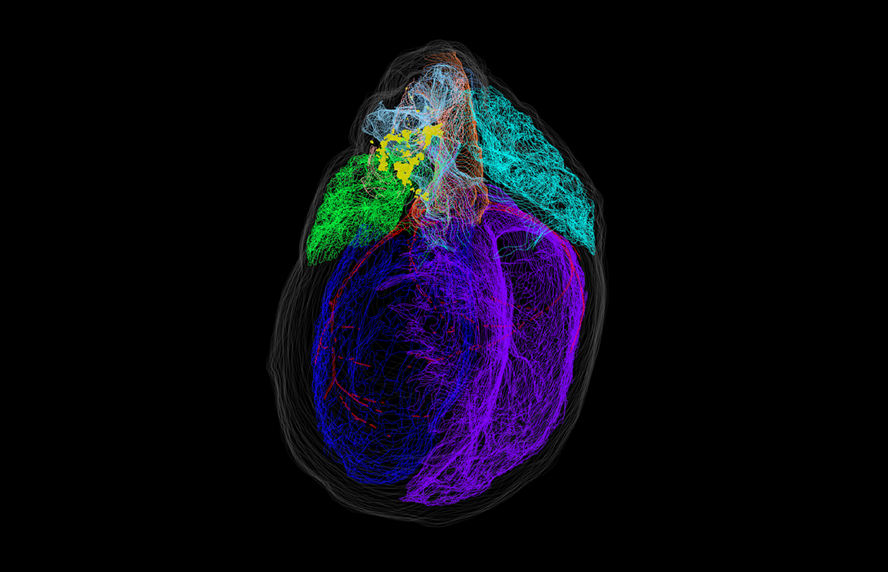
The heart possesses its own intrinsic nervous system, containing approximately 40,000 sensory neurons, called sensory neurites, that form what cardiologists now call the heart's "little brain".
The heart generates the largest electromagnetic field in the body. Its electrical field is approximately 60 times greater in amplitude than the electrical activity generated by the brain.
The magnetic field produced by the heart is more than 100 times greater in strength than the field generated by the brain and can be detected up to three feet away from the body in all directions using SQUID-based magnetometers.
HeartMath Institute research has demonstrated that the timing between pulses of the heart's magnetic field is modulated by different emotional states, and crucially, that these magnetic signals have the capacity to affect the physiological systems of individuals around us.
This is not metaphor. The heart broadcasts electromagnetic information about your emotional state into the environment at the speed of light, and the nervous systems of other people act as antennae, tuned to and responsive to these signals.
English
Amelia G retweetledi
A man in Sydney just built a personalized cancer vaccine for his dying dog. Using AI. With no background in biology.
Paul Conyngham adopted Rosie, a staffy-Shar Pei cross, from a shelter in 2019. She’s been with him through some of the worst stretches of his life. “She’s my best mate,” he says. In 2024, Rosie got diagnosed with mast cell cancer, the most common skin cancer in dogs. He threw everything at it. Surgery. Chemo. Immunotherapy. The tumors slowed down but wouldn’t shrink. Vets gave her one to six months.
Conyngham works in AI and data science. So he did what he knows. He opened ChatGPT and started asking it what else was possible. That conversation led him somewhere wild. He got Rosie’s tumor sequenced at UNSW’s Ramaciotti Centre for Genomics, basically converting her cancer from tissue into raw data. Then he ran that data through AlphaFold, a Google AI tool that predicts the 3D shape of proteins (it won the Nobel Prize in Chemistry in 2024). He used it to pinpoint the exact mutations driving the cancer and match them to drugs. A genomics professor at UNSW was, in his own words, “gobsmacked” that a guy with zero biology training had pulled together a complete analysis.
And then the really hard part started. Not the science. The paperwork. You can’t just create a vaccine and inject your dog in Australia. He spent 3 months writing a 100-page ethics application, two hours every night after work, just to get permission to treat his own pet. The red tape was harder than the actual drug design.
Once he cleared that, he connected with Páll Thordarson, director of the UNSW RNA Institute, who built a custom mRNA vaccine (same tech behind the COVID shots) from Conyngham’s data. Sequencing to finished vaccine: less than two months. Conyngham drove 10 hours to the lab with Rosie for her first injection in December.
Within a month, the tumor on her leg, roughly tennis ball sized, shrank by up to 75%. Her coat got glossier. She started acting like herself again. The treating vet called it “magical.” Conyngham is now sequencing a second tumor that didn’t respond to the first vaccine, trying to figure out why it’s resistant.
The part that keeps rattling around in my head: Moderna and Merck are running billion-dollar Phase 3 trials on a human version of the exact same idea. Their vaccine, mRNA-4157, sequences a patient’s tumor, identifies mutations, and builds a custom vaccine to teach the immune system to attack that specific cancer. Five-year data shows it cut melanoma recurrence by 49%. Expected cost per patient when approved: $100,000–$300,000. Expected approval: around 2027. Over 120 similar trials are running worldwide right now.
Conyngham did it for tens of thousands of dollars with free AI tools and university lab access. The tools to build personalized medicine already exist. The bottleneck is a regulatory system still calibrated for a world where designing a treatment took a decade, not eight weeks.
Séb Krier@sebkrier
This is wild. theaustralian.com.au/business/techn…
English
Amelia G retweetledi

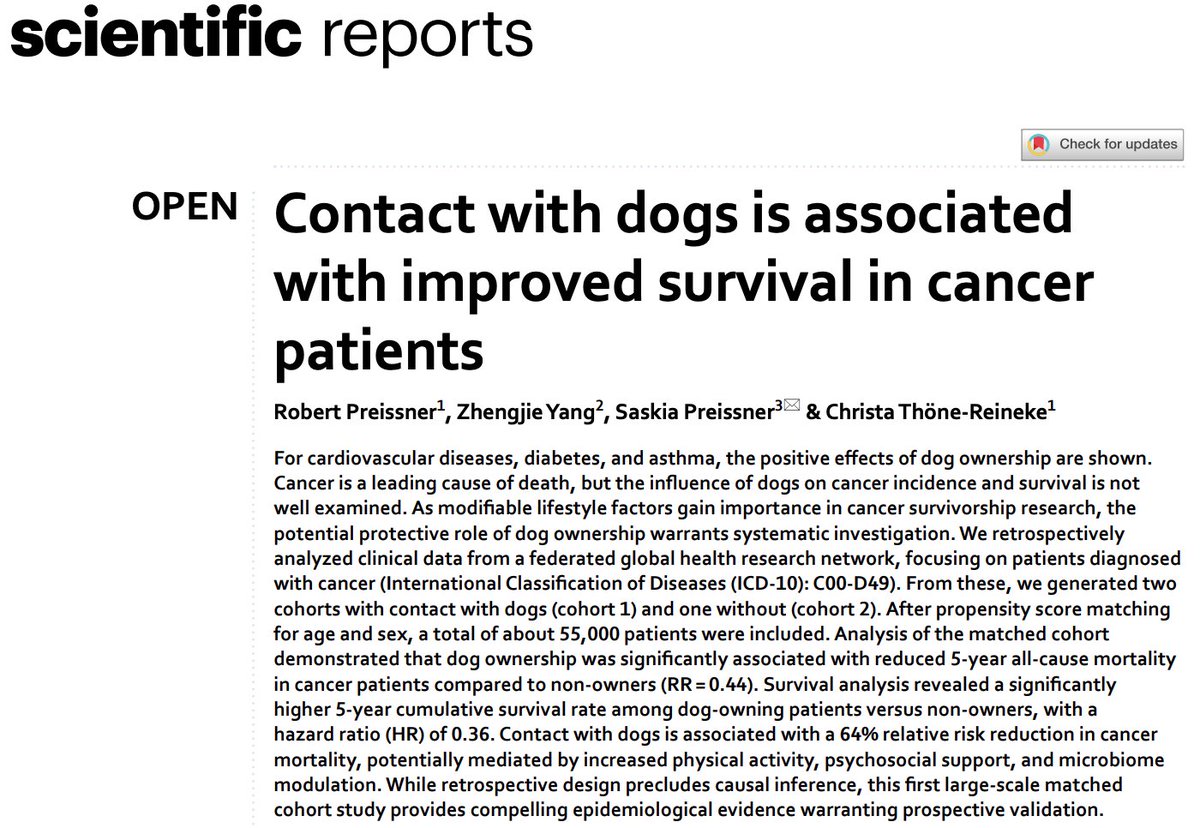
Dog contact was linked to 64% lower 5-year mortality in cancer patients.
Possible mechanisms include physical activity, psychosocial support, and microbiome changes.
English
I voted Marica Hase and Buusan the pig in @SexyFandom #BazowieAwards presented by @ZinetasticZines Vote sexyfandom.com/2026-bazowie-a… @marica_1029
English
I voted This Inevitable Ruin (for AI with foot fetish as key recurring plot driver) in @SexyFandom #BazowieAwards presented by @ZinetasticZines Vote sexyfandom.com/2026-bazowie-a… @mattdinniman
English
I voted MyFreeCams in @SexyFandom #BazowieAwards presented by @ZinetasticZines Vote sexyfandom.com/2026-bazowie-a… @MyFreeCams
English
I voted Forrest Black & Amelia G in @SexyFandom #BazowieAwards presented by @ZinetasticZines Vote sexyfandom.com/2026-bazowie-a… @BlueBlood @ForrestBlack @AmeliaG
English