AxieSnipern ❗️
540 posts


chatGPT thinks I’m 7.8/10 hot
that’s about a 5 in sf but a 10 in nyc. i’ll take it!
prompt below 👇

English

@Cristiano @Herbalife Your photo better be good. Also, stick to the script—you totally forgot to mention CoverGirl LashBlast Mascara. #ANTM
English

A new chapter for me and @Herbalife.
The next era of wellness is Pro2col.
Find out more: hrbl.me/CR7Pro2col
#Ad
English

Svenska
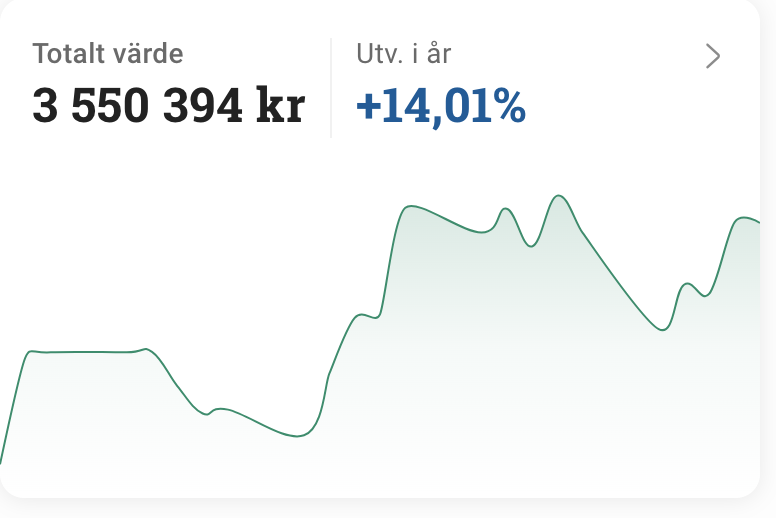
Om mig: Började investera 2019, fick arv 300k att placera. Bra timing med Covid. Sålde bort mig och blev ett medelmåttigt år. Började studera, investerade allt i MSTR. Portföljen gick från 800k till 200k. Höll ut, fokuserade på annat än börsen.
Svenska
@Aktieprenoren @21MMandNoMore @MaestroInvest Saker jag trodde skulle hända hände inte. Så gick in på avanza å klickade sälj. Skulle ha ändrat courtageklassen😅
Svenska
@AxiePISTOL @21MMandNoMore @MaestroInvest Det var @21MMandNoMore som mitt inlägg var riktat till :)
Men vad var anledningen till att du sålde (allt)?
Svenska
@Aktieprenoren @21MMandNoMore @MaestroInvest Haha kul att du kollar in! Kort sagt har jag inte legat investerad i MSTR på ett tag nu, sålde allt kring 350USD. Portföljen är nere halv mille, dollarn stor faktor.
Svenska
@21MMandNoMore @MaestroInvest @AxiePISTOL Update här? Ser fortfarande ljust ut? Bör man som ung fortsätta ligga all in nu med -60% i ryggen? Ännu högre uppsida nu kanske, läge börja trycka belåning?
Svenska
@TheShortBear Would love for you to have a chat with @_Checkmatey_
English

Crypto as the Next Safe Haven?
By the end of this decade, crypto could emerge as the ultimate safe-haven asset.
Historically, 80–90% of crypto ownership has been retail-driven, with institutional participation remaining marginal.
Even today, despite ETFs and regulatory progress, long-term institutional ownership of Bitcoin is estimated at only ~15–25%, with Ethereum even lower at ~10–15%.
Pension funds, sovereign wealth funds, insurers, and endowments remain structurally under-allocated.
As ownership shifts, behavior follows.
We are already seeing early signals of this transition. The recent surge in bond yields, expanding fiscal stimulus, and mounting sovereign debt pressures have triggered a powerful rally in precious metals. This is not merely inflation hedging. It is a crisis of trust in sovereign debt, real yields, and long-term monetary credibility.
Crypto, and Ethereum in particular, stands alone as the only asset class that combines a true structural trifecta:
•Sovereign-less neutrality
•Real yield via protocol-level burn and fee mechanics
•Inflation-adjusted growth driven by network adoption
Even gold and silver, while historically reliable stores of value, remain physically constrained, costly to transport, and vulnerable to regulatory intervention, export controls, and capital restrictions.
Political leaders may pledge fiscal discipline and monetary stability, yet recent history suggests the opposite. In a world defined by geopolitical competition, demographic pressure, reindustrialization, and security-driven spending, structural deficits and monetary expansion appear unavoidable.
Ethereum, specifically, offers something fundamentally different.
It enables global capital to move outside political pressure, transparently reflects real monetary debasement, and provides native yield through the most secure, liquid, and programmable financial network ever created.
As tokenization, stablecoins, and decentralized financial infrastructure expand, Ethereum’s role as the settlement layer of the global economy becomes increasingly embedded. This creates a powerful structural demand tailwind.
In a world of rising geopolitical risk, deteriorating sovereign balance sheets, and eroding trust in fiat stability, crypto, and especially Ethereum, is positioned to be repriced entirely: from a speculative high-beta asset into a sovereign-less, yield-bearing, global safe-haven instrument.
This dynamic is not theoretical.
We have already observed its early form in emerging markets, where crypto adoption has long served as a hedge against capital controls, currency debasement, confiscation risk, and political instability. In these regions, crypto is not speculation. It is financial survival.
Now imagine this flow expanding from emerging markets to the entire global system, as tensions between the U.S. and the rest of the world intensify and monetary debasement accelerates into a full-fledged sovereign debt crisis.
I see no credible alternative.
Gold and silver have already repriced violently, moving hundreds of percent over the past cycle. They are signaling a profound structural shift in capital allocation and trust.
While crypto investors have been forecasting versions of this paradigm for years, this is the first time that the West itself is being forced to confront it, and at exponential speed. Unlike emerging markets, where monetary instability is cyclical, the West has operated under the assumption of permanent financial credibility. That assumption is now being challenged.
If the scale of the U.S. monetary system and the vast network of dollar-denominated trade, reserves, and financial infrastructure, begins to fundamentally question the integrity of the system, the resulting capital flows could be historic.
It is a regime change.
There may still be time to stabilize and rebalance, but doing so will be extraordinarily complex, politically constrained, and structurally difficult.
Feedback?
English

if you ever meet someone who at one point was globally ranked in a video game
hire them immediately
English

Hello all,
I shared interview with @NemCapSE who is arguably the best living investor on the planet. He has compounded 50% CAGR for 17 years and grew his capital from $16.000 to $50.000.000 without ever doing DCF models or spreadsheets.
Hope you will like it.
Thank you Chris.
English
@memecrashes Yeah it obviously cancel eachother out, anwser is 0 newton
English

the physical illiteracy rates of this app need to be studied
Mathieu@miniapeur
For my followers:
English
@borkedsys What ive found out is that when it comes to teamwork, 1+1=3. And their is your margin of profit.
English

AxieSnipern ❗️ retweetledi
$QQQ Nasdaq in October 99 broke out of its grind range and ran higher by 83% within a period of 101 sessions, 147 days (21 weeks/5months).
Internet stocks went wild, valuations stretched and many of the doubters of the early years succumbed to the pressure of crowds.

English
@BorsFageln Älskar att det står 24h rekt, bästa tidslinjen vi får uppleva
Svenska

Black friday igår.
Troligtvis det största likvideringseventet man kommer få uppleva.
Ash Crypto@AshCrypto
Covid crash: $1.2 Billion in liquidations FTX crash: $1.6 Billion in liquidations Today: $19.16 Billion in liquidations This is Biggest liquidation event in history of crypto and almost 20x bigger than the Covid crash of March 2020.
Svenska
@stckpkr Åkte i somras taxi med en som jobbade på hedgefond i Australien, ända innehavet han pratade om var hemnet.
Svenska

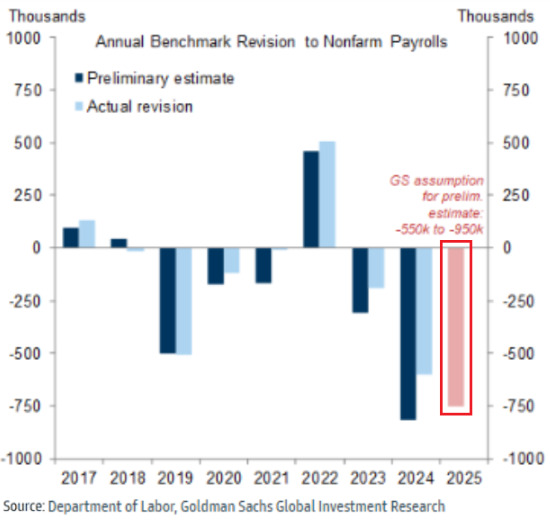
Massive jobs data revisions are coming:
On September 9th, the BLS will release its preliminary benchmark revision to nonfarm payrolls for April 2024 through March 2025.
Goldman Sachs estimates the revision could cut reported payrolls by 550,000 to 950,000 jobs.
This implies payroll growth was overstated by a massive 45,000 to 80,000 jobs PER MONTH.
If confirmed, it would mark the largest 12-month revision since 2010.
This also follows an earlier 589,000 downward adjustment for the year ending March 2024.
What is happening with the labor market data?
English
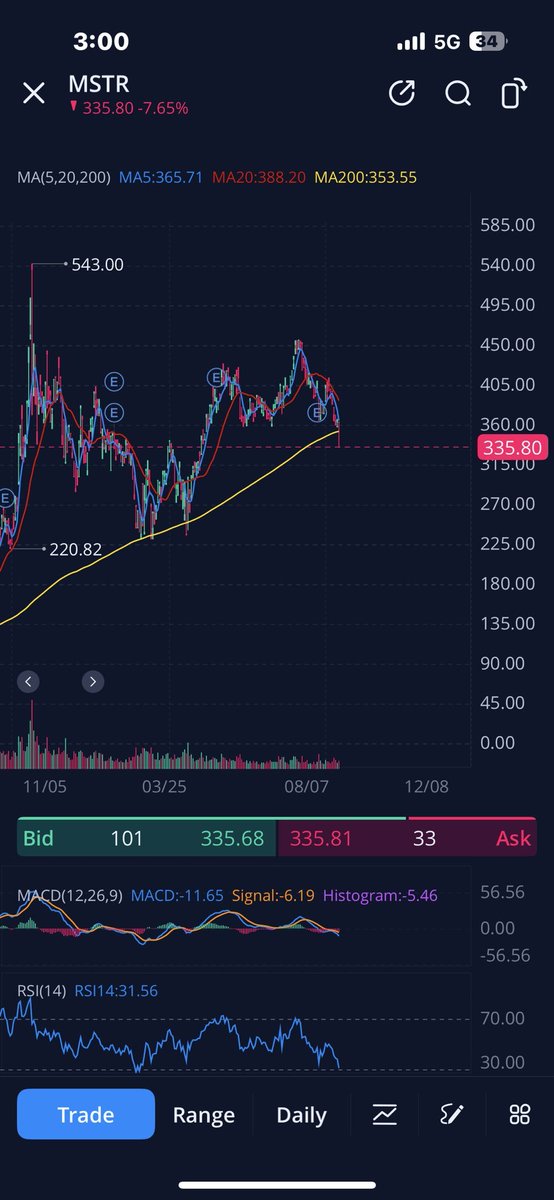
if you do not see the similarities from 2021, and now price breaks 200ma, i do not see this going well. Stocks dont crash when they break 10/20ma's, they crash when they cross 100/200ma's. From now on, the best time to cut losses is yesterday, every day.
English

CURRENT VIEW ON $BTC
Controversial take, but curious what people think… Given the price action in $BTC, I wonder two things:
1. Has $BTC topped shorter-term?
2. How compressed will prospective return be over the coming years?
We had an absolutely beautiful setup in Bitcoin. Great consolidation. All-time highs. Tons of bullshit treasury purchases to fuel the fire. Positive regulatory news. Every trader I know (including me for the idiots that think I’m a permabear) was leveraged long to the hilt.
And yet we could only get two real days of price expansion. At this point, who is the marginal buyer? Who isn’t long on a setup like that?
Structurally, I’ve felt $BTC will go higher but that the massive returns are gone. As an asset reaches mass adoption, realized vol compresses as do returns. There is less price discovery to occur. It’s just basic market structure theory.
Every cycle in $BTC, the returns have been about a magnitude less. And the failure of this breakout makes me think $BTC is largely approaching the era of market returns (market single-year returns/vol can be far higher than most think though). It didn’t take much imagination to see a quick move to $130k, $140k, $150k (the people who think $1m is around the corner are high on hopium IMO). Yet here we are.
I always then end up wondering the second deriv… if returns compress and approach market returns, how many people would still hold bitcoin? The data doesn’t lie. Most holders of $BTC are in it solely for speculative purposes. People are looking for 1000%+ returns or even 100% returns.
What happens to the average holder if we experience years of traditional market returns? What happens to the average holder if all of a sudden $ETH or some other coin starts to offer higher prospective returns?
I have zero idea the future. Not a forecast. But certainly questions worth thinking about.
@TheFlowHorse @skyquake_1 @TedHZhang
English