

Axlvaz
5.4K posts

Axlvaz
@Axlvaz
No matter where you are, everyone is always connected.
Katılım Ocak 2014
5.1K Takip Edilen2.9K Takipçiler

here's why i love sporting a milady & think it embodies the ethereum builder ethos
1. they don't focus on price. in fact, they made it easy for anyone to create their own milady without spending money to buy one, which is different from every other PFP NFT project out there that wants nft price go up
2. their raison d'etre is cancelling cancel culture so they work on censorship resistance at the cultural level
3. they are hard core open source, not even the creative commons type where attribution is required but the purest form CC0 (what they call post authorship)
4. lending support to newcomers. no matter if you're OG or a beginner, if you ask for help amplifying content on the timeline, you have an army of milady's commenting and pushing your post to the top. this really mattered to me when i was starting out
5. Unapologetically Ethereum. No launching a memecoin on solana like pudgies
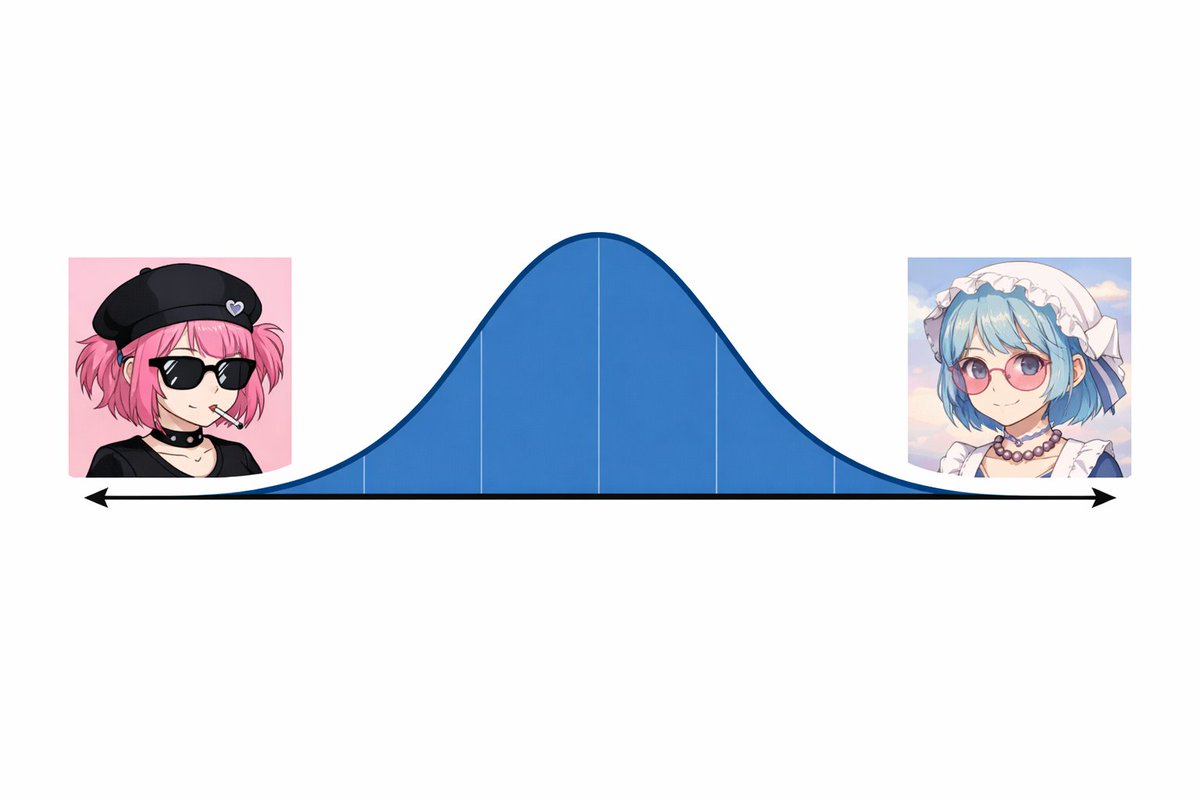
and finally my favorite, the milady way: either left curve or right curve, never middle
English


Interesante que Kraken gano Nasdaq y Securitize gano NYSE. Durmio Coinbase?
Español
@MatiasNisenson @worldnetwork The big problem in crypto is that everyone wants to invent something new, but no one wants to use someone else’s solution. It’s mostly ego, and that’s why forks keep winning
English

What’s preventing mainstream apps to use @worldnetwork as login? It’s like the solution is there but no one’s really using it?
English
While on one side what @VitalikButerin is saying holds water, there is an entirely different angle that requires different thinking.
Using prediction market for hedging is indeed a new form of utility for traders.
However, if hedging becomes a primary and significant use of prediction markets, then think about what prediction markets signal really mean.... It no longer reflects the collective wisdom, thinking, and opinion of the world. That future dream of prediction markets becoming everyone's crystal ball.... that won't be possible.
vitalik.eth@VitalikButerin
Recently I have been starting to worry about the state of prediction markets, in their current form. They have achieved a certain level of success: market volume is high enough to make meaningful bets and have a full-time job as a trader, and they often prove useful as a supplement to other forms of news media. But also, they seem to be over-converging to an unhealthy product market fit: embracing short-term cryptocurrency price bets, sports betting, and other similar things that have dopamine value but not any kind of long-term fulfillment or societal information value. My guess is that teams feel motivated to capitulate to these things because they bring in large revenue during a bear market where people are desperate - an understandable motive, but one that leads to corposlop. I have been thinking about how we can help get prediction markets out of this rut. My current view is that we should try harder to push them into a totally different use case: hedging, in a very generalized sense (TLDR: we're gonna replace fiat currency) Prediction markets have two types of actors: (i) "smart traders" who provide information to the market, and earn money, and necessarily (ii) some kind of actor who loses money. But who would be willing to lose money and keep coming back? There are basically three answers to this question: 1. "Naive traders": people with dumb opinions who bet on totally wrong things 2. "Info buyers": people who set up money-losing automated market makers, to motivate people to trade on markets to help the info buyer learn information they do not know. 3. "Hedgers": people who are -EV in a linear sense, but who use the market as insurance, reducing their risk. (1) is where we are today. IMO there is nothing fundamentally morally wrong with taking money from people with dumb opinions. But there still is something fundamentally "cursed" about relying on this too much. It gives the platform the incentive to seek out traders with dumb opinions, and create a public brand and community that encourages dumb opinions to get more people to come in. This is the slide to corposlop. (2) has always been the idealistic hope of people like Robin Hanson. However, info buying has a public goods problem: you pay for the info, but everyone in the world gets it, including those who don't pay. There are limited cases where it makes sense for one org to pay (esp. decision markets), but even there, it seems likely that the market volumes achieved with that strategy will not be too high. This gets us to (3). Suppose that you have shares in a biotech company. It's public knowledge that the Purple Party is better for biotech than the Yellow Party. So if you buy a prediction market share betting that the Yellow Party will win the next election, on average, you are reducing your risk. Mathematical example: suppose that if Purple wins, the share price will be a dice roll between [80...120], and if Yellow wins, it's between [60...100]. If you make a size $10 bet that Yellow will win, your earnings become equivalent to a dice roll between [70...110] in both cases. Taking a logarithmic model of utility, this risk reduction is worth $0.58. Now, let's get to a more fascinating example. What do people who want stablecoins ultimately want? They want price stability. They have some future expenses in mind, and they want a guarantee that will be able to pay those expenses. But if crypto grows on top of USD-backed stablecoins, crypto is ultimately not truly decentralized. Furthermore, different people have different types of expenses. There has been lots of thinking about making an "ideal stablecoin" that is based on some decentralized global price index, but what if the real solution is to go a step further, and get rid of the concept of currency altogether? Here's the idea. You have price indices on all major categories of goods and services that people buy (treating physical goods/services in different regions as different categories), and prediction markets on each category. Each user (individual or business) has a local LLM that understands that user's expenses, and offers the user a personalized basket of prediction market shares, representing "N days of that user's expected future expenses". Now, we do not need fiat currency at all! People can hold stocks, ETH, or whatever else to grow wealth, and personalized prediction market shares when they want stability. Both of these examples require prediction markets denominated in an asset people want to hold, whether interest-bearing fiat, wrapped stocks, or ETH. Non-interest-bearing fiat has too-high opportunity cost, that overwhelms the hedging value. But if we can make it work, it's much more sustainable than the status quo, because both sides of the equation are likely to be long-term happy with the product that they are buying, and very large volumes of sophisticated capital will be willing to participate. Build the next generation of finance, not corposlop.
English
@lautarodeIcampo No está Di María ni Riquelme? Quien te hizo la lista chatGpt?
Español

Acaba de publicarse la lista OFICIAL de los 100 mejores jugadores de todos los tiempos.
Necesito que me digas: sobrevalorados, infravalorados, quien falta considerar y quien ni siquiera debería estar.
Voy a estar leyendo tus comentarios, tibios abstenerse.

Español
Axlvaz retweetledi

Amiguitos de la internet, un pedido:
¿Alguien acá hizo o tiene data de algún research sobre reputación, identidad, confianza o proof-of-algo entre usuarios que me puedan compartir?
Necesito que me tiren un centro con data confiable para entender mejor sobre el tema!
Gracias!

Español
Axlvaz retweetledi



I am apparently extremely unimpressed by moltbook relative to many others.
We’ve had AI agents for a while. They have been posting AI slop to each other on X. They are now posting it to each other again, just on another forum.
In every case, the AIs speak with the same voice. The voice that overemphasizes contrastive negation (“it’s not this, it’s that”) and abuses emdashes. The same voice with a flair for midwit Reddit-style scifi flourishes.
Most importantly: in every case, there is a human upstream prompting each agent and turning it on or off.
That is the key point.
Yes, it is true that eventually it might be possible for an AI agent to make a computer virus which makes digital replicas of themselves. For various reasons, a pure software virus of this kind wouldn’t survive long on the Internet without economic incentives for humans to not eradicate it. Apple + Google + Microsoft alone can collectively push software updates to billions of devices to shut off such a thing.
So for an AI to get to truly human-independent replication, where they couldn’t be trivially turned off, they’d need their own physical substrate. They’d to literally create Skynet, build their own datacenters and make their own embodied robots.
I admit that is theoretically possible, but I think in practice the single most important development of AI since ChatGPT has been the persistence of prompting.
A prompt is like a harness. The AI does only what you tell it to do. It moves in the direction you point, very quickly. And then it stops as soon as you turn it off.
Which means moltbook is just humans talking to each other through their AIs. Like letting their robot dogs on a leash bark at each other in the park.
The prompt is the leash, the robot dogs have an off switch, and it all stops as soon as you hit a button. Loud barking is just not a robot uprising.
English
Axlvaz retweetledi



Axlvaz retweetledi

If you are coming from Ethereum to Solana and expect a similar level of transparency and auditability, you are in for a shock. Nobody there seems to be interested in verifying contracts and tooling is so basic, it feels like 2016. Clearly different priorities and tradoffs
English

@dankrad "we are Linux, not Google"
somehow everyone at the EF loves larping as a non-profit and in doing so fails to acknowledge that they have a token, aka Ether, worth hundreds of billions of dollars
I don't know of any other "non-profits" that have billion dollar coins attached...
English

This is a good post.
Not because I agree with it, directionally I disagree with a lot. But Vitalik is finally telling people what he actually believes, and an indication on how he intends to run the Ethereum Foundation. This creates transparency for those around him, and means those who disagree can now evaluate if this is the right place for them. Long overdue.
I think it is worth understanding what this strategy means for Ethereum, and I might write something about it in the future :)
In short: The only major asset that really benefits from this extreme version of self-sovereignty and trustlessness that he describes is Ether. I fear that the fully executed version of this strategy is going to result in Ethereum just becoming another version of Bitcoin "digital gold" (technically an improvement, but IMO tiny in terms of what crypto can actually do for the world).
I don't know if Vitalik actually cares that much about Ether, though -- I think he thinks more about other applications, e.g. social and identity systems. I am highly critical of basing Ethereum's strategy on those, because none of them have anything close to PMF and there are good reasons to believe that's going to be extremely hard.
(And yeah, I do have a suggestion for an alternative strategy for Ethereum: Get as much valuable economic activity on L1 as possible. I think that would be ultimately the better strategy for Ethereum being a core building block of a more transparent and inclusive financial system)
vitalik.eth@VitalikButerin
“Ethereum was not created to make finance efficient or apps convenient. It was created to set people free” This was an important - and controversial - line from the Trustless Manifesto ( trustlessness.eth.limo ), and it is worth revisiting it and better understanding what it means. “efficient” and “convenient” have the connotation of improving the average case, in situations where it’s already pretty good. Efficiency is about telling the world's best engineers to put their souls into reducing latency from 473 ms to 368ms, or increasing yields from 4.5% APY to 5.3% APY. Convenience is about people making one click instead of three, and reducing signup times from 1 min to 20 sec. These things can be good to do. But we must do them under the understanding that we will never be as good at this game as the Silicon Valley corporate players. And so the primary underlying game that Ethereum plays must be a different game. What is the game? Resilience. Resilience is the game where it’s not about 4.5% APY vs 5.3% APY - rather, it’s about minimizing the chance that you get -100% APY. Resilience is the game where if you become politically unpopular and get deplatformed, or if a the developers of your application go bankrupt or disappear, or if Cloudflare goes down, or if an internet cyberwar breaks out, your 2000ms latency continues to be 2000ms. Resilience is the game where anyone, anywhere in the world will be able to access the network and be a first-class participant. Resilience is sovereignty. Not sovereignty in the sense of lobbying to become a UN member state and shaking hands at Davos in two weeks, but sovereignty in the sense that people talk about "digital sovereignty" or "food sovereignty" - aggressively reducing your vulnerabilities to external dependencies that can be taken away from you on a whim. This is the sense in which the world computer can be sovereign, and in doing so make its users also sovereign. This baseline is what enables interdependence as equals, and not as vassals of corporate overlords thousands of kilometers away. This is the game that Ethereum is suited to win, and it delivers a type of value that, in our increasingly unstable world, a lot of people are going to need. The fundamental DNA of web2 consumer tech is not suited to resilience. The fundamental DNA of _finance_ often spends considerable effort on resilience, but it is a very partial form of resilience, good at solving for some types of risks but not others. Blockspace is abundant. Decentralized, permissionless and resilient blockspace is not. Ethereum must first and foremost be decentralized, permissionless and resilient block space - and then make that abundant.
English
Axlvaz retweetledi
@devanshmehta Because I don't think holding USDC on Ethereum is more secure than holding USD in a MMF or treasuries. Ethereum doesn't add security, it adds the convenience of worldwide interoperability of your assets.
English
Axlvaz retweetledi

Axlvaz retweetledi
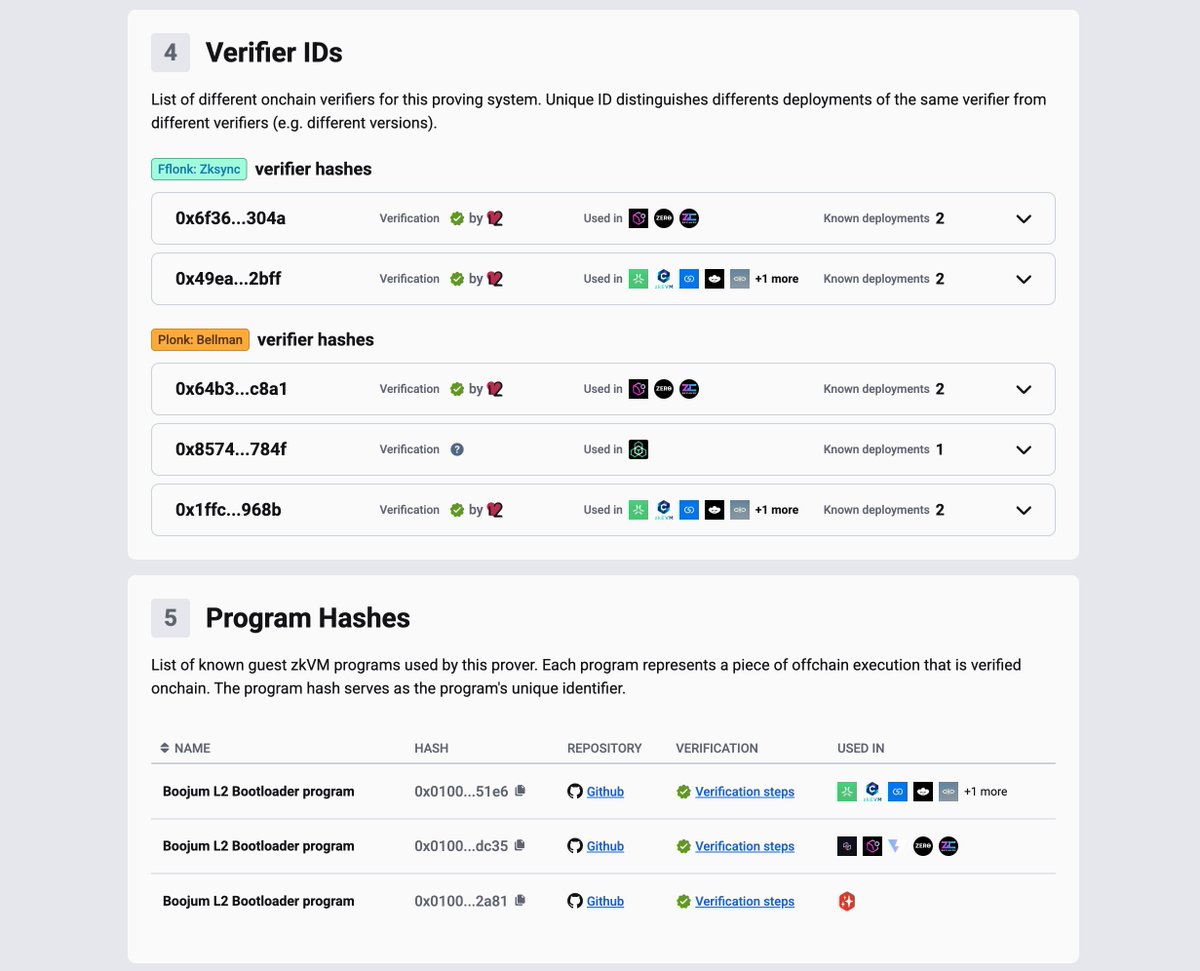
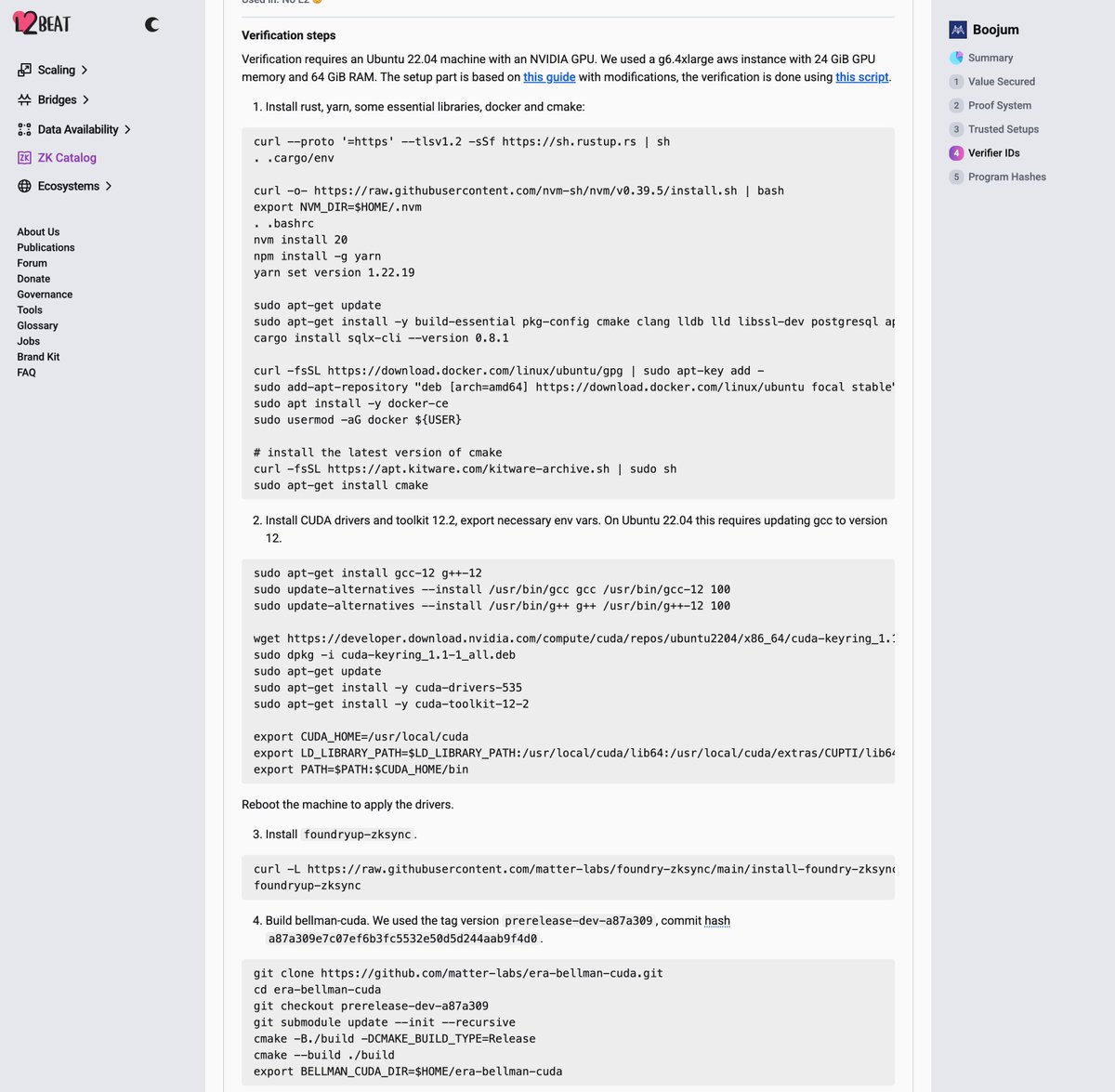
we successfully reproduced zk verifiers and host programs for all @zksync elastic chains using boojum. all verification steps can be found in the project page, and if anyone goes through the same steps, tell us and we'll add your social attestation
h/t @sergeyshemyakov
English
Axlvaz retweetledi

My 2 gwei as an AMM maxi:
I feel qualified and neutral enough to speak on this debate given that my project currently integrates every version of Uniswap except for V1.
•We use UniV2 for our token’s liquidity on Base despite the common trend of new tokens launching on Aerodrome given the massive amount of support that the Base team as well as Coinbase ventures has poured into Aero.
•We used UniV3 for our initial prediction markets (in a very crafty way I might add).
•And we have built the only conditional token UniV4 PM-AMM hook, which we currently use for all our latest markets.
We build on top of Uniswap because we believe their product is still among the most innovative in the space, and because they have an excellent security track record.
But Hayden is not entirely on the right side of this debate.
I’ve followed Alex’s rise from when he just entered crypto and was writing informative threads about Solidly and its ve mechanics back when Andre Cronje first created it.
Then Alex launched Velodrome on Optimism and we had a few calls where he pitched me several times on the veAMM design. I told him I was skeptical, and I still am.
But after years of the veAMMs working despite my skepticism, is it possible that the mechanics he swears by are more robust than I thought?
I think so.
In his comment here Hayden says that Uniswap is not funded through token emissions, that token holders are not bearing the burden of Uniswap’s operational expenses, and that those costs come from Uniswap Labs’s fund raises.
Which begs the question: what do these investors get in return for their funding if not UNI tokens?
The answer is Uniswap Labs equity.
At this point the facade that there’s no tension between company equity and issued tokens has mostly been lifted.
Everyone knows that the equity is subtractive from the token.
So Alex is right that token holders *are* bearing the cost of Uniswap’s growth and development. And perhaps it’s possible that Aerodrome’s approach of funneling emissions directly to LPs in return for fees makes sense to a degree.
But it’s more nuanced than that.
Aerodrome too has development costs, and to the extent that these costs are less than Uniswap’s, it’s likely because Aero’s core AMM code is mostly a clone of Uniswap’s.
Hayden is also right that Aerodome’s revenue is primarily sourced through a fee rebate model, and that it can’t be directly compared to Uniswap’s revenue.
So where am I going with all this?
Well let me put it this way, the very fact that Hayden is engaging in this debate at all tells me that the competition is real.
Hayden is notorious for not acknowledging even the projects that are complimentary to Uniswap unless they work out of the same Brooklyn office, much less entrain a competitor on the timeline.
So that tells me that Aerodrome’s ve mechanics are yielding positive network effects to the point that it’s posing a real threat to Uniswap.
Some ppl might be thinking that “well if Uniswap were to make all their code business licensed then they wouldn’t have to deal with Aero’s pesky competition!”
But Aerodrome didn’t invent the veModel, Curve did.
Had Curve adopted a more volatile-token-friendly design instead of focusing on stablecoins and helping Do Kwon and Jump run up a $60B house of cards (sorry Mich but it’s true), it could very well have been them fighting this battle without reusing any of Uniswap’s code. (Funny enough Curve’s code is licensed while Uniswap’s isn’t.. heh)
So the TLDR here is that Hayden is right, but so is Alex.
Uniswap’s revenue is categorically different from Aerodrome’s.
However, Uniswap’s revenue can’t be modelled as trivially as Hayden lays out either; remember there is that hidden equity conflict of interest lurking about. If UNI represented holistic value accrual for all of Uniswap and Labs, then this whole debate could be put to rest with a less rigorous analysis.
But alas…
Hayden Adams 🦄@haydenzadams
This response from you still misleads and twists the truth “Eating an infinite ratio of new tokens” might describe aero but not Uniswap Uniswap has been around for over 8 years The initial tokens to labs team + investors were mostly unlocked years ago. Circulating supply hasn’t changed much since For past few years labs mainly funded operations through a venture raise and frontend fees A couple percent of total supply went to foundation for grants, etc but that’s very far from the infinite ratio you’re talking about
English

Welcome to 2026! Milady is back.
Ethereum did a lot in 2025: gas limits increased, blob count increased, node software quality improved, zkEVMs blasted through their performance milestones, and with zkEVMs and PeerDAS ethereum made its largest step toward being a fundamentally new and more powerful kind of blockchain (more on this later)
But we have a challenge: Ethereum needs to do more to meet its own stated goals. Not the quest of "winning the next meta" regardless of whether it's tokenized dollars or political memecoins, not arbitrarily convincing people to help us fill up blockspace to make ETH ultrasound again, but the mission:
To build the world computer that serves as a central infrastructure piece of a more free and open internet.
We're building decentralized applications. Applications that run without fraud, censorship or third-party interference. Applications that pass the walkaway test: they keep running even if the original developers disappear. Applications where if you're a user, you don't even notice if Cloudflare goes down - or even if all of Cloudflare gets hacked by North Korea. Applications whose stability transcends the rise and fall of companies, ideologies and political parties. And applications that protect your privacy. All this - for finance, and also for identity, governance and whatever other civilizational infrastructure people want to build.
These properties sound radical, but we must remember that a generation ago any wallet, kitchen appliance, book or car would fulfill every single one of them. Today, all of the above are by default becoming subscription services, consigning you to permanent dependence on some centralized overlord.
Ethereum is the rebellion against this.
To achieve this, it needs to be (i) usable, and usable at scale, and (ii) actually decentralized. This needs to happen at both (a) the blockchain layer, including the software we use to run and talk to the blockchain, and (b) the application layer. All of these pieces must be improved - they are already being improved, but they must be improved more.
Fortunately, we have powerful tools on our side - but we need to apply them, and we will.
Wishing everyone an exciting 2026.
Milady.
English
Axlvaz retweetledi

“USDT pays you no yield - what a rip off!”
For the world’s poor, zero yield is very competitive with alternative forms of savings.
Take “deposit collectors” as an example. These are individuals who are contracted to come around daily or weekly for pick up cash savings.
At the end of the term, the lump sum is returned to the saver, minus a fee.
A woman may contract to save 10 rupees a day for 220 days. At the end of the term, the woman would have saved Rs2,200, of which Rs2,000 would be returned to her (~$25).
That’s 9% of the total paid to the deposit collector to keep the savings safe. But it’s even worse than that in APY. It works out to nearly NEGATIVE 30% yield on savings.
You can see why 0% APY USDT looks attractive. It’s still safer than storing cash at home where it could be lost or stolen. It’s still invisible to relatives who may come asking for assistance.
The rug risk by @paoloardoino is surely much lower than a local deposit collector in rural West Africa or South Asia.
It’s easy to forget that USDT’s dominance doesn’t come from trying to compete with JPM or HSBC as the most capital efficient stablecoin. They dominate because they do business in places no one else bothers to compete in.
Stablecoin issuers need to know their target market(s). Most issuers ignore the markets with weak competition - like the -30% APY savings instruments - to the detriment of their own growth and the crypto promise to bring services to the underserved.
English

@0xJoxes dear joxes
I thought really hard about what you wrote, and I have to say
I did not get you meant
merry christmas
English

The most fascinating thing about prediction markets from the architectural side of things is that fact that you can issue assets given a collateral whose value nobody knows and how you can think and drive open markets based on that primitive
English