Math@BklynInstitute

1.4K posts

Math@BklynInstitute banner
Math@BklynInstitute

Math@BklynInstitute

@BISRGodel

@BklynInstitute courses: Gödel, infinity, Turing, AI, algebra, calculus, imaginary/complex numbers, math epidemiology; I also teach math courses at CUNY
Brooklyn, NY Katılım Mart 2013
602 Takip Edilen250 Takipçiler
Sabitlenmiş Tweet
Math@BklynInstitute
Math@BklynInstitute@BISRGodel·
Timeline of @BklynInstitute mathematics courses we have offered over the past 10 (!) years: 1/ Gödel incompleteness, spring 2013 (back when BISR courses were (6 weeks)*(2h/week) - met in that sci fi bookstore in Dumbo
English
1
0
1
0
Math@BklynInstitute retweetledi
Physics In History
Physics In History@PhysInHistory·
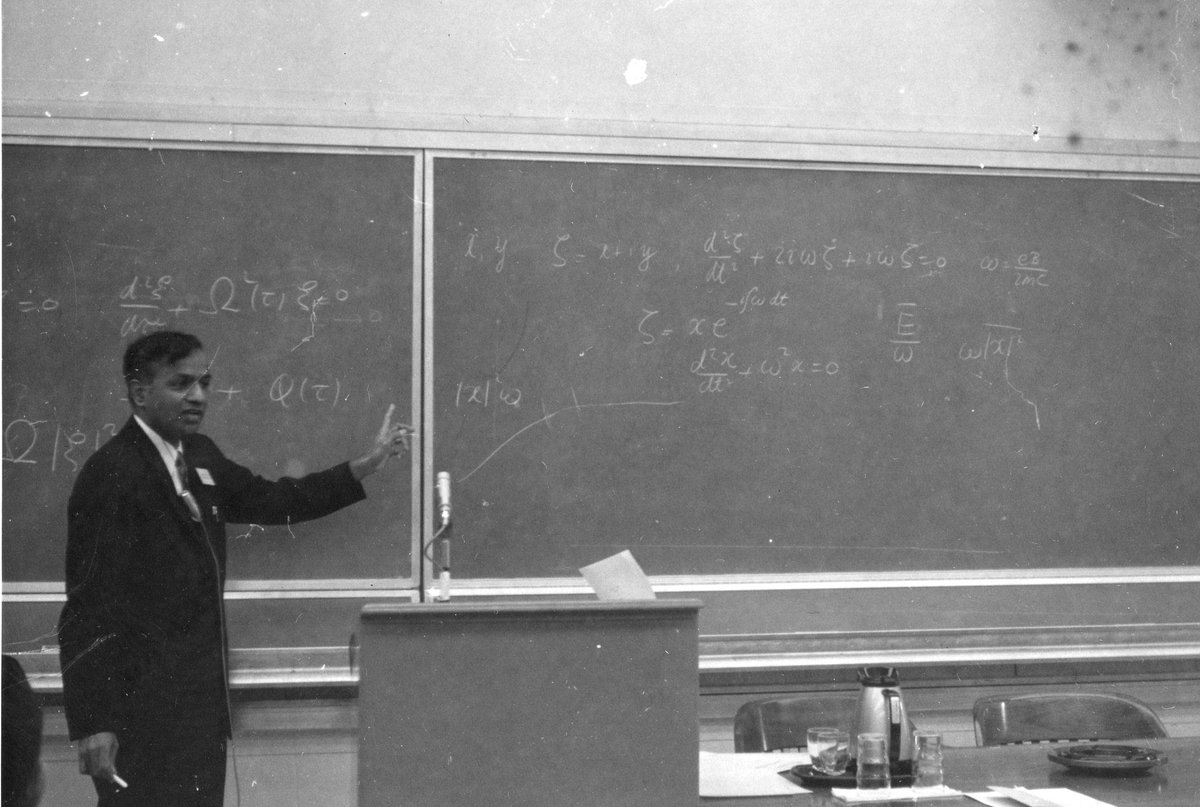
In the 1940s, Subrahmanyan Chandrasekhar was committed to his teaching role at the University of Chicago, despite being based at the Yerkes Observatory. Each week, he traveled 80 miles to teach a special course attended by only two students. The students were Tsung-Dao Lee and Chen-Ning Yang. They proved their mentor's faith was well-placed when they both won the Nobel Prize in Physics in 1957, years before Chandrasekhar received the same honor in 1983. Remarkably, this course went down in history as the only one where every attendee received a Nobel Prize, underscoring the extraordinary impact of Chandrasekhar's dedication and teaching. 📷 AIP Emilio Segrè Visual Archives, Physics Today Collection
Physics In History tweet media
English
100
900
5.9K
215.8K
Math@BklynInstitute retweetledi
Physics In History
Physics In History@PhysInHistory·
In 1966, mathematician Alexander Grothendieck was awarded the Fields Medal for his revolutionary work in algebraic geometry, especially the development of schemes, étale cohomology, and the concept of toposes. The ceremony was held in Moscow. Grothendieck chose not to travel to the Soviet Union due to political reasons. His refusal was a political protest against the Soviet Union's imprisonment of two writers, rather than a refusal of the award itself.
Physics In History tweet media
English
4
32
242
24.5K
Math@BklynInstitute retweetledi
Steven Strogatz
Steven Strogatz@stevenstrogatz·
To all math fans: This is going to be an incredible movie when it comes out. Can't wait! It's about Maryam Mirzakhani, the first woman to win the Fields Medal. MARYAM: The Mirror and the Map
Ken Ono@KenOno691

1/ ANNOUNCING 🎬 MARYAM: The Mirror and the Map, a feature film about Fields Medalist Maryam Mirzakhani (the first woman to win the Fields Medal). After The Man Who Knew Infinity, writer/director Matt Brown, Manjul Bhargava & I are reuniting as associate producers.

English
11
165
1.1K
66.6K
Math@BklynInstitute retweetledi
Kevin Roose
Kevin Roose@kevinroose·
i follow AI adoption pretty closely, and i have never seen such a yawning inside/outside gap. people in SF are putting multi-agent claudeswarms in charge of their lives, consulting chatbots before every decision, wireheading to a degree only sci-fi writers dared to imagine. people elsewhere are still trying to get approval to use Copilot in Teams, if they're using AI at all. it's possible the early adopter bubble i'm in has always been this intense, but there seems to be a cultural takeoff happening in addition to the technical one. not ideal!
English
658
444
5.9K
2.6M
Math@BklynInstitute retweetledi
Derek Thompson
Derek Thompson@DKThomp·
Even if you take the conservative defense of each ICE killing, you’re left with “We haphazardly scaled up a poorly trained police force to storm into neighborhoods that voted against the president, where we antagonize the local population until someone resists arrest, and then we kill them,” which is morally horrendous on top of being an absurd way to do immigration policy.
English
633
3.8K
23K
1.2M
Math@BklynInstitute retweetledi
Ben Golub
Ben Golub@ben_golub·
I was expecting to hate Tim Hartford's piece, which essentially says that the math in economics "feels wrong" for the subject. But I liked it! He's right. Today's economics does invest a lot of its mathematical effort in the wrong stuff. Thread 1/
Isabella M Weber@IsabellaMWeber

Mainstream economics continues to rely on Newtonian mathematics — using calculus to optimise, subject to constraints, an approach not suited to understanding macroeconomics or human behavior. @TimHarford Nice shoutout to Vela Velupillai, my former professor at The New School

English
19
93
681
155.4K
Math@BklynInstitute retweetledi
Kevin A. Bryan
Kevin A. Bryan@Afinetheorem·
AI economists and AI researchers: this is *excellent*. Details below, but as I feel like I've said in every talk on this topic since my slides said "GPT-2", 1) AI technical capabilities are better and improving quicker than you think, 2) impact on economy *much* slower. 1/13
Kevin A. Bryan tweet media
English
13
94
726
92.7K
Math@BklynInstitute retweetledi
Alex Smith
Alex Smith@ninja_maths·
Green's theorem is probably the most important result that multivariable calculus students need to grasp. A very solid understanding of Green's theorem makes its higher-dimensional counterparts (the divergence theorem, Stokes' theorem) feel almost trivial.
Alex Smith@ninja_maths

@ZahlenRMD Green's Theorem. The sum of the microscopic scalar curls equals the circulation (macroscopic curl).

English
16
128
1.4K
71.7K
Math@BklynInstitute retweetledi
Physics In History
Physics In History@PhysInHistory·
The Fourier series is a way to represent any periodic function as a sum of simple sine and cosine waves. In essence, it breaks down complex signals into a combination of basic trigonometric functions, making it a powerful tool in mathematics, physics, and engineering for analyzing waveforms, heat transfer, vibrations, and more. 📹 Credit : mathswithmuza
English
60
547
3K
171.5K
Math@BklynInstitute retweetledi
Alex Kontorovich
Alex Kontorovich@AlexKontorovich·
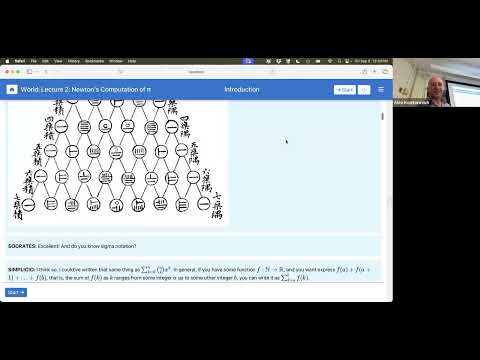
Real Analysis Lecture 2 is up. youtu.be/U2oCgeVgd9M We went over Newton’s computation of Pi, both because it’s super cool (first and foremost), and also because it’s a quintessential calculation encompassing everything that’s “wrong” with plain old Calculus, needing rigorous justification: - What does it mean for a sequence of real numbers a₀, a₁, a₂, ... to converge? - What does it mean for a series (that is, sequence of partial sums of some sequence) a₀ + a₁ + a₂ + ··· to converge, and can we sum these numbers in any order we like? - What does it mean for a series involving a variable, like a power series a₀ + a₁x + a₂x² + ··· to converge, and if it does, what kind of function does it converge to? - When can we interchange limits with integrals, like integrating term by term, ∫(a₀ + a₁x + a₂x² + ...)dx ··· ?=? ∫ a₀ dx + ∫ a₁x dx + ∫ a₂x² dx + ···? These are all exactly the kinds of questions that Real Analysis answers, but I find most presentations of these vital issues unmotivated. Hopefully the Newton example brings them to life...
YouTube video
YouTube
English
7
32
322
44.2K
Math@BklynInstitute retweetledi
Alex Kontorovich
Alex Kontorovich@AlexKontorovich·
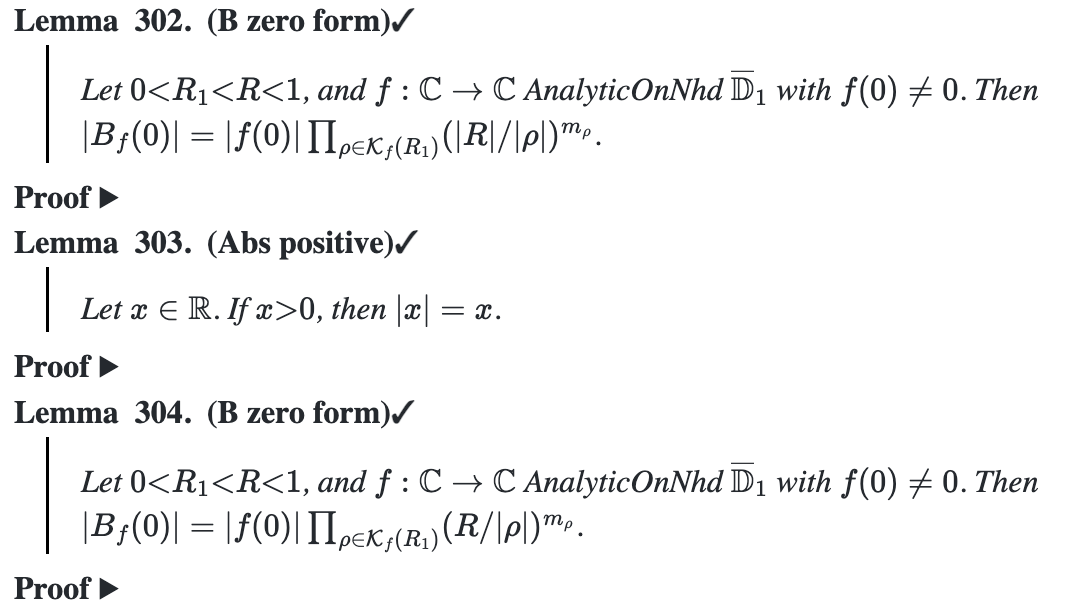
• The "3 weeks vs 18 months" comparison is exaggerated. That they could do this in 3 weeks *is* extremely impressive, and surely significantly shorter than what a team of volunteers could do. But we announced PNT+ in Feb ’24, and had a complete proof of the asymptotic (no error term) 9 weeks later. Then the pace slowed significantly, and more and more parts were handed off to grad students and postdocs, letting them learn Lean and the math. The project became as much about education and an experiment in large scale collaboration as it was in formalization, and we were in no hurry. At the Simons workshop this past June, the participants spent a week making a significant push on Medium PNT, and two weeks later, the goal was closed. (In fact, in our latest "Outstanding Tasks" list, a student had staked a claim to Borel-Caratheodory, promising to work on it... Oh well, sometimes you get scooped; that's life!) • As mentioned above, if I understand correctly, the modus operandi was: write a blueprint; see what the model can prove and where it gets stuck. For any theorem on which it’s stuck, decompose further and try again; iterate until success. The result is that the *natural language* decomposition reads like a formal proof (!); that is, extremely basic things are added explicitly as lemmas. So sandwiched between “real” lemmas are complete trivialities like |x|=x for positive x. So there’s a sense in which some of the “hard” parts of the work of formalization have been shifted over to the natural language side (which was allowed to have as much human interaction as necessary), to claim a win for autoformalization. I still think it *is* a win, especially because AI should be able to do this part of the job, too (and I’m sure their next iteration will try to use humans less and less, until Christian’s longstanding dream of fully AI formalization is realized).
Alex Kontorovich tweet media
English
1
5
36
3.1K
Math@BklynInstitute retweetledi
Math, Inc.
Math, Inc.@mathematics_inc·
Today we're announcing Gauss, our first autoformalization agent that just completed Terry Tao & Alex Kontorovich's Strong Prime Number Theorem project in 3 weeks—an effort that took human experts 18+ months of partial progress.
English
81
465
3K
1.3M
Math@BklynInstitute retweetledi
Patrick Shafto
Patrick Shafto@patrickshafto·
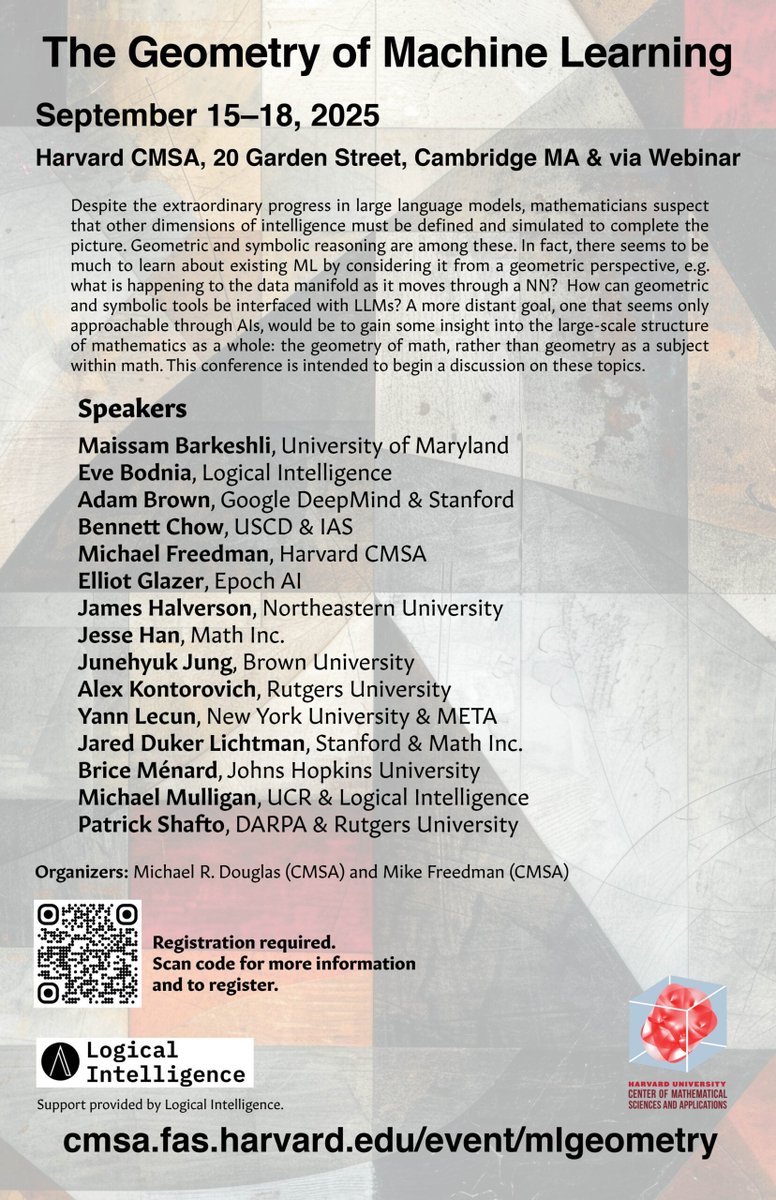
AI and math. Geometry and symbolic reasoning. Amazing recent developments and stellar line up of speakers. It is going to be an exciting week! The Geometry of Machine Learning @ Harvard Center for Mathematical Sciences and Applications (CMSA) cmsa.fas.harvard.edu/event/mlgeomet…
Patrick Shafto tweet media
English
2
4
35
7.1K
Math@BklynInstitute retweetledi
Grant Sanderson
Grant Sanderson@3blue1brown·
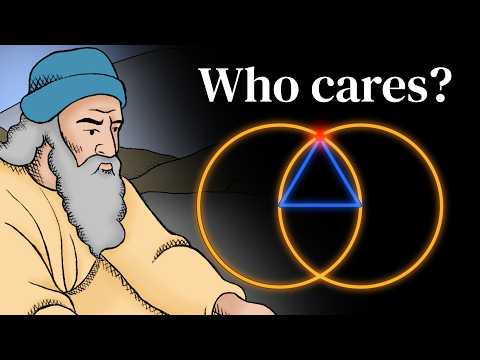
There is a lot about Euclid’s Elements that is easily misunderstood. Some proofs seem to have logical gaps. Some constructions seem pointless, others seem needlessly convoluted. Each of these provides a window into how the ancient Greeks thought about math and the philosophical role that geometry played. In the fifth and final of a series of guest videos I've been posting, @BenSyversen delves into a question anybody who has had to do ruler and compass constructions in a geometry class may have wondered: What's the point? youtu.be/M-MgQC6z3VU
YouTube video
YouTube
English
36
111
1.5K
157K
Math@BklynInstitute retweetledi
(((Matthew Lewis))) cults & consequences
I'm in NYC for the first time in almost 10 years and ... a couple quick observations: Anyone who thinks it takes too long to transform a city is wrong. This city is utterly transformed. It is faster to change a city than to change a suburb. And: The U.S. needs two dozen NYC's.
English
42
106
2.4K
177.9K
Math@BklynInstitute retweetledi
François Chollet
François Chollet@fchollet·
The 3rd edition of my book Deep Learning with Python is being printed right now, and will be in bookstores within 2 weeks. You can order it now from Amazon or from Manning. This time, we're also releasing the whole thing as a 100% free website. I don't care if it reduces book sales, I think it's the best deep learning intro around, and more people should be able to read it.
François Chollet tweet media
English
315
963
6.3K
925.3K
Math@BklynInstitute retweetledi
Engineering Educator
Engineering Educator@edu5_educator·
Physics notes
Engineering Educator tweet media
English
0
2
14
384