Benjamin Ball

2K posts

Benjamin Ball banner
Benjamin Ball

Benjamin Ball

@BenjaminBallA

Award-winning presentation coaching for leaders. Remote & in-person. Stand out when you Pitch, Present & Persuade. Investor Presentation Experts. 15+ years.

84 Brook Street, London, W1K Katılım Mart 2010
407 Takip Edilen336 Takipçiler
Benjamin Ball retweetledi
Owen Winter
Owen Winter@OwenWntr·
The local elections in one chart. Labour has been squeezed between the Greens in young wards and Reform in older working-class wards
Owen Winter tweet media
English
86
508
4.9K
670.9K
Benjamin Ball retweetledi
Sovey
Sovey@SoveyX·
Did you know Korea sells “one-a-day” banana packs? Instead of every banana ripening at once, each one is at a different stage. One is ready today. The next one is ready tomorrow. The last one is still spiritually in college, “experimenting.” Simple. Genius. Solves the entire banana problem. What do you think? Would you prefer your bananas this way?
Sovey tweet media
English
1.7K
5.3K
54K
5.9M
Benjamin Ball retweetledi
John Bistline
John Bistline@JEBistline·
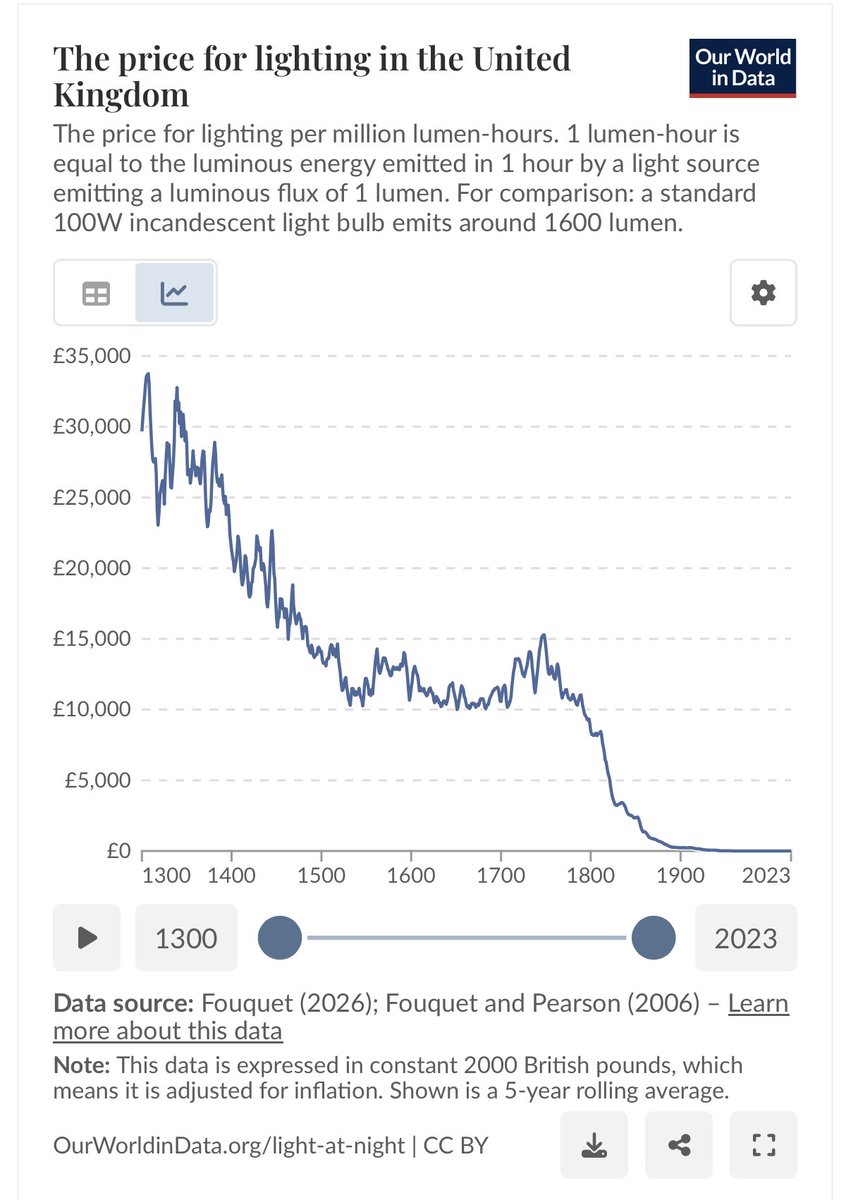
If you think that’s impressive, zoom out 700 years. The cost of lighting in the UK has fallen from £35,000 per million lumen-hours in 1300 to essentially £0 today. One of the most underrated progress charts ever made.
John Bistline tweet media
Connor O’Brien@cojobrien

This was shocking to me. Lighting has gone from the largest residential use of electricity to the sixth-largest in my lifetime. Clothes dryers alone now use more aggregate electricity than lighting in people's homes.


English
15
72
551
58.7K
Benjamin Ball retweetledi
Shai Goldman
Shai Goldman@shaig·
Joby just completed it's first electric aircraft flight , JFK to Manhattan in 10 minutes , future is here
English
182
307
3.4K
464.9K
Benjamin Ball retweetledi
Dudes Posting Their W’s
Dudes Posting Their W’s@DudespostingWs·
Japanese engineers developed a “Sword Tip Visualization System” for the Fencing World Championships, and it makes fencing look absolutely incredible to watch.
English
954
10.2K
98.2K
6.3M
Benjamin Ball retweetledi
Massimo
Massimo@Rainmaker1973·
The art of sentence length by Gary Provost
Massimo tweet media
English
16
72
328
16.9K
Benjamin Ball retweetledi
Untold Secrets
Untold Secrets@RealGemsfinder·
it's a million dollar invention.
English
295
822
8.8K
6.8M
Benjamin Ball retweetledi
andrew engler
andrew engler@aerockrose·
In 2011, Ford CEO Alan Mulally gave a 52-min masterclass on leading a turnaround when everything is broken. He walked into a company losing $17B a year. His frameworks: - The data sets you free - One Ford, not 97 distractions - Weekly truth-telling at 7 a.m. 12 lessons:
English
20
213
1.7K
510.8K
Benjamin Ball retweetledi
Documenting Saylor
Documenting Saylor@saylordocs·
Charlie Munger’s 1998 Harvard speech is the ultimate cheat code for life. He compressed 74 years of billionaire wisdom into just 30 minutes. Most people spend four years in college and learn less than what’s in this video. Save this video, you will come back to this.
English
4
306
1.2K
192.6K
Benjamin Ball retweetledi
Nancy Duarte
Nancy Duarte@nancyduarte·
After decades of working with leaders at companies like Apple, Salesforce, and Cisco, we've identified 4 storytelling techniques that consistently work to deliver important messages in high-stakes settings: 1. Start with the unexpected Don’t begin your presentation with context. Instead, begin with the moment that makes people think, “Wait…what?” Instead of something like: “Here’s an update on our September campaign…” Try starting with the most interesting detail: “I broke our biggest marketing rule last month, and it worked.” Lead with the surprise. You can add context later. 2. Let people feel the tension After the surprise, don’t rewind to the beginning. Take your audience to the moment where things weren’t working. Flat numbers. Missed goals. Stalled progress. Instead of: “The campaign was underperforming, and our team went back to the drawing board.” Try: "We were two weeks out from the end of the quarter. The campaign wasn’t producing results, and the team was out of ideas. That’s when I decided to take a risk...” You don’t need to explain the problem. You need to make people feel it. 3. Use real dialogue When your audience hears what was actually said, they stop listening to you and start visualizing the moment. This helps them connect emotionally with what you’re saying. Instead of: “The campaign manager said team morale was low and they were struggling to find a solution.” Try: “My campaign manager pulled me aside in the hallway and said, ‘We’ve tried everything. The team has been working overtime, and we don’t know what else to do.’” Dialogue brings listeners into the moment with you. It makes the story real. 4. Share the lesson Never assume people will infer the meaning you intended. End your story by answering: - What does this mean? - How should someone act differently now? Example: “Breaking our biggest marketing rule helped us turn this campaign around and hit our numbers. I strongly suggest we revisit our marketing guidelines. We could be leaving a ton of revenue on the table.” Without the lesson being clear, even a good story feels unfinished. These are the same techniques we teach to our clients at Duarte. Try them out during your next presentation and watch how people lean forward and tune in to your message
English
4
46
304
28.1K
Benjamin Ball retweetledi
Gurwinder
Gurwinder@G_S_Bhogal·
It’s good to periodically prompt your chatbot about something you know exceptionally well, just to remind yourself that it doesn’t know what it’s talking about.
English
70
190
3.3K
67.8K
Benjamin Ball retweetledi
Big Brain Business
Big Brain Business@BigBrainBizness·
Jordan Belfort, former American stockbroker, on why asking the right questions closes more deals than the perfect pitch: Most salespeople lose the deal before they even make the pitch, and they don't even realise it. Belfort explains that the famous "sell me this pen" exercise is a test designed to reveal whether a salesperson truly understands what selling is. "If you ask someone who's not a professional salesman, who doesn't have the right instincts, they will start actually trying to sell you a pen. This pen is great. This pen writes upside down. It's the best value for its money. This pen will last forever. Buy this pen." That approach, he says, is the wrong one entirely. "The only rational thing you could do when someone says, 'Sell me this pen,' is to start asking them questions." Instead of pitching, a skilled salesperson shifts into discovery mode: How long have you been in the market for a pen? What type of pens have you used in the past? Is it for business or personal use? When you buy a pen, how much do you typically spend? The questions serve as the foundation of the entire sale. @wolfofwallst distills his philosophy down to a single principle: "The key to selling is to find out — step one — what are your client's needs, values, what pain are they looking to fill? And you look to fill that need at the most basic level." The best pitch isn't the one with the most compelling features. It's the one built entirely around what the buyer already told you they need.
English
8
65
517
109.8K
Benjamin Ball retweetledi
Ihtesham Ali
Ihtesham Ali@ihtesham2005·
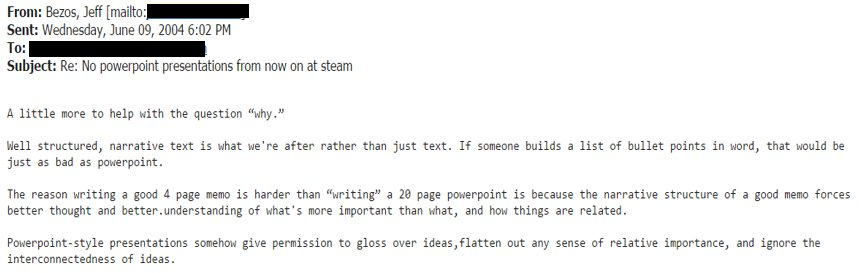
Jeff Bezos banned PowerPoint at Amazon in 2004. Every executive thought he had lost his mind. Twenty years later, it's the single best decision he ever made for how Amazon thinks. Here's the meeting format he replaced it with, and how I use the same structure with Claude: On June 9, 2004, Bezos sent a single internal email to his senior team. Subject line: "No PowerPoint presentations from now on at STeam." No debate. No transition period. Done. In its place, he mandated something that made new executives visibly uncomfortable their first week. A six-page narrative memo. Written in full sentences. Real paragraphs. Verbs and nouns. No bullet points, no slide headers, no charts doing the thinking for you. And before a single word of discussion, everyone in the room sits in complete silence for 30 minutes and reads it. His reasoning was precise. "There is no way to write a six-page, narratively structured memo and not have clear thinking." PowerPoint, he believed, was a tool for hiding confused thinking behind clean slides. Bullet points create the illusion of logic without requiring it. You could put three contradictory ideas on three consecutive slides and nobody would catch the contradiction because slides don't force you to connect anything. A narrative does. The moment you have to write "therefore" or "because of this" or "which means," you are forced to actually know whether the logic holds. The gaps that bullet points paper over become impossible to hide inside full sentences. The great memos, he said, take a week or more. Written, rewritten, shared with colleagues, set aside for two days, then edited again with a fresh mind. The thinking happens in the writing, not in the meeting room. Here is why the silent reading matters as much as the memo itself. Bezos knew that if executives were handed the memo the night before, half would skim it. A third would bluff. The silence ensures every single person in the room has done the actual thinking before the discussion starts. Everyone arrives at the conversation from the same foundation. No one can ride on someone else's preparation. Kindle started as a six-pager. AWS, which now generates more profit than all of Amazon's retail operations combined, began as an internal memo about making Amazon's own developers more efficient. The narrative was so logically sound it scaled into a multi-billion dollar industry. The format didn't just improve meetings. It became the engine that produced Amazon's biggest ideas. I use the same forcing function now, except I use Claude to stress-test the memo before it ever reaches a room. I dump my rough thinking into Claude and run one prompt: "You are a hostile senior executive who has read this memo. You have 30 minutes of silence behind you and a red pen. Find every place where the logic jumps without explaining itself, every claim that sounds confident but has no support, and every paragraph where I'm hiding confusion behind clean language. Be brutal." What comes back is not feedback. It is the exact experience of having your thinking pressure-tested by someone who had nothing better to do for 30 minutes than find every hole in your argument. The memo gets rewritten. Then I run it again. By the time it reaches anyone who matters, it has survived something close to what Bezos built into every Amazon meeting by design. Most people use AI to write faster. Bezos built a system to force thinking deeper. Those are opposite directions, and only one of them compounds.
Ihtesham Ali tweet media
English
5
47
190
18.3K
Benjamin Ball retweetledi
Michael Millerman
Michael Millerman@millerman·
Henry Kissinger's speechwriter Winston Lord once spent days on a report, then submitted it. Kissinger sent it back: 'Is this the best you can do?' Lord rewrote it, resubmitted. Same response. This went on 3-4 times. Finally Lord snapped: 'Damn it, yes, it's the best I can do.' Kissinger: 'Fine, then I guess I'll read it this time.' This is exactly how I work with Claude.
Michael Millerman tweet media
English
41
352
3.5K
254.9K
Benjamin Ball retweetledi
Brian McLaughlin
Brian McLaughlin@BrianMcL94·
I've thoroughly enjoyed this book on speechwriting by @PhilipJCollins1. The section on jargon deserves its own book.
Brian McLaughlin tweet media
English
2
2
7
2K
Benjamin Ball retweetledi
Graham Linehan
Graham Linehan@Glinner·
ZXX
336
3.7K
22.6K
1.8M