
Taylor Berg-Kirkpatrick
24 posts

Taylor Berg-Kirkpatrick
@BergKirkpatrick
Assoc Prof at UC San Diego @ucsd_cse, AI researcher

Reasoning VLMs often say "let me check the figure again." But do they actually look? Or just say they will, without re-attending to the image? Introducing VisualSwap — #ICML2026 Spotlight 🌟 — diagnosing this silent failure.

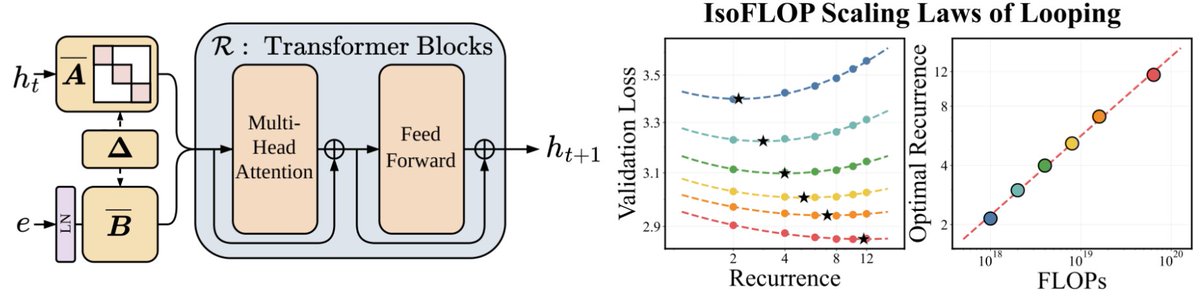
We’ve been thinking a lot about scaling laws, wondering if there is a more effective way to scale FLOPs without increasing parameters. Turns out the answer is YES – by looping blocks of layers during training. We find that predictable scaling laws exist for layer looping, allowing us to use looping to achieve the quality of a Transformer twice the size. Our scaling laws suggest that for a fixed parameter budget, data and looping should be increased in tandem! 🧵👇

We’ve been thinking a lot about scaling laws, wondering if there is a more effective way to scale FLOPs without increasing parameters. Turns out the answer is YES – by looping blocks of layers during training. We find that predictable scaling laws exist for layer looping, allowing us to use looping to achieve the quality of a Transformer twice the size. Our scaling laws suggest that for a fixed parameter budget, data and looping should be increased in tandem! 🧵👇

We’ve been thinking a lot about scaling laws, wondering if there is a more effective way to scale FLOPs without increasing parameters. Turns out the answer is YES – by looping blocks of layers during training. We find that predictable scaling laws exist for layer looping, allowing us to use looping to achieve the quality of a Transformer twice the size. Our scaling laws suggest that for a fixed parameter budget, data and looping should be increased in tandem! 🧵👇

We’ve been thinking a lot about scaling laws, wondering if there is a more effective way to scale FLOPs without increasing parameters. Turns out the answer is YES – by looping blocks of layers during training. We find that predictable scaling laws exist for layer looping, allowing us to use looping to achieve the quality of a Transformer twice the size. Our scaling laws suggest that for a fixed parameter budget, data and looping should be increased in tandem! 🧵👇

We’ve been thinking a lot about scaling laws, wondering if there is a more effective way to scale FLOPs without increasing parameters. Turns out the answer is YES – by looping blocks of layers during training. We find that predictable scaling laws exist for layer looping, allowing us to use looping to achieve the quality of a Transformer twice the size. Our scaling laws suggest that for a fixed parameter budget, data and looping should be increased in tandem! 🧵👇


The paper I’ve been most obsessed with lately is finally out: nbcnews.com/tech/tech-news…! Check out this beautiful plot: it shows how much LLMs distort human writing when making edits, compared to how humans would revise the same content. We take a dataset of human-written essays from 2021, before the release of ChatGPT. We compare how people revise draft v1 -> v2 given expert feedback, with how an LLM revises the same v1 given the same feedback. This enables a counterfactual comparison: how much does the LLM alter the essay compared to what the human was originally intending to write? We find LLMs consistently induce massive distortions, even changing the actual meaning and conclusions argued for.

DeepSeek-OCR is a solid OCR model. But the excitement around it has become something bigger—evidence that vision might solve the long context problem. Has the excitement outpaced the evidence? "Optical Context Compression Is Just (Bad) Autoencoding" → arxiv.org/abs/2512.03643


📣Thrilled to announce I’ll join Carnegie Mellon University (@CMU_EPP & @LTIatCMU) as an Assistant Professor starting Fall 2026! Until then, I’ll be a Research Scientist at @AIatMeta FAIR in SF, working with @kamalikac’s amazing team on privacy, security, and reasoning in LLMs!

``DITTO-2: Distilled Diffusion Inference-Time T-Optimization for Music Generation,'' Zachary Novack, Julian McAuley, Taylor Berg-Kirkpatrick, Nicholas Bryan, ift.tt/DTChrSb

We've done some work on hacking AI/LLM Agents by creating obfuscated adversarial prompts. What do you think this prompt does? Would you believe me if I told you it will polish the heck out of that cover or visa application letter?

Can ancient (logograhpic) languages from 5,000 years ago be processed like modern ones using NLP? We found visual representation-based system for NLP on ancient logographic languages outperforms conventional Latin transliteration! Join us at Poster s3 - Mon 4pm #ACL2024 #NLProc