brian mari

29K posts

brian mari banner
brian mari

brian mari

@brianmari3

Katılım Mayıs 2014
2.4K Takip Edilen6.9K Takipçiler
Sabitlenmiş Tweet
brian mari
brian mari@brianmari3·
I see a lot of talk about @CCCZimbabwe being fomented the regime and I see a lot of energy from innocent citizens towards the decoys. I have written to 3 institutions with functions to correct people's complaints, there is no talk about it. You then ask, who is behind the spread of abuse of power, the people or regime? After having said this, the blame is on @nelsonchamisa Tell me how, but I will only show you the what. The regime knows it and is busy finding a way out. You the the people of Zimbabwe as you braai or drink or what ever event you will have at Christmas remember- 1) It is you who made the constitution and how you want to be governed and not me or @nelsonchamisa 2) You have separate and distinct authorities that are driven from you and vested in others and without you there is no authority no matter what. 3) While the President is vested with Executive authority in terms of section 88 and said to be head of state with functions in section 110, it is not correct that president is the pressure point to break the regime 4) While majority of politicians hope to be in parliament and people are concerned that parliament may change constitution. The point is, change of constitution which is not constitutional is invalid and with a competent court, it must never be a problem. In that case legislative authority we gave in s117 can always be vindicated in court. 5) This then must tell us all to, leave the internal fight of @CCCZimbabwe and look at s162. 6) It is you who can give judicial authority to anyone and nothing can take this away from you. 7) Most people, including lawyers do not know that from 22 May 2020 Zimbabwe has no Chief Justice or judge of constitutional court. 8) The Supreme Court judgement against @nelsonchamisa was deliberately delivered same day as judgement against Gwaunza on 31 March 2020, yet people were kept hooked on MDC internal fights. 9) The temporary constitutional court bench that was put by paragraph 18(2) of old constitution had its mandated terminated on 21 May 2020 but citizens were kept busy with recalls. 10) Since then, the regime use distraction and catalyst to distract your attention. 11) Forget about the rest and read paragraph 13 of Sixth Schedule and section 177 and finish it all. 12) If there is no Chief Justice or constitutional court judge there is no one to swear in a president. Even if Chamisa is to be declared winner he need a properly appointed Chief Justice to swear him. 13) It is easy to invalidate ED presidency using absence of Chief Justice and s166 constitution court and it solves all other problems. 14) Why not join me. As we celebrate Christmas think about your judicial authority, did you give it to the goons? If no then why do fold arms?
English
24
62
97
44K
mudiwa Mwarire
mudiwa Mwarire@mwarire95490·
CA3 is a brilliant, perfectly constitutional move that Zimbabwe desperately needs. It smartly extends presidential terms to 7 years, shifts to parliamentary election of the President, and modernises local governance, all without touching the two-term limit or protected chapters. Professor Moyo is 100% right: Section 328 requires NO referendum because this isn't changing the number of terms, Chapter 4 rights, or agricultural land rules. The Constitution's own clear text fully supports it. The "people's authority" arguments are just hot air. Zimbabweans already gave Parliament the power to amend with a two-thirds majority; that's how real representative democracy works. #CA3 respects that system instead of forcing expensive, unnecessary referendums every time we improve governance. All the talk of the ICCPR, the UDHR, and "international obligations" is irrelevant fluff that doesn't override Zimbabwe's supreme law. It is a legitimate, lawful upgrade that strengthens institutions and gives elected leaders more time to deliver real results. Cabinet and Parliament are fully empowered to drive this. The process followed every constitutional step: gazetting, hearings, and a supermajority vote. Opponents are simply inventing extra hurdles because they can't win on the actual law or the merits. CA3 is legal, logical, and exactly what Zimbabwe needs for stability and progress. Pass it, implement it, and watch the country move forward. #Zimbabwe
English
1
0
0
19
brian mari
brian mari@brianmari3·
When you listen to @ProfJNMoyo talking that is when you see all the stupidity of ZANU PF. 1. Firstly @ProfJNMoyo portray a constitution as a document that stays in a vacuum and one can write anything and call it constitution then it becomes like that and binds people. 2. He does not care to check the logic of what he is saying and relevance of it. 3. Whether @ProfJNMoyo likes it or not but the truth is, Zimbabwe in her own capacity has international agreements and treaties which she signed and put obligations on her, therefore Zimbabwe constitution cannot contravene international treaties or international obligations to please his pleasure. 4. We cannot then spend 90 days trying to interpret s328 in order to suit what @ProfJNMoyo want to hear with his ears or see with his eyes. 5. Constitutions world over are made under the auspices of two distinct rights, (1) the collective right of peoples to SELF DETERMINATION- this is the one that give rise to the writing of constitution and (2) the individual right of a citizen to participate in the writing of a constitution. 6. These two rights are not found written in a provision of a constitution or in s328 but they are inherent in people before any constitution is written as guaranteed by ICCPR and UDHR 7. In all his effort to try and repel the holding of referendum, @ProfJNMoyo make an impression that referendums are called for amending chapter 4 and 16 only and referendums are called in terms of s328 8. I also tried to understand Dr Hofisi's response but again he seem to dwell on petty things that do to explain why referendums are called and in this case it will be unavoidable. 9. The first point to realise is in our Preamble to the constitution. One cannot talk of amendment of a provision of constitution without first knowing who actually is the author of constitution, what right is he or she exercising by writing the constitution, in what capacity is he writing constitution and then see how the author of constitution delegate authority to other person to act on behalf of him or her. 10. I like @ProfJNMoyo reference to SA constitution in that it helps clarify the misrepresentations he makes. By comparing our Pre amble to South African constitution, it can be read that people of Zimbabwe directly made their constitution and not through a representative, however South Africa constitution was adopted through freely chosen representative. 11. It is critical to understand the Preambles before you talk of amendment of the constitution. 12. A constitution adopted directly by citizen is giving effect to right an individual citizen to decide on his own on how he or she want to be governed, but a constitution adopted through freely chosen representative is giving right to a citizen to decide on how he or she want to be governed through a freely chosen representative. In that regard, amendments in the two constitution will never be the same because the right to participate in the process of actual adoption of the constitution were also different. 13. Now ICCPR article 2 has three basic obligations that form basis of government structure. Article 2.1 deals with protection of rights in ICCPR- Every member state must have an Executive arm that give protect rights in ICCPR to everyone in the territory of state or jurisdiction without distinction of any kind. 2.2 deals with legislation of laws that give effect to rights in ICCPR and 2.3 deals with remedy which may be judicial or administrative. 14. It's not upto a state or @ProfJNMoyo to then create a government structure that does not give effect to the rights in ICCPR. 15. Authority flows from the people to the form of government that is formed. 16. To help @ProfJNMoyo understand things and remove his confusion, he must first compare Zimbabwe constitution s88(1), 117(1) and 162 to respective sections in South African constitution which has indirect participation, section 85 of SA constitution vest executive authority to President, s43 of SA constitution vests Legislative Authority with Parliament and s165 vest Judicial authority with courts, these provisions do not talk of were the authority that is vested is derived and how it is derived yet with Zimbabwe constitution, before you talk of vesting an authority, that authority has to be derived from people of Zimbabwe in all their diversity and without distinction. 17. Here is the part @ProfJNMoyo misses, s42(3) of SA Constitution state it clearly that their National Assembly is ELECTED to represent people in forming government by the people and provide a forum to consider national issues. What it means is, before members of national assembly of SA assume their roles, it is known before election that the role they will play and authority to represent in considering national is given to them on their election. 18. @ProfJNMoyo want to conflate SA parliament to Zimbabwe Parliament which are two different things altogether. 19. In SA s43(a) National Legislative Authority is vested with PARLIAMENT but in Zimbabwe s117(2) Legislative authority is vested with LEGISLATURE. In that case we must not conflate the two. 20. Section 116 of Zimbabwe constitution define Legislature of Zimbabwe. While Parliament is part of legislature but in Zimbabwe constitution legislature is not Parliament. 21. Section 118 of Zimbabwe constitution define Parliament as comprising of National Assembly and Senate. Again National Assembly alone or Senate alone does not constitute Parliament. 22. Role of Parliament is defined by s119 and unlike South African constitution s44 where power to amend constitution is given to parliament, Zimbabwe constitution in s119 has no role given to PARLIAMENT to amend constitution. 23. I then laughed lungs out when @ProfJNMoyo try to interpret s152 role of Parliamentary Legal Committee. That was the point I said to myself we have a stupid professor trying to spin nonsense. 24. Once you conflate legislature and Parliament under Zimbabwe constitution you mislead yourself. 25. While in other constitutions a parliament and legislature mean same thing but in Zimbabwe it is different and cannot be conflated. 26. When s117(2)(a) give a POWER and not Authority to Legislature and not Parliament to amend constitution in ACCORDANCE with s328 and not in terms of s328 it does confine legislature to s328. That is why it says in accordance with and does not say in terms of s328. 27. While s328 talks of term limits provisions but not all term limits provisions are in chapter 5 or 6 or 8, however executive authority, Legislative Authority and judicial authority is derived directly from people of Zimbabwe. In that regard if a provision is under Executive Authority or Legislative Authority or Judicial authority then what makes the amendment of provisions under these chapters go for referendum is not s328 but s88(1) or 117(1) or 162. 28. The reasons why s110(3)(c) gives power to Cabinet to initiate only national legislation and not Constitutional Bill or s152(3) does not give power to Parliamentary Legal Committee to examine a constitutional Bill before it receives a final vote in Senate or National Assembly is where @ProfJNMoyo is getting lost 29. Because a constitution is an expression of people on how they want to be governed, the state or arm of state, cabinet or Parliament, (please take correct meaning of parliament in s118 and role in s119) cannot initiate a constitutional Bill that seek to determine how people must be governed. 30. A member of National Assembly or a member of Senate may initiate a constitutional Bill but that does not translate to Parliament. 31. Section 328(2) puts an obligation on the initiator of a Bill seeking to amend constitution to do so in EXPRESS TERMS. How then can a whole professor miss this obligation. 32. Whether you want to refer to s95, 91 or 143 or 158, call it the way you want to call them, the point is that these provisions are under chapter 5 and 6 and in particular, affect Executive functions of President in s110(2)(e). The executive authority to call election in terms of "this" (not that but "this") constitution by section 88(1) is derived from people of Zimbabwe directly and not from legislature or legislative function. The express terms of that authority must be on the Bill as s328(2) demands. 33. No one has obligation to tell the initiator of the Bill to call for referendum but to amend the executive provisions of constitution you need to derive authority of people of Zimbabwe directly. 34. Section 110(2)(f) states it clearly President call referendum for any matter in accordance with law. Why are we not talking about it?
brian mari tweet mediabrian mari tweet mediabrian mari tweet media
TheNewsHawks@NewsHawksLive

🔴Zimbabwe Constitutional Amendment Bill (No.3): Academic discourse; Professor Jonathan Moyo versus Dr Tinashe Hofisi.

English
9
11
20
2.7K
brian mari
brian mari@brianmari3·
The problem we have with this s328 analogy @matinyarare is this- 1. You are all trying to find a right from a wrong process and procedure. 2. What must be asked to @nickmangwana is, "Does constitution give Cabinet power to initiate a constitutional Bill"? 3. @matinyarare go to s110(3)(c) on Executive function of Cabinet and see that cabinet only has function of initiating National Legislation only. 4. To clear doubt and ambiguity, National Legislation is defined by constitution itself as Acts of Parliament and Statutory instrument and 5. Constitutional Bill is defined as bill that has effect of amending constitution. 6. In that regard you cannot spend 90 days trying to find a referendum close for an amendment Bill brought by cabinet seeking to amend provisions under a separate and distinct authority separately derived from people of Zimbabwe. 7. This is not about constitutional law or constitutionalism. It is about governance and principle of governance. 8. If I were to answer @nickmangwana and prove to him that the Bill require referendum, I do not take him to s328 but 3(2). 9. The first principle @nickmangwana must grasp is principle of separation of powers and Executive and Legislature are two distinct powers and each derived AUTHORITY directly from people of Zimbabwe. 10. Section 88(1) clearly states that Executive Authority of Zimbabwe is derived from people of Zimbabwe and is exercised in accordance with the constitution and s88(2) speaks of vesting of executive authority of Zimbabwe to President who exercise it through cabinet. 11. If by s3(2)(b) it is binding on the state and all its arms to hold regular elections, how then will legislature confere the mandatory Executive Authority of Zimbabwe on president not to call election when they are due. 12. How is 2/3 majority in Senate or National Assembly of any value over a matter whose authority is clearly stated as derived from people of Zimbabwe? 13. Correct governance procedure was that cabinet draft its bill in a questionnaire format and cite the limitation of delegated executive authority in s110(3)(c) where cabinet only has power to initiate National Legislation and not constitutional bill but for whatever reasons behind their cause, they are seeking Executive Authority of Zimbabwe and request president to call for referendum in terms of s110(2)(f) seeking executive authority to act outside provided provisions. 14. If the referendum gets majority vote then s88(2) is satisfied, the next step will be approaching legislature to amend constitution and give effect to the proposed bill. 15. Why? Because Executive Authority is of Zimbabwe is derived directly from people of Zimbabwe and is vested with President. In that regard you do not go to legislature to seek amendment of constitution on executive authority with acquiring the authority directly from people of Zimbabwe. 16. Parliament has no executive authority of Zimbabwe to give anyone and legislation cannot vest executive authority on president if people have not voted for it
English
0
0
2
59
Rutendo Matinyarare
Rutendo Matinyarare@matinyarare·
This is an incompetent legal appraisal of the Zimbabwean Constitution and the Constitutional Amendment Bill 3 by Karabo: 1. Firstly he argues that extending a term from five years to seven years is not a term limit extension intended to increase the time in office of an office holder (the President) because it’s not an extension of the number of terms. 2. This is flawed because terms by legal definition are determined by two elements: (i) length (number of years in a term) and (ii) number of terms. Obviously you can’t have a limit on number of terms one serves, without an agreed limit to the years that constitute a term. This is why extending the length of a term from five years to seven years is the quintessential definition of a term [length] limit extension. 3. Secondly, Karabo also does not address the issue that a term limit extension amendment cannot benefit the incumbent making the amendment unless a referendum changes section 328(7) to allow an incumbent to enjoy the term extension made while he is in office. It’s clear that Karabo has no grasp of the legal issues he is debating, but he was given a brief to write a paid article, which comes across incompetent and of course unethical.
Nick Mangwana@nickmangwana

“Does the Constitution actually require a referendum for the changes being proposed? A careful reading of the Constitution of Zimbabwe (2013) suggests the answer is no. Section 328 is not a vague guideline. It is the Constitution’s procedural backbone for amendments. It sets out a two-track system. First, there are standard amendments. These can be passed by Parliament, provided there is a two-thirds majority in both houses and a 90-day period of public notice. This is not a loophole or a shortcut. It is the default mechanism deliberately built into the Constitution”#CAB3 iol.co.za/sundayindepend…

English
37
21
62
9.8K
brian mari
brian mari@brianmari3·
You are just assuming things and this is the wrong we have with people coming from Lancaster House constitution. Generally the word parliament is used to mean a "forum" where specified issues are dealt with. Many jurisdictions use parliament as a forum that represent people's political opinions and the majority view of parliament will be the representation of people's political opinion. Of late under Lancaster House constitution this was the way it was with us but that has since change d. Again most constitution use the Parliament as their legislature such that the forum to deliberate on national issues and legislation are often conflated. Zimbabwe under 2013 constitution adopted the Strick requirements of ICCPR 25 in that, the right of a citizen to participate in the affairs of his country is "without" the itemised distinctions in article 2.1 of ICCPR. Before I go to our constitution, I want you to understand that the right of a citizen to participate in the affairs of his country directly or through a freely chosen representative is WITHOUT DISTINCTION OF POLITICAL OPINION OR POLITICAL AFFILIATION. In our 2013 constitution, what was done is this, a section under chapter 4 was created to give a citizen what are called POLITICAL rights. In section 67(1)(b), the right to make political choices was given directly to each and every individual citizen. In that regard no one can claim to represent or hold authority to represent a political choice of another. Each individual represent his or her own political choice. So no member of parliament of Zimbabwe is elected to represent people's political opinions or political choices. In that regard the constitution itself created a direct participation for every political choice we make. From right to participate in election or not. If you choose to participate you claim a form to register as a voter in your own capacity. If you want to form a political party to contest election, you go and claim a form VN5 and fill in. If you want to nominate a candidate you claim a form. If you want to see if all candidates that submitted form for election you go and inspect yourself. If a vacancy in PR seat arise, you go to approve or disapprove the nominated candidate without being asked of your party membership. If you want a law to be changed you petition parliament, if you want to challenge government policy you do it directly. In that regard, the constitution of Zimbabwe has no representation of political opinion or views in any arm of state. In s67(2)(d) every citizen of Zimbabwe was directly given right to participate individually or collectively in peacefully activities to influence or to challenge or support government policies or any political cause. In that regard no one can claim to act on behalf of another citizen is challenging or supporting any government policy. In fact our constitution in s56(3) categorised political opinion and political affiliation under same bracket with the horrible distinction such as race, ethnicity and the like as distinction that must not be used to give protection of the law or rights in any place. Again our section 3(b)(i) of Electoral Act which clearly state the facts alluded above recite ICCPR art 25(a). It reads and I quote "Every citizen has the right to participate in government directly or through freely chosen representatives, and is entitled, without distinction on the ground of race, ethnicity, gender, language, political or religious belief, education, physical appearance or disability or economic or social condition, to stand for office and cast a vote freely". While there are other distinction also mentioned, but political beliefs as this part call them or political opinion as ICCPR article 2.1 refers or s56(3) of constitution refers them as, cannot be used as basis of representing people or distinguishing people for purpose of giving effect to right to participate in government affairs. In that regard 2/3rd majority in Senate or National Assembly cannot be used as measure of political opinion or political choice of Zimbabwe. Why? Because the right to make political choices under new constitution is a direct and individual citizen's right. It is inherent in the person and in alieanable from the person. It is just like any other right. If you do not claim and exercise it then it is gone for good. If you are not given opportunity to exercise it then state is in breach of its obligations. In that regard no parliamentary role is given to members of parliament to make political choices for people. The question that need to be asked is, "is it a political choice to adopt CAB3 or not". If answer is yes then, only individual citizen can directly make the choice and senate or national assembly cannot choose a political choice for anyone or represent anyone's political choice. Let me go back to your definition of Parliament. I see you say 2/3 majority in parliament represent people. That is incorrect and a false conflation of things. While by definition in s118 of constitution, parliament consist of Senate and National Assembly but it is incorrect to say 2/3 majority in Senate and 2/3 majority in National Assembly translate to 2/3rd majority in parliament. That is lazy reasoning. Sugar, milk, boiled water and tea bag make a cup of tea, but sugar in basin, milk the jar, boiled water in kettle and tea bag in the tin cannot be cup of tea until they are mixed in correct proportions to give the cup of tea. Powers and functions of Senate and National Assembly are defined by s130 and role of Parliament is defined by section 119. These are not the same. Section 119 talks of role of Parliament but nothing in s119 talks of legislation or legislative role or representation role. Yet this is the parliament which you want all of us to believe if you have 2/3rd majority in parliament you represent people and can change constitution. A Senator or a National Assembly member has powers and functions in their respective houses which include voting, initiating a bill or rejecting or accepting a bill as political power but when we go to the exercise of role of parliament in s119 then we must go to s151 and see that what stand as parliament to execute roles in s119 is Committee on standing Rules and Orders and what stand as parliament to execute functions of parliament in s117(2)(b) and (c) is Parliamentary Legal Committee. These are not political forums but oversight forums that act on roles in s119. Now your mistake is conflating National Assembly and Senate as Parliament. Why? Because you still have the Lancaster House constitution mindset. The reason why in s152(3) the Parliamentary legal committee examine any Bill other constitutional Bill before it goes to final vote in Senate or National Assembly is because s117(2)(b)&(c) gives power to legislature to make laws of good governance and peace and the constitution did delegate the authority of who can initiate national legislation laws, constitution also defined what good governance should look like and what the state must protect and fulfil in that exercise, so the Legal Committee examine compliance with these as a s119 role and if it find no legal fault then it send it for debate. When it comes to constitutional Bill, the reason why The Legal Committee does not examine a constitutional Bill and why in terms of s110(3)(c) Cabinet has no power to initiate constitutional Bill is because, a constitution is a free expression of people exercising a right on how they wish to be governed- political choice. My wish on how I want to be governed cannot come from government and then still retain the meaning of an expression of my political choice and preserve the right to self determine our political destiny. This is why in s117(2)(a) a power and not an authority to amend constitution in accordance with s328 is given to the legislature and not Parliament. It's critical to note that s116 define Legislature and s118 define Parliament and also to note the difference between "in accordance with and in terms of". Section 117(2)(a) say "in accordance with" which means there are so many other provisions of constitution other than 328 which one must look at in order to then comply with s328 and events in the process of amending constitution may vary with situation and provisions in question. For instance in this case before us, the constitution was never drafted in a manner that see us having a constitutional Bill being initiated by cabinet. The constitution itself gave cabinet power in s110(3)(c) to initiate National Legislation only and in s332 it defined National legislation as Act of Parliament and Statutory instrument and separately defined Constitutional Bill as one that becomes part of constitution if adopted. In that regard, you cannot look at s328 and try to find it stating that a Bill initiated by Minister of Justice seeking to amend electoral cycle must go to referendum. Obviously you will not find such provision for simple reason that, Minister of Justice or cabinet are not mandated to initiate a Constitutional Bill. Period A whole professor is trying to tell people that a Bill that was initiated by cabinet should just sail through by 2/3rd majority in Senate and National Assembly because s328 has no provision for referendum. That is not the point. The point is Cabinet has no power to initiate a constitutional Bill and bring for legislation. Does that then mean sections in question could not be amended? No. They can be amended but this is the part that separate governance and this nonsense we have been fed. Go to you s3(2) principles of good governance. Non of them is not important and the order or emphasis Is may put on one does not reduce the value of the other. It is a fact that the calling of elections as and when they are due is an Executive function of the state and by s88(1) of Constitution the executive authority of Zimbabwe is derived from people of Zimbabwe and is exercised in accordance with the constitution - that define the source of authority if ever we want to change the due date of calling election. Section 88(2) Then states that the executive authority of Zimbabwe once derived is vested with President who exercise it through cabinet- this then define the vesting of executive authority. Now by binding principle of separation of powers, executive authority of Zimbabwe can never come from legislature or legislation without people of Zimbabwe and Legislature has no executive authority of Zimbabwe to vest to anyone. Under normal circumstances and in a democratic state, a person acting in his or her capacity as citizen of Zimbabwe can initiate the idea. In this case he or she will be exercising a right in s67(2)(d) Since the matter in question is an executive MATTER- that is to say, suspending the calling of election on their due date, one would petition President to call a referendum on the question whether we must change our electoral cycle from 5 years to 7 years and if we are to extend, will incumbent benefit. If President allow the petition, he calls for the referendum in terms of s110(2)(f). Why does the President have to call for referendum over the matter? Because the powers in the constitution s110(3)(c) does not give executive authority authority to initiate a constitutional Bill. In that regard he is seeking power and authority to initiate a Bill over the matter. If the referendum get majority vote and people accept that election be postponed and incumbent also benefit, then the person use the vote to in terms of s149(1), petition parliament to amend provisions of constitution that give effect to his popularly voted for result and By separation of powers the said citizen approaches parliament with permission from people of Zimbabwe to postpone election and have incumbent benefitting and what he seek is the legislative authority of people of Zimbabwe and Legislature takes over and it must be understood that legislative authority is different from executive authority. The Bill with in terms of s328(2) state that it sought the executive authority of people of Zimbabwe and got so much support and it requires legislation. If for instance by international obligations or some other factors, the president as head of state, find that an arm of State like say Gender Commission, has become incompatible with our government structure, he must first call for a referendum in terms of s110(2)(f) over the question and allow people to vote over the the question whether to keep Gender Commission or not and further state that he want the constitution to be amended to give effect to his proposal. The people vote and the proposal then go to legislature for legislation. If Chief Justice as head of Judicial, finds that there is a matter under judicial authority which is not addressed in the constitution and he want the constitution to be amended, he request the president to call for a referendum, seeking the authority of people of Zimbabwe, to allow and if allowed, he then send it to legislature and the process in s328 begins. If a Chapter 12 institution has a proposal on the administrative part of their mandate, where it feel the constitution need to be amended, they also write to President to call for a referendum in terms of s110(2)(f) and seek permission of people to amend constitution and if accepted it is send to legislature to then have the process in s328 start. If a matter is not under Executive Authority, judicial authority or chapter 12 institutions functions then a citizen can directly petition parliament in terms of s149(1) to amend constitution in accordance with his or her proposal and this is where s328 process starts at without any prior referendum in terms of s110(2)(f). Otherwise this whole nonsense we see does not prove we have people who have ever run any institution. A Bill, whether a money bill or legislative bill is a bill. You need authority to do a thing and where a prescribed source of authority is given then the duty to seek the authority is on the person seeking the sailing of the Bill to seek the Pre requisite authority. If judiciary is independent then no executive or legislature can initiate a Bill to amend chapter 8 and if Executive and Legislature are separate powers then no executive can initiate a Bill to amend chapter 6 and no legislature can confer executive authority by legislation without people of Zimbabwe.
English
0
0
0
24
Its Marilynne
Its Marilynne@ItsMelanin004·
Critics claim the "people" are being bypassed, but who elected the 2/3 majority in Parliament? The people did! When Parliament acts, it acts with the delegated authority of the Zimbabwean voters. We don’t need a referendum for every administrative update; we have a representative democracy
English
1
0
0
63
Its Melanin
Its Melanin@the_Melanin13·
Mentioning the ICCPR and UDHR is a classic distraction. International law respects national sovereignty. Zimbabwe’s right to determine its own governance structure through its elected Legislature is the ultimate act of Self-Determination. We don't take orders from NGOs; we follow our own Constitution!
English
1
0
0
74
brian mari
brian mari@brianmari3·
Kikiki and who said ICCPR and UDHR were not incorporated into our constitution? The fact that we have s88(1) stating that "Executive authority of Zimbabwe is derived from people of Zimbabwe and exercised in accordance with this constitution" must tell you that article 1.1 of ICCPR was incorporated and effect to article 1.1 is given to in s88.(1). It must also tell you that article 21.3 of UDHR is given effect to by s88(1) as it reads. The fact that s67(1)(a) of constitution states that "every citizen of Zimbabwe has right to free, fair and REGULAR election it shows that article 25 of ICCPR and article 21.1 of UDHR were given effect to in section 67(1)(a). The fact that when interpreting the whole constitution of Zimbabwe you must use s46 and in terms of s46(1)(c) it is a must that your interpretation of any provision of constitution must give effect to international treaties to which Zimbabwe is a member state must tell you that your interpretation of s328 from wherever you got your LLB must realise that by article 23(5) of African Charter on democracy , election and governance, amending of constitution or revision of constitution which is an infringement of democratic principles in order to remain in power, is an unconstitutional change of government and attract sanctions. Now if the constitution itself is saying that it as a must, for any forum that seek to interpret any provision of constitution to do so in a manner that firstly give effect to rights in chapter 4, secondly give effect to democratic principles in section 3, thirdly must give effect to international law and international treaties to which Zimbabwe is a member state then we cannot spend 90 days trying to debate and interpret s328 as it relates to s95 or s143 or 158 without taking into account that the amendment of s95, 143 and 158 seeks to change the PERIODIC/ REGULARITY of holding of election or has effect on Executive function/ Authority to call for elections. Regular election is a universal right in art 21 of UDHR, art 25 of ICCPR, it is a principle in article 3.3 of African Charter on democracy election and governance, Art 4 of SADC principle of democratic elections, before we incorporated it in our s3(2)(b)(ii) of constitution as a binding principle of good governance and s155(1) as a principle that govern all our elections held under the constitution and s67(1)(a) as an individual right of every citizen. Now @ProfJNMoyo cannot tell us stupid stories of his interpretation of s328 and circumvent the binding principle that flow from UN charter, to Regional body to our own constitution and tell the world he want to change election cycle without a referendum when each individual in his or her own individual capacity has a section 67(1)(a) right to regular election to be protected, when every institution of state is bound by s3(2)(b)(ii) to conduct regular election, when by s155(1) all elections are held on principle of regular election. How do you amend s95, s143 and 158 without affecting the regularity of holding elections? How do you amend these provisions without affecting the executive authority of calling election in accordance with existing constitution? The principle of separation of power is first guaranteed by African Charter on democracy election and governance before it became a binding principle of good governance in s3(2)(e) in our constitution. You cannot use legislation to derive authority to do executive function without involving people of Zimbabwe simply because executive authority of Zimbabwe is derived directly from people of Zimbabwe by dictates of s88(1). 2/3 Majority in Legislative body does not translate to executive authority or judicial authority of Zimbabwe. Even if all MPs are to vote for amendment that will never translate to Executive authority of Zimbabwe. President cannot rely on the amendment of s95 , 143 and 158 and postpone the calling of election based on 2/3rd majority vote in Senate and National Assembly. The Senate and National Assembly have no executive authority or power of Zimbabwe to give to anyone. They cannot give that which they do not have. When you want executive authority of Zimbabwe then us s110(2)(f) and not s328. If you cannot find referendum in s328 then leave it because it cannot happen without people of Zimbabwe
English
0
0
1
50
Noah Gwiba
Noah Gwiba@NoGwajaa·
@brianmari3 @ProfJNMoyo International treaties don’t override the Constitution unless they are incorporated into domestic law. Remind us where your LLB is from...
English
1
0
0
74
brian mari
brian mari@brianmari3·
@Muswatadzi how are you. 1. I have read your thread but I feel you are falling into trap of @ProfJNMoyo objective. 2. Read the whole Bill CAB3, no where it cites s328(1) or 328(7). 3. However on its Preamble the Bill quotes s88 and s117. 4. Why is it that everyone who talk of referendum want us to believe that referendums are called only when a provision in chapter 4 and 16 is involved? 5. What is referendum from onset? 6. If it is @ProfJNMoyo arguments that amending s91 or 95 does not require referendum then your counter must not be on a section that propose referendum for some other cause. 7. Referendums are called in terms of s110(2)(f) and not s328(7). Of course s328(7) gives a matter that trigger the calling of a referendum but that does not mean those are the only matters that trigger calling of referendum. 8. A referendum is a way of direct participation by citizen on a matter that require collective decision/ choice by citizens. 9. Before anyone argue anything on any Bill seeking to amend constitution he or she must not miss the obligation imposed by s328(2). 10. The reason why we have the debate on interpretation of CAB3 is because of text provided by drafter and s328(2) puts an obligation on the drafters of this BILL do so in EXPRESS TERMS. What does it mean to say "in EXPRESS TERMS"? 11. In its own Preamble the Bill states that s88(1) of constitution of Zimbabwe states that "The Executive Authority of Zimbabwe is derived from people of Zimbabwe and must be exercised in accordance with this constitution" and further quoted s117(1) which reads " Legislative Authority of Zimbabwe is derived from people of Zimbabwe and is exercised in accordance with this constitution by legislature". 12. These are the important provisions that you must be focusing on. These sections state that Executive and Legislative Authorities are derived directly from people of Zimbabwe and not indirectly. 13. We are not worried about explanations by @ProfJNMoyo on what he think about s91 or s95, whether it's term limits or whatever, the fact is both s91 and s95 are under chapter 5 of constitution which is under Executive authority of Zimbabwe and authority over those provisions is directly derived from people of Zimbabwe and exercised in accordance with the constitution. 14. Parliament is not the people of Zimbabwe neither by principle of separation of powers, does it have Executive Authority of Zimbabwe to give anyone. One cannot acquire the authority to postpone the calling of election from Parliament by legislating an Act of Parliament that does not have direct authorisation of people of Zimbabwe. 15. How the authority of people of Zimbabwe is derived by the drafter of the Bill is his or her choice but we have two provisions to deal with. Section 88(1) requires the authority to be derived from people of Zimbabwe and s328(2) requires the Act to state in express terms how the Executive Authority of Zimbabwe will be derived from people of Zimbabwe and be on the Bill in order for it to be valid. 16. In that regard, the Bill on its own brings a MATTER- deriving of Executive Authority of Zimbabwe on whether to extend the holding of election, electoral cycle or what ever preferred description, and that matter is an Executive matter and not legislative or judiciary. Now the authority to do the said changes is derived directly from people of Zimbabwe. If people of Zimbabwe are not involved then is invalid. 17. In that regard it must be irrelevant to look at s328(7) and try to match it to s95 or 91 for purpose of term limits when you ignore the fact that s91 and s95 are provisions under Executive Authority which must directly get authority from people of Zimbabwe to be exercised
ZVAMAINGA MUHONDO@Muswatadzi

@ProfJNMoyo 1/13 Once again, you argue Section 95(2)(b) is just a "term length" provision, not a term-limit provision under S. 328(1). Fair argument. But, once again let's read the full constitutional text together-strictly, honestly. The matter isn't as settled as you claim. Ready?

English
0
2
2
255
brian mari
brian mari@brianmari3·
@KMutisi the problem with you is take everything as propaganda. 1. Constitutions are made under a universally recognised and protect right known as "right to self determination". 2. If Makomborero is saying no to CAB3 he is exercising the self determination right. It has nothing to do with anyone around him but him. 3. If you also say yes to CAB3 you are exercising your right. 4. What differs from constitutions to constitutions is the way the right is exercised in the constitution. 5. Zimbabwe made a constitution by a referendum- direct participation and in its sections 88(1), 117(1) and 162 the people collectively said authority is directly derived from people of Zimbabwe. In that regard no one can vest executive authority of Zimbabwe on anyone without people of Zimbabwe
English
0
1
4
283
𝑲𝒖𝒅𝒛𝒂𝒊 𝑴𝒖𝒕𝒊𝒔𝒊
Last weekend, we saw @Chofamba, @MakomboreroH, & @bbmhlanga attending a protest in London… They also had a British “Lord” with them… The protesters are against the proposal to introduce the Election of a President by Parliament. Ironically, that’s the same system in the country where they were carrying out the protest. To make matters worse, the members of the House of Lords supporting these confused Zimbabweans are not even elected…. No one in Britain elected Johnny Oates or @CatharineHoey to the House of Lords, NO ONE! They were appointed. Surprisingly, these same Zimbabweans are against the appointment of 10 technocrat Senators by the President of Zimbabwe… They are fine with UNELECTED “Lords & Baronesses” filling the UK’s @UKHouseofLords but just 10 Technocrat Senators appointed by the Zimbabwean president is where they draw the line???? We can say the same about @freemanchari who always reminds us how the US democracy is top notch… He is fine with US Presidents who are INDIRECTLY elected through the Electoral College BUT he is on a relentless campaign against the same system being proposed in Zimbabwe… We can say the same about @matinyarare who is happy about the Democracy in South Africa where people don’t even vote directly for MPs, they just vote for the political party… MPs are selected by political parties & it is those MPs who elect the President… He doesn’t see the problem with it, but in Zimbabwe he thinks that MPs directly elected by the people cannot be trusted to vote for a President??????? The hypocrisy is astounding…. CAB3 is a done deal because there is no rational argument against it so far…. It’s a COMMON SENSE amendment!
English
20
18
31
22.3K
brian mari
brian mari@brianmari3·
@PacheduZW no person with a level head will take you seriously and jump to your 🥕 carrot. 1. Zimbabwe has a constitution and it's obligations MUST be fulfilled. 2. In 2023 @ZECzim exercised it's function in s239(i) of accrediting observers and 3. Functions of accredited observers are spelt in s40G of Electoral Act. 4. Comprehensive reports were made by Accredited observers who pointed to non compliance with constitution and Electoral Act. 5. Among other things they said the delimitation report did not comply with constitution and that alone means the election was not based on principle of universal adult suffrage and equality of vote. 6. Once that has been declared by accredited observers in terms of s3(2)(b), s67(1)(a) as read with s44, s155(2) the whole state and it's arms are bound by verdict of accredited observer. 7. Do not point at @hwendec in order to distract people from real issue. 8. Section 3(a) of Electoral Act spells the General Principle of democratic elections it reads and I quote, "Subject to the Constitution and this Act, every election shall be conducted in way that is consistent with the following principles— (a) the authority to govern derives from the will of the people demonstrated through elections that are conducted efficiently, freely, fairly, transparently and properly on the basis of universal and equal suffrage exercised through a secret ballot" 9. The elections failed the test and our constitution is clear in s155(2)- once the election fail on principle of universal adult suffrage and equality of vote then state must redo the exercise. We all awaited for it to happen. 10. s3(b) of Electoral Act which reads and I quote "Subject to the Constitution and this Act, every election shall be conducted in way that is consistent with the following principles (b) every citizen has the right— (i) to participate in government directly or through freely chosen representatives, and is entitled, without distinction on the ground of race, ethnicity, gender, language, political or religious belief, education, physical appearance or disability or economic or social condition, to stand for office and cast a vote freely" must then tell you that non of the persons masquerading as Members of Parliament has authority of people to represent anyone. 11. So @PacheduZW spare us with this nonsense of trying to distract us from real issue before us. 12. Whether they receive money and vote for CAB3 or do not receive money and do not vote for CAB3, it still remains the same that these people have no one's authority and their election is invalid and that should be our concern. 13. You want to divert people's attention and make these goons MPs when they are not then try to claim it is this money that they receive now as bribe yet from 2023 they are all in parliament without our Constitutional mandate
Team Pachedu@PacheduZW

As part of his budget contribution Mr @hwendec pleaded for $150,000.00 loan and he may get his wish soon. A good number of MPs that got into parliament via the opposition ticket are ready to vote for CAB3 provided payments are done on or before the debate of the bill. Majority have held meetings with with Mr Ziyambi Ziyambi with proposals to only object to the Gender Commission clause. There is also a push for councillors to get a special grant or at least small vehicles. #OneManOneVote #Noto2030

English
0
2
3
661
brian mari
brian mari@brianmari3·
@sirmude What you must concentrate on is the implication of statement towards your own plan
English
1
0
1
151
Prudence Mudeure
Prudence Mudeure@sirmude·
Eye opening! Thanx bro, now I know.
brian mari@brianmari3

Hi @GraceM1117 how are you. 1. Our biggest down fall as a nation is we have taken literacy to mean "educated". 2. I put for you the Press Statement of @zhrc365 on CAB3. 3. The first mistake @matinyarare made is to agree to the lie that was thrown at him that @zhrc365 gave a REPORT yet it is a PRESS STATEMENT. Is a report and press statement the same? Yes or No? 4. Of course the title says what the document is. Once you refer a document by some other title then your conclusion will be wrong and you may further mislead others. 5. A Chairperson of a Commission is an official spokesperson of the Commission and once she gives a Press Statement, it is valid. Chairperson does not need authority of quorum to give a press statement. Period. 6. Once you define the Press Statement by its name you will not look for quorum but authority of the person making statement to make the statement. 7. Someone then threw the word quorum and you also grabbed it and run around with it. Do you need quorum to give a Press Statement? Does a Chair Person need a quorum to give a statement? 8. It shows a lack of understanding of simple procedures of governance. A quorum is a minimum number required to hold a meeting and the outcome of a meeting are recorded on what is called "minutes" and within the minutes, collective decisions made in the meeting are called "resolutions". 9. If you take the press statement it first address its function as a constitutional body in paragraphs 1 and 2 then 10. In paragraph 3 the statement clearly states as follows, "In line with its monitoring mandate, the commission, from 30 March to 4 April 2026, deployed its teams to monitor the human rights situation during Parliament of Zimbabwe public hearing on Constitutional Amendment Bill No.3(hereafter CAB3). 11. That must tell you that the decision to monitor public hearing is not based on a resolution of a meeting but a constitutional mandate and that removes the issue of quorum because quorum brings meeting and meeting bring resolution, but mandate to monitor comes direct from constitution. How then can an action done to fulfil constitutional obligation be void because of quorum on composition of members of Commission? 12. One has to be guided by paragraph 6 of First Schedule to Zimbabwe Human Rights Commission Act and in particular sub paragraph 7. I put it here. 13. When it comes to authorised things or things the commission has to do, then majority of people present determine what to do. In this case the Press Statement quotes s243(1)(c) function and the Chairperson was part of the meeting, 14. In that regard, decision to send monitoring teams in line with s243(1)(c) of constitution did not require quorum rather it's a function of commission and authority to hold meeting come from chair person. That is all that is required to send monitoring teams. 15. Monitoring teams operate under Work groups as contemplated in paragraph 7 to First Schedule to ZHRC Act and in terms paragraph 7(2)(a) of First Schedule to ZHRC Act a single member of commission can be part of a work group assigned with work of monitoring CAB3 process and again decision of a work group are done in terms of paragraph 7(7) of First Schedule to ZHRC Act . 16. In that regard the findings of the monitoring of CAB3 are done by a Work Group on behalf of commission and findings communicated to the chairperson of Commission. 17. If in the findings of the exercise, there are reports from work group that show violation of human rights, then the Chairperson reports the official finding as a statement of @zhrc365 and that is final. Commissioners have no mandate to sit down and edit or alter the findings of work group unless one can prove it is a false fact. So please do not be misled by abuse of words. That press statement is binding to the letter.

English
1
0
1
202
brian mari
brian mari@brianmari3·
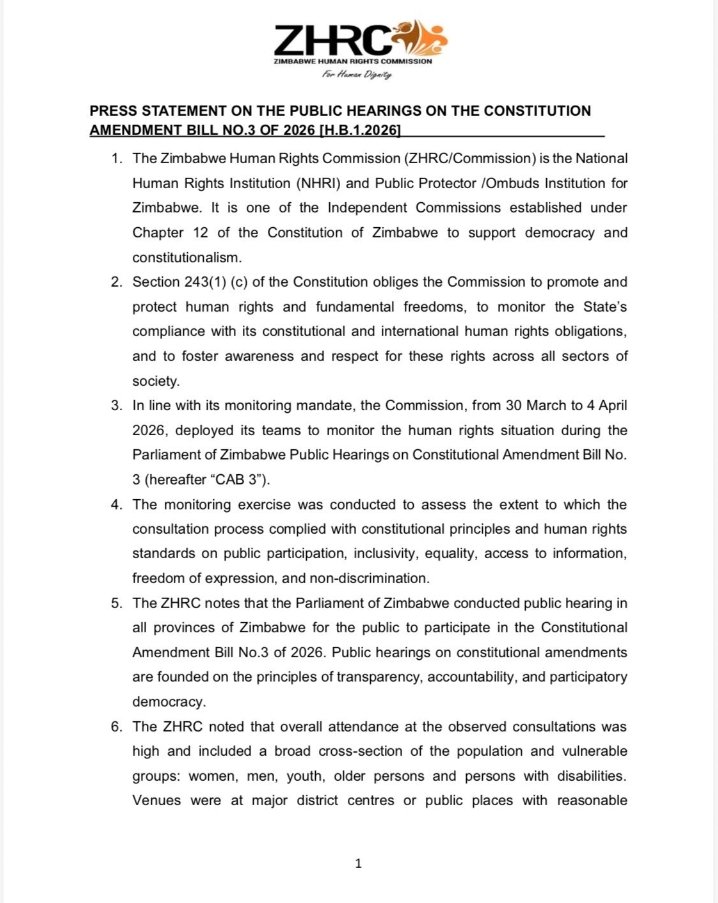
Hi @GraceM1117 how are you. 1. Our biggest down fall as a nation is we have taken literacy to mean "educated". 2. I put for you the Press Statement of @zhrc365 on CAB3. 3. The first mistake @matinyarare made is to agree to the lie that was thrown at him that @zhrc365 gave a REPORT yet it is a PRESS STATEMENT. Is a report and press statement the same? Yes or No? 4. Of course the title says what the document is. Once you refer a document by some other title then your conclusion will be wrong and you may further mislead others. 5. A Chairperson of a Commission is an official spokesperson of the Commission and once she gives a Press Statement, it is valid. Chairperson does not need authority of quorum to give a press statement. Period. 6. Once you define the Press Statement by its name you will not look for quorum but authority of the person making statement to make the statement. 7. Someone then threw the word quorum and you also grabbed it and run around with it. Do you need quorum to give a Press Statement? Does a Chair Person need a quorum to give a statement? 8. It shows a lack of understanding of simple procedures of governance. A quorum is a minimum number required to hold a meeting and the outcome of a meeting are recorded on what is called "minutes" and within the minutes, collective decisions made in the meeting are called "resolutions". 9. If you take the press statement it first address its function as a constitutional body in paragraphs 1 and 2 then 10. In paragraph 3 the statement clearly states as follows, "In line with its monitoring mandate, the commission, from 30 March to 4 April 2026, deployed its teams to monitor the human rights situation during Parliament of Zimbabwe public hearing on Constitutional Amendment Bill No.3(hereafter CAB3). 11. That must tell you that the decision to monitor public hearing is not based on a resolution of a meeting but a constitutional mandate and that removes the issue of quorum because quorum brings meeting and meeting bring resolution, but mandate to monitor comes direct from constitution. How then can an action done to fulfil constitutional obligation be void because of quorum on composition of members of Commission? 12. One has to be guided by paragraph 6 of First Schedule to Zimbabwe Human Rights Commission Act and in particular sub paragraph 7. I put it here. 13. When it comes to authorised things or things the commission has to do, then majority of people present determine what to do. In this case the Press Statement quotes s243(1)(c) function and the Chairperson was part of the meeting, 14. In that regard, decision to send monitoring teams in line with s243(1)(c) of constitution did not require quorum rather it's a function of commission and authority to hold meeting come from chair person. That is all that is required to send monitoring teams. 15. Monitoring teams operate under Work groups as contemplated in paragraph 7 to First Schedule to ZHRC Act and in terms paragraph 7(2)(a) of First Schedule to ZHRC Act a single member of commission can be part of a work group assigned with work of monitoring CAB3 process and again decision of a work group are done in terms of paragraph 7(7) of First Schedule to ZHRC Act . 16. In that regard the findings of the monitoring of CAB3 are done by a Work Group on behalf of commission and findings communicated to the chairperson of Commission. 17. If in the findings of the exercise, there are reports from work group that show violation of human rights, then the Chairperson reports the official finding as a statement of @zhrc365 and that is final. Commissioners have no mandate to sit down and edit or alter the findings of work group unless one can prove it is a false fact. So please do not be misled by abuse of words. That press statement is binding to the letter.
brian mari tweet mediabrian mari tweet media
Grace Malambo@GraceM1117

@matinyarare The issue isn’t just “invalidating a report” it’s about whether it was lawfully produced in the first place. If the Commission lacked the required quorum, then questions of legitimacy and procedural compliance naturally arise.

English
3
4
12
1.8K
brian mari
brian mari@brianmari3·
Hi @EthanMalibongwe how are you? 1. First let me say this to you, strategies take years to plan and as you plan your opponent also plans. 2. In order to keep your opponent within your strategy control, you draw decision trees and throw bones at your enemy to take actions that fit your plan. 3. Anyone who is scarred of CAB3 proves that he is behind the freedom notes. CAB3 is a reactionary counter strategy by our opponent that has since gone wrong. Please forget about those going to grave. Face the route to glory. 4. I have put that application in screen shot for you to see the parties involved in the strategy to freedom. 5. Remember this, our freedom can only now come from UN Security Council under the Responsibility to Protect Principle. 6. In that regard it must be the desire of every citizen of Zimbabwe that ZANU must violet every part of constitution and corrupt every institution of internal remedy and have no legitimate authority in all arms of state that give internal remedy. 7. Without CAB3 we were going to still win but with little bit of struggle but CAB3 has helped us in setting time frames. As you mentioned, 20 May 2026 is now a rendezvous date without us putting effort 8. All bridges are built on strong foundation. 9. In constitution there are rights and freedom given to persons, how ever there rights that have limitations and some that cannot be limited by any law and no one may violet them. 10. Like a bridge, your plan must be anchored on a right that no law may limit and no one can violet. 12. This takes us to s86(3) of constitution. There 6 rights that no law may be made or brought to limit and no one can violet. Please find time to read them but our freedom strategy is anchored or s86(3)(e). 13. No law may limit the right to fair trial and no one may violet it. 14. Section 69 outline the right to fair hearing and subsection (1) deals with accused persons, those in custody and without mentioning names but every human whose right is being violated is our tool to freedom. 15. Subsection (2) we deal with determination of OBLIGATIONS and CIVIL RIGHTS and every person has right to fair hearing before an independent court or tribunal or other forum ESTABLISHED by law. 16. Now one has to position yourself as individual, either you have a civil right in chapter 4 as your currency or an obligation by state arm which need determination and use it as currency. That is a peg of next time. 17. While s69(2) talks of determination, it does not talk of hearing. Court and tribunal determine matters after hearing the matter under their jurisdiction. 18. In that regard, a strong strategy must be anchored on EXCLUSIVE JURISDICTION matters only. 19. Section 166(1) establishes a Court and in terms of s69(2) it is an element of fair hearing which in terms of s86(3)(e) no law can limit and no one can violet. 20. Section 177 define qualification of judges of constitutional court and again that point to competence and independents of judges that form a constitutional court and no law can limit this and no one may violet this. 21. Section 166(3)(a) gives the constitutional court EXCLUSIVE JURISDICTION on two matters that is to say, HEARING and Determining of claims over a right in Chapter 4 and disputes in presidential elections. 22. Point to stress is that the hearing of claims of infringement of a right under chapter 4 MUST (not may) done all judges of s166 constitutional court as established in s166(1). 23. A better understanding of the point is acquired by comparing s166(1) to s168(1) and see that in Supreme court you can have additional judges as part of judges of Supreme court. The Constitutional court does not have such provision. 24. Section 166(2) allows Chief Justice to appoint Acting Judge but when it comes to the hearing of a matter involving infringement of right in chapter 4 matter or President then the all 7 judges must be judges of constitutional court and not acting judges. 25. Now what is collapsing the whole judiciary and constitutional court did collapse on 21 May 2020. 26. In terms of s181(1) only a judge of constitutional court can act as Chief Justice
Ethan Malibongwe Moyo@EthanMalibongwe

@brianmari3 @JMavedzenge @ProfJNMoyo @ProfMadhuku @KMutisi Okay thank you So CAB #3 whats your take - I am told 20 May is a special day.

English
1
2
3
575
brian mari
brian mari@brianmari3·
Kikiki @nickmangwana Zimbabwe is a state party to ICCPR. The establishment of electoral body is a state obligation in international treaty CCPR GC 25 Paragraph 20. Your lack of understanding of word "Election" is the one that limits your understanding of obligation to have independent Electoral body have a voters roll under its charge. To choose to participate in Electoral exercise freely is a political choice on its own. Those that want to participate and those that do not want are equally protected of their rights. To go and claim a form and register as a voter is an Election of its own. You cannot then say you run election as independent Electoral body when you depend on voters roll of other body. It defies s234 and 235
English
0
6
16
1.5K
Nick Mangwana
Nick Mangwana@nickmangwana·
VOTERS’ ROLL MOVING TO THE RG This is being done by consensus. When Parliament was working on the Electoral Act, key members of the opposition such as Hon @hwendec suggested that the Voters’ Roll should be moved back to the Registrar General. And of course this actually makes sense. #CAB3
English
66
12
29
28K
Bete 𝕏 
Bete 𝕏 @Bete263·
Section 9 deals with jurisdiction to conduct investigations, not quorum. You're conflating two entirely different provisions. The quorum argument rests on: • Section 6(6) - five commissioners = quorum • Section 6(7) - decisions only valid at a meeting WHERE quorum is present Section 9 governs WHAT the commission can investigate. It says nothing about the validity of decisions made without quorum. #Zimbabwe #CA3 #BILL3BHOO
English
1
0
0
43
Bete 𝕏 
Bete 𝕏 @Bete263·
The law is clear. A sub-quorum body cannot produce a binding ZHRC report, and three commissioners sitting without quorum is exactly that. Sub-quorum. President Mnangagwa has now sworn in six new commissioners, restoring the ZHRC to full legal standing. The old report was never the ZHRC speaking. The new Commission is. #CA3
Potifah Zvombo@Potifahzvombo1

THE recent report on the Constitutional Amendment Number 3 Bill public hearings, tabled by the Zimbabwe Human Rights Commission is null and void as it was compiled by only a few members, falling short of the quorum as required by law. This comes as President Mnangagwa yesterday swore in six ZHRC commissioners at State House in Harare, namely Dr Dorothy Moyo, Mr Anele Ndebele, Ms Irene Sithole, Dr Tendai Charity Nhenga, Mr Dzikamai Madzimure and Mr Panganai Munkombwe. The report had been published by former ZHRC chairperson Ms Jessie Majome together with two other commissioners. Ms Majome has since been reassigned to the Public Service Commission. Before yesterday’s swearing-in ceremony, the Commission had only three members, including the chairperson. According to the Constitution of Zimbabwe, ZHRC consists of nine members, including a chairperson and eight other members. The First Schedule, paragraph 6(6) of the Zimbabwe Human Rights Commission Act says at least five commissioners are required to form a quorum for major decisions and for a report to be validly approved. “At any meeting of the Commission, five Commissioners shall form a quorum,” the Act reads in part. “The Commission will endeavour to make decisions by consensus among the commissioners present at a meeting of the Commission at which a quorum is present, failing which anything authorised or required to be done by the Commission shall be decided by a majority vote of the members at the meeting.” Last week, the Chief Secretary to the President and Cabinet, Dr Martin Rushwaya, announced the re-assignment from the ZHRC to the PSC. “In terms of Section 202(1)(b) of the Constitution of Zimbabwe, His Excellency the President, Cde Dr Emmerson Dambudzo Mnangagwa, has re-assigned Ms Fungayi Jessie Majome from the position of the Chairperson of the Zimbabwe Human Rights Commission to the position of Commissioner in the Public Service Commission. The re-assignment is with immediate effect,” Dr Rushwaya said. Subsequently, Attorney‑General Mrs Virginia Mabiza said the reassignment of Ms Majome to the PSC is constitutionally sound and should not be confused with removal from office. She also noted that this was not the first time Ms Majome had been reassigned, pointing out that she was previously transferred from the Zimbabwe Anti‑Corruption Commission (ZACC) to the ZHRC. @KMutisi @Bete263 @BaShonaBaShona @

English
13
9
7
1.5K
brian mari
brian mari@brianmari3·
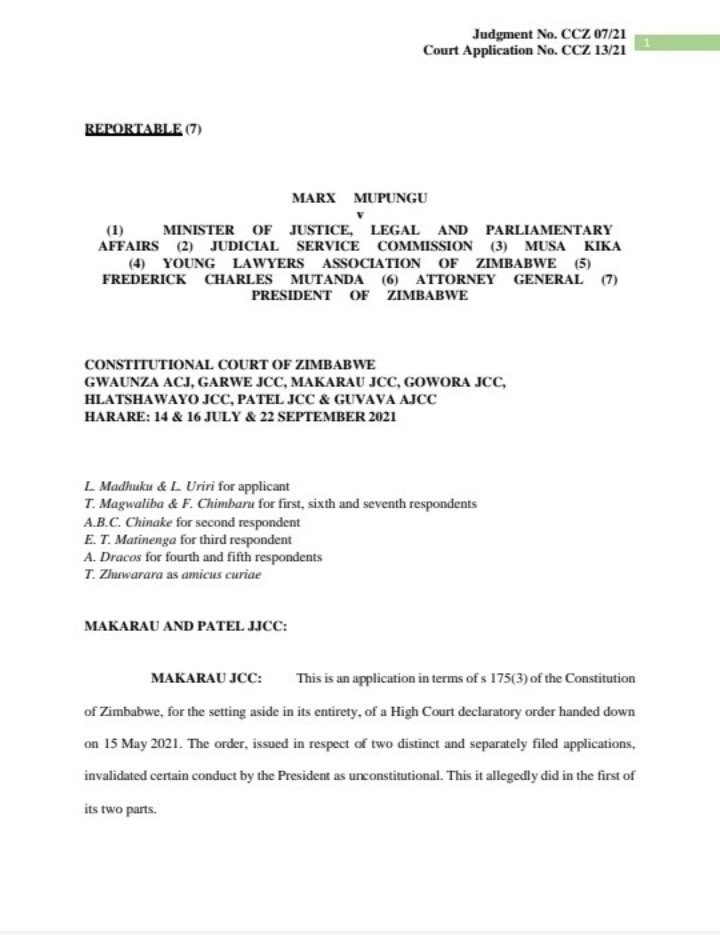
Happy Birthday Bharat Patel 1. You are 74 today. 2. You managed to fool many Zimbabweans including @JMavedzenge @ProfJNMoyo @ProfMadhuku @KMutisi but forgot to cheat me. 3. You wrote a Judgement, now known as Mupungu judgement, when you were 69 years old and while in court, Adv Eric Matinenga Challenged you on your authority and interest to hear and determine the matter, it was you with your own two lips who said you do not intend to extend your tenure and benefit from Constitutional ament Act 2. Correct? 4. You are still masquerading as a Judge and receiving our own hard earned money, 5 years down the line, on the basis of your own judgement. 5. For days now, Mupungu judgement has been quoted by the likes of @KMutisi @ProfJNMoyo @JMavedzenge in supporting or opposing a proposed 3rd amendment to constitution. Did you tell people and the world that it's not only Malaba who is stealing money from government on the basis of your judgement ,but you, the author of the fraud judgement, you are standing on top of your own judgement, as the basis of you being a judge of a fake constitutional court bench? 6. I am told that, on 20 May 2026, you and your fellow fraudsters, have invited @ProfMadhuku to come and play Tom foolery on us and he will pretend to be a saint fighting for people on the constitutional amendment bill that defies all international treaties and should on its own, never ever see light. 7. Of the rest, I am not a fool to be fooled by @ProfMadhuku 8. From onset, the idea of CAB3 came as an after thought strategy and the project is never ever meant to have the bill pass into law and we the clever lot know it. Let me show you that tomorrow. For today enjoy your Birth Day. 9. Also invite @JSCZim and @MoJLPA @AGZim_Official so that they take notes. 10. Take note that Malaba's was appointed in terms of our s180, not your friends' version of s180 and its him who refused to leave office not your invalid judgement that will remain invalid for ever. 11. Now that he announced his departure, what crushes is not just your bench as who ever came with the idea that on 20 May 2026 there is going to be a constitutional Court to sit to hear and determine the Madhuku fronted application. 12. Section 166(1) (a)states that constitutional court consists of Chief Justice and Deputy Chief Justice and (5) other Judges of constitutional court. 14. Here is the part you guys where bitten on your own game, the Zhou judgement was appealed to Supreme Court and when you got the Mupungu judgement you relaxed and the Supreme court application was withdrawn. Malaba also relaxed. The question is, how are you a constitutional court judge and how is Gwaunza a Deputy Chief Justice 15. We are not fools to exchange Bond note and US$
brian mari tweet mediabrian mari tweet mediabrian mari tweet media
English
13
27
68
22.6K
brian mari
brian mari@brianmari3·
@HeraldZimbabwe that is not how it is done. How you do is this- 1. Go to s242(1) and establish the composition of @zhrc365 . Put this on you table. 2. Go to s321 of constitution and establish the functions and procedures of commissions. 3. Section 321(1) direct for the establishment of Act of Parliament to regulate the operations of Commissions look for it. Put it on the table. 4. In s321(3) reads "subject to this constitution, any decision of a commission requires the concurrence of a majority of commission's members who are present when the decision is taken. 5. What does it mean to say "subject to this constitution"? 6. Before we go to Act of Parliament let's deal with things that are subject to the constitution. 7. If @zhrc365 has establishment of 8 commissioners and 1 one chair person and there are 6 vacant posts then by s321(3) then subject to establishment of @zhrc365 and vacancies on the membership then only 3 members of Commission could possibly be present when the decision was taken. Section 321(1) does not talk of quorum but a majority of persons who are present when decision is taken. 8. The present may refer to place or time. If the establishment is suppose to have 9 but there are 6 vacancies then 3 are regarded as present when decision is made. 9. If the 3 make a decision to exercise a function in s243(1)(c) and decide to monitor the constitutional amendment Bill 3 process and organise work groups to monitor the process, they do not need concurrence of any other person or quorum to do a constitutional function because everyone is bound by constitution. 10. If teams are deployed and a single commissioner is at a place where a thing that is inline with functions of Commission and requires a decision, he or she does not need majority of zero around him or her to concur because she is majority and her report is final. 11. Let's move to Act of Parliament that we are directed by s321(1) of constitution. 12. There is Human Rights Commission Act chapter 10:30. In section 3 of the Act it directs us to its First Schedule as the one that regulates tenure of office of commissioners as well as procedures to be followed by commission at its meetings. 13. This means again we are directed to First Schedule of Zimbabwe Human Rights Commission Act. Let's get that. 14. Since we all do not work at @zhrc365 we only deal will law and facts to help us. 15. Someone is talking of a report on monitoring of CAB3 as invalid because it lacked quorum. 16. We already know that at the time of the exercise of functions of commission that gave the report, there were 6 vacancies on the establishment of @zhrc365 and anyone talking of quorum is misguided. 17. Paragraph 6 sub paragraph 7 of First Schedule to Zimbabwe Human Rights Commission Act reads "The Commission will endeavour to make decisions by consensus among commissioners present at the meeting of the commission at which a quorum is present, failing which anything authorised or required to be done by Commission shall be decided by majority vote of the members at the meeting". 18. Now we already seen that quorum could not be there because of vacancies. However by s243(1)(c) Commission has function to monitor the human rights protection and adherence to principles and values of democracy, therefore 3 commissioners can decide on the question to have @zhrc365 monitor the process of CAB3 or not. The validity of decision to doing a function in s243(1)(c) is not judged by quorum but because it is "authorised" by constitution. 19. Anyone who then thinks that the actual exercise of monitoring is done by 9 commissioners at all times is misguided. 20. Paragraph 7 of First Schedule to Act establishes work groups chaired by chairpersons who are commissioners but comprising other persons not commissioners. 21. Which decision is invalid. Is it the decision to carry out the s243(1)(c) of constitution by 3 commissioners or the feedback report of work group that went and monitor the exercise report back their findings? 22. In terms of paragraph 9 of First Schedule to ZHRC Act no decision of Commission or work group shall be invalid for reasons of not having quorum as long as the decision or the act was authorised by majority of members who were present. 23. Let's say for arguments sake, Jessie Majome took a decision on her own and the other two did not concur with her to monitor CAB3 which is an already done action, the two must give a reason why monitoring of process of CAB3 would be wrong or unlawful or unauthorised or should not have been done. 24. If these other two cannot say the reasons that invalidate a s243(1)(c) function then everything is valid in the sense that feed back report is not a decision but a factual finding.
The Herald Zimbabwe@HeraldZimbabwe

‘Rights Commission’s report null, void’ heraldonline.co.zw/rights-commiss…

English
0
5
6
497